
Introduction: When the Body and Mind Simultaneously Send Out a Distress Signal
In my massage therapy work, I often encounter clients who step into my treatment room with an unshakable fatigue written on their faces. Their chief complaints are often complex: chronic anxiety, nights spent tossing and turning, unable to sleep, followed by a lack of energy during the day. Sometimes, this is even accompanied by seemingly unrelated physical issues, such as prolonged menstrual periods with spotting, or the mysterious appearance of many small bruises on the body.These different symptoms are like a tangled ball of yarn—seemingly messy and chaotic. However, on the "wisdom map" of Traditional Chinese Medicine (TCM), they often all point to the same source: an energy deficiency in the "Spleen" system. And the key to awakening this inner power is hidden in one of the smallest, most easily overlooked corners of our body: the "Yinbai point" (SP1), located on the big toe.
Unlock the Body's Fountainhead of Vitality: Where Is the Yinbai Point (SP1)?
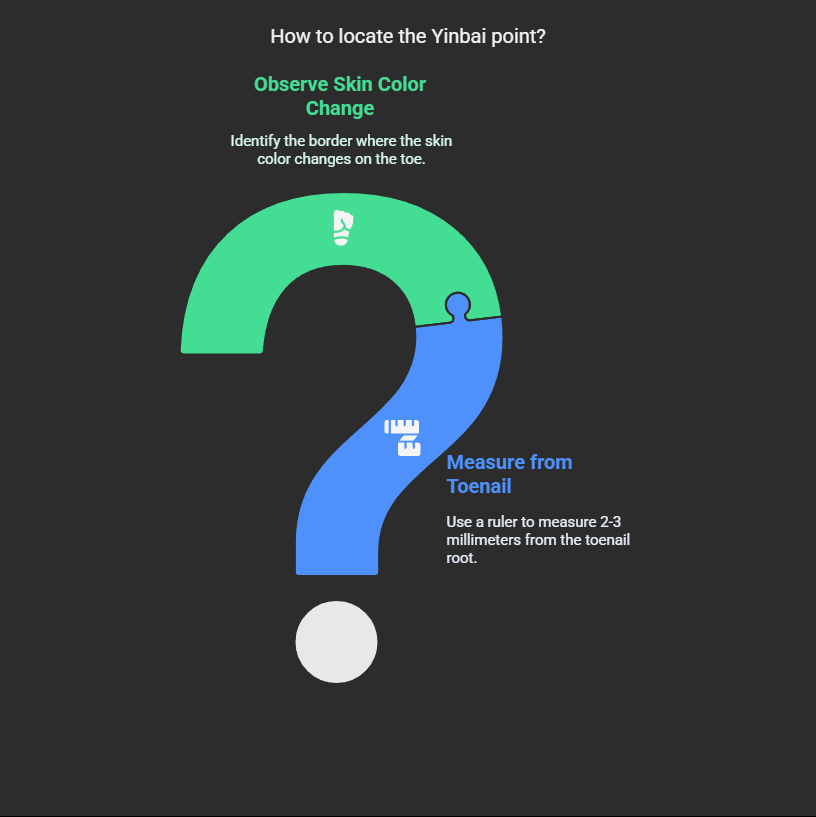
So, where exactly is this magical Yinbai point? Please take off your shoes and socks and look at your big toe. The Yinbai point is located on the inner (medial) side of the big toe, approximately 2-3 millimeters from the corner of the toenail root.An easier way to find it is to observe the junction where the skin color changes on your toe—the "border of the red and white flesh" where the skin of the top of the foot meets the skin of the sole. The Yinbai point lies on this line.Its name, "Yinbai," is itself full of poetic meaning: "Yin" represents something hidden or concealed, while "Bai" (white) is associated with Qi in Traditional Chinese Medicine. This name vividly depicts how the meridian Qi of the Spleen channel flows out from the depths of the body like a secret spring, marking the beginning of the entire meridian.
The Body's Natural 'Tourniquet': The Wondrous Power of the Spleen's Function to Govern Blood
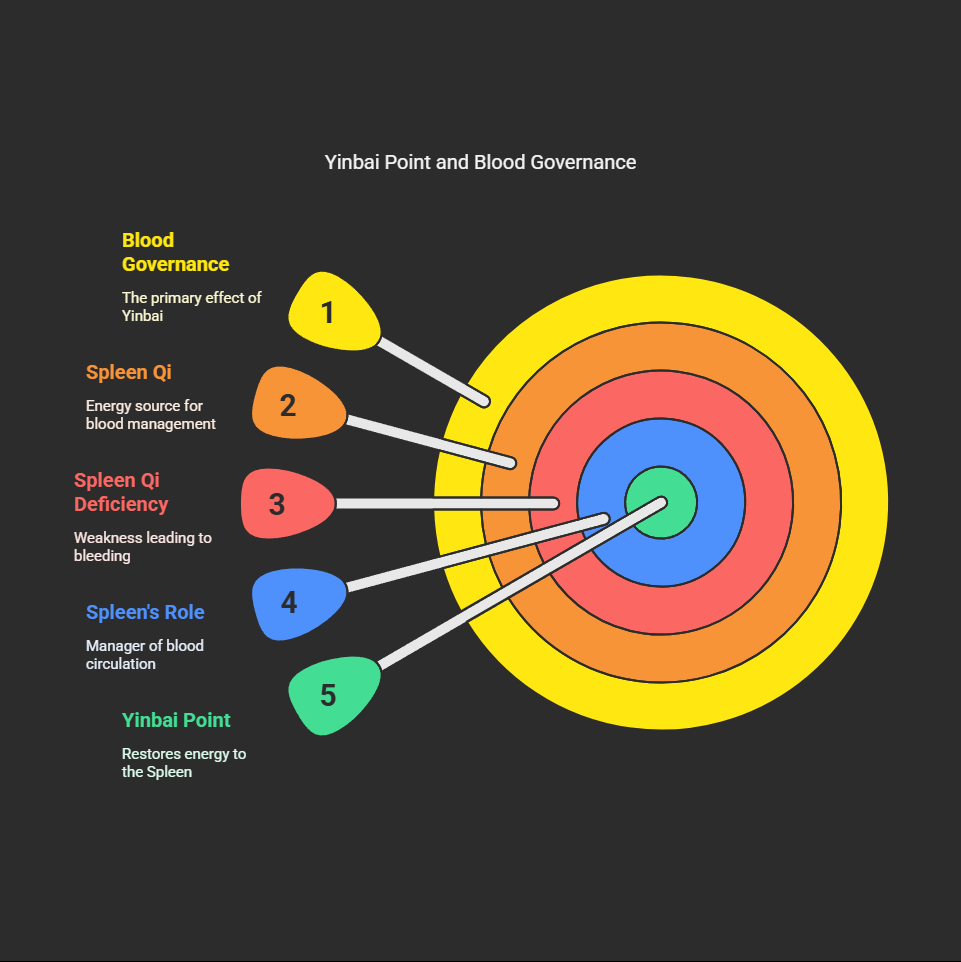
The most well-known and praised effect of the Yinbai point is its powerful ability to "govern the blood," making it what could be called the body's natural hemostatic agent. To understand this, we need to grasp a core concept in Traditional Chinese Medicine (TCM): "the Spleen governs the blood."You can imagine the Spleen (in the TCM sense) as a meticulous manager. One of its crucial duties is to ensure that blood circulates properly within the vessels and does not spill out. When this "manager" becomes weak due to overwork (a condition known as "Spleen Qi Deficiency"), its ability to restrain the blood diminishes, and various chronic bleeding problems can arise as a result.This is precisely where the Yinbai point shows its great strength. It can directly replenish energy for this fatigued "manager," strengthening its ability to contain the blood and thereby improving the issue.
Saying Goodbye to the Troubles of Excessive Bleeding: The Clinical Applications of the Yinbai Point
In clinical practice, this function is a great boon for many women. For issues such as functional uterine bleeding (known as "Beng Lou" in Traditional Chinese Medicine), excessive menstrual flow (menorrhagia), or overly prolonged periods, the Yinbai point is a primary acupoint of choice for regulation. Similarly, it can also be effective for blood in the stool (hematochezia), blood in the urine (hematuria), and even nosebleeds caused by Spleen Deficiency.It must be especially emphasized that for bleeding caused by deficiency or cold patterns, using moxibustion to warm the Yinbai point is particularly effective. The warming power of the moxa herb can penetrate deep into the meridian, injecting a warm current into the Spleen. This greatly enhances its "blood-governing" efficacy and helps the body to restore order.
An Emotional Anchor for Anxious Thoughts: The Secret of the Heart-Spleen Connection
However, the energy of the Yinbai point extends far beyond regulating tangible blood. It is also a profound emotional regulator, capable of providing a stable anchor for our restless and anxious inner selves.From a Traditional Chinese Medicine (TCM) perspective, the relationship between the Heart and the Spleen is as close as that of siblings. The Spleen is responsible for producing Qi and blood, while the Heart requires sufficient blood to be nourished so that it can properly house our spirit and consciousness (a concept known as "the Heart houses the Shen"). When the Spleen's energy is deficient and it cannot produce enough high-quality blood, the Heart becomes "malnourished." A malnourished Heart is naturally unable to stabilize the Shen, and as a result, problems like anxiety, worry, insomnia with excessive dreaming, and palpitations will emerge. This is a typical state of "Heart and Spleen Deficiency."
From Strengthening the Spleen to Calming the Spirit: A Complete Healing Pathway
Therefore, the "mind-calming" (An Shen) effect of the Yinbai point doesn't come from nowhere; it is a natural extension of its "Spleen-strengthening" function. By stimulating this starting point of the Spleen meridian, we can activate the vitality of the entire system and promote the generation of Qi and blood.When fresh and abundant Qi and blood continuously nourish the Heart, the Shen (Heart-Mind/spirit) has a stable residence, and those chaotic thoughts and restless emotions will naturally calm down. This perfectly interprets the holistic view of Traditional Chinese Medicine's "unity of body and spirit" (Xing Shen He Yi): once the body's material basis (blood) is well-regulated, the problems at the spiritual level (Shen) are also readily solved.It reminds us that at their core, physical fatigue and mental anxiety are born from the same root.
Your At-Home Wellness Toolbox (Part 1): Simple and Effective Acupressure
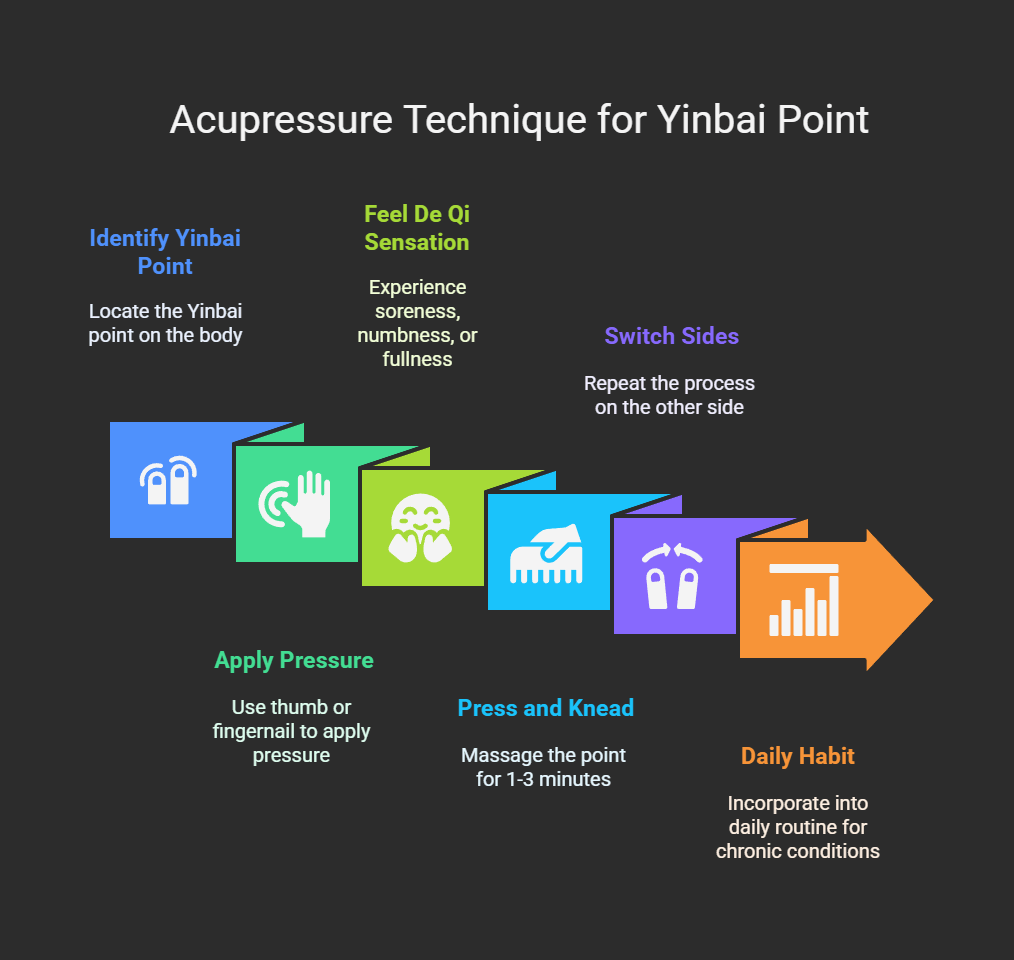
Now, let's put theory into practice. The simplest method is acupoint pressing (acupressure).You can use the tip of your thumb or index fingernail to apply a steady, firm pressure to the Yinbai point. The ideal pressure is one that allows you to feel a unique sensation of "soreness, numbness, fullness, or an ache." In Traditional Chinese Medicine (TCM), this is known as "De Qi," which indicates the acupoint has been effectively activated.You can press and knead one side for about 1 to 3 minutes, and then switch to the other side. For chronic conditions, it is recommended to make this a daily habit, performing it once or twice a day. This simple action can be done while you're watching TV, taking a short break at the office, or even before bed. It is a form of self-healing that you can do anytime, anywhere.
Your At-Home Wellness Toolbox (Part 2): The Warm Healing of Moxibustion
If you wish to achieve a deeper level of healing, moxibustion is the best choice—especially when you feel a sense of deficiency-cold or an aversion to cold in your body. The warming nature of moxibustion can inject the energy of "Fire" into the Spleen meridian (which belongs to the "Earth" element), thereby invigorating the Spleen Yang.When practicing this at home, you must put safety first: use high-quality, smokeless moxa sticks, maintain good indoor ventilation, and have sand or water ready to extinguish the moxa stick afterwards.Hold the ignited moxa stick and suspend it about one to two inches above the Yinbai point. The guiding principle is to feel a comfortable warmth, not a burning pain. Perform a "circling moxibustion" by moving the stick in small circles over the area. Each session should last for about 5 to 10 minutes, or until the local skin turns slightly red.
A Powerful Alliance: The Wisdom of Acupoint Pairing Where 1+1 is Greater Than 2
If you want to multiply the effects, you can try simple acupoint pairing.To boost energy, improve digestion, and nourish the blood, you can pair the Yinbai point (SP1) with the famous "Zusanli" point (ST36) located below the knee. The latter is a "star" acupoint for tonifying the Qi and blood of the entire body, and combining the two can greatly strengthen the function of the Spleen and Stomach. To specifically focus on gynecological health, you can press or apply moxibustion to the Yinbai point along with the "Sanyinjiao" point (SP6) on the inner side of the lower leg. Sanyinjiao can simultaneously regulate three meridians—the Liver, Spleen, and Kidney—making it a core, essential point for gynecological wellness. This type of combination is like writing a concise yet highly effective wellness prescription for your body.
Safety First: When Should You Seek Professional Help?
This guide is intended to provide safe methods for at-home self-care, but it can never replace professional medical diagnosis. If you have bleeding disorders, diabetes, or are taking anticoagulant medication (blood thinners), you should be extra cautious before performing any form of self-stimulation.As a special reminder, pregnant women should not self-administer strong stimulation or moxibustion to the Yinbai point without the guidance of a professional Traditional Chinese Medicine (TCM) practitioner, in the interest of safety.If you experience any warning signs such as sudden, unexplained heavy bleeding, fainting, severe depressive moods, or acute, intense pain, please seek immediate professional medical assistance. True health is the perfect combination of self-care and professional guidance.
Conclusion: On Your Own Two Feet, Find the Switch for Mind-Body Balance
The Yinbai point, this tiny acupoint located at the tip of our toe, is the guardian of the Spleen meridian's health. It functions like a wise, bi-directional regulating valve, capable of both protecting our body's material foundation (blood) and stabilizing the spiritual core of our emotions (the Shen or Heart-Mind).Learning to have a dialogue with an acupoint like this is not merely about pressing on a sore spot; it is about listening to your body's voice and establishing a connection with your own inner healing power. It tells us that profound health and balance do not always need to be painstakingly sought externally. The answer, perhaps, lies right at our own feet, waiting to be gently awakened.


