
Have you ever felt a dull ache in the back of your thighs after a long day of sitting at the office? Or when you bend over, does the distance between your hands and your toes feel impossibly far? Perhaps that nagging and unexplained lower back pain is quietly impacting your quality of life?As a massage therapist, I encounter clients troubled by these issues every single day. The primary culprit behind these problems is often a group of crucial yet frequently overlooked muscles in our body—the hamstrings.This article will do more than just offer simple stretching advice. It will guide you on an in-depth exploration into the mysteries of this "unsung engine," helping you build a resilient and functionally sound foundation for your body to achieve a true "Happy Healthy Life."
Meet Your "Unsung Engine"
First, we must understand that the "hamstrings" are not a single muscle, but a team of muscles located on the back of the thigh. This team consists of the semitendinosus, semimembranosus, and biceps femoris muscles.A key anatomical feature is that most of them cross both the hip joint and the knee joint, making them "biarticular muscles" (or two-joint muscles). This unique structure gives them complex functions, but it also makes them a region highly susceptible to injury.Imagine them as a servant who must attend to two masters—the hip and the knee—simultaneously. During dynamic movements, the demands from each end often conflict with one another, generating immense stress. This is the core reason why they are both powerful and yet so vulnerable.
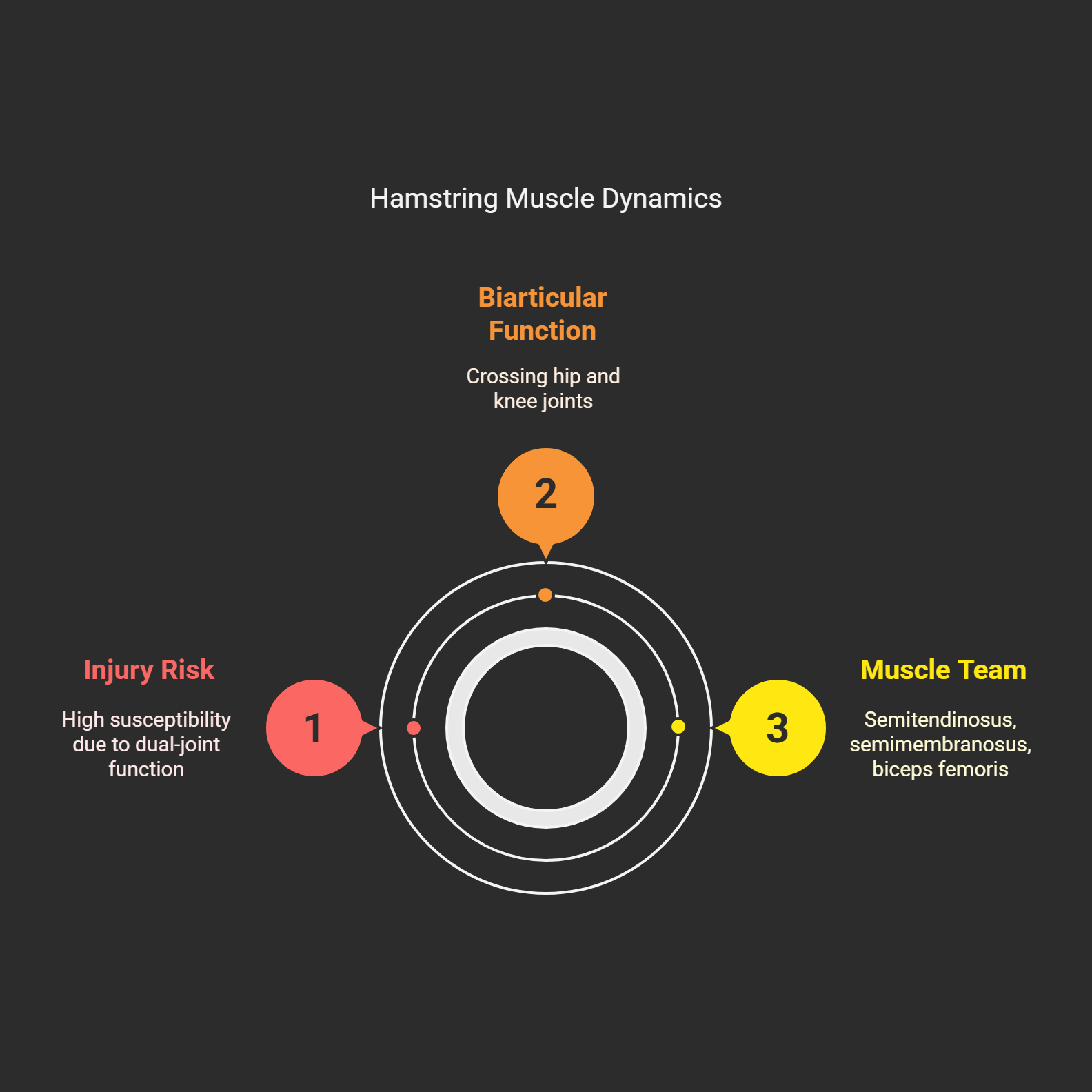
In daily life, the hamstring team plays an indispensable dual role. The first is hip extension, which is the action of pulling the thigh backward. This is the primary power source that propels our body forward when we walk, run, and climb stairs. The second is knee flexion, the action of bending the knee, which is crucial for walking, decelerating, and controlling the lower limbs.Furthermore, they work in synergy with the core and gluteal muscles to stabilize the pelvis, providing a solid foundation for our spine. This diversity of function, while enabling us to perform complex movements, also means that the health of the hamstrings directly impacts our entire body's mechanical balance and functional performance.
A Modern Epidemic: Why Are Our Hamstrings So Tight?
In modern society, sitting for extended periods has become the norm, but our bodies were not designed for this. When we sit for a long time, our knees are bent, causing the hamstrings to remain in a shortened, contracted state for prolonged periods.This continuous shortening leads to "adaptive shortening," where the length of the muscle fibers actually decreases, and blood circulation in the area also deteriorates. What's worse, this chronically shortened state is often accompanied by muscle weakness, as the muscles are not being used through their full range of motion.This creates a vicious cycle: the muscles become both tight and weak, making them more susceptible to injury when sudden exertion is required. This is also one of the root causes of the back and lower back pain felt by many office workers.
The tightness of the hamstrings is closely related to pelvic posture, but this relationship is more complex than most people imagine.In one scenario, truly shortened hamstrings will pull the pelvis down, causing a posterior pelvic tilt. This, in turn, flattens the natural curve of the lower back, leading to a "slouching" posture with a rounded back.However, another more hidden and common cause is the seemingly contradictory anterior pelvic tilt. This posture is typically caused by tight hip flexors (the front of the thighs) combined with weak abdominal and gluteal muscles. The pelvis is pulled forward, which actually places the hamstrings in a constantly overstretched state, much like a rubber band that has been pulled too taut.
This feeling of "pseudo-tightness" is a key reason why treatment is often ineffective for many people. When the hamstrings are passively lengthened due to an anterior pelvic tilt, the brain interprets the continuous tension signal as "tightness." In this situation, blindly performing traditional hamstring stretches will not only fail to solve the problem but may actually exacerbate micro-tears in the muscle, making the situation worse.Therefore, from a therapist's perspective, accurately assessing the pelvic position is crucial. The real solution is not to stretch the already over-lengthened hamstrings, but rather to release the tight hip flexors that are causing the anterior tilt, and to strengthen the weak abdominal and gluteal muscles to pull the pelvis back into a neutral position.
Our body is a precise mechanical system, and muscle balance is the cornerstone of its stable operation. A common phenomenon is that the quadriceps on the front of the thigh are far more developed than the hamstrings on the back. When the quadriceps are overly dominant, the relatively weaker hamstrings must work much harder to "brake" and stabilize the knee joint, which undoubtedly increases the risk of strains.Furthermore, due to prolonged sitting, many people experience "gluteal amnesia," a condition where the gluteal muscles fail to activate effectively. This forces the hamstrings to compensate and take over the hip extension movement that should be driven by the powerful glutes. This results in chronic overuse and tightness in the hamstrings, creating a constant tug-of-war.
The Chain Reaction: How the Back of the Thigh Affects the Entire Body
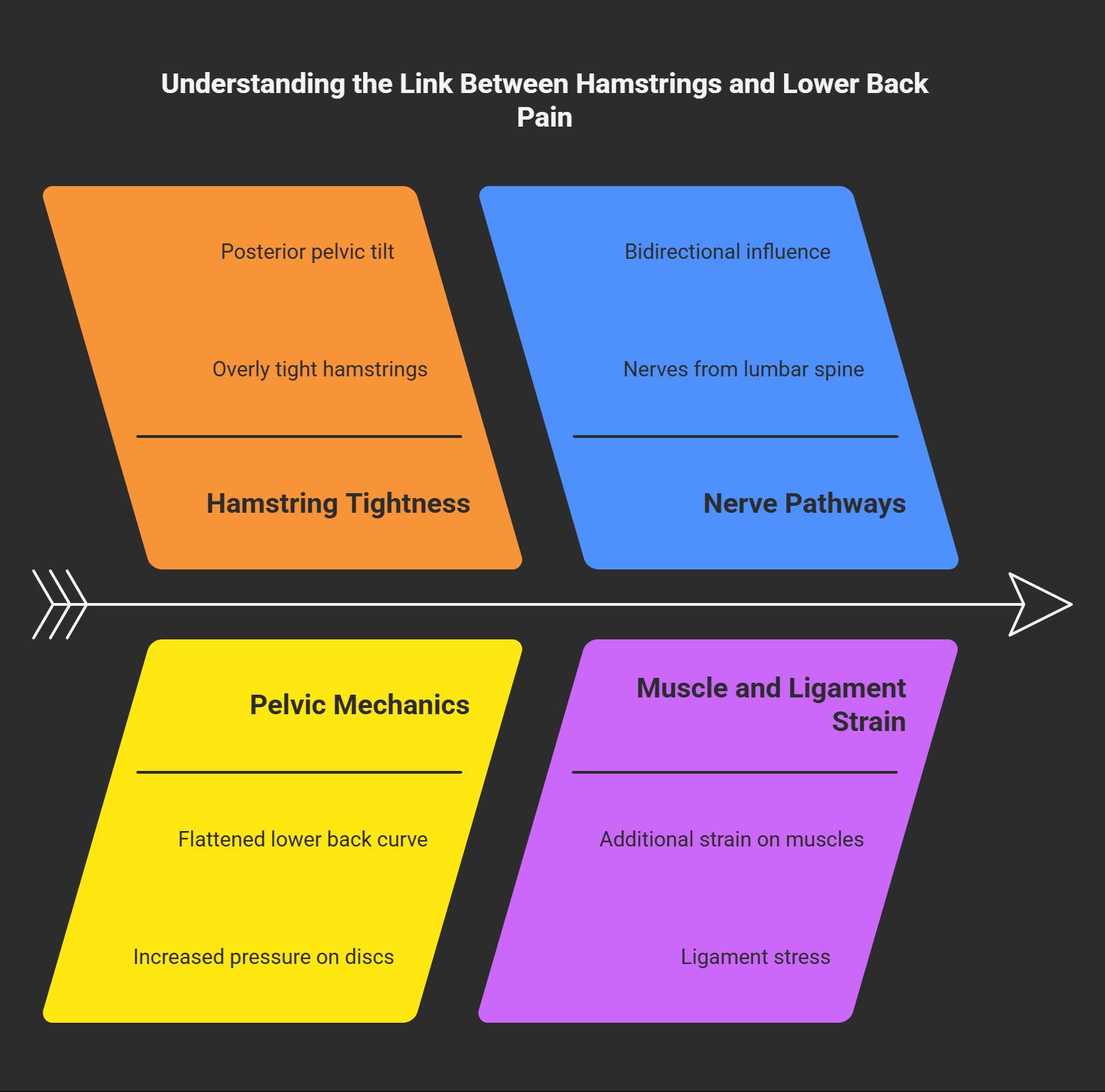
A direct mechanical link exists between the health of the hamstrings and lower back pain. When the hamstrings are overly tight, they pull down on the pelvis, leading to a posterior pelvic tilt. This posture flattens the natural curve of the lower back, thereby increasing pressure on the intervertebral discs and placing additional strain on the muscles and ligaments of the lower back, ultimately causing pain.On a deeper level, the nerves that control the hamstrings primarily originate from the lumbar spine. This creates a bidirectional pathway of influence: a problem in the lumbar spine can trigger hamstring tightness, and conversely, chronically tight hamstrings can, by altering pelvic mechanics, in turn affect the health of the lumbar spine.
The hamstrings are a crucial "dynamic stabilizer" for the knee joint. They work in synergy with the cruciate ligaments at the front of the knee to collectively protect the joint's stability. When the hamstrings are tight or weak, this stabilizing mechanism is compromised.Tight hamstrings alter normal gait mechanics, forcing the quadriceps to generate greater force to overcome their resistance. This increases the pressure on the joint between the kneecap and the femur (the patellofemoral joint) and is one of the potential underlying factors for many cases of "Runner's Knee" or anterior knee pain.Therefore, as therapists, when we address knee problems, we frequently examine the condition of the back of the thigh, because the root of the issue may very well be hidden there.
For sports enthusiasts and athletes, the health of the hamstrings is directly linked to athletic performance. There is a very fitting analogy: running with tight hamstrings is like "driving a car with the handbrake on."A lack of muscle elasticity and flexibility directly limits the hip joint's range of motion, thereby shortening stride length and reducing running efficiency, agility, and speed. The body must expend more energy to overcome this internal resistance, causing the athlete to fatigue more quickly.Therefore, having flexible yet strong hamstrings is not only for injury prevention but also for fully unleashing the body's athletic potential, making every run and jump more fluid and efficient.
More Than Just Stretching: The Art of Releasing Deep-Seated Tension
Many people find that even if they stretch very diligently, a certain chronic, stubborn "feeling of tightness" in their hamstrings never goes away. This is often an important signal indicating that the problem may be more than just a simple lack of muscle elasticity.In such cases, it is highly likely that unhealthy scar tissue or myofascial adhesions have formed during the healing process of past micro-tears. This scar tissue acts like a knot tied between the muscle fibers, preventing the muscle from stretching and gliding normally. Persistently stretching in a forceful, traditional manner can, in fact, repeatedly tear this fragile tissue, which explains why manual therapy is needed to resolve these types of chronic problems.
When stretching fails to resolve deep-seated tightness, professional massage therapy can play its unique role. Sports massage or deep tissue massage can significantly improve local blood circulation, bringing nutrients to the muscles while accelerating the removal of metabolic waste.More importantly, a therapist can use specific manual techniques, such as cross-fiber friction, to address the myofascial adhesions and scar tissue formed from old injuries or chronic strain. These rigid tissues are the primary obstacles limiting muscle extensibility. Through physical release, the normal gliding and elasticity of the muscle fibers can be restored, fundamentally eliminating that "stuck" feeling and paving the way for true recovery.
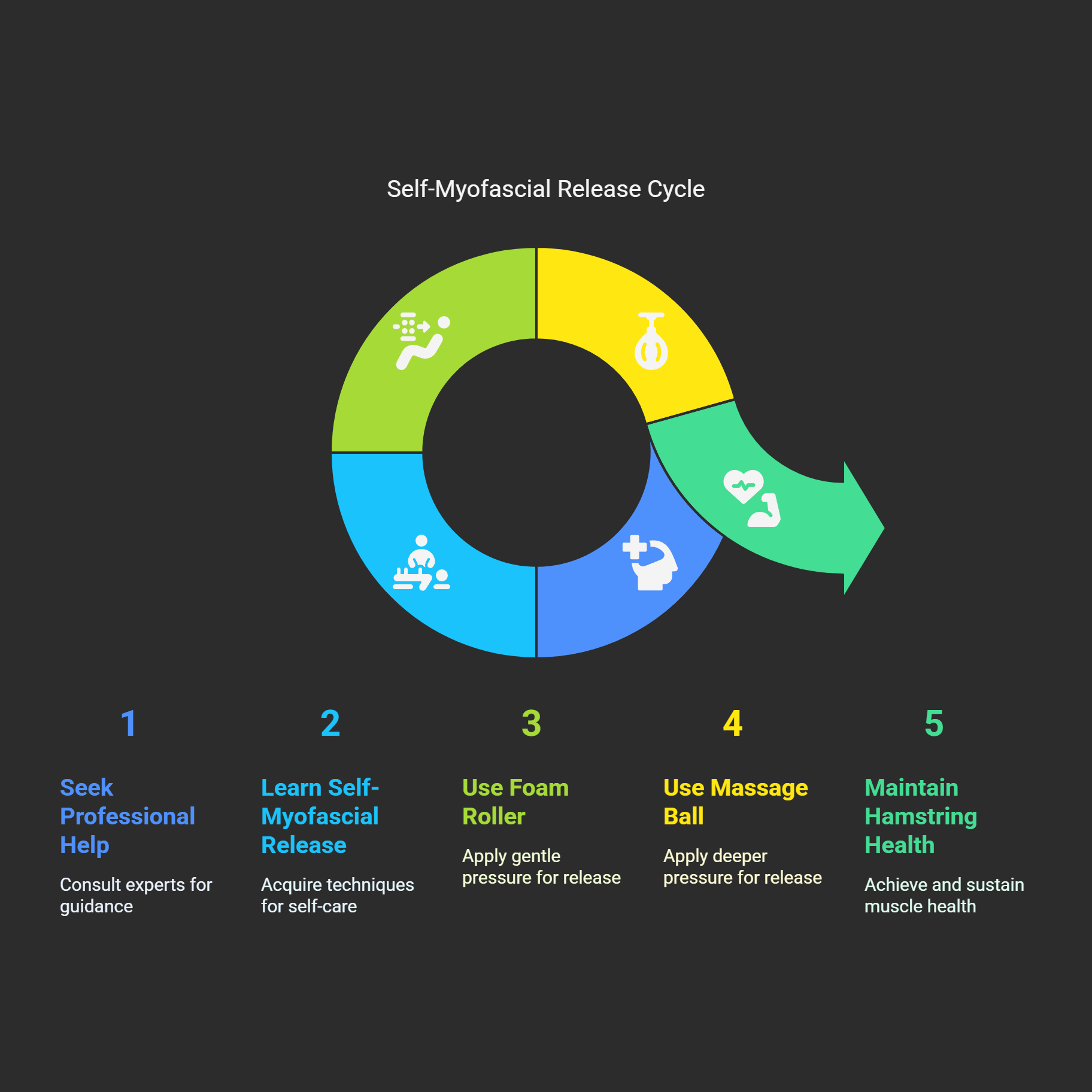
In addition to seeking professional help, learning self-myofascial release is key to maintaining hamstring health. A foam roller is a common tool; you can sit on the roller and slowly roll back and forth along the entire back of your thigh. When you find a particularly sore "trigger point," you can pause on it for about 30 seconds while taking deep breaths.If you want a deeper, more precise release, a massage ball (such as a tennis ball) is an excellent choice. A very effective method is to sit on the edge of a firm chair, place the massage ball under your thigh, and apply pressure using your body weight. Then, slowly straighten and bend your knee. This movement allows the muscle to slide under pressure, achieving a deep tissue release effect.
Massage and stretching are not an either/or choice; when combined, they produce a synergistic effect where one plus one is greater than two. We can compare this process to untangling a knotted rope.Massage and self-myofascial release are like the process of "untying the knots"; they release the trigger points and adhesions within the muscle. Once these "knots" are undone, the muscle tissue becomes more pliable and easier to lengthen. Performing safe, static stretching at this point is like "straightening the rope"—it can restore the muscle's proper length more effectively and safely.This synergy achieves a more lasting and significant improvement in flexibility than using either method alone, making it the golden combination for both professional therapy and daily maintenance.
Conclusion: Regain Your Mobility, Reboot Your Life's Engine
In conclusion, the health of your hamstrings is far more complex than can be addressed by simple stretching alone. It is an intricate system that requires an integrative approach to care, encompassing myofascial release, muscle lengthening and stretching, functional strengthening, and the harmonization of the mind-body connection.From a therapist's perspective, a true "Happy Healthy Life" stems from a deeper understanding of and respect for your body. We need to shift from passively enduring pain to actively managing our own physical health. When we learn how to maintain this hard-working "unsung engine," we are not only freeing ourselves from the shackles of tightness and pain, but we are also winning the freedom to enjoy an active, unrestricted life to the fullest.


