
Introduction: The Voice of Pain—Are You Listening Corrected?
Similar stories unfold every day in my massage therapy room. An office worker who sits in front of a computer for long hours, sighing in frustration from nagging lower back pain; or a dedicated runner, incredibly disheartened by recurring knee pain. They've tried all sorts of methods, from heat packs and medicated patches to expensive braces, yet they only manage the symptoms without addressing the root cause.At this point, I always gently guide them to shift their focus away from the "victim" of the pain—your lower back or knee—and turn it towards the often-overlooked "culprit behind the scenes": the front of your thighs, also known as the quadriceps.This journey of exploration will completely change your understanding of your body's pain.
The "Great Impostor" in Our Body: Getting to Know the Quadriceps
Don't get me wrong, the quadriceps muscle itself is a hero; it is the power core for us to stand, walk, run, and jump. But when it becomes imbalanced, it transforms into the "great impostor" of the musculoskeletal system. Its own tightness and problems cleverly project pain signals to other locations, most commonly the knee and the lower back.This causes all our efforts at relief to feel like fighting a war without an enemy—we are simply focusing on the wrong target. As a therapist, I am accustomed to viewing the human body as a sophisticated, interconnected system. The quadriceps are the very hub of the lower limb kinetic chain, and their state of health has far-reaching consequences, profoundly affecting the pelvis, knees, and even the distant spine.
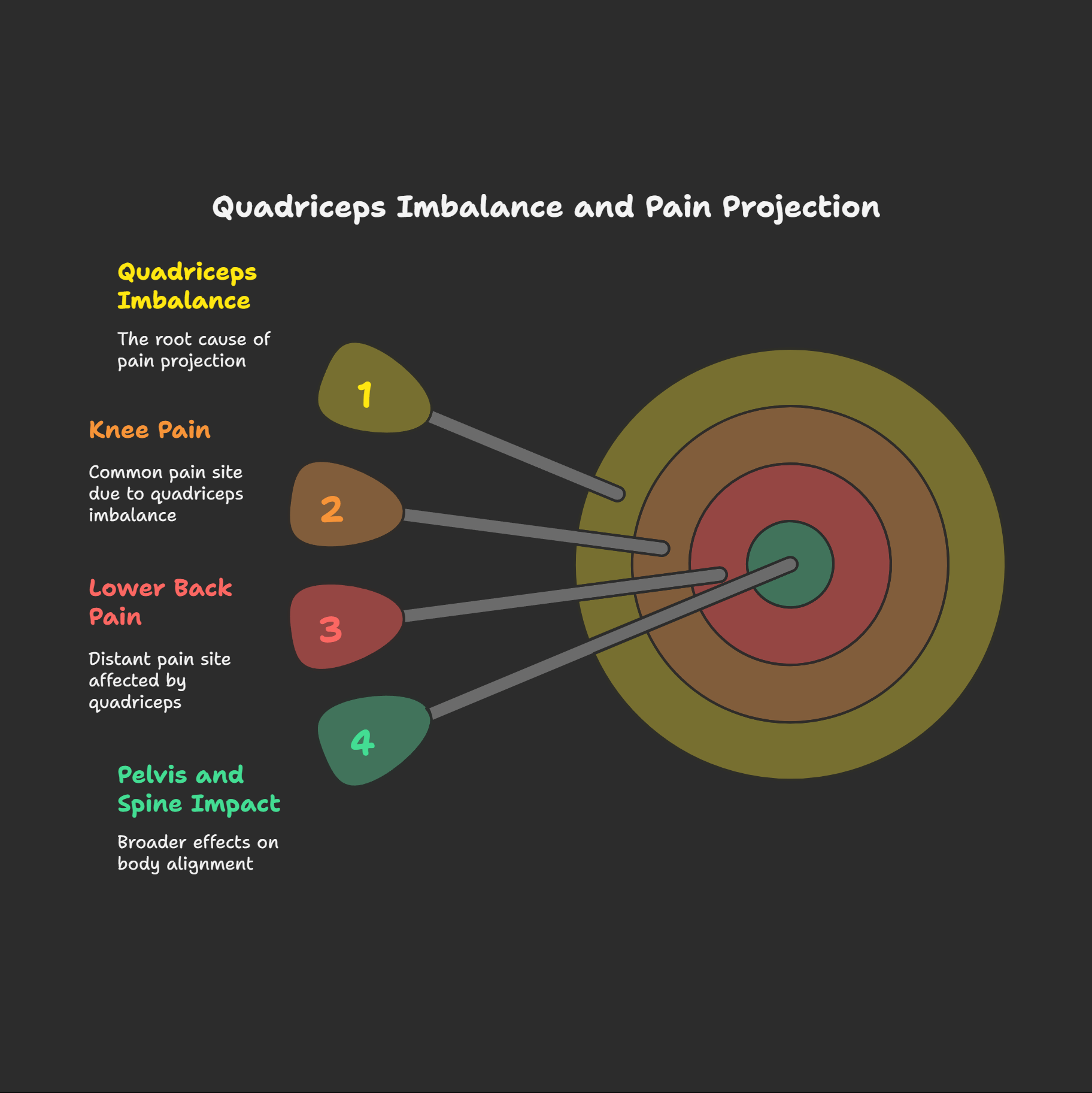
Pain's Secret Connection: How Do the Quadriceps Trigger a Chain Reaction?
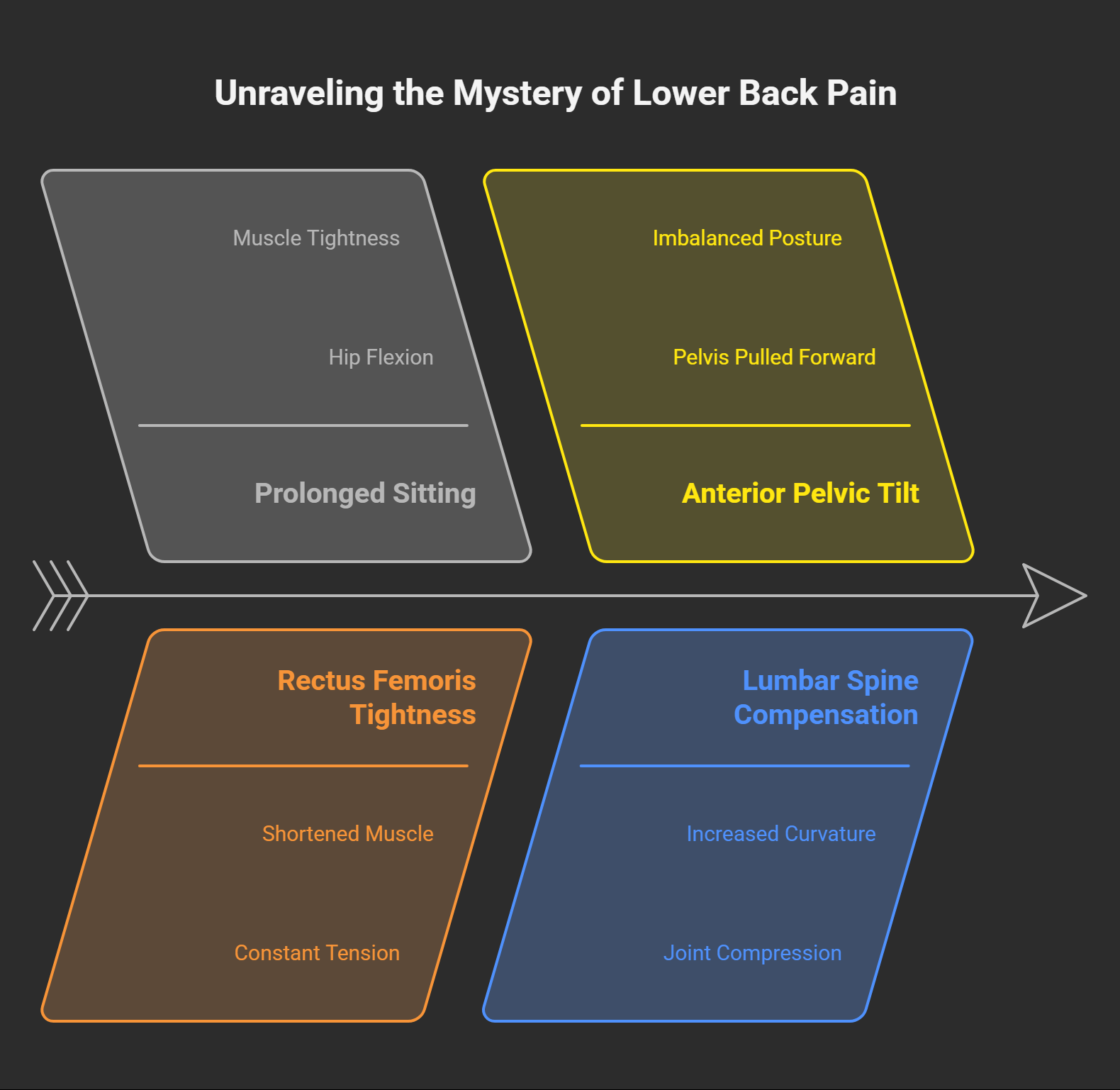
Let's first unravel the mystery of lower back pain. The prolonged sitting posture of modern life keeps the hip joint in a flexed position. This causes the rectus femoris—the part of the quadriceps that crosses both the hip and knee joints—to remain in a shortened and tightened state for long periods.Because the rectus femoris originates at the front of the pelvis, it acts like a rope that is constantly being tightened, day after day pulling your pelvis forward and causing an anterior pelvic tilt. To maintain the body's balance, your lumbar spine is forced to compensate by increasing its curvature, which in turn compresses the joints and triggers muscle tightness, ultimately leading to that nagging chronic lower back pain.It's a precise domino effect, and the first domino to fall is often a tight quadriceps muscle.
The Knee Joint's "Silent Killer": An Imbalanced Tug-of-War
For the knee, quadriceps tightness acts more like a "silent killer." Our kneecap (patella) is supposed to glide smoothly in the track of the femur. However, when the forces within the quadriceps become imbalanced—typically when the outer muscle (vastus lateralis) is overly strong and tight while the inner muscle (vastus medialis) is relatively weak—it's like an unfair tug-of-war. The kneecap gets forcefully pulled to the outside, causing it to "derail."This abnormal tracking pattern leads to constant rubbing of the cartilage, triggering inflammation and pain at the front of the knee. This is especially noticeable when you go up or down stairs or stand up after prolonged sitting. Much of the time, the knee pain you feel is actually the quadriceps sending out a distress signal.
The Art of Precision Stretching: It's More Than Stretching, It's a Dialogue with Your Body
Now that we know the root of the problem, we can begin to perform meaningful stretches. But please remember, the quality of a stretch is far more important than the quantity. Before you begin, be sure to warm up for 5-10 minutes to prepare your muscles.During the stretch, coordinate with long, deep, and steady breaths. You should feel a gentle pulling sensation, not sharp pain. A key principle is to "hold still"—never bounce back and forth, as that can trigger a defensive contraction in the muscle. What we are pursuing is not the range of motion, but the depth and precision of the stretch.Treat every stretch as a deep dialogue with your own body, gently inviting the tight muscles to relax.
The Therapist's Stretching Playbook: A Detailed Guide to Three Highly Effective Moves
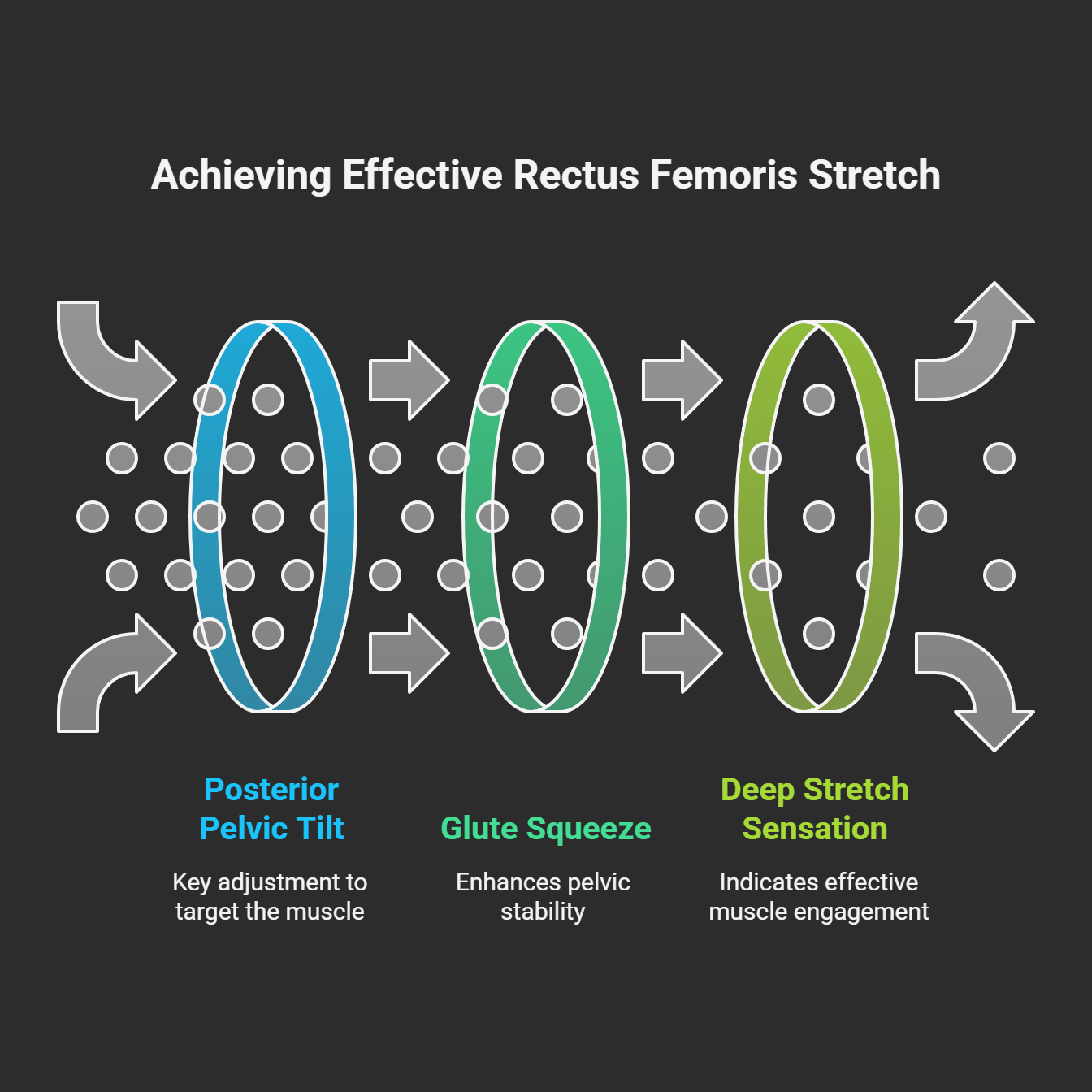
1. The Kneeling StretchThis is the move I most recommend for those with sedentary lifestyles. Assume a kneeling lunge position, with a towel placed under your back knee for comfort.The key is not how far you lean your body forward, but whether you can perform a posterior pelvic tilt—that is, slightly tucking your tailbone and squeezing your glutes. This small adjustment "locks" the pelvis and directs the stretch precisely to the rectus femoris muscle, effectively helping to counteract an anterior pelvic tilt.You will be surprised to find that even with very little body movement, the stretching sensation is much more profound. This is the way to stretch that truly addresses the problem at its root, rather than just superficially pulling on the front of the thigh.
2. The Side-Lying StretchAnother excellent choice is the side-lying stretch. This position is the most friendly to the lower back, placing almost no pressure on it, making it especially suitable for beginners or those currently struggling with lower back pain.After lying on your side, slightly bend your bottom leg up towards your chest. This action stabilizes your pelvis and lumbar spine, ensuring that all the stretching force is concentrated on the quadriceps of your top leg. Next, use the hand on the same side to grasp your ankle and gently pull your heel towards your buttock.In this safe and stable position, you can more attentively feel the extension of the muscle, achieving an optimal relaxation effect.
The Four Great Traps of "Ineffective Stretching" to Avoid
In my clinical observation, the reason many people's stretches are ineffective is that they fall into several common traps.Arching the Lower Back: This is the most frequent mistake. When you try to pull your heel closer, your body unconsciously compensates by arching your back. This not only fails to stretch the target muscle but also increases stress on your lumbar spine. Letting the Knee Flare Out: Allowing the knee of the stretching leg to open outwards will disperse the pulling force, greatly diminishing the effectiveness of the stretch. Forgetting the Pelvic Tilt: During a kneeling stretch, if you only lean your body forward without actively performing a posterior pelvic tilt, the effect of the stretch will be cut in half. Pulling the Ankle Outward: Avoid pulling your ankle towards the outside of your buttock. This places unnecessary twisting pressure on the knee joint.
Beyond Stretching: An Integrated Strategy for Lasting Health
Precision stretching opens a "window of opportunity" for you, but to make the effects last, we need a more complete strategy.The first step is "Release." You can use a foam roller or a massage ball to perform myofascial release on the front of your thighs before you stretch. When you find a particularly sore point, hold the pressure there for 30-60 seconds. This pressure helps to "trick" the nervous system into deactivating the muscle's hyper-alert state. This process releases deep knots and makes the subsequent stretching much more effective.This sequence of "release first, then stretch" is a key secret in professional therapy for enhancing results.
The Symbiosis of Release and Strengthening: Building a Stable Body Structure
The effects of simply releasing and stretching are often temporary. To fundamentally solve the problem, we must follow the golden rule of "Strengthening."When the quadriceps are overly tight, their partners (antagonist muscles)—the gluteus maximus and core muscles—often become weak due to a principle called "reciprocal inhibition." Therefore, after you have created a new range of motion through stretching, you must immediately use exercises like the Bridge and Plank to awaken and strengthen these dormant muscles.Strengthening the weak glutes helps pull the pelvis back into a neutral position, while a strong core provides solid support for the lumbar spine. Release creates the possibility for change, but strengthening is what makes that change lasting and healthy.
Conclusion: Turn Knowledge into Action, Become the Master of Your Own Body
Together, we have completed an in-depth journey from the surface of pain to the core of the problem. I hope you now understand that the answer to the knee or lower back pain that has troubled you for so long may very well be hidden in the front of your thighs, a place you often ignore.True health management is a three-in-one strategy: first, use myofascial release to "Release" the knots; next, use precision stretching to "Stretch" the tight muscle fibers; and finally, use targeted training to "Strengthen" the weak muscle groups, establishing a completely new physical balance.Starting today, please begin to listen to your body's voice and transform this knowledge into gentle yet firm action. You absolutely have the potential to become your own body's best therapist. Of course, if the pain persists or worsens, be sure to seek professional medical assistance for a personalized evaluation.


