
Foreword: Your Feet, the Unsung Heroes of a Healthy Life
In my massage therapy practice, I've observed a common phenomenon: many people don't truly realize the importance of their feet until they send out painful warning signs. Your feet are not just the foundation supporting your entire body's weight; they are key to your overall health and quality of life.They are the starting point of the body's kinetic chain, a chain composed of countless interconnected joints and muscles that extends from the soles of your feet all the way to your spine. A problem in any single link of this chain can trigger an unexpected chain reaction, affecting other parts of your body. Therefore, foot health is the cornerstone of an active, pain-free life. Neglecting it is like building a house on an unstable foundation.
We must understand the immense pressure our feet endure. When you are merely walking, each step places a force on your foot equivalent to three times your body weight; and when running, this number can soar to an astonishing seven times. This also perfectly explains why foot problems are so common and have such a profound impact.The health of our feet directly determines our ability to move, affecting whether we can enjoy walking, sports, or time spent with family and friends. Acknowledging and caring for our feet is the indispensable first step toward a "Happy Healthy Life," and this is the core philosophy I hope to share with you through this article.
Deconstructing the Foot: Understanding the Anatomy and Biomechanics of the Plantar Fascia
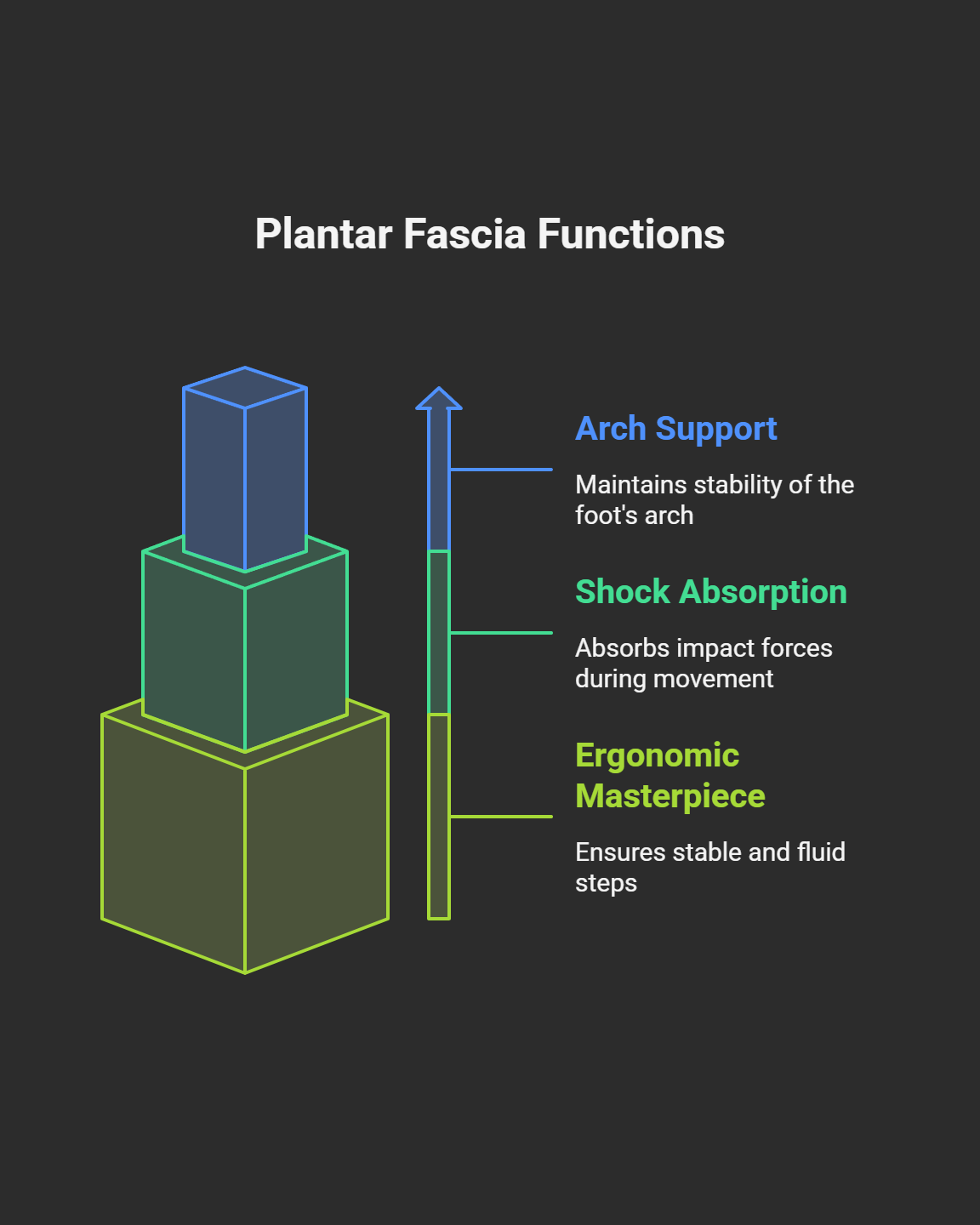
To understand foot problems, we must first get to know one of its most central structures—the plantar fascia. You can imagine it as a strong, thick band of fibrous tissue, like a sturdy ligament, that runs from your heel bone (calcaneus) all the way to the base of your toes.It has two primary functions:To support the arch of the foot, playing a key role in maintaining the stability of the medial longitudinal arch.To act as one of the body's most important shock absorbers, responsible for absorbing the immense impact forces transmitted from the ground when we walk and run.This ingenious structure, a masterpiece of human ergonomics, ensures that our every step is stable and fluid.
The operation of the plantar fascia follows an ingenious principle known as the "Windlass Mechanism."When you stand on your tiptoes, or during the push-off phase of walking as your toes naturally bend upwards (dorsiflex), the plantar fascia is pulled taut, much like a windlass tightening a cable. This action instantly raises the arch, transforming the otherwise flexible foot into a rigid lever structure.This clever biomechanical conversion is the key to our ability to propel the body forward efficiently and powerfully. Understanding this mechanism helps us to see why excessive tension or improper forces can easily overload this system, which in turn triggers pain.
The Pain of the Foot: An In-depth Analysis of the True Nature of Plantar Fasciitis
Plantar fasciitis is the most common cause of heel pain, but its name is actually somewhat misleading. Traditionally, the "-itis" in the name implies an inflammatory response. However, modern histological studies have found that in the plantar fascia of most chronic sufferers, typical inflammatory cells are often absent.Therefore, the condition is more accurately described as a degenerative condition (fasciosis), characterized by micro-tears in the fascial tissue, disorganized collagen fibers, and chronic tissue degeneration. The core concept behind this degeneration is that the "load" placed upon the fascia has chronically exceeded its "capacity."
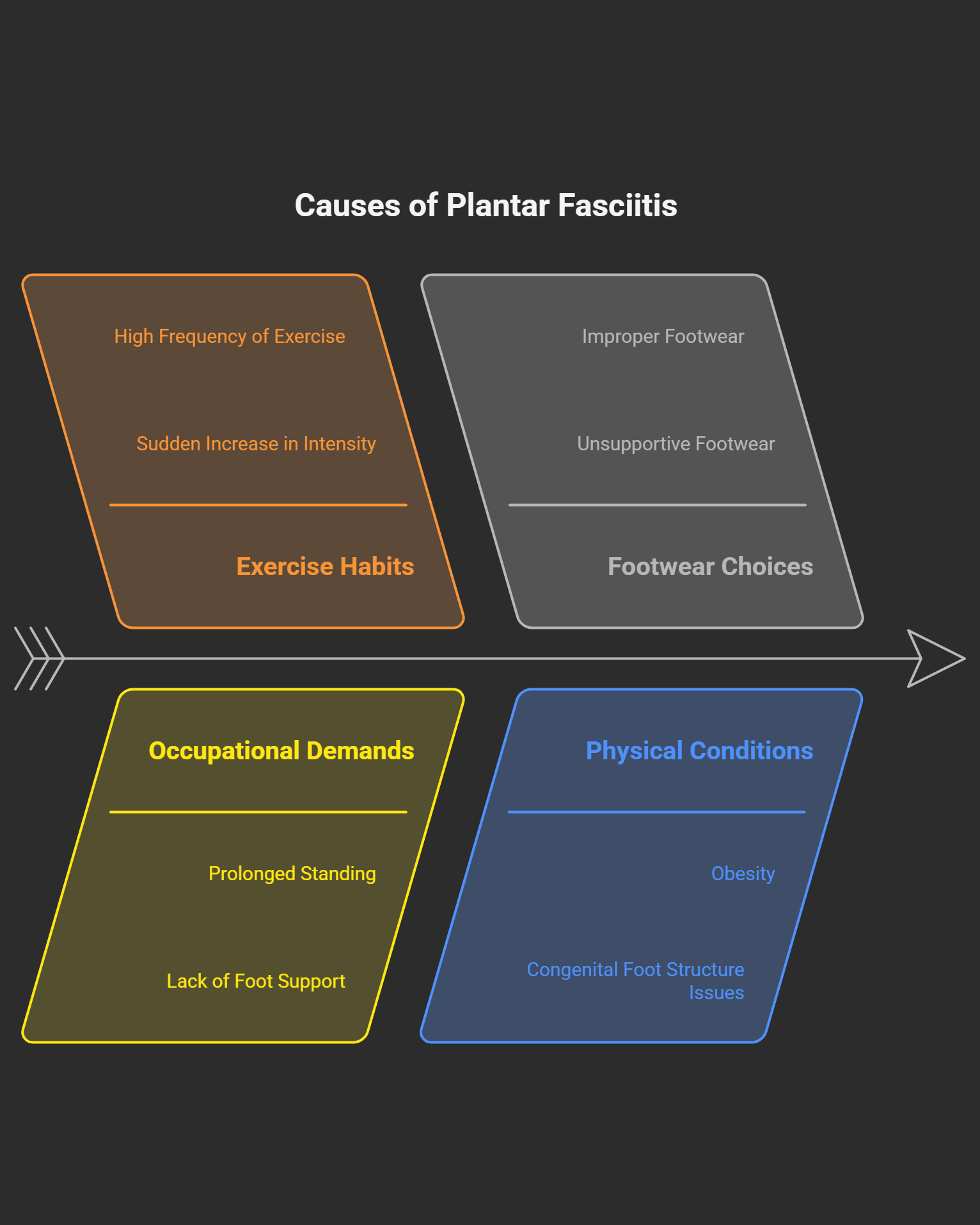
The risk factors that trigger this imbalance are numerous and common in daily life. For example, a sudden increase in the intensity or frequency of exercise, a job that requires prolonged standing, or long-term use of unsupportive or improper footwear can all subject the plantar fascia to excessive stress.Furthermore, obesity places an additional load on the feet, while congenital foot structure issues, such as flat feet or high arches, can alter the foot's biomechanics and increase tension in specific areas. These factors work in concert, causing the fascial tissue to be unable to repair itself in time after continuous micro-trauma, which ultimately leads to the onset of degeneration and pain.
Debunking the Myths: The Truth About Morning Pain and Bone Spurs
The most classic symptom of plantar fasciitis is, without a doubt, the sharp, stabbing pain in the heel that occurs with the first step out of bed in the morning. This phenomenon is known medically as "post-static dyskinesia."The reason for this is that after a night of rest, the plantar fascia is in a shorter, more contracted state. When you suddenly stand and apply your body weight, it creates an intense pulling force on the fascia. This pain typically subsides after a few minutes of walking, once the fascia has had a chance to stretch out slightly. However, it may worsen again after prolonged periods of standing or activity, which is a signal of fascial fatigue.
Many patients, after having an X-ray, will attribute their heel pain to a "bone spur" discovered on the image, but this is actually a long-standing misconception.The formation of a bone spur is a calcified growth that the body produces due to chronic, excessive pulling of the plantar fascia at its attachment point on the heel bone. In other words, the bone spur is the "result" of the fascia's long-term distress, not the "cause" of the pain. In fact, many people in clinical settings who have bone spurs never feel any pain at all.Therefore, the focus of treatment should be on repairing the degenerated fascial tissue and reducing its load, rather than fixating on the bone spur itself.
The Chain Reaction: How Plantar Fasciitis Affects Your Body's Entire Kinetic Chain
Foot pain is by no means just a localized problem; its effects spread like a ripple, affecting the entire body. Our body is enveloped by a three-dimensional network of connective tissue called "fascia," which, like a bodysuit, connects all our muscles and organs together. The plantar fascia is a part of this vast network. It is tightly connected to the calf muscles via the Achilles tendon and extends upwards, becoming a key starting point of the "Superficial Back Line" that runs through the back of the legs, the buttocks, and the back.Therefore, when the plantar fascia becomes tight and contracted due to pain, this tension is directly transmitted upwards, leading to calf tightness or Achilles tendinitis.
To avoid the point of pain on your heel, you might unconsciously change your walking posture, for example, by landing on the outer edge of your foot or reducing the amount of time you bear weight on the affected side. This compensatory gait, developed to adapt to the pain, can further trigger problems in your knees, hips, and even lower back, as these areas are forced to bear weight in an abnormal way.What's more interesting is that the influence of this kinetic chain is bidirectional. Hip instability or weak gluteal muscles can also cause your foot to over-pronate when you walk, which in turn increases the stress on your plantar fascia. This explains why a good therapist, when treating your heel pain, will also take the time to assess and treat your hips.
The Healing Journey Begins at Home: A Practical Guide to Self-Care
Fortunately, over 90% of people with plantar fasciitis can achieve significant improvement through simple and consistent at-home care. Empowering yourself to begin implementing the following strategies today is the first step toward recovery.The core of rehabilitation lies in a dual strategy of "reducing the load" and "increasing the capacity."First, reduce the continuous irritation to the fascia by getting adequate rest and avoiding high-impact activities (such as running and jumping). You can temporarily switch to low-impact exercises like swimming or cycling to maintain your fitness. Second, increase the elasticity and resilience of the fascia and its surrounding muscles through regular stretching and massage.
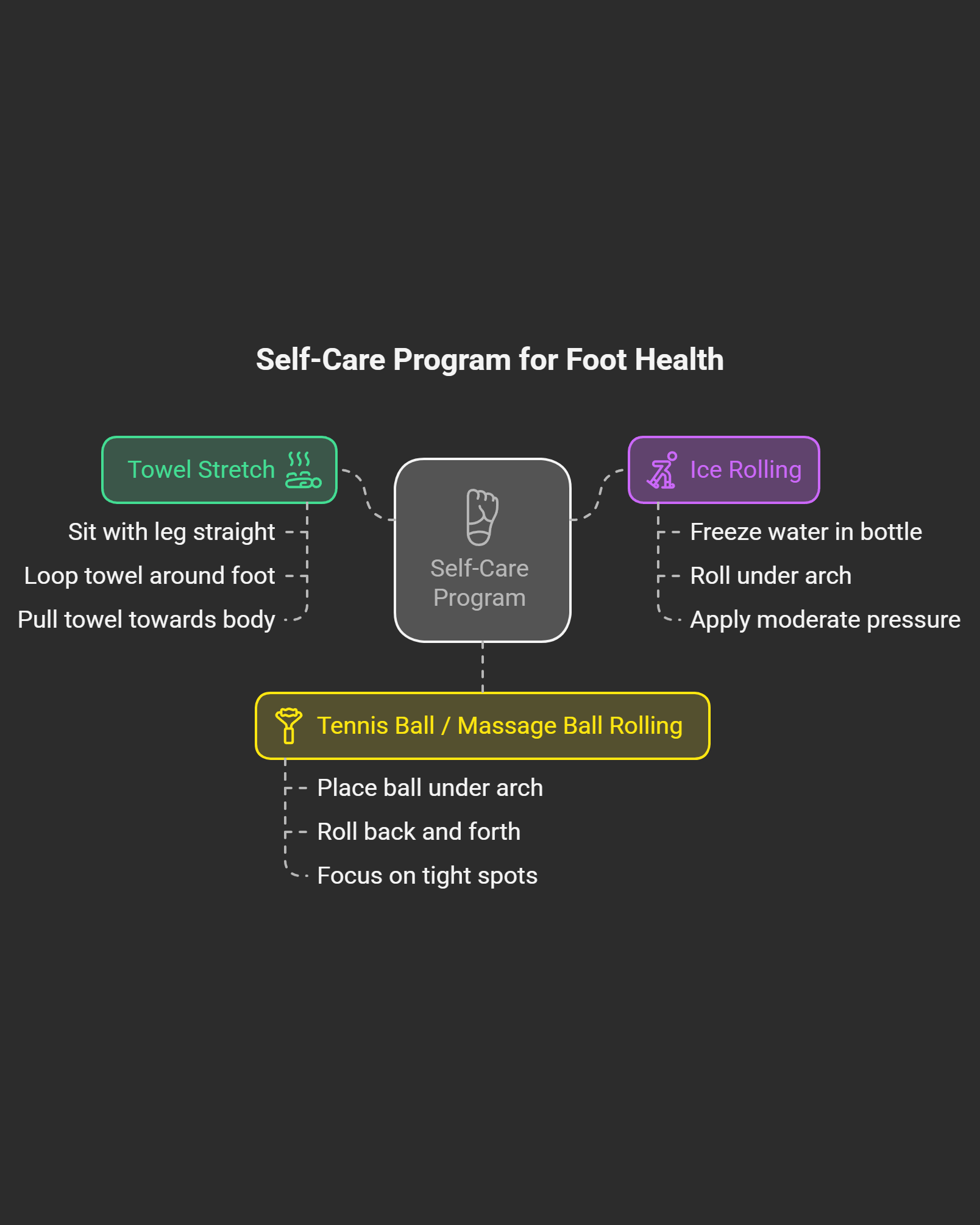
Here is a complete self-care program that I have organized for you. It is recommended that you perform it consistently every day:
1. Towel Stretch: Sit with your affected leg straight out in front of you. Loop a towel around the ball of your foot. Pull the towel with both hands, bringing your toes towards your body until you feel a stretch in your arch and calf. Hold for 30 seconds and repeat 3 times. Do this twice a day.
2. Ice Rolling: Fill a plastic drink bottle with water and freeze it. While seated, place the frozen bottle under the arch of your foot. Apply moderate pressure and roll it back and forth to achieve the simultaneous effects of icing and massage. Roll for 10-15 minutes, 2-3 times a day.
3. Tennis Ball / Massage Ball Rolling: While seated, place a tennis ball or a firmer massage ball under the arch of your foot. Apply pressure and roll it back and forth, paying special attention to points that feel tight or sore. Roll for 2-5 minutes, 1-2 times a day.
The Power of Professional Help: When to Seek Advanced Treatment
Although self-care is crucial, if your pain does not improve after several weeks of self-care, or if the pain is severely impacting your daily life, seeking professional help is a necessary and wise choice.An experienced massage therapist or physical therapist can use more precise assessment and manual techniques to address the root of the problem. For example, a therapist may use "deep tissue massage" to release adhesions and scar tissue that have formed in the calf muscles or the sole of the foot due to chronic tightness. "Myofascial release" is another technique that uses sustained, gentle pressure to stretch the tight fascial network, restoring its proper elasticity and ability to glide.
Furthermore, "trigger point therapy" specifically targets the "knots" in muscles (especially common in the calf muscles) that cause referred pain. By applying direct pressure to these points to release accumulated tension, this therapy can effectively alleviate pain that seems to originate from the sole of the foot.A particularly effective professional technique is "cross-friction massage." In this method, the therapist, without using lubrication, applies deep massage with their fingertips in a direction perpendicular to the fascial fibers. This precise friction stimulates local blood circulation and promotes the healing and realignment of damaged collagen fibers.A professional may also recommend the use of orthotic insoles or night splints to provide more comprehensive support, either from a biomechanical perspective or by providing a continuous stretch.
Conclusion: Step by Step, Regain Your Mobility
In summary, your feet are the foundation that supports your "Happy Healthy Life." Plantar fasciitis is, in essence, a condition of tissue degeneration and injury caused by an imbalance between "load" and "capacity."The road to recovery requires a comprehensive strategy that not only focuses on the painful sole of the foot itself but also addresses the balance of the entire body's kinetic chain and acknowledges the profound impact of chronic pain on mental health. Through persistent self-care, combined with professional intervention when necessary, you are fully capable of breaking the vicious cycle of pain and reclaiming control over your own body.
Please stop viewing your feet as merely a source of trouble and pain, and instead, see them as the foundation of your health, worthy of your dedicated care and investment.Starting today, take positive action—stretch regularly, choose suitable footwear wisely, and learn to listen and respond to the signals your body sends you. As long as you are willing to persevere, step by step, you can certainly reclaim a life that is painless, active, and full of joy.This is the true meaning of "A Happy Healthy Life Begins with Your Feet."


