
Hello, I am your massage therapist. In my work, I have seen many people live with seemingly unrelated long-term issues: perhaps it's the nagging menstrual pain that arrives every month, recurring itchy skin, or that all-too-familiar knee soreness. These problems seem completely different, but their roots may point to the same place.Today, I want to share a secret with you—a powerful "health switch" that exists within our bodies but is often overlooked. This switch is not only a treasure of Traditional Chinese Medicine theory, but it is also a key that I have personally witnessed bring profound change to my clients during treatment sessions. It is the Xuehai acupoint, a veritable hub for managing the health of the body's Qi and Blood.
Meet the Xuehai Acupoint: The Sea of Qi and Blood Within Your Body
In my treatment sessions, I like to compare the body to a sophisticated ecosystem, and the Xuehai acupoint is a vast ocean within this system. Its name is rich with poetry and wisdom: "Xue" (血) represents the Qi and Blood that sustain life, and "Hai" (海) means a sea, a place where a hundred rivers converge.Therefore, the Xuehai point is precisely where the Qi and Blood of the Spleen meridian are most abundant and where they gather. There is a common saying in Traditional Chinese Medicine, "The Spleen governs the Blood," meaning the Spleen and Stomach are responsible for transforming the food we eat into the Qi and Blood that nourish the entire body. The Xuehai point is like a large, regulatory reservoir established on the body's surface by this "Qi and Blood factory" (the Spleen). It stores an abundant supply of blood, ready to be dispatched to wherever it is most needed. This is the fundamental reason it can address so many different issues.
The Mystery of "Bai Chong Ke" (The Nest of a Hundred Insects): The Foundation of Skin Health
What's more interesting is that the Xuehai acupoint has another vivid nickname—"Bai Chong Ke" (百蟲窠), which means the "Nest of a Hundred Insects." This name might sound peculiar, but it precisely describes another of Xuehai's powerful functions.When you experience that unbearable itching sensation that feels as if small insects are crawling under your skin, Traditional Chinese Medicine (TCM) describes this as the "hundred insects" causing trouble. This nickname directly points to the outstanding efficacy of the Xuehai point in treating stubborn skin problems like eczema and urticaria (hives).This also reveals a profound concept: "To treat wind, first treat the blood; once the blood circulates, the wind will extinguish itself." In TCM, many skin problems are rooted in an imbalance of the "Blood." By regulating this "Sea of Blood," the annoying "hundred insects" naturally lose the soil in which they thrive.
Precision Location: Easily Find Your Health Switch
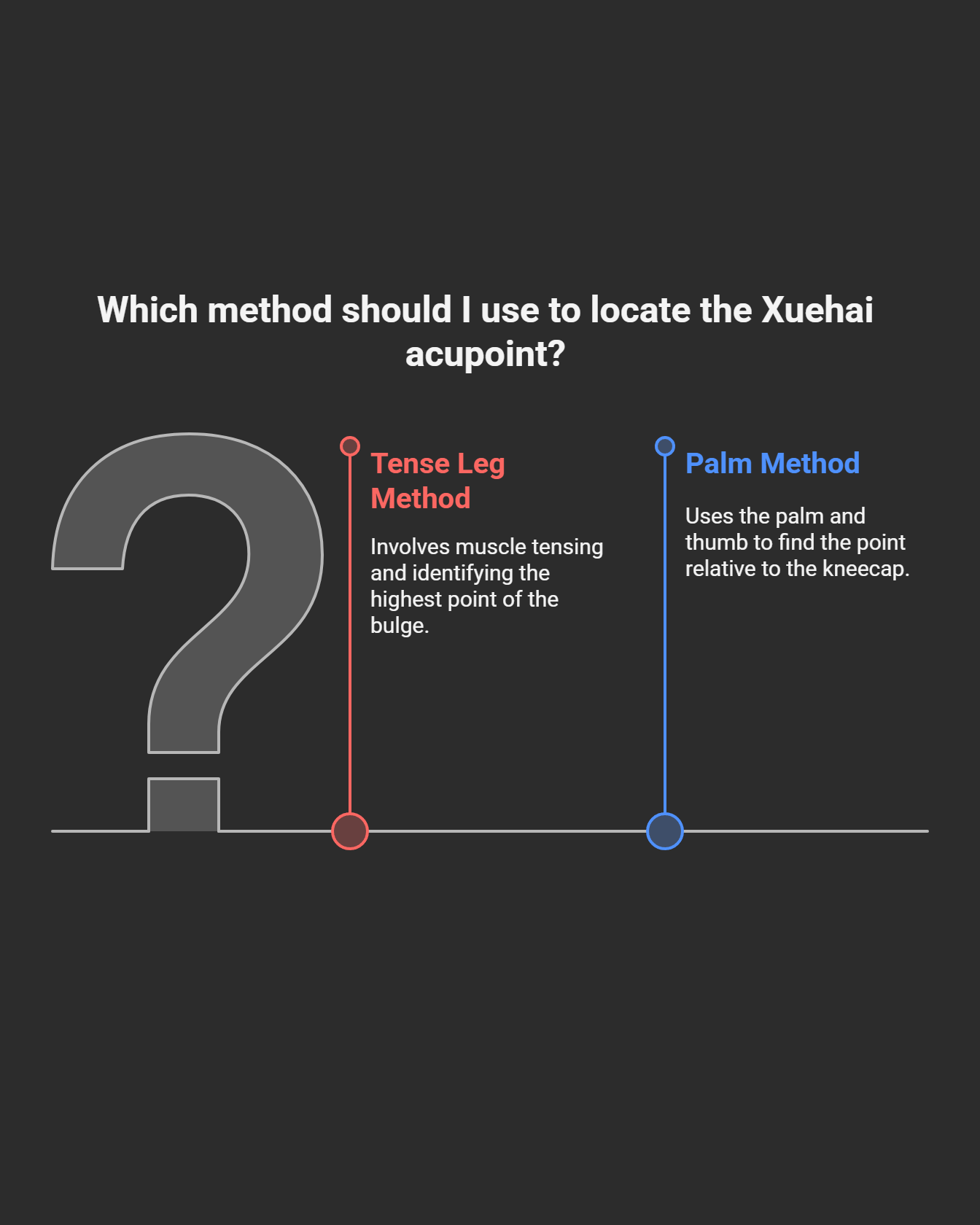
To awaken the healing power of the Xuehai acupoint, the first step is to locate it with precision. When guiding my clients in at-home self-care, I typically recommend two of the most intuitive and foolproof methods.The "Tense Leg Method": Simply sit down and straighten your leg, tensing the muscles. You will see a muscle bulge naturally on the inner side of your thigh, just above the kneecap. The highest point of this muscle bulge is the Xuehai point. When you press it, there is usually a distinct sensation of soreness and distension.The "Palm Method" (Simpler): Bend your knee to a 90-degree angle. Place the palm of your opposite hand over your kneecap, letting your thumb open naturally to about a 45-degree angle. The spot where the tip of your thumb lands is the Xuehai point.Both of these methods are very suitable for use in your daily self-care routine.
Activating the Power of Xuehai: Experiencing the Wonder of "De Qi"
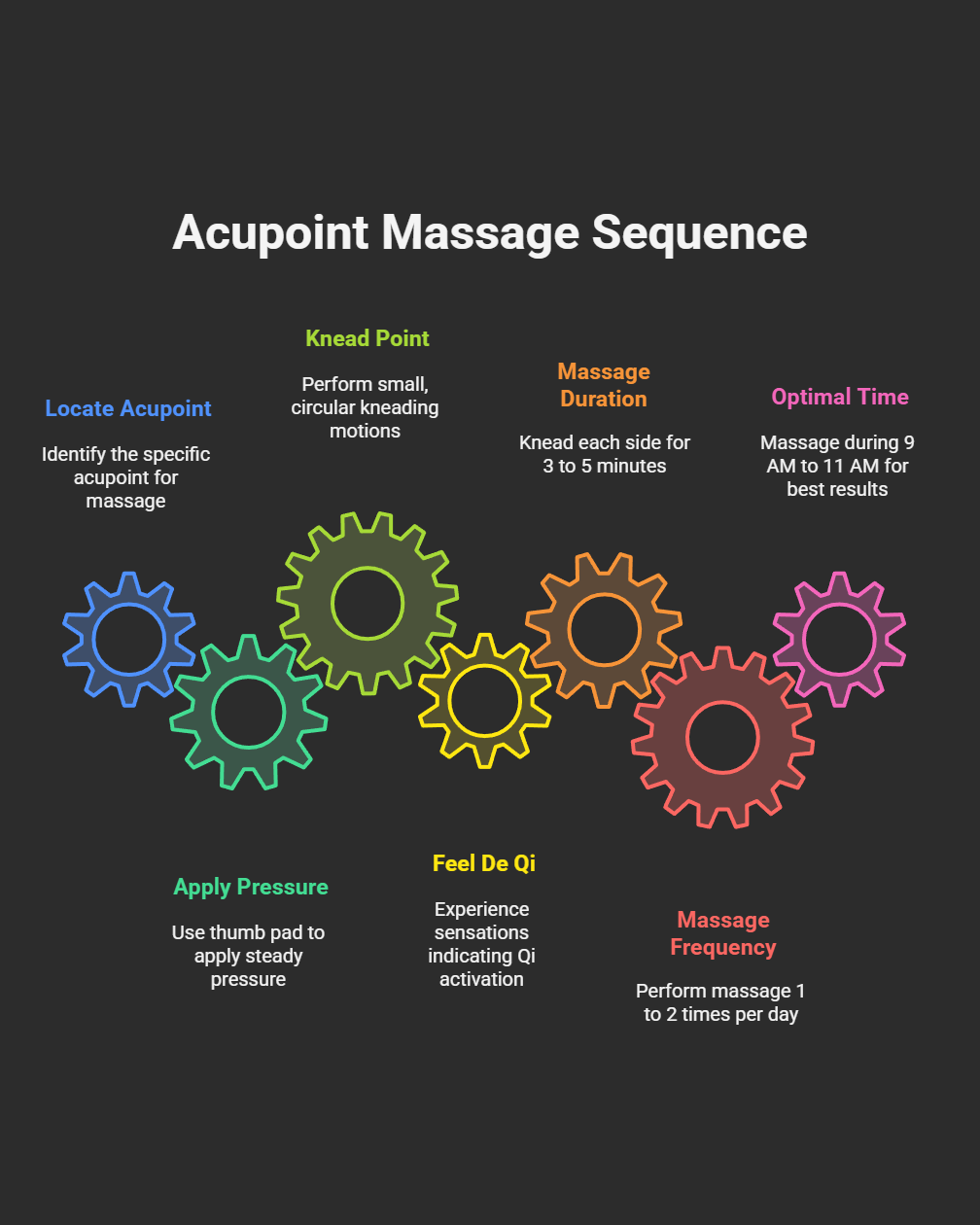
Once you have located the acupoint, we can begin the effective self-massage. The method I recommend most is the "Point-Kneading Method." Use the pad of your thumb to apply steady, deep pressure to the Xuehai point while making small, circular kneading motions. During this process, focus on feeling a slight sensation of soreness, distension, or numbness. We call this "De Qi," and it indicates that you have successfully activated the Qi of the meridian.It is recommended to knead the point on each side for 3 to 5 minutes, and you can do this 1 to 2 times per day. According to the wisdom of Traditional Chinese Medicine, the Qi of the Spleen meridian is most active between 9 AM and 11 AM. Performing the massage during this time will yield more significant results, so consider incorporating it into your morning routine.
Advanced Technique: The Art of Tonifying (Nourishing) and Sedating (Clearing)
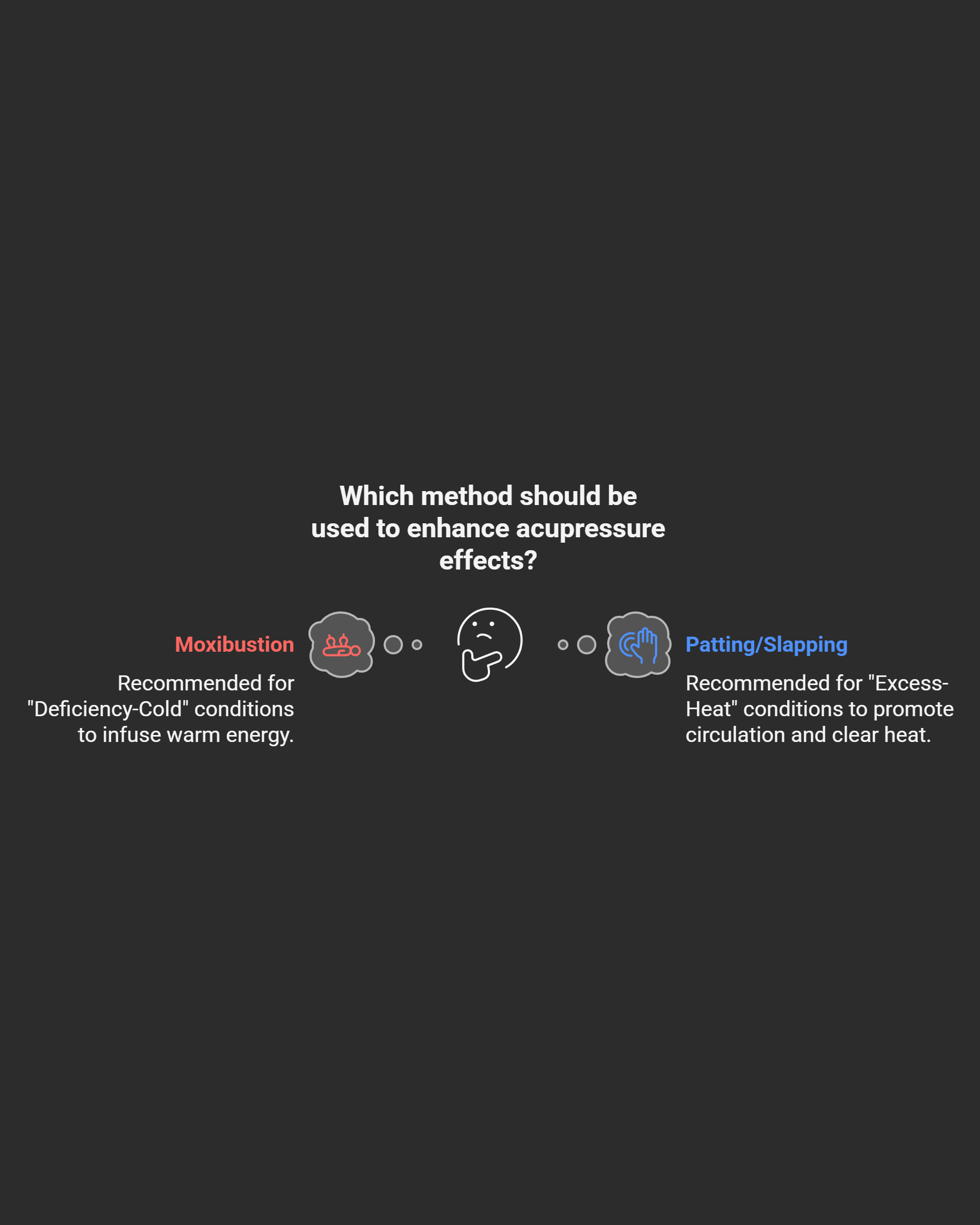
In addition to basic acupressure, we can also use different methods to enhance the effects based on the body's condition.If your issue leans towards "Deficiency-Cold" (e.g., menstrual pain due to uterine cold, or cold hands and feet), I would recommend using moxibustion. The gentle heat from the moxa stick can infuse the Xuehai point with warm energy, which is an excellent "tonifying" or "supplementing" method (補).Conversely, if your problem leans towards "Excess-Heat" (e.g., acute urticaria/hives or skin issues caused by Blood-Heat), you can try the "Patting/Slapping" method. Regularly pat the Xuehai point area with your palm for 3 to 5 minutes. This can effectively promote the circulation of Qi and Blood and clear pathogenic heat. This is a safe "draining" or "purging" method (瀉) that helps the body expel excess fire-heat.
The Master-Hand of Gynecological Health: The Secret to a Smooth Monthly Cycle
In my professional career, the Xuehai acupoint is undoubtedly one of the points I use most frequently when helping female clients with gynecological issues. Traditional Chinese Medicine posits that "women are rooted in Blood" (女子以血為本), and the uterus is also known as the "Chamber of Blood" (血室), a concept closely linked to the "Sea of Blood."By regularly massaging or applying warm compresses to the Xuehai point, one can directly regulate the blood circulation of the uterus, resolve the blood clots and stasis that lead to menstrual pain, and warm the uterus. I often recommend that clients start enhancing their self-care routine one week before their period is due and combine it with another major acupoint for gynecology, Sanyinjiao (SP6). The combination of these two points can more comprehensively improve issues of irregular menstruation and menstrual pain, making each monthly cycle smoother.
The Skin's Fire Extinguisher: Say Goodbye to the Root Cause of Itching
When clients are distressed by the itching from eczema or urticaria (hives), I once again emphasize the concept, "To treat wind, first treat the blood." I guide them to imagine the wandering red rash as a wildfire fueled by "Blood-Heat." Stimulating the Xuehai point is like directly "cooling down" and "dredging" the blood, which removes the fuel for the fire, causing the flames of itching to naturally and gradually die down.I recommend they pair the Xuehai point with the Quchi acupoint (LI11), located at the elbow, to form the "Itch-Stopping Duo." Xuehai regulates the blood foundation from the inside, while Quchi clears pathogenic heat from the body's surface on the outside. This pincer attack from within and without can more effectively relieve the skin's redness, swelling, heat, and itching.
The Guardian of the Knee Joint: The Key to an Agile Gait
Knee pain is another issue I frequently treat, and since the Xuehai point is located near the knee joint, it is an excellent acupoint for nurturing the knees. Stimulating it not only directly increases local blood supply—bringing nutrients to damaged tendons and ligaments and carrying away inflammatory substances—but it also systemically "invigorates blood and dispels stasis."From a Traditional Chinese Medicine perspective, many types of arthritis are considered "Bi Syndrome" (痹症), a condition caused by the obstruction of Qi and Blood. I recommend that clients combine the massage of Xuehai with the other two members of the "Three Musketeers of the Joints"—Yanglingquan (GB34), which governs all the sinews and tendons, and Zusanli (ST36), which supplements Qi and Blood. Working together, these three points provide a comprehensive nourishment and repair solution for the knee joint, helping you to regain a flexible and steady gait.
Safety First: Precautions for Massaging the Xuehai Acupoint
As a responsible therapist, I must remind you of some important precautions.First, pregnant women should avoid self-massaging this point, as its powerful blood-invigorating effect could potentially affect the pregnancy.Second, if your menstrual flow is already very heavy, you should avoid over-stimulation; switch to gentle pressure or warm compresses instead.Furthermore, please do not perform any form of massage or Gua Sha on skin that has open wounds, infections, or inflammation.Finally, if you have a bleeding disorder or are currently taking anticoagulant medication (blood thinners), you must consult your doctor before performing any acupressure.Listening to your body's signals is always the most important part of self-healing.
Conclusion: Become the Guardian of Your Inner Ocean
In summary, the Xuehai acupoint is an amazing healing hub within our bodies. It is not only a key for regulating gynecological health, improving skin quality, and nurturing the joints, but it is also a window that allows us to observe and regulate the state of our own Qi and Blood.Every person's body possesses an innate healing potential, and the Xuehai point is one of the simplest and most effective keys to unlocking it. Starting today, please take a little time to have a dialogue with this inner sea of life using your own hands. By practicing with persistence, you will personally witness the profound and beautiful changes you create for your own health.


