
Hello, I am your massage therapist. After a long day, have you ever felt that familiar ache? Your eyes feel dry and burning, a dull pain throbs behind your temples, and your shoulders and neck become unbearably stiff. This isn't just fatigue; it's the mark that our modern digital life leaves on our bodies.In my work, I see clients every day who come in for shoulder and neck pain, but when we delve deeper, the story's starting point is almost always their eyes. Eye fatigue is rarely an isolated problem. It is the epicenter of a tension pattern, and its effects radiate throughout the entire head, neck, and upper back. Therefore, we need to approach it in a more comprehensive way, treating it as a holistic myofascial and musculoskeletal issue.
This article aims to provide a holistic and practical toolkit to help you understand, alleviate, and prevent this nagging discomfort. We will embark on this healing journey together:First, we will understand the root of the problem from an anatomical perspective.Next, we will explore the healing power of thermotherapy (warmth therapy).Then, we will learn how to gently exercise the eye muscles.Finally, I will share with you a therapist's secret weapon—utilizing the art of "touch," specifically acupressure, for targeted relief.Are you ready to reclaim your sense of comfort? Let's begin.
Section One: Unlocking the Secret of Tired Eyes—Why Do Your Eyes and Neck & Shoulders Protest Together?
Medically, the symptoms triggered by prolonged screen-gazing are referred to as "Digital Eye Strain" (DES). Research shows that anyone who continuously views a screen for more than two hours a day is in the high-risk group.The culprits are several key factors:First, our blinking rate drops dramatically, from a normal rate of nearly 20 times per minute to less than 7. This prevents the eyes from receiving adequate moisture, leading to dryness and irritation.Second, the pixels on a screen are far less distinct than printed text, forcing our eye muscles to work harder to constantly maintain focus. Screen glare and poor contrast undoubtedly make matters worse.Finally, poor indoor lighting or the dry air circulated by air conditioning can exacerbate the stress and discomfort on the eyes.
To truly understand how to find relief, we must first get to know these silently working muscles.You can imagine the internal "ciliary muscle" of the eye as the autofocus motor of a camera. It contracts when you look at near objects (like a screen). Staring at a screen for long periods forces it into a state of continuous contraction, and eventually, it will "cramp," causing your vision to be blurry when you look up at something in the distance.In addition, there are six "extraocular muscles" responsible for controlling the various movements of the eyeball. Even when you think you are just passively staring at the screen, they are actually making thousands of micro-movements to track the images. This continuous, low-intensity activity ultimately leads to muscle fatigue, much like holding a very light dumbbell for hours on end.
More importantly, eye fatigue is not an isolated event; it is a systemic problem that triggers a chain reaction. From my perspective as a therapist, the body is a sophisticated network woven from fascia and muscles, and tension in one area inevitably affects others.To see the screen clearly, we often unconsciously lean our heads forward, creating what is known as "tech neck." This places immense pressure on the cervical spine and shoulder muscles. This tightness then travels upwards to the head, triggering tension headaches. At the same time, the fatigued eye muscles themselves are also generating pain.You can imagine it like ripples in a pond: the eye strain is the stone thrown into the water, and the ripples spread outwards, eventually causing a headache that extends to your shoulders.
Section Two: The Healing Power of Warmth—The Science and Practice Behind Hot Compresses
A warm towel offers more than just comfort; it is a powerful physiological intervention.Heat causes vasodilation. You can imagine the heat as a traffic controller, clearing the way for the micro-vessels around your eyes. This brings the oxygen and nutrients needed for repair while simultaneously carrying away the metabolic waste products that cause soreness.Furthermore, the gentle warmth sends a relaxation signal to the nervous system, effectively relieving muscle tightness and spasms and achieving a pain-relieving effect. Even more cleverly, the heat can warm and melt the clogged oils in the Meibomian glands within the eyelids, allowing your body's self-produced "lubricant" to flow smoothly, fundamentally improving the problem of dry eyes.
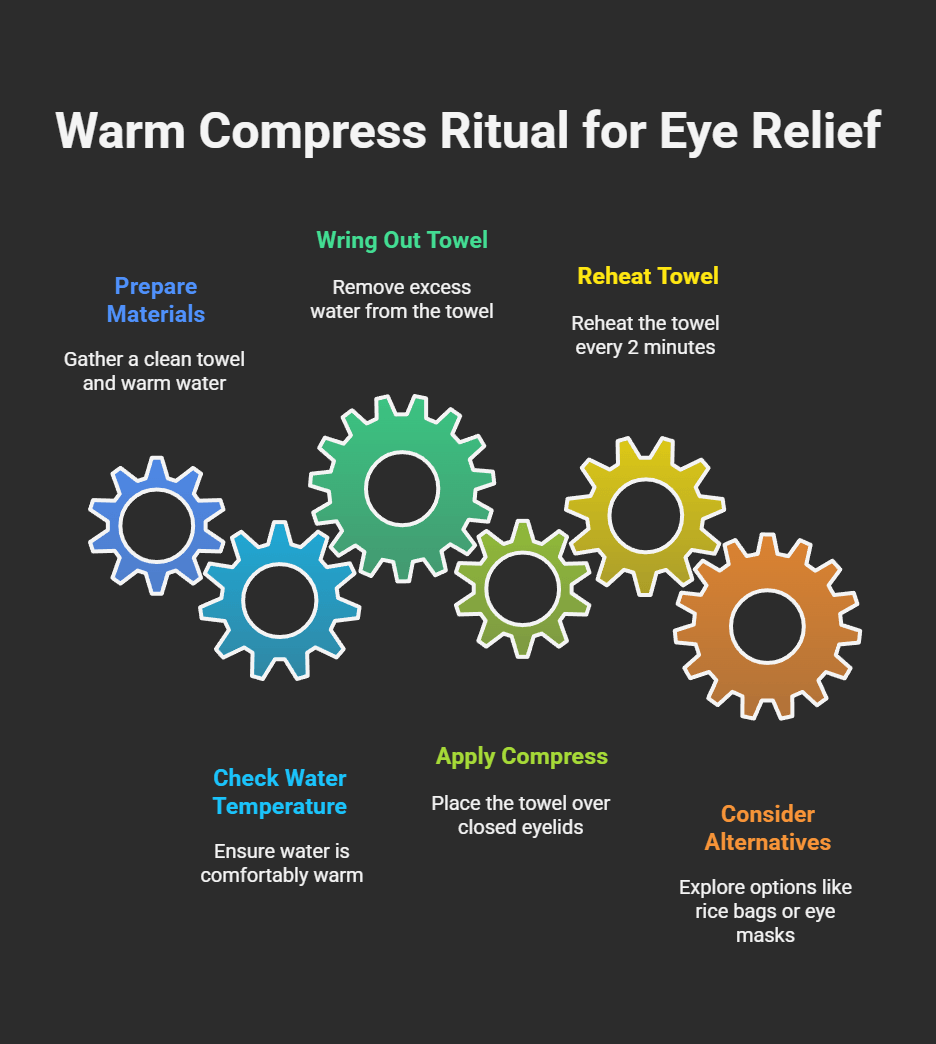
To perform an effective warm compress ritual, prepare a clean towel and a bowl of warm water. The water temperature should be comfortably warm, never too hot.Wring out the towel so that it doesn't drip and gently place it over your closed eyelids for 5 to 10 minutes. For the best results, it is recommended to re-soak and reheat the towel whenever it begins to cool. Research indicates that reheating the compress every 2 minutes is most effective for raising eyelid temperature.You can choose the simplest option, a wet towel, which is convenient but cools down quickly. Alternatively, you could use a microwavable rice bag, which retains heat better. For those who suffer from chronic dry eye or severe digital eye strain, investing in a professional moist heat eye mask will provide a more sustained and stable therapeutic effect.
Section Three: Yoga for the Eyes—A Curated Set of Eye Exercises to Restore Muscle Flexibility
Unlike exercising other parts of the body to pursue "strength," the goal of eye exercises is "flexibility." We aim to restore the muscles that have become rigid from prolonged, fixed gazing, improve their coordination, and release tension. You can think of it as "yoga for the eyes," not "weight training for the eyes."A comprehensive eye exercise routine should target both the "internal muscles" responsible for focusing and the "external muscles" responsible for movement.First, the most important habit is the "20-20-20 Rule": every 20 minutes, shift your gaze away from the screen and look at an object at least 20 feet (about 6 meters) away for 20 seconds. This simple action can effectively prevent spasms in the muscles responsible for focusing.
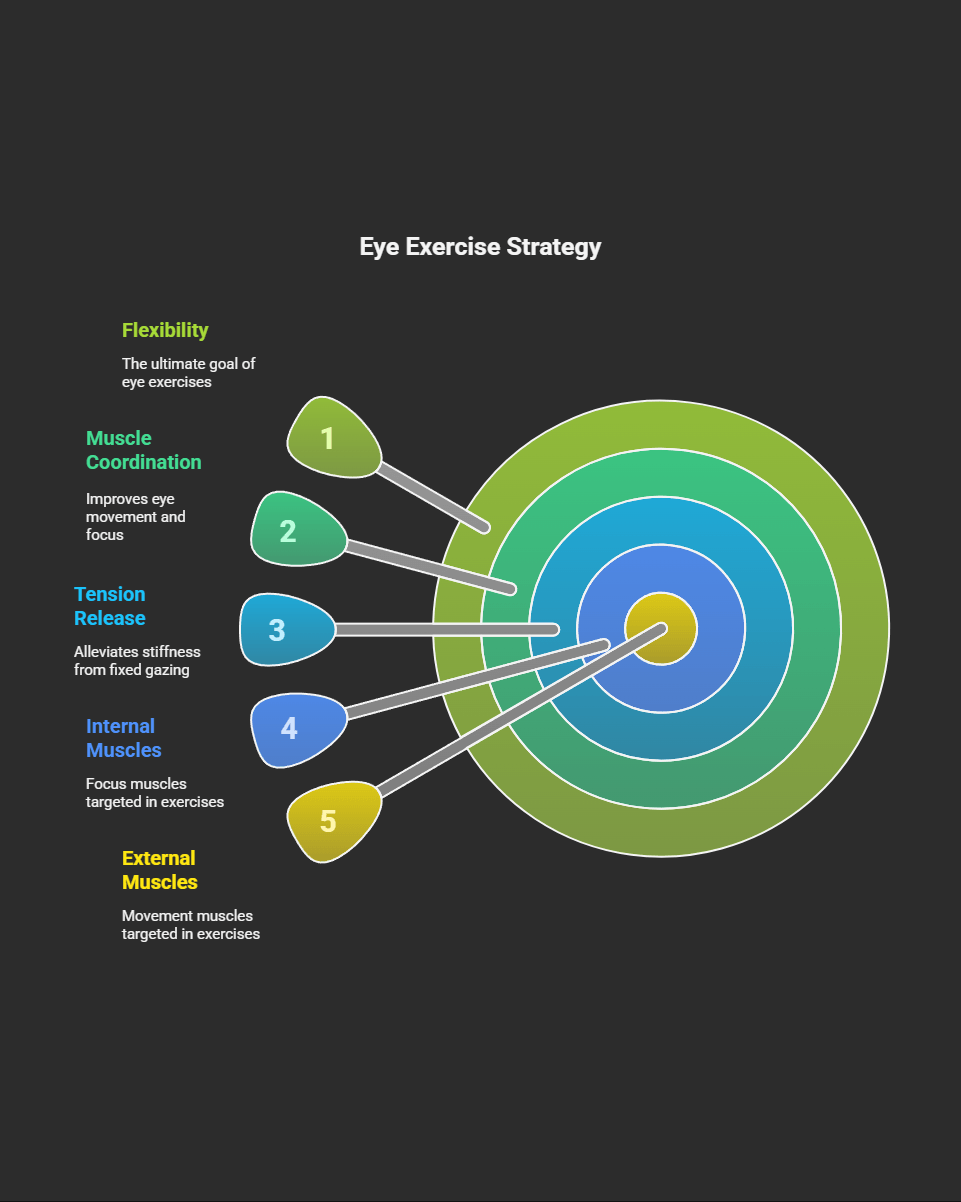
For a deeper training session, you can try the "Far-Near Focus Shift":Hold your thumb about 25 cm in front of your face. Focus on it for 15 seconds, then shift your focus to a distant object and gaze at it for 15 seconds. Repeat this 10 times.Next, let's stretch the extraocular muscles responsible for movement:Eye Rolls: Close your eyes and slowly roll your eyeballs in a large circle clockwise 5 times, then repeat in the counter-clockwise direction.Figure Eights: Imagine a giant number "8" lying on its side in front of you. Slowly trace its outline with your eyes. This can improve the coordination of your eyeballs.Finally, don't forget deep relaxation (palming):Rub your hands together quickly to generate heat. Gently cup your palms over your closed eyes. Breathe deeply for 1 to 2 minutes and feel the tranquility brought by the warmth and darkness.
Section Four: The Art of Touch—Using Acupressure for Targeted Relief
In my massage therapy work, applying pressure to specific points is a key technique for releasing muscle knots or trigger points. You can also apply this technique to yourself, pressing on specific acupoints around the eyes.These points are not chosen at random. From an anatomical perspective, they correspond to important physiological locations, such as the belly of a muscle or nerve pathways. Through steady pressure, you can physically release muscle tension, promote local blood circulation, and block pain signals.When performing this, please use the pad of your thumb, index, or middle finger. Apply a steady but firm pressure and slowly make small circles until you feel a "comfortable, sore, and full sensation."
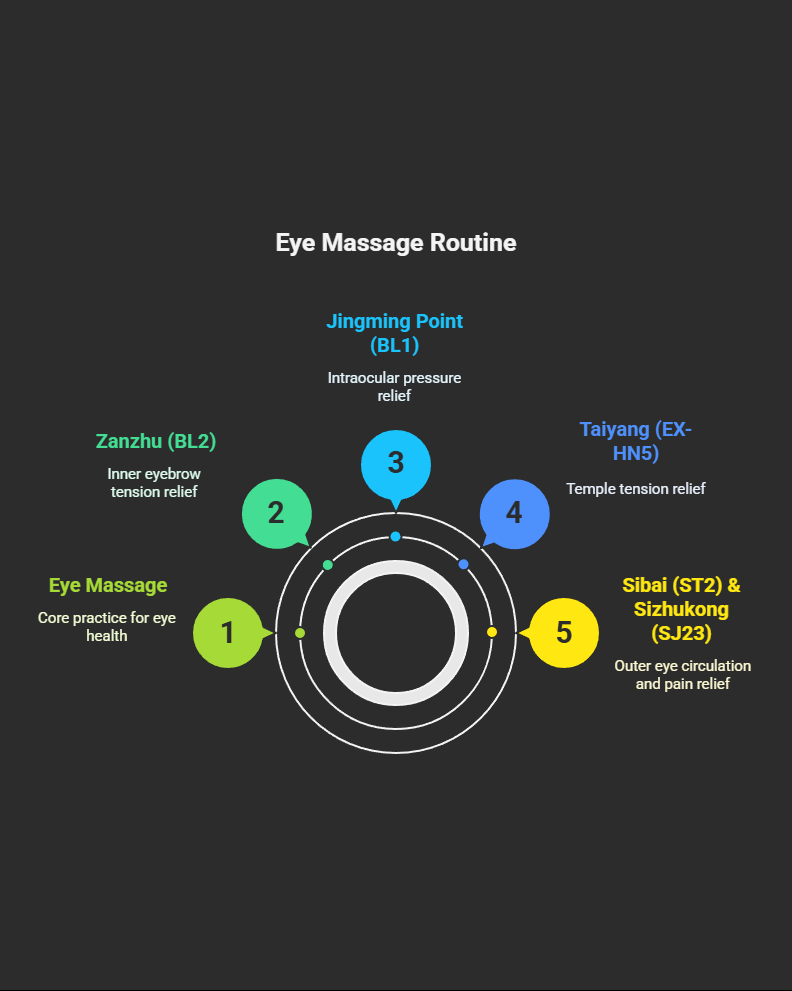
Here is your personal eye massage routine. It is recommended to press each point for 20 to 30 seconds:
Zanzhu (BL2) :Located in the depression at the inner end of the eyebrow. Use your thumbs to press upwards and knead in small circles. This releases tension in the forehead and muscles of the upper eye socket and alleviates frontal headaches.
Jingming Point (BL1):Location: In the small hollow at the inner corner of the eye, near the bridge of the nose.Technique: Gently pinch this area with your thumb and index finger, applying pressure towards the bridge of the nose. Do not press directly on the eyeball.Benefits: Relieves intraocular pressure and eye fatigue; helps to improve dryness and eye discomfort related to nasal congestion.
Taiyang (EX-HN5): Located in the soft depression of the temples, about one finger-width from the outer corner of the eye. Press with the pad of your middle finger and massage in a circular motion. This is extremely effective for relieving tension headaches, migraines, and pressure at the outer corners of the eyes.
Sibai (ST2): Located about one finger-width below the eye, in the depression on the cheekbone directly below the pupil. Gently press upwards towards the depression on the lower orbital rim.Benefits: Promotes blood circulation in the infraorbital region, which helps to alleviate eye twitching and sinus pressure.
Sizhukong (SJ23): Located in the depression at the outer tip of the eyebrow.Technique: Press firmly and massage in small circles.Benefits: Relieves pain and pressure in the outer corner of the eye and the temple area.
Section Five: Building Sustainable Habits for Long-Lasting Comfort
As your therapist, I must emphasize that prevention is always the key. If the root cause of the problem—poor ergonomics—persists, even the best relief techniques will only be a temporary fix.Please review your work environment:The top of your screen should be at or slightly below your eye level, and it should be about an arm's length away.Minimize glare from windows or overhead lighting as much as possible.Use a chair that supports your back and ensure your feet can rest flat on the floor.Most importantly, constantly remind yourself to avoid the forward-head "tech neck" posture.View these adjustments as the most fundamental investment you can make in your physical health.
To truly integrate relief into your life, I recommend establishing a regular "Five-Minute Eye Break" every few hours. This routine can be very simple:1 minute: Perform the far-near focus shift exercise.1 minute: Do eye rolls.1 minute: Press the Taiyang (temple) and Zanzhu (BL2, at the start of the eyebrow) acupoints.1 minute: Perform palming (gently covering your eyes with your warm palms).1 minute: Blink deliberately and frequently.These seemingly small actions, when accumulated, will produce a huge change. At the same time, don't forget to support your body from the inside. Ensure you drink plenty of water throughout the day, as dehydration directly worsens dry eye symptoms. A balanced diet is also an indispensable part of maintaining long-term eye health.
Conclusion: Reclaiming Your Visual and Physical Comfort
Your body is communicating with you through discomfort. The soreness in your eyes and the stiffness in your neck are clear signals, reminding you to pause, take a deep breath, and take good care of yourself.By integrating the four core principles you've learned today into your daily life, you can transform from being a passive victim of digital eye strain into an active manager of your own health: understand the root of the problem, soothe with warmth, release with movement, and perform targeted healing through touch.Please remember, while these techniques are very effective, they cannot replace professional medical care. If you experience severe or persistent pain, be sure to consult an ophthalmologist.Now, begin with a deep breath and a gentle eye stretch, and reclaim the comfort and vitality that belong to you.


