
Have you ever been startled awake the moment you get out of bed in the morning by a sharp, piercing pain coming from your heel? A pain so intense that it makes every step you take hesitant and difficult. As a massage therapist, I see people every day who are deeply troubled by foot fatigue.The fast pace of modern life, prolonged periods of standing, or improper footwear are quietly placing shackles on our feet. But please believe me when I say that the path to relief may be simpler than you think, and it can be found in a small tennis ball.Today, I will guide you to a deeper understanding of the root cause of your pain and share a professional, safe, and extremely effective self-care program to help you break free from these constraints, take light, pain-free steps once again, and truly enjoy your "Happy Healthy Life."
Chapter One: Listening to Your Feet's Cry for Help – Where Does the Pain Come From?
Before we start to relieve the pain, it is crucial to understand what is happening under your foot. Your foot pain most likely originates from an unsung hero that silently supports you—the plantar fascia.You can imagine it as the string of a bow; it extends from your heel to your toes, providing the arch of your foot with elastic support and the ability to absorb shock. When this tough band of tissue becomes overloaded from an accumulation of daily stress, it can lead to micro-tears and inflammation. This is what is medically known as "plantar fasciitis." It is not the result of a single incident, but a warning signal produced by the combined effect of multiple factors, reminding us that it's time to take good care of our body's most important foundation.
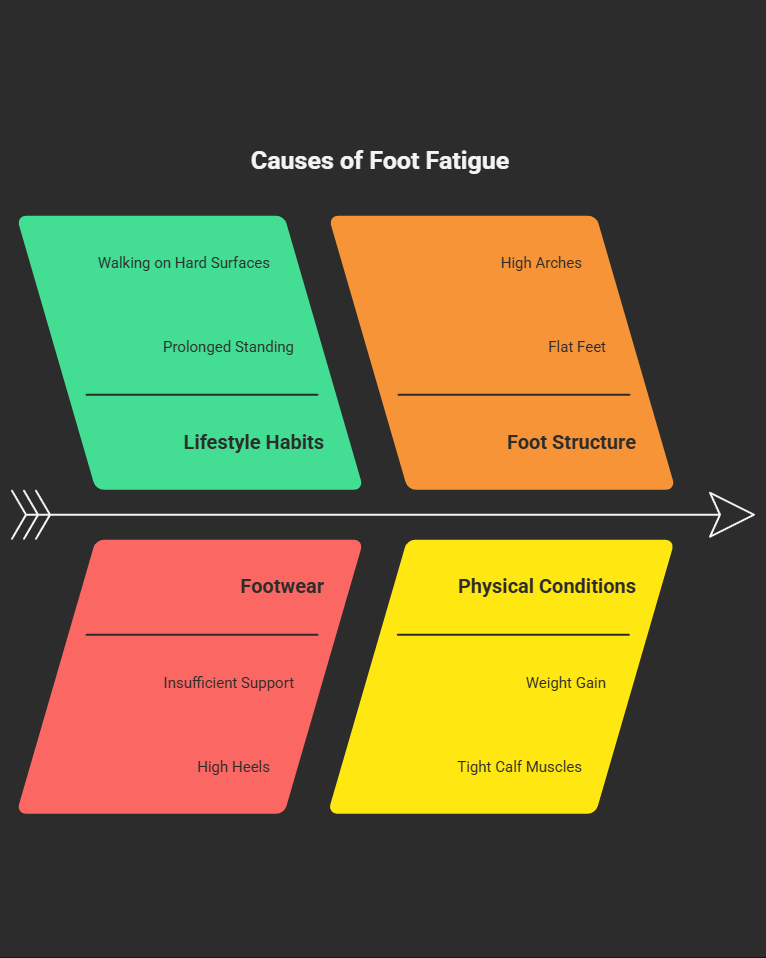
Many lifestyle habits are the main culprits behind foot fatigue.Prolonged standing or walking on hard surfaces, which is a daily reality for retail staff, nurses, or teachers, can continuously weaken the fascia's elasticity. Wearing shoes with insufficient support, overly hard soles, or beautiful yet uncomfortable high heels will similarly alter the normal way your foot bears weight, causing an abnormal concentration of pressure.Furthermore, your innate foot structure (such as flat feet or high arches), weight gain, or even excessive tightness in your calf muscles can all act like a domino effect, ultimately transmitting pressure to the sole of your foot and triggering that troublesome pain. Therefore, the key to solving the problem lies in thinking from a systemic perspective: "What is causing my feet to bear so much pressure?"
The most classic symptom is, without a doubt, "first-step pain in the morning"—that sharp, piercing pain in your heel when you get out of bed, which eases slightly after a few minutes of activity but then worsens again at the end of a long day. This happens because overnight, the plantar fascia remains in a shortened and stiff state, and your first step in the morning suddenly stretches it, naturally triggering intense pain.Other signals include a distinct tender point when you press on your heel or arch, and in severe cases, this may even be accompanied by slight swelling. If this description is a close match for your situation, then the following tennis ball release method will be the most capable assistant in your self-care toolbox.
Chapter Two: The Science of Rolling – The Deep Healing Power of a Small Ball
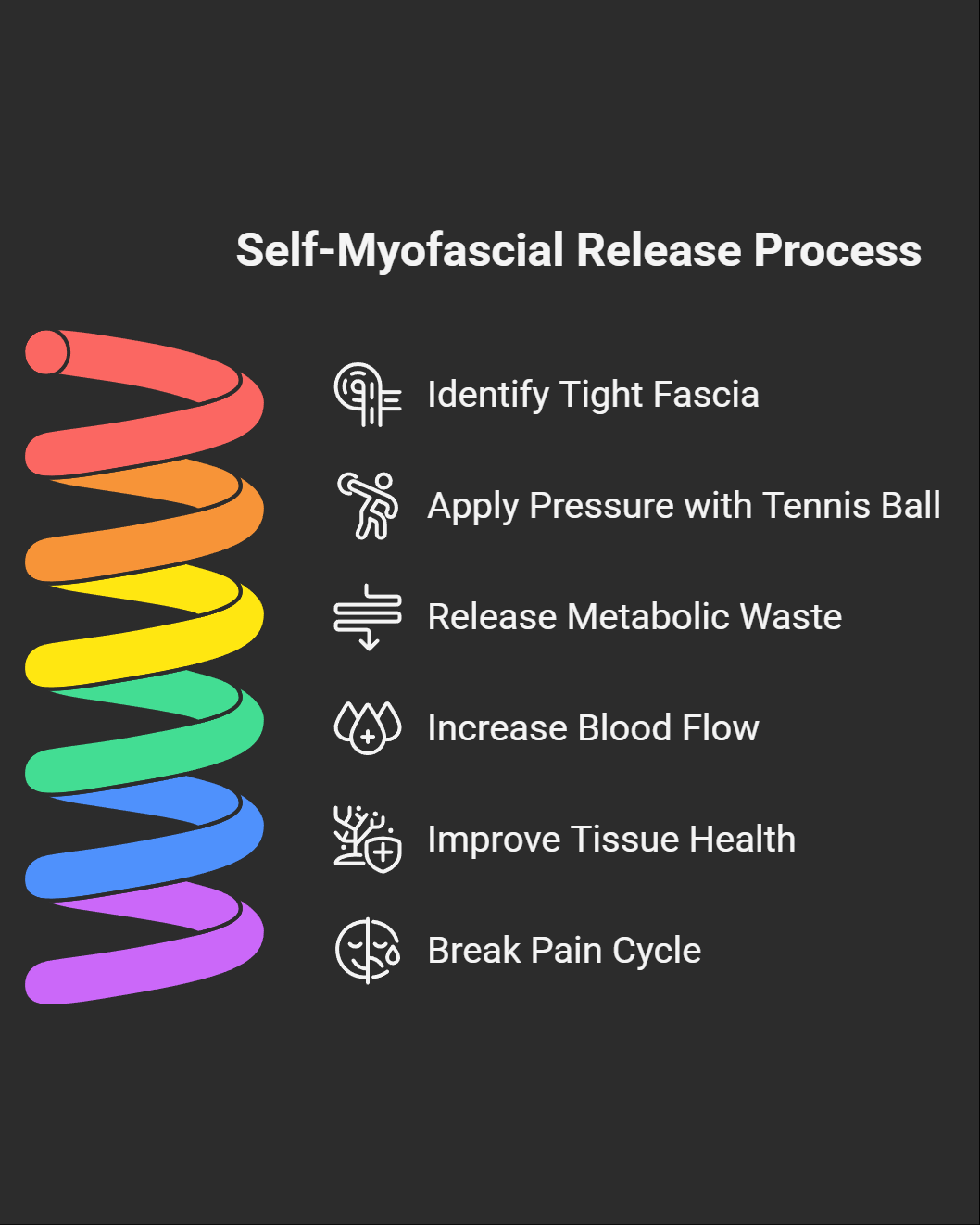
Rolling the sole of your foot on a tennis ball may seem simple, but it is based on a subtle scientific principle we call Self-Myofascial Release (SMR).Fascia is the 3D network of connective tissue that runs throughout our entire body. When it becomes tight and develops adhesions (what we commonly call "knots") due to stress, it triggers pain. When you use a tennis ball to apply pressure to these tender points, it's like squeezing a sponge full of old water; you are forcing the metabolic waste out of the area. When the pressure is released, fresh, oxygen-rich blood flows back in.This fundamentally improves the health of the tissue environment and breaks the vicious cycle of pain.
However, the most profound effect of SMR comes from a "dialogue" it has with our nervous system.Within our muscles, there is a type of sensory receptor called the Golgi Tendon Organ (GTO), which is responsible for detecting changes in muscle tension. When you use a tennis ball to apply deep, sustained pressure to a tight point (usually for 30 seconds or more), you are powerfully stimulating the GTO.It then sends a signal to the brain that says, "The tension here is too high! To protect the tissue, please relax this muscle." After receiving this "safe" request, the brain issues a command, allowing the overly tight muscle and fascia to relax. This is the secret to how we "persuade" rather than "fight against" the body to achieve a deep release.
Once the nervous system sends the signal to relax, a series of beneficial chain reactions occurs. First, the sensation of pain is significantly reduced. Second, when the fascial restrictions are released and the muscles are no longer tight, the joint's range of motion naturally increases.Interestingly, the benefits extend far beyond the foot. The body's fascia is interconnected through "myofascial lines." The sole of the foot is the very starting point of the "Superficial Back Line," a line that extends upwards to the calf, along the back, and all the way to the scalp. This explains why many people, after rolling the soles of their feet, are surprised to find that their ability to bend over and touch the ground has also improved. This is a perfect manifestation of improving the entire kinetic chain from its very foundation.
Chapter Three: The Therapist's Practical Guide – Your Step-by-Step Action Plan
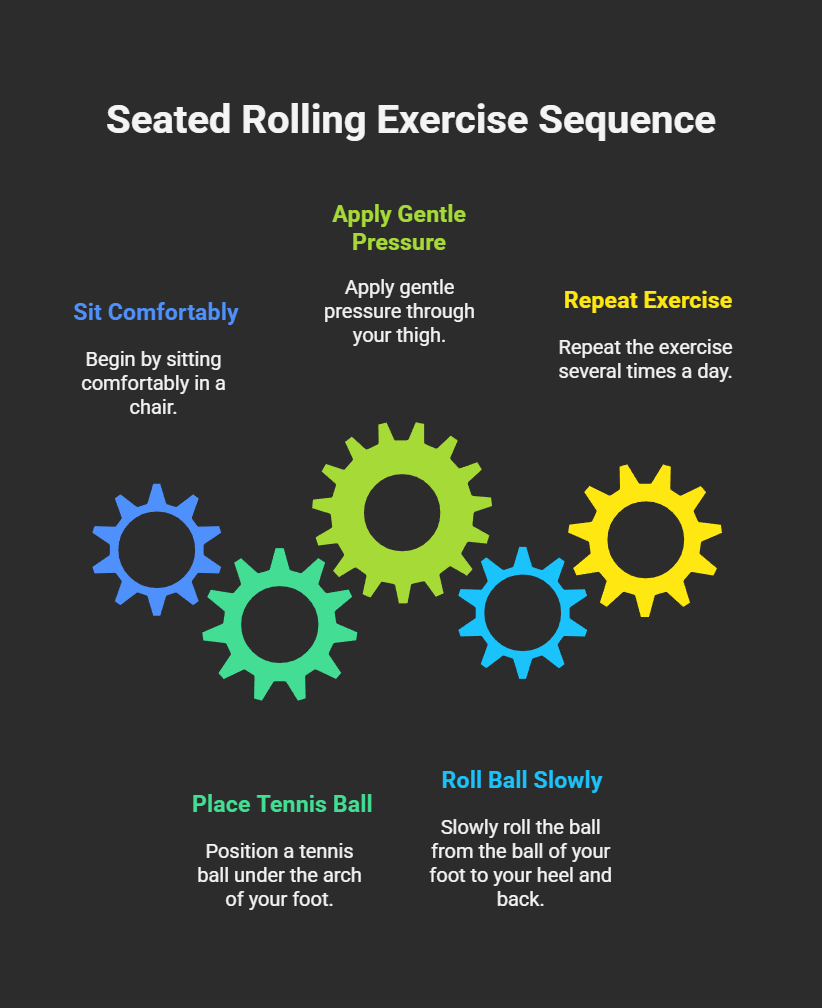
Now, let's put theory into practice. Please do this barefoot, and have a sturdy chair or be near a wall for support.For beginners or those in an acute phase of pain, I strongly recommend starting with Seated Rolling. Sit comfortably in a chair, place a tennis ball under the arch of your foot, and apply gentle pressure through your thigh. Slowly roll the ball from the ball of your foot to your heel, and then back again. This position offers the maximum amount of control and safety, allowing you to gently explore the condition of your sole.You can do this several times a day, investing 1 to 2 minutes in each foot per session. It can even be done easily at the office.
When you feel that the pressure from the seated position is no longer sufficient to bring relief, you can advance to Standing Rolling. Please hold onto a support to maintain your balance. Place the tennis ball under your foot and slowly transfer a portion of your body weight onto the foot that is on the ball to achieve a deeper pressure. In the same way, roll slowly along the sole of your foot for 1 to 2 minutes.Next, we will perform a more precise "Trigger Point Release." While rolling, consciously search for those sensitive spots that feel particularly sore or tight. When you find one, stop rolling and keep the ball fixed on that point. Apply a steady, tolerable pressure and hold it for 30 to 90 seconds while taking long, deep breaths, until you feel the tightness begin to "melt."
To take the effects to the next level, you can try the advanced "Press and Move" technique. While maintaining pressure on a trigger point, slowly and with control, curl your toes upwards, then curl them downwards. Repeat this 5 to 10 times. This movement actively stretches the connected muscle fibers while the fascia is pinned down, producing a more intense release.Remember, consistency is the cornerstone of success. Integrating this practice, which only takes a few minutes each day, into your life as a preventive and maintenance habit will have far superior long-term effects than intense remedies performed only when pain flares up.
Chapter Four: Safety First – Practicing Self-Care Intelligently
As you begin your self-care journey, it is crucial to learn to differentiate between "good pain" and "bad pain."When rolling, the sensation you should be seeking is a deep, satisfying "sore and full feeling"—this is a signal that the tissue is being released. The "bad pain" that should make you stop immediately includes any sharp, tearing, burning, or electric-shock-like radiating pain.A simple rule is to keep the discomfort level within a 5 to 7 range on a 0 to 10 pain scale. In this context, pain is data to guide you, not a target to be conquered. Please explore with curiosity, not confrontation.
"To do a good job, one must first sharpen one's tools."A tennis ball is the ideal entry-level tool, as its texture is gentle. If you need deeper pressure, you can choose a firmer lacrosse ball. For acute inflammation or after exercise, a frozen water bottle, which combines SMR with ice therapy, is an excellent choice. You can customize your toolbox based on your own feelings and needs.However, the most important thing is to know "when not to do it." This massage is absolutely forbidden under any of the following circumstances:Acute injuries (such as fractures or ligament tears)Open woundsSkin infectionsSevere local redness, swelling, heat, and painConditions such as deep vein thrombosis (DVT) or severe peripheral neuropathy (common in diabetes)Safety always comes first.
Chapter Five: Building a Holistic Strategy for Lasting Health
A tennis ball is an excellent tool for relieving symptoms, but to achieve lasting relief, we need a more comprehensive strategy. The ball rolling completes the "Release" of tightness; next, we need to "Stretch" to restore the tissue's length.Be sure to regularly perform calf stretches, as tight calves are one of the main culprits behind plantar fasciitis. At the same time, don't forget to gently pull your toes back towards the top of your foot with your hand to directly stretch the plantar fascia itself. Hold each of these two stretches for 30 seconds and repeat 3 times. This will significantly improve the flexibility of your foot.
Finally, we need to "Strengthen" the foot to build true resilience. While sitting on a chair, try to scrunch up a towel on the floor with your toes, or try to pick up marbles from the floor with your toes. These simple games can effectively train the small intrinsic muscles that support the arch of your foot.Furthermore, it is equally important to review and adjust your lifestyle. Investing in shoes with good arch support, practicing weight management, and avoiding sudden, drastic increases in your exercise volume are all wise measures to protect your feet at their source.If the pain persists for several weeks without improvement or is very severe, be sure to seek the professional assistance of a physical therapist or a podiatrist.
Conclusion: The Power of Relief, Right Under Your Feet
The fatigue and pain in your feet are a signal from your body, inviting you to listen, understand, and make a change. A small tennis ball is a powerful medium for effective communication with your own body.When you learn how to use it correctly and safely, and combine it with stretching, strengthening exercises, and lifestyle adjustments, you have mastered a complete self-healing program. This is not just about eliminating the pain of the moment, but about building a more stable and resilient foundation for your body.Go ahead and integrate this simple ritual, which takes only a few minutes each day, into your "Happy Healthy Life." This act of self-care will pay you back with countless easy, steady, and worry-free steps in the future.


