
Hello, and welcome to the "Happy Healthy Life" healing column. I am your massage therapist. In my treatment room, I have witnessed countless clients arrive with similar problems: persistent tension in the forehead, nighttime teeth grinding that makes sleep difficult, annoying sinus pressure, and ever-present temporomandibular joint (TMJ) pain.These symptoms not only rob life of its comfort but also often leave people feeling helpless. Today, I want to share with you a profound yet often-overlooked healing concept: for many of our head and facial troubles, the key to relief may be hidden at the most distant end of our body—our feet.
This article will be a practical guide, leading you on an exploration of the invisible neural connection between your feet and your face.Together, we will unveil the mysteries of the trigeminal nerve, understand why pressing specific areas on the feet can produce such significant effects, and I will provide a self-massage routine that you can easily practice at home.Are you ready? Let's embark on this healing journey that begins with the feet and leads directly to physical and mental well-being, injecting new vitality and new possibilities into your healthy life.
Part One: The Master of Your Face—Getting to Know the Trigeminal Nerve
To understand the principle of this healing, we must first get to know the main character of our story—the trigeminal nerve. It is the largest and most complex nerve in our face, like a commander-in-chief that governs the vast majority of our facial sensations.After extending out from the brainstem, it divides into three main branches.The first branch (the ophthalmic nerve) is responsible for the forehead and the area around the eyes. This is why you feel tension between your eyebrows or increased eye pressure when you are stressed.The second branch (the maxillary nerve) governs the cheeks, upper jaw, and the sinus area. This explains why sinusitis can trigger a dull, aching sensation in the cheeks.
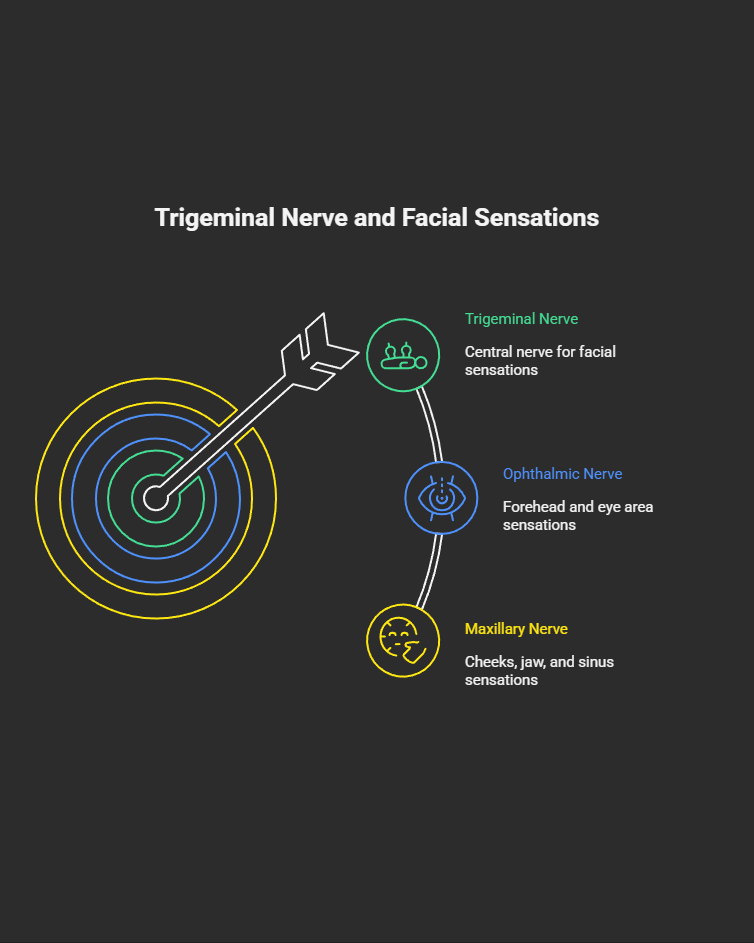
The third branch (the mandibular nerve) governs the lower jaw and the lower row of teeth, and it also controls our powerful chewing muscles. This is why temporomandibular joint (TMJ) dysfunction, teeth grinding, and even certain types of toothache are all intimately related to the state of this nerve.When these neural pathways are irritated by stress, poor posture, or neck tension, various discomforts arise. Understanding this "neural map" is the first step in our precise healing approach, allowing us to solve the problem from its very root.
Part Two: The Bridge to Healing—Why is Pressing on the Feet Effective?
You might be curious, how can pressing on the distant feet possibly affect the face? The principle behind this combines ancient wisdom with modern neuroscience.Traditional foot reflexology considers our feet to be a microcosm of the entire body, distributed with corresponding "reflex zones." By stimulating these reflex zones, we can promote the flow of "Qi" within the body and clear energy blockages, thereby restoring the body's balance and self-healing capabilities. This is a holistic, whole-person perspective that views the feet as a gateway to health.
From the perspective of modern neuroscience, this process is even more specific. Our feet are covered with an extremely rich network of nerve endings. When we apply precise pressure to a specific reflex zone, it is equivalent to sending a strong neural signal to the brain.This signal can effectively "override" the pain signals, prompting the brain to release natural pain-relieving substances—endorphins. At the same time, it can also soothe our "fight or flight" response system, allowing the mind and body to enter a state of deep relaxation. Therefore, foot massage is not merely about relaxing muscles; it is a direct communication with the central nervous system.
Part Three: The Therapist's Treasure Map—Locating the Key Reflex Zones
Now, let's find the treasure on our map. Our primary target is the "Trigeminal Nerve reflex zone." It is located on the big toe of each foot, running along the inner edge (the side closer to the second toe) from the very tip of the toe down to the side of the nail bed. This area corresponds to the entire distribution of the trigeminal nerve on our face.However, to achieve the best results, you must master a professional-level secret: the "Cross-Correspondence Principle." This principle is based on the way our nervous system is wired: sensations from the left side of the body are processed by the right side of the brain, and vice versa.
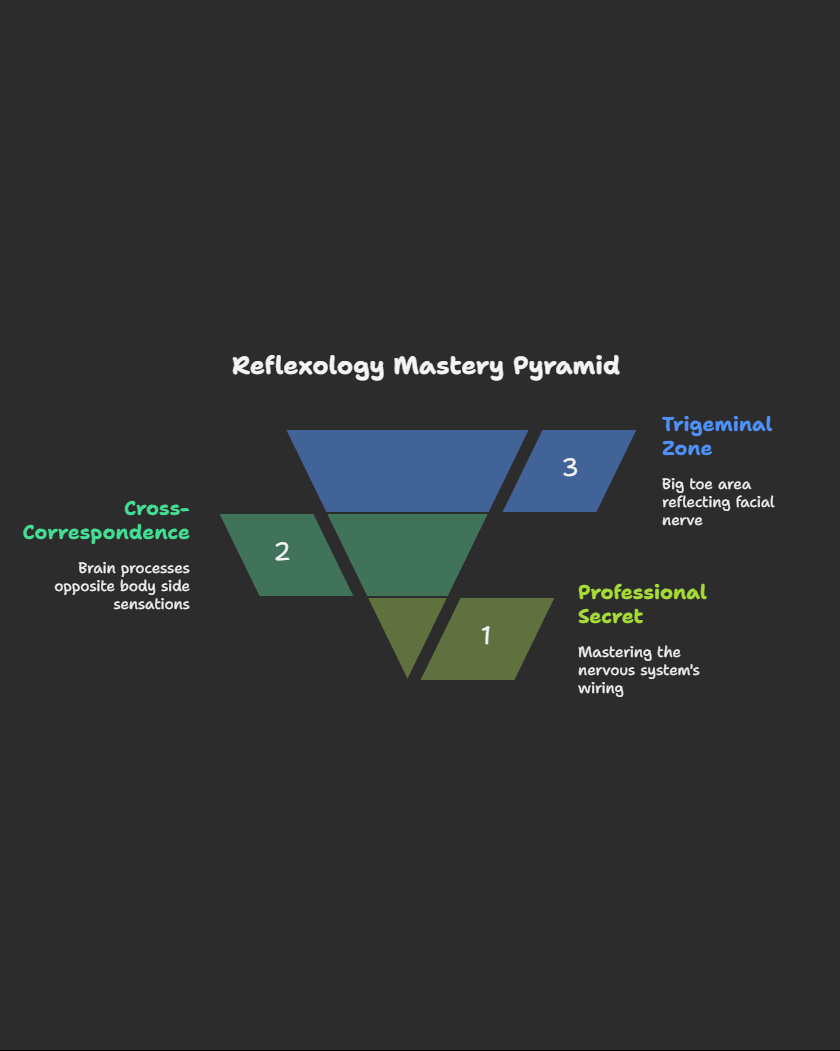
This means that if your pain is on the right side of your face, you should focus on treating the reflex zone on your left foot. If the pain is on the left side of your face, then you should focus on massaging your right foot.This seemingly counter-intuitive rule is the key that distinguishes amateur from professional practice, and it is the secret weapon for achieving significant results when dealing with one-sided pain. Be sure to remember this principle; it will multiply the effects of your self-healing and allow you to experience truly precise and profound relief.
To construct a comprehensive healing plan, we also need some important "supporting characters." Treating a single point has limited effects, but when combined with the surrounding support systems, the results will be more lasting and profound.First is the "Brain/Head" reflex zone, located at the very tip of the big toe. Massaging this area helps to calm the mind and relieve the root cause of headaches.Second is the "Cervical Spine" reflex zone, which runs along the long axis of the inner side of the big toe. This is crucial for relieving facial pain that is triggered by neck tension.
Additionally, the tips of the other four toes are the "Sinus" reflex zones, which specifically address nasal discomfort. Below the ball of the foot, on the front half of the sole, is the powerful "Solar Plexus" reflex zone. This is the body's stress center; gently pressing here can bring about deep relaxation and lay a stable foundation for the entire healing process.Incorporating these supporting reflex zones into your massage routine is the only way to truly support your body's balance and health from multiple levels.
Part Four: A 15-Minute At-Home Healing Routine
Now, I will guide you through a simple yet highly effective self-care routine. Please find a quiet, comfortable corner. The best time to do this is just after a hot bath or a warm foot soak, as the warmth will help to relax the muscles in your feet and enhance the effects. Get your lotion or massage oil ready, and let's begin.
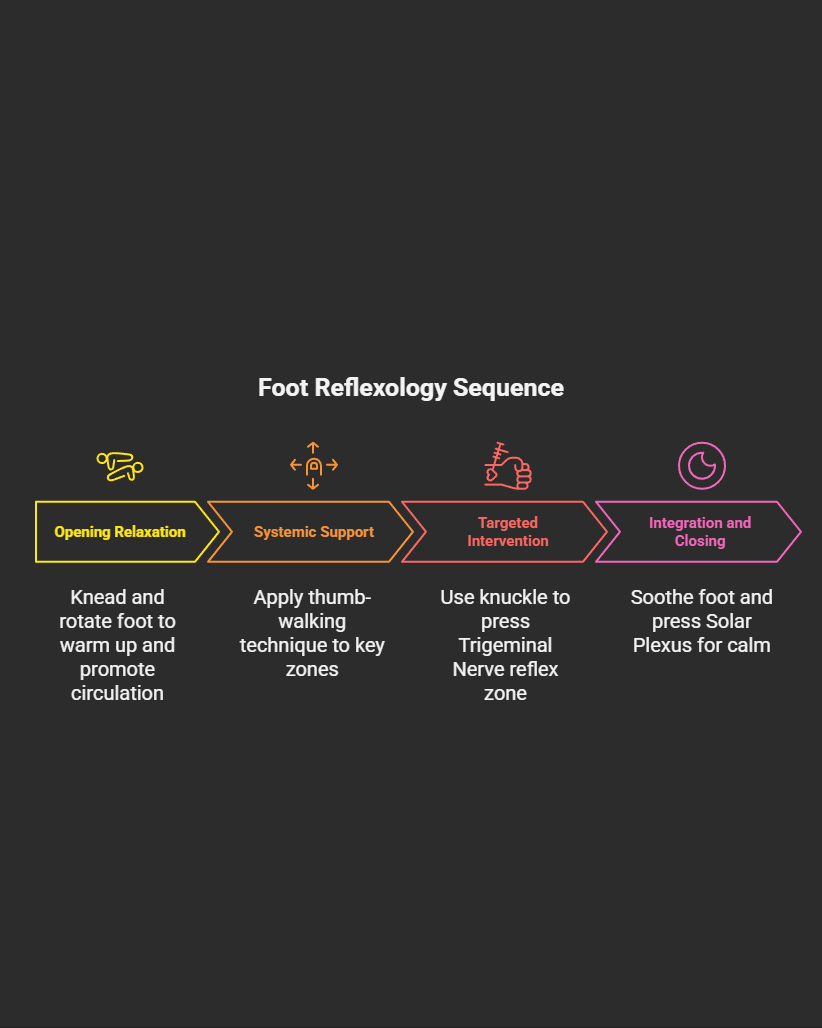
Step One: Opening Relaxation (2 minutes)First, use both hands to gently knead and rotate your entire foot and ankle. This action is designed to warm up the foot, promote blood circulation, and send a "prepare to relax" signal to your nervous system.
Step Two: Systemic Support (5 minutes)Next, using your thumb, steadily press forward like an inchworm (the "thumb-walking technique"). Sequentially work on several key supporting zones: the Solar Plexus reflex zone on the front part of your sole, the Brain/Head and Sinus zones on all of your toe tips, and the Cervical Spine reflex zone on the inner side of your big toe.
Step Three: Targeted Intervention (6 minutes)This is the core step. Please follow the "Cross-Correspondence Principle" and work on the big toe of the opposite foot.Switch to using the knuckle of your index finger. Perform 10-15 slow, deep sliding presses along the Trigeminal Nerve reflex zone on the inner side of the big toe. If you feel a particularly sore "granular" or "cord-like" texture, you can hold a stationary press on that point for 30 seconds. Remember, the sensation should be a comfortable "sore ache," not a sharp pain.
Step Four: Integration and Closing (2 minutes)Finally, use gentle, long strokes to soothe the entire foot. Press the Solar Plexus reflex zone one more time to help the body integrate the healing signals and return to a state of calm.
Part Five: Safety First and the Role of the Professional
Although foot reflexology is very safe, there are still some situations that require caution. If you are in the early stages of pregnancy, have wounds or infections on your feet, have a history of thrombosis (blood clots), or suffer from severe cardiovascular disease, please consult your physician before proceeding.This guide provides a powerful self-care tool that can effectively manage daily stress and discomfort. However, we must emphasize that foot reflexology is a "complementary" therapy.
For severe, sudden, or persistent pain, such as suspected trigeminal neuralgia, seeking a proper medical diagnosis from a physician is absolutely necessary.Our role is to be a member of your health team, working in a complementary partnership with mainstream medicine. Through our professional techniques, we help you to manage symptoms, release stress, and improve your overall quality of life.
Conclusion: Empowering Yourself with the Gift of Health, Right in Your Own Hands
From the anatomy of the trigeminal nerve to the neurological principles of reflexology, and on to the precise location and massage techniques, you have now mastered the knowledge to elevate a simple foot massage into a profound healing ritual.The core of this power lies in "informed and intentional touch." When we understand the principles of how our body works and apply these techniques with awareness, we unlock an extraordinary ability to soothe pain and release accumulated stress.
Here at "Happy Healthy Life," we firmly believe that true health comes from a deeper connection and harmony between the mind and body. We hope this guide becomes a treasured tool on your bookshelf, one that, whether for yourself or for your family, allows you to open a door to relief and tranquility through your own gentle yet powerful hands, and to live a healthier, happier quality of life.


