
Hello, I am your massage therapist. In my work, I see clients every day who feel tense and uncomfortable due to modern lifestyles. Among their complaints, one that is becoming increasingly common—almost a universal language of our era—is: "My eyes are so tired, and my neck is so stiff."This isn't just fatigue; it's a warning signal from our bodies after being deeply immersed in a digital life. Today, from the perspective of a "Happy Healthy Life," I want to share with you a simple yet extremely effective drug-free method for self-healing. Let's gently press the reset button for our tired eyes together.
Section One: For Those of You in Front of a Screen, Do These Problems Sound Familiar?
At the end of a long day, do you also often feel your eyes burning and dry, perhaps accompanied by a dull headache? This is no coincidence; it's a classic case of "Digital Eye Strain."Data shows that as many as 90% of office workers spend their day in front of a screen. Prolonged staring drastically reduces our blinking frequency, preventing our eyeballs from getting enough tear lubrication. At the same time, our eye muscles become exhausted from the constant tension. This discomfort not only affects our work efficiency but also quietly steals our quality of life.As a massage therapist, I must emphasize that this is by no means just a problem with your eyes.
Many people overlook the fact that eye fatigue and neck and shoulder pain are essentially "two sides of the same coin."When we look down or lean forward to view a screen for extended periods, our cervical spine bears an immense amount of pressure, causing the surrounding muscles and fascia to become chronically tight. This tension is then transmitted upwards along the meridians and nerves, directly affecting the blood circulation in the head, which in turn exacerbates eye discomfort and headaches.Therefore, a truly effective solution must simultaneously address both the eyes and the neck and shoulder area—two regions that seem distant yet are intimately connected. What we need is a holistic solution that can break this vicious cycle.
Section Two: A Gift from Ancient Wisdom—Getting to Know the "Miracle Acupoint," Jingming (BL1)
Fortunately, ancient Traditional Chinese Medicine (TCM) wisdom has already prepared an answer for us: acupressure. Among the many acupoints, there is one that is famous for its outstanding effects on the eyes, and its name says it all—the Jingming acupoint. As its name implies, "Jingming" means "bright eyes." This acupoint is the key switch for activating our eyes' self-repair capabilities.Finding it is very simple. Please close your eyes and, with your fingertip, gently feel for the depression slightly above the inner corner of your eye, right next to the bridge of your nose. That soft hollow you feel is the point.
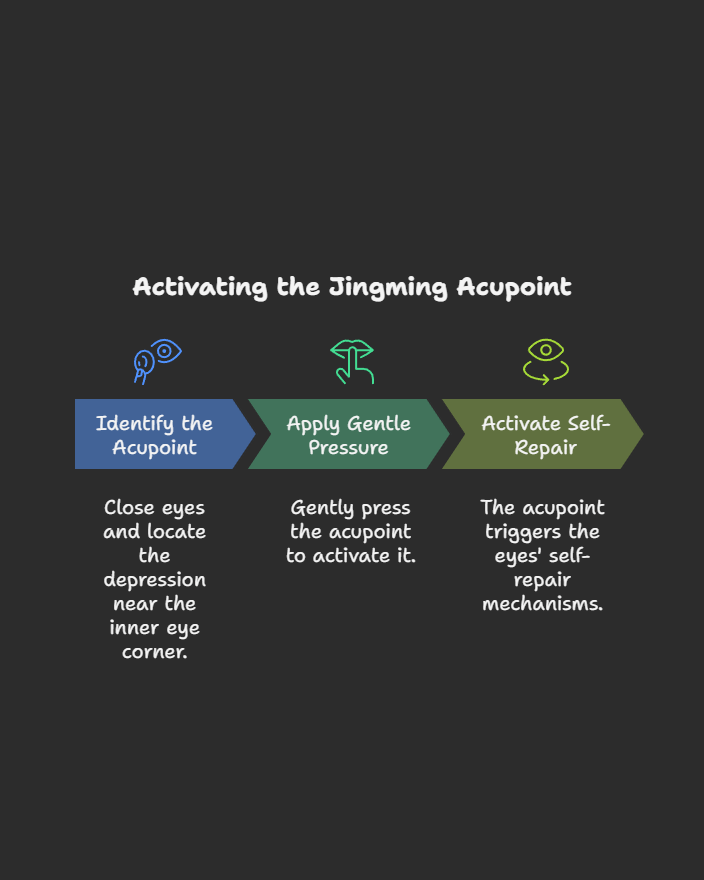
In the Traditional Chinese Medicine (TCM) meridian system, the Jingming point is the first acupoint on the Foot Taiyang Bladder Meridian, designated as BL1. This is one of the longest meridians in the human body, starting from the eye, traveling along the head and back, and extending all the way to the foot.Therefore, stimulating the Jingming point can not only directly inject vitality into the eyes and promote the circulation of Qi and Blood to achieve the effect of "benefiting the eyes and brightening vision," but it can also clear "Wind-Heat" that has accumulated in the head and face. This effectively relieves redness, itching, and pain in the eyes. It is like the master gate of the eye's energy channels and can effectively alleviate almost all types of eye discomfort.
Section Three: Your Personal Care Ritual—How to Correctly Massage the Jingming Acupoint
Knowledge must be put into practice to have power. Now, please follow my guidance to learn this simple self-care ritual.First, be sure to thoroughly clean your hands. Then, find a comfortable seated position, relax your shoulders, and take several deep breaths to calm your mind and body.Once you are ready, use the pad of your index finger or thumb and gently place it on the Jingming point you just located. Apply a gentle yet firm pressure, directing it towards the nasal bone, not towards the eyeball. You should feel a slight sensation of "soreness, numbness, or distension." This is a normal reaction to stimulating the acupoint, which in Traditional Chinese Medicine is called "De Qi."
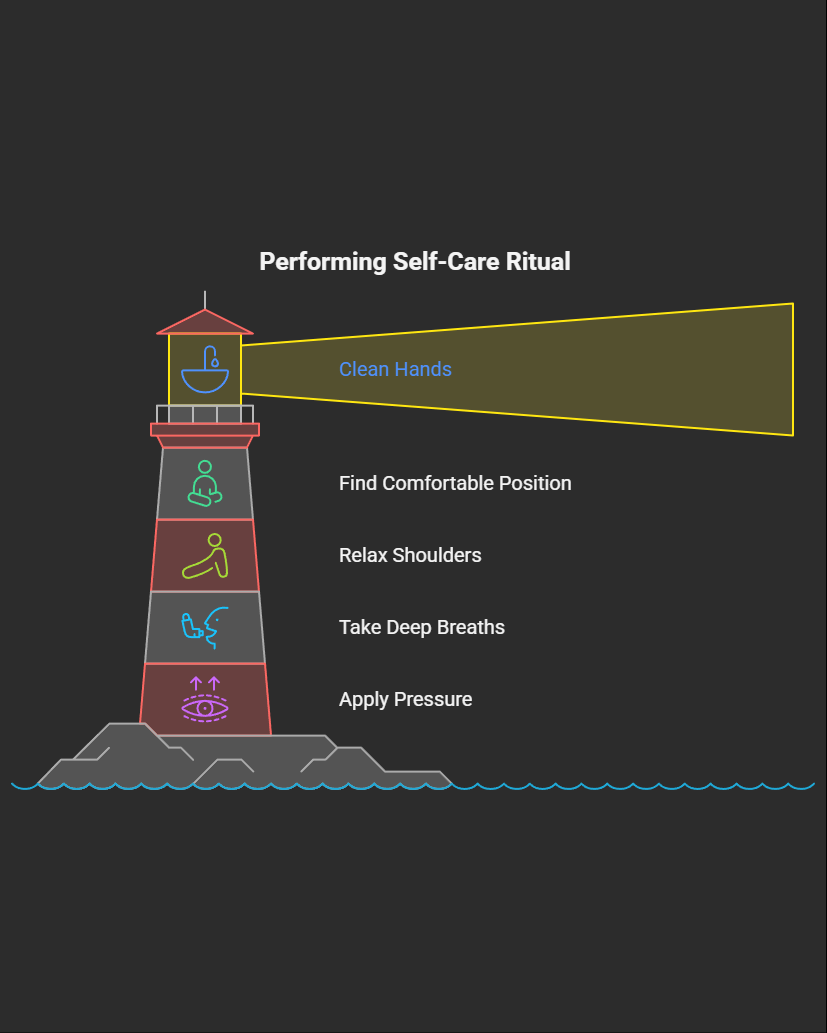
Once you have found this sensation, maintain the pressure and begin to massage in slow, gentle, small circles for about one minute. You can alternate between clockwise and counter-clockwise directions.After the circular massage, you can switch to a static press. Hold the pressure for about 10 to 15 seconds while coordinating with long, deep breaths, and then slowly release. This entire process can be repeated 2 to 3 times.Please remember, the whole procedure should be performed within a comfortable range. If you feel any sharp pain, it means the pressure is too great. This simple action is the most gentle care you can give yourself, anytime and anywhere.
Section Four: A Powerful Alliance—Building Your Comprehensive Eye-Care Acupoint Toolbox
Although the Jingming point is very powerful on its own, in the therapeutic philosophy of Traditional Chinese Medicine, combining different acupoints can produce a more comprehensive synergistic effect. Here are a few "golden partners" that I have carefully selected for you, which are easy to find and remarkably effective.First is our distal "Great General of Pain Relief"—the Hegu point (LI4). It is located on the back of your hand, at the highest point of the muscle that bulges when you press your thumb and index finger together. The Hegu point is a key acupoint for dealing with all problems of the head and face and can effectively relieve eye pain and headaches. However, please note: pregnant women should avoid applying strong pressure to this point.
Next is our "Local Reinforcement Team" around the eyes.The Sibai point (ST2), located in the depression of the infraorbital ridge directly below the pupil, can effectively relieve eye redness, swelling, and eyelid twitching.The Zanzhu point (BL2), located in the depression at the inner end of the eyebrow, works in perfect synergy with the Jingming point to soothe forehead tension and aching along the brow bone.Finally, and one that I consider to be critically important, is the Fengchi point (GB20), located at the back of the neck. It is in the hollows below the occipital bone, between the two large neck muscles. Stimulating the Fengchi point can directly release deep pressure in the neck, addressing the root cause of insufficient blood supply to the eyes that results from poor posture.
Part Five: Integrating into Daily Life to Unlock Your "Happy Healthy Life"
After mastering these powerful tools, the most crucial step is to seamlessly integrate them into your busy daily routine.You could try an "Acupoint Pomodoro Timer." During the 5-minute break you take after every 25 minutes of work, spend one or two of those minutes performing the massage.Alternatively, you can use "habit stacking" by linking this new habit to an old one. For example, do it every morning after you wake up, or in the interval while you're waiting for your coffee to brew. Let this eye-care routine become as natural a part of your life as brushing your teeth.
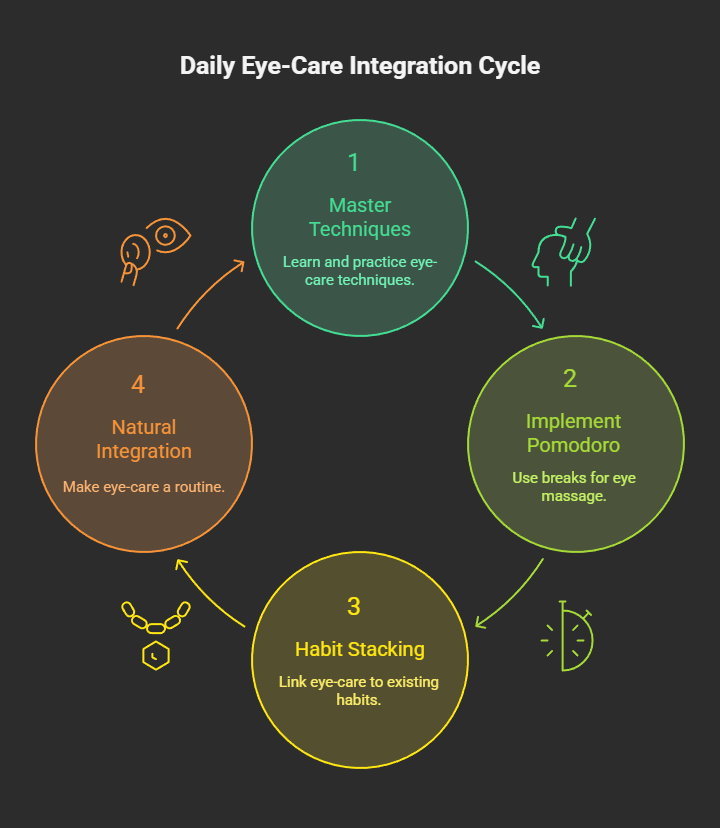
Please remember, acupressure is not merely a physiological stimulation; it is a complete ritual that breaks a harmful cycle.When you perform the massage, you are forced to stop looking at a screen, to change your static posture, to draw your attention away from the external world and back to yourself, and to perform conscious deep breathing. This, in itself, is a direct countermeasure to the root behaviors that cause digital eye strain.In an era where institutional support can sometimes be lacking, mastering this simple, free, and effective method of self-care means that you can take immediate action and proactively take responsibility for your own health.
Conclusion
In this era of being surrounded by screens, our eyes are bearing an unprecedented burden. But please do not view this fatigue as an inevitable price to be paid. What you have learned today is not just the location of a few acupoints, but a tool for self-empowerment.It gives you the ability, amidst the overwhelming flood of a world where we passively receive information, to use your own hands to proactively win back comfort, clarity, and tranquility for yourself. From now on, please put this knowledge into practice. Every gentle press is the most heartfelt comfort you can give to your hard-working eyes, and it is also a critically important "reset button" that you are pressing for your own health amidst the digital wave.


