
Hello, I am your personal massage therapist. In my professional career, I have seen countless shoulders and necks made tense by our modern lifestyle.Many of my clients walk in with a shared problem: that persistent, distracting ache at the base of the back of the head, a stiffness that makes the neck feel "locked up," and a dull headache that seems to never fade. This has become a common imprint of our digital era—"tech neck."Today, I want to share with you a secret weapon I often teach my clients, a "reset button" that is built into our bodies. It is not only a piece of ancient wisdom but also a powerful self-healing tool that can help us reclaim comfort and vitality in a world dominated by screens.
This magical button is the Tianzhu acupoint. Its name is full of power: "Tian" (天) refers to our head (the heavens), and "Zhu" (柱) is a supporting pillar. As its name implies, it is the "pillar that holds up the heavens" within our body, responsible for supporting the head and maintaining a clear mind.This article will serve as your ultimate guide. From my perspective as a professional therapist, I will guide you in transforming this acupoint, which may sound a little mysterious, into a tangible, practical, and highly effective wellness tool for your daily life, allowing you to "recharge" your "Happy Healthy Life" anytime, anywhere.
Why Is My Neck Always So Tired? Deconstructing the Causes of "Tech Neck"
Before we discuss how to solve the problem, let's first understand its root cause. Imagine that your head weighs about as much as a bowling ball. When you are sitting with proper posture, your cervical spine and muscles can support it very efficiently.However, when we lower our head to look at a phone or lean forward to gaze at a computer screen, this "bowling ball" moves off its point of balance. Research shows that for every inch your head tilts forward, the pressure on your neck increases by an additional 10 pounds. Over time, this is equivalent to forcing the muscles at the back of your neck, particularly the trapezius and the suboccipital muscles, to run a never-ending endurance race.
These chronically overworked muscles become abnormally tight and shortened, and can even develop minute scar tissue. This is the direct cause of that feeling of neck stiffness and restricted range of motion.More importantly, this area is a critical channel for the blood supply and nerves that go to the brain. When the muscles become a stiff "bottleneck," they can impede circulation and even impinge on important nerves, such as the greater occipital nerve. Once this nerve is irritated, it triggers a classic tension headache that radiates from the back of the head to the crown or behind the eyes.Therefore, the key to resolving "tech neck" lies in releasing this anatomical "traffic hub."
Finding Your "Pillar That Holds Up the Heavens": A Therapist's Guide to Precision Location
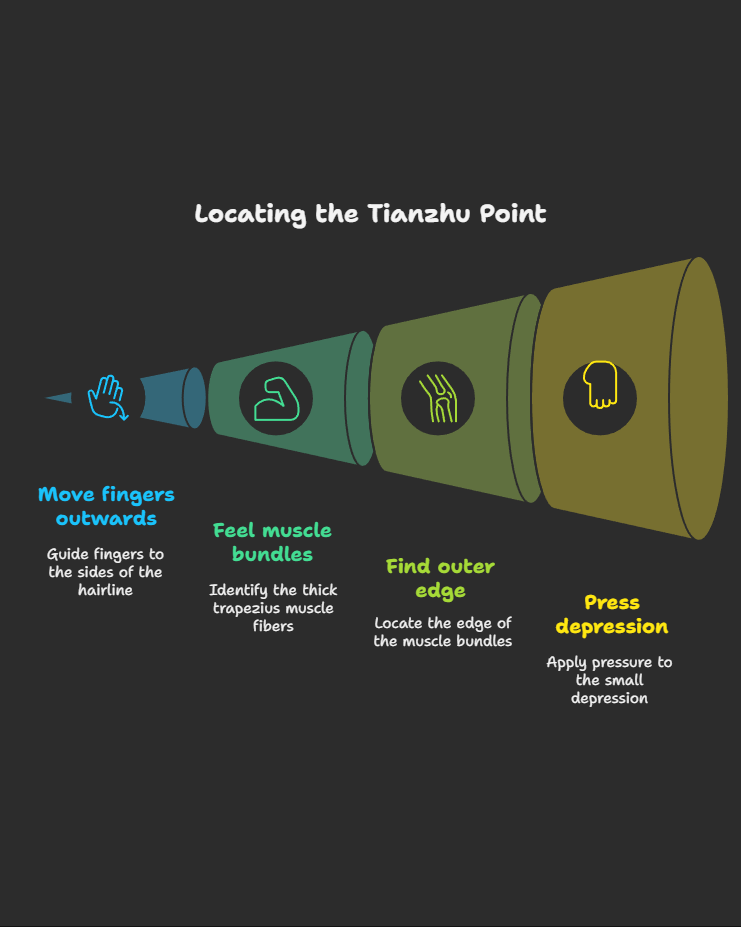
The effectiveness of acupressure begins with precise location. As a therapist, I know that "finding the right spot" is half the battle. Now, please follow my guidance, and let's find this energy switch on your body together.First, find a comfortable seated position and relax your shoulders. Place one finger on the very center of the back of your neck, where you can feel the protruding bones of your cervical spine. Next, slide your finger up along this centerline until you touch the base of your skull, right at the hairline on the back of your head.
Now, from the midpoint of the hairline, move your index and middle fingers outwards to the left and right, respectively, by about the width of one thumb. You will immediately feel two very thick, rope-like vertical muscles—these are the upper fibers of your trapezius muscle.Our target—the Tianzhu point—is hidden on the outer edge of these two muscle bundles, in a small depression right on the hairline. When you press this spot with the pads of your fingers, it should produce a unique, deep sensation of soreness and fullness. This feeling might even radiate upwards towards the crown of your head. This is what Traditional Chinese Medicine calls "De Qi," and it is the signal that we have found the correct location.
The Healing Magic Behind the Acupoint: How Does the Tianzhu Point Bring You Relief?
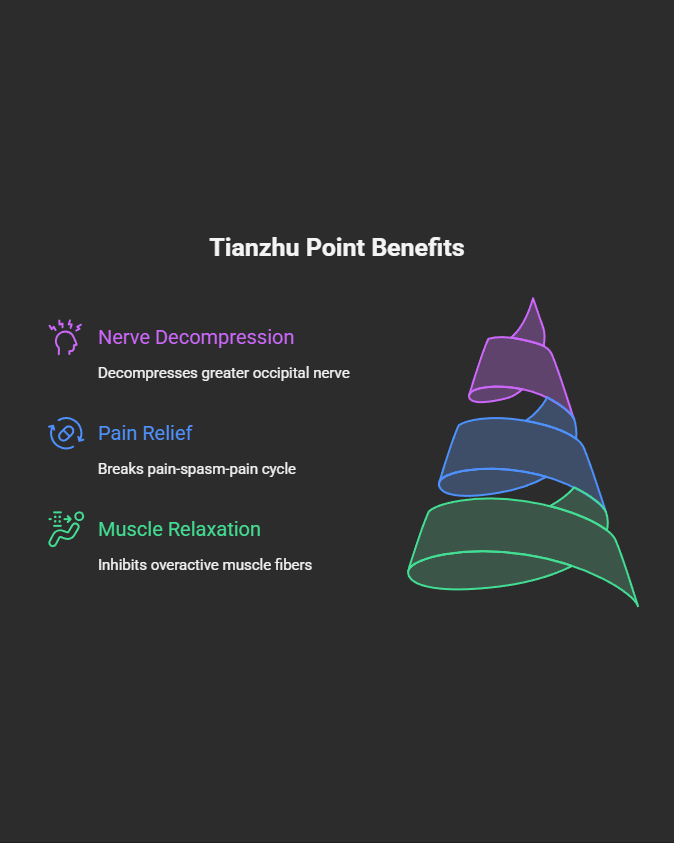
When you press the Tianzhu point, what wonderful changes are actually happening inside your body? It's much more than just relaxing a single muscle.From a modern physiological perspective, applying steady pressure to the Tianzhu point sends a "you can relax now" signal to your central nervous system. This helps to inhibit overactive muscle fibers, breaking the vicious cycle of "pain-spasm-pain" and directly relieving the stiffness and soreness in your neck.At the same time, this action effectively decompresses the impinged greater occipital nerve. This blocks the transmission pathway of tension headaches right at the source, bringing you an immediate sense of relief.
From the perspective of Traditional Chinese Medicine (TCM) meridian theory, the Tianzhu point is located on an important "energy superhighway" that runs through the entire body, known as the Foot Taiyang Bladder Meridian. This meridian is our body's first line of defense against external pathogenic factors and is also the main channel for the circulation of Yang Qi.The pressures of modern life, blue light stimulation, and information overload can cause imbalanced energy to rush upwards and disturb the head, leading to brain fog, irritability, and fatigue.Stimulating the Tianzhu point is like clearing a roadblock on this congested highway. It allows fresh Qi and Blood to be supplied smoothly to the head, which not only "clears the head and brightens the eyes" (清頭明目) but also effectively channels stress away, "cooling down" your brain.
An Infusion of Vitality: Your Three-Minute Self-Healing Ritual
Now that you know the location of the Tianzhu point and its powerful effects, it's time to integrate it into your daily life. I have designed this method to be very simple, so you can easily do it at the office, on your sofa at home, or even during a break in your commute.This is your very own three-minute self-healing ritual.First, find a comfortable seated position where your back is supported. Lean back slightly to completely relax your neck muscles. Close your eyes and take three to five long, deep abdominal breaths, bringing your attention away from your distracting thoughts and back to your body.
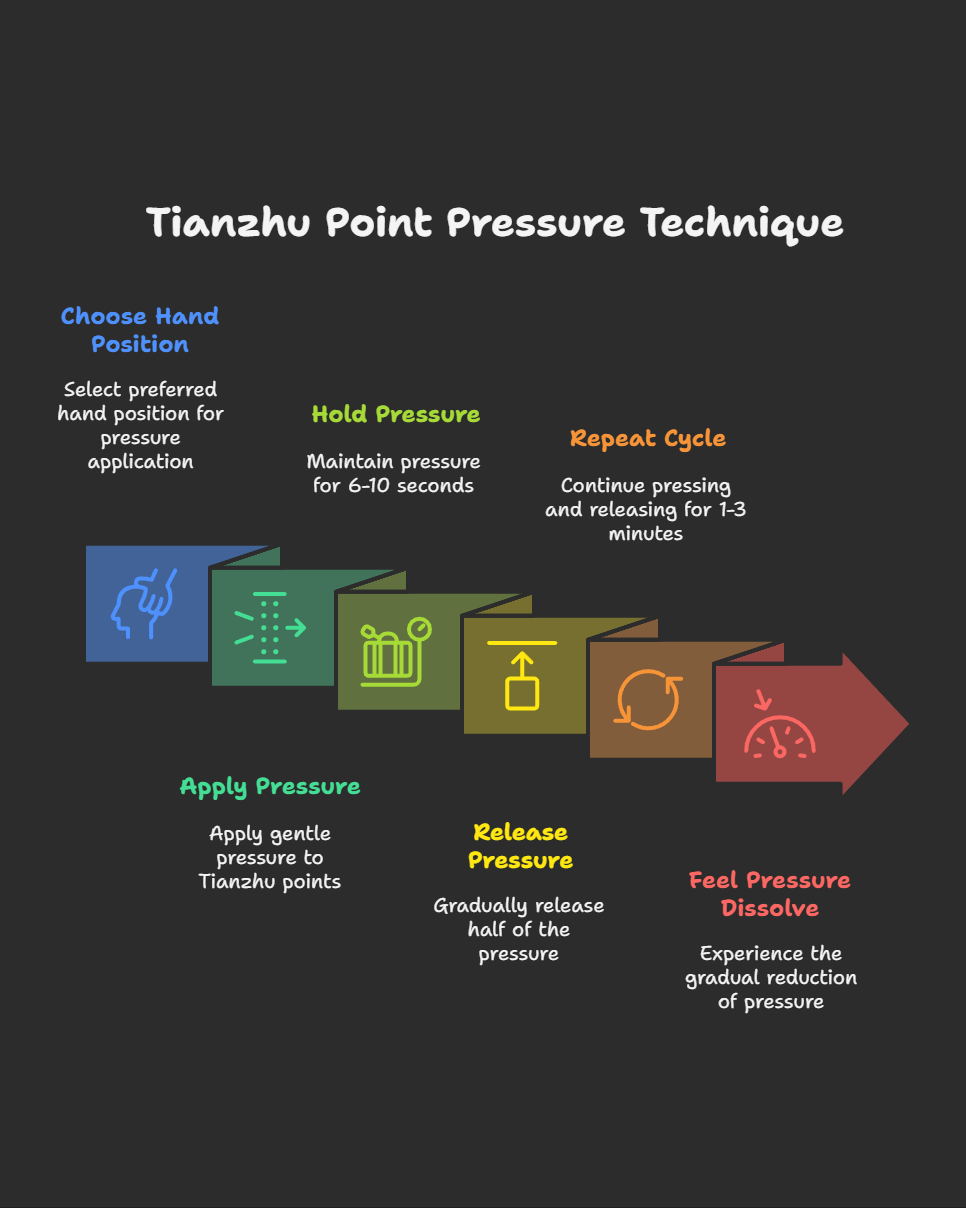
Next, choose the hand position you prefer.You can clasp your hands behind your head, letting both thumbs hang down naturally to press on the Tianzhu points on both sides at the same time, using the weight of your head to apply pressure.Alternatively, you can use the pads of your right index and middle fingers to press the left Tianzhu point, and vice versa.As you slowly exhale, gradually apply a steady yet gentle pressure deep into the acupoint until you feel that familiar sore, full sensation. Hold this pressure for about 6 to 10 seconds. As you inhale, gently release about half of the pressure, but do not lift your fingers from the skin.Repeat this cycle of pressing and releasing for about one to three minutes, and feel the process of the pressure in your neck gradually dissolving.
The Power of Synergy: Creating the "Golden Triangle" for Shoulder and Neck Relief
In my clinical practice, I rarely use just a single acupoint. Like a seamlessly cooperating team, the combination of acupoints can produce a synergistic effect where one plus one is greater than two.For the most common shoulder and neck problems modern people face, I especially recommend a "Golden Triangle" formula composed of three acupoints. They can comprehensively unbind your entire upper body.The protagonist of this combination is, of course, our Tianzhu point, which is responsible for addressing the vertical tension in the back of the neck.The second member is the Fengchi point (GB20). It is located right next to the Tianzhu point, slightly outwards and upwards, in the distinct depression directly beneath the base of the skull. Like a "deep pool," it specifically deals with the pressure at the base of the skull.
The third key player is the Jianjing point (GB21), located at the highest point of the shoulder. To find it, you can slide your finger from the base of your neck outwards along the trapezius muscle. The point that feels distinctly sore when you press on the highest and most muscular part of the shoulder is it.When you combine the massage of these three acupoints—Tianzhu to relax the back of the neck, Fengchi to release the base of the skull, and Jianjing to unbind the shoulders—it is as if you are performing a deep, "carpet clean" of the entire major disaster zone for stress. This can greatly improve your head's range of motion and melt away the chronic stiffness and discomfort that has taken hold in your shoulders and neck.
Conclusion: Let the "Pillar of Heaven" Become the Cornerstone of Your Daily Health
In summary, the Tianzhu point is far more than just a point for treating neck pain; it is a master control switch for your head's circulation, your mental clarity, and your spiritual state. Under the heavy pressure of modern life, it serves as both a structural support for our bodies and an energetic barrier for fending off stress and maintaining inner balance.I sincerely recommend that you integrate this simple three-minute self-massage ritual into your daily routine. Whether it's during a short break from work, before bed after a long day, or at any moment you feel tense and fatigued, please remember to activate this built-in healing tool.
Please view this as an active investment in your long-term health and vitality, rather than just another item on your to-do list.Through regular practice, you will be able to personally experience how this ancient acupoint, passed down for thousands of years, can bring a profound sense of tranquility and relief to your modern life. This will make a "Happy Healthy Life" no longer just a slogan, but a tangible, daily experience that is within your reach.
Professional Reminder:Although self-acupressure is an extremely safe and effective tool for relieving common discomforts, it cannot replace a professional medical diagnosis. For pain that is long-term, severe, or accompanied by other symptoms (such as dizziness or numbness), please be sure to consult your physician or a licensed professional therapist for a comprehensive evaluation.


