
Hello, I am your massage therapist. In my work, I frequently meet people who feel as if they are being pressed down by an invisible boulder—weighed down by work stress, emotional fluctuations, unexplained fatigue, and an indescribable feeling of being "stuck."This feeling, paradoxically, seems to increase rather than decrease during the spring, when all of nature is reawakening, and the mind is more prone to irritability and unease. What if I told you that on your own foot, there is a powerful "happiness switch," a marvelous acupoint that can help us release stress and smooth out our emotions? Would you be surprised?Today, I want to share this secret from ancient wisdom with you, a self-care treasure I often recommend to my clients—the Taichong acupoint. Let's learn how to activate it together and bring harmony and peace to your body and mind.
Why Do We Feel So Agitated? Understanding the Liver, Your Body's Stress Manager
In the wisdom of Traditional Chinese Medicine (TCM), our "Liver" system is like a master strategist, a general responsible for directing the smooth flow of the entire body's energy (Qi) and emotions. When this general is functioning well, our thoughts are clear, our emotions are stable, and our energy is abundant.However, the constant pressures of modern life, especially suppressed anger or feelings of frustration, can cause this general's command system to fail, leading to what is known as "Liver Qi Stagnation" (肝氣鬱結). This is like a major traffic jam in a city's transportation system; the energy simply cannot flow smoothly.As a result, the body sounds an alarm: you might feel a sense of fullness or oppression in your chest or along the sides of your ribs, a sensation of something being stuck in your throat, and you may find yourself sighing frequently without realizing it. This is your body's attempt to clear this internal traffic jam.
The Challenge of Spring: Why Do Mood Swings Intensify?
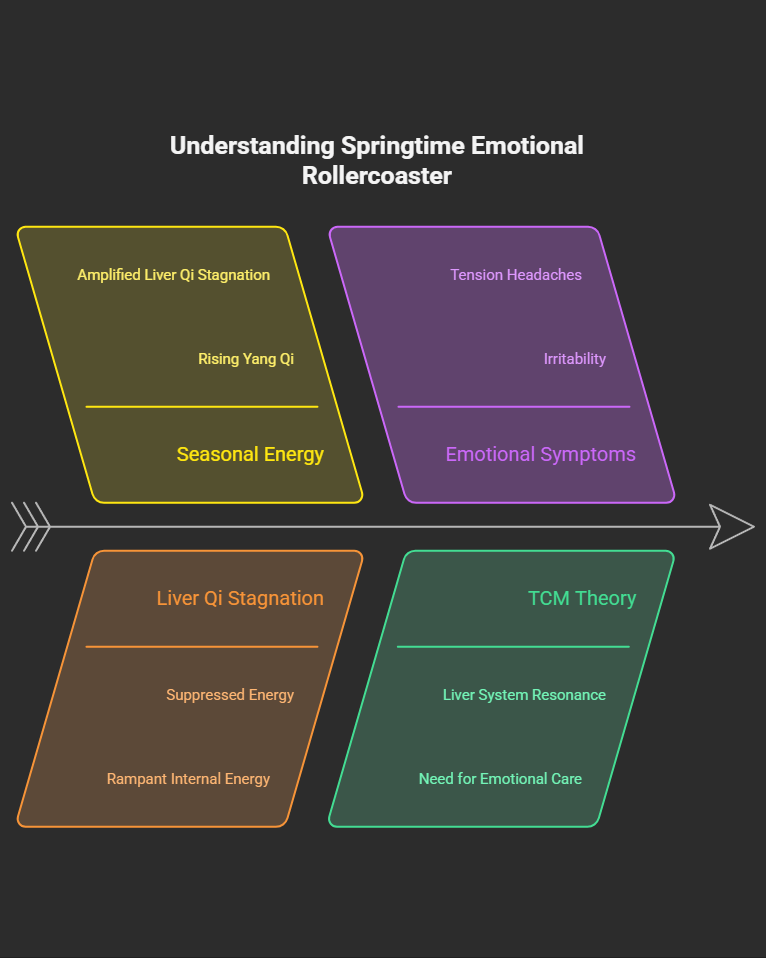
Have you ever noticed that even though the sun is shining in spring, your emotions are more prone to being like a rollercoaster, full of ups and downs? This is not your imagination.Traditional Chinese Medicine (TCM) theory posits that the energy of the spring season has a deep resonance with our Liver system. Spring is the season of rising Yang Qi, a time of growth for all living things. This powerful, upward-moving energy acts like a magnifying glass, amplifying any pre-existing "Liver Qi Stagnation" within our bodies. Spurred on by the rising energy of spring, this suppressed energy has nowhere to go and runs rampant inside us, leading to an exacerbation of problems like irritability, anger, tension headaches, and even insomnia.Therefore, spring is both a golden period for nurturing the Liver and ensuring the smooth flow of Qi, and it is also the season that most requires us to carefully tend to our emotions.
Find Your "Worry-Relief Valve": Precisely Locating the Taichong Acupoint
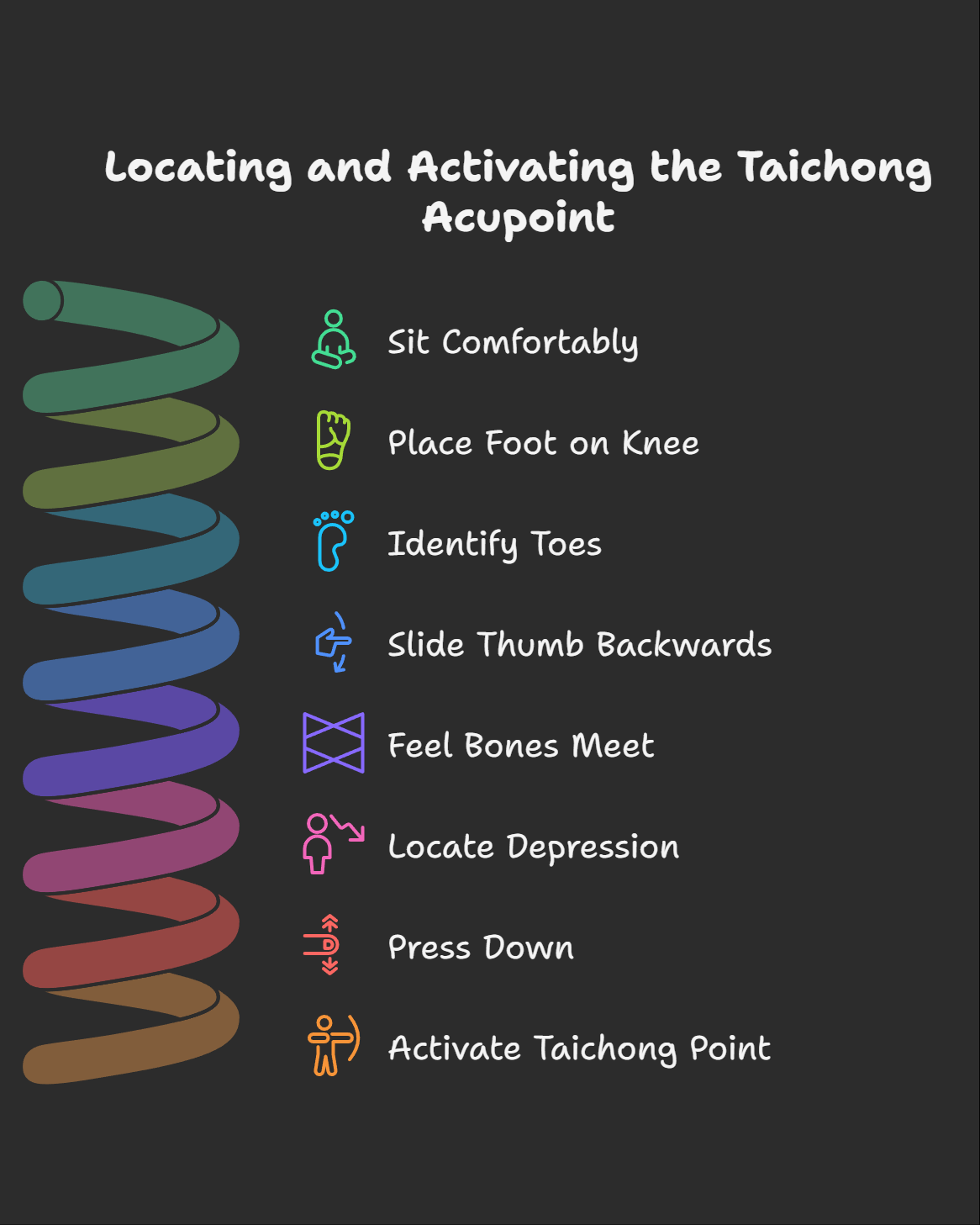
Now, let's find this magical "happiness switch"—the Taichong acupoint.Please sit comfortably and place one foot on the knee of your other leg. Look at the top of your foot and find your big toe and your second toe. Using your thumb, slide backwards along the space between these two toes, moving towards your ankle. You will feel two bones meet underneath your thumb, forming a "V" shape.Just before this "V" junction, there is a distinct depression. When you press down, you will feel a clear sensation of soreness and fullness—congratulations, that is the Taichong point! It is hailed as the "master switch" of the Liver meridian because it can directly mobilize and regulate the source energy of the entire Liver system, making it the key hub for clearing stagnation.
The Art of Acupressure: How to Correctly Activate the Taichong Acupoint
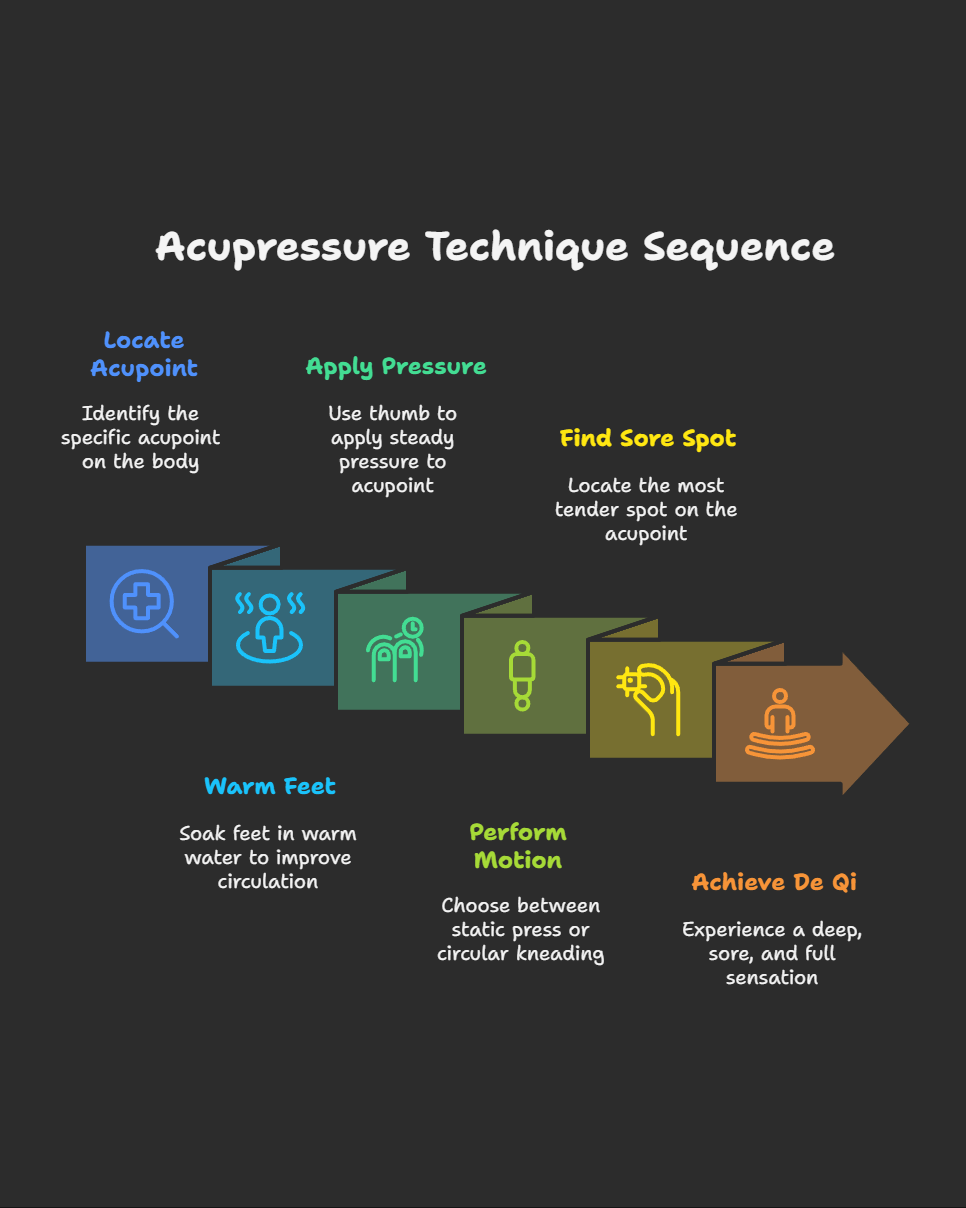
Once you have located the acupoint, the correct pressing technique is the key to unleashing its effectiveness. If your feet are cold, I recommend soaking them in warm water first. This will allow your Qi and Blood to flow more smoothly and increase the sensitivity of the acupoint.Next, using the pad of your thumb, aim for the depression of the Taichong point and apply a steady, deep, vertical pressure. You can either perform a static point-press or a slow, circular kneading motion. While pressing, be sure to find the spot that feels the most sore, full, and tender, as that is precisely where the energy blockage is most severe.Our goal is to seek a "De Qi" sensation—that is, a deep, sore, and full feeling, not a sharp, piercing pain. This is the sign of effective stimulation.
Practical Guide: Frequency, Duration, and Optimal Timing
For the best daily wellness results, I recommend you massage the Taichong acupoint 1-2 times a day. Focus on the point on one foot at a time, continuously kneading for 3 to 5 minutes. This is enough time to establish a stable "De Qi" sensation and allow the regulatory effects to fully develop.If you suddenly feel a surge of anger or frustration during the day, try to sit down immediately and press this acupoint. It can act like an emergency pressure-release valve, helping you to quickly "let off steam."However, the time I personally recommend the most is at night before bed. Performing the massage after a warm foot soak will not only help to calm your spirit for sleep but will also align with the rhythm of the Liver and Gallbladder meridians repairing themselves at night, according to TCM theory, making the effects twice as powerful.
Synergy (Part One): Unbinding the Liver Meridian with Stretching
To thoroughly release the stagnation of Liver Qi, in addition to acupressure, we can also incorporate physical stretching. In Traditional Chinese Medicine (TCM), it is said that "the Liver governs the sinews," meaning the flexibility of our fascia directly reflects the health of our Liver system.A wonderful yoga pose for this is the "Butterfly Pose" (Baddha Konasana), as it perfectly stretches the inner thighs, which is the main pathway of the Liver meridian.The method is simple: sit up straight, bring the soles of your feet together, and hold your ankles with your hands. Let your knees sink down towards the floor on both sides, like the wings of a butterfly. You can hold this pose statically for 1-3 minutes. With each long, deep breath, imagine sending that breath to the stretching area on your inner thighs. This movement physically "opens" the meridian, creating space for the free flow of Qi and Blood.
Synergy, Part Two: Using Breath to "Cool Down" the Nervous System
Have you ever noticed that when we are stressed, our breathing becomes short and shallow? This is a classic sign of a state of stress. We can directly switch the state of our nervous system by consciously changing our breathing pattern.Please try "Abdominal Breathing":Lie down or sit comfortably, and place one hand on your abdomen.Inhale slowly through your nose, feeling your abdomen gently expand like a balloon.Then, exhale even more slowly through your mouth, feeling your abdomen fall.This deep, slow breathing is one of the most effective ways to activate our body's "rest and digest" mode (the parasympathetic nervous system). It can directly calm an over-excited nervous system, creating a peaceful internal environment for the smooth flow of Liver Qi.
Synergy (Part Three): Using Diet to "Lighten the Load" on Your Liver
Your diet during the spring is another major support for regulating the Liver. The famous Tang Dynasty physician, Sun Simiao, advised to "reduce the sour and increase the sweet" (省酸增甘). This means that in spring, one should eat fewer sour foods, as their astringent nature can inhibit the natural upward and outward expansion of Liver Qi. At the same time, one should moderately increase naturally sweet foods to fortify the Spleen, which helps to balance the Liver Qi.You can eat more green vegetables (such as spinach and broccoli), as the color green corresponds to the Liver in TCM. You can also consume a moderate amount of pungent foods like ginger and mint to help disperse stagnation. Meanwhile, naturally sweet foods such as Chinese yam, jujubes (red dates), and carrots can nourish the Spleen and Stomach and stabilize emotions. Avoid greasy foods and alcohol, as they directly increase the workload of our "General" (the Liver).
The Modern Scientific Validation of Ancient Wisdom
You might be curious as to how pressing a single point on your foot can have such a profound impact. Modern science offers an interesting explanation for this.What we refer to as "Liver Qi Stagnation" in Traditional Chinese Medicine (TCM) is highly correlated with the dysfunction of the body's primary stress response systems, such as the Autonomic Nervous System (ANS), in modern medicine. Chronic stress keeps our "fight or flight" mode (the sympathetic nervous system) continuously active.Research has found that stimulating key acupoints like Taichong can significantly regulate Heart Rate Variability (HRV), switching our nervous system to the healthier "rest and digest" mode (the parasympathetic nervous system). This means that pressing the Taichong point is, in essence, a form of non-invasive neuromodulation. It helps our brain to "reboot" its stress response and restore inner balance.
Important Reminder: Safety First!
Before you begin to enjoy the benefits of the Taichong acupoint, I must, in my professional capacity, remind you of several important safety precautions.The most critical point is this: If you are currently pregnant, please absolutely do not press the Taichong point! This acupoint has a powerful effect of moving Qi and invigorating blood, which could potentially affect the stability of your pregnancy.Furthermore, please avoid applying pressure to any areas with open wounds, rashes, or varicose veins. If you have a bleeding disorder or are taking anticoagulant medication (blood thinners), the pressure you apply should be very gentle. For those with severe chronic illnesses, it is always a wise choice to consult your primary care physician before beginning any new self-care program.Please remember, acupressure is an excellent complementary therapy, not a substitute for formal medical treatment.
Conclusion: Your Health is in Your Own Hands
The Taichong acupoint is a precious gift from our bodies—a simple, effective, and readily accessible tool for self-care. However, its true power is found when you integrate it into a more comprehensive health strategy. By combining focused acupressure with conscious stretching, deep and long breaths, and a diet that aligns with the seasons, you are building a multi-layered and powerful support system for your physical and mental health.Please listen to your body's voice, and enjoy this process of reconciling with yourself and de-stressing your life. May you, this spring and indeed every day, find your inner peace and joy, and realize a true "Happy Healthy Life."


