
Hello, I am your personal massage therapist. In my work, I encounter bodies every day that are exhausted by modern life: stiff shoulders and necks caused by prolonged sitting, lowered immunity due to stress, and the colds that always arrive unexpectedly with the change of seasons.Many people are searching for a path to wellness that is simple, effective, and can be integrated into their daily routine. Today, I want to share with you a secret weapon hidden deep within the wisdom of Traditional Chinese Medicine—a "health switch" located on our back. It is called the Fengmen acupoint, and it is a key to a "Happy Healthy Life," helping us to fend off external invasions and release internal stress and discomfort.
The Fengmen Acupoint: Your Body's Overlooked "Gate of Defense"
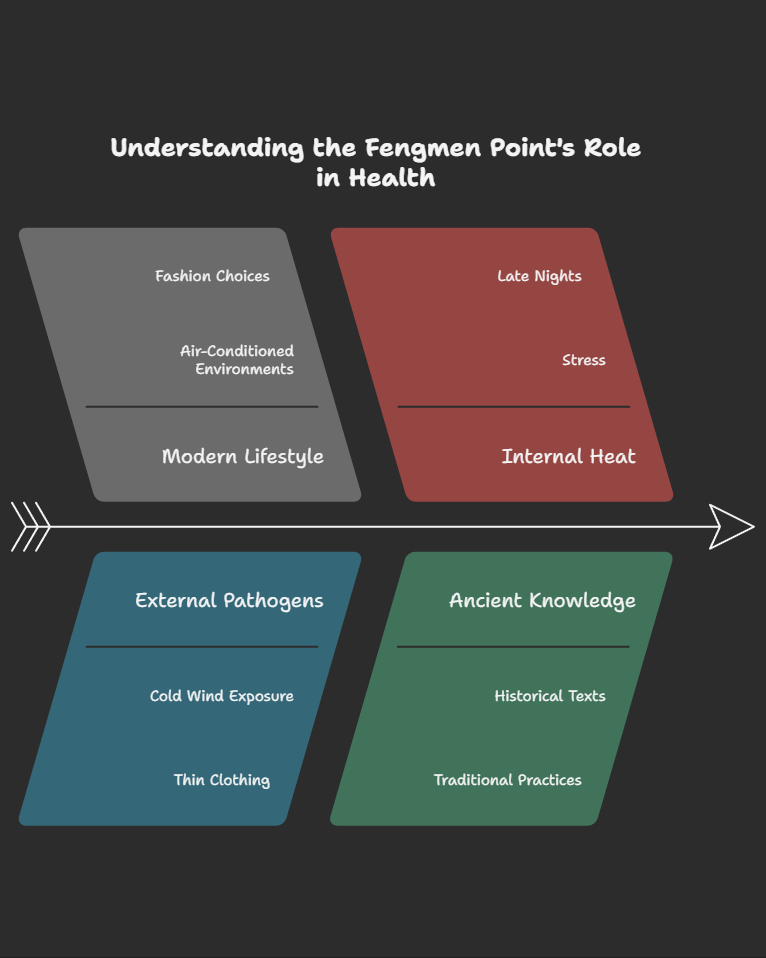
You might be curious—the name "Fengmen" sounds a bit mysterious. What does it actually mean?In the ancient wisdom of Traditional Chinese Medicine (TCM), "Feng" (Wind) is considered a primary culprit in causing many illnesses and is often called "the chief of a hundred diseases." It's like a troublemaking leader that often carries cold or dampness with it as it invades our bodies. "Men" simply means a gate or a passageway.Therefore, the literal meaning of the "Fengmen acupoint" is the "Gateway for Wind"—the portal through which pathogenic wind enters and exits. This acupoint is located on our upper back, which is precisely the body's first line of defense against the invasion of external pathogenic factors. When our body's protective shield (the Wei Qi or Defensive Qi) is weak, this gate is easily breached, leading to problems like the common cold and headaches.
Why is the Fengmen Acupoint So Important for Modern People?
This ancient acupoint is all the more important today because our modern lifestyle has inadvertently thrown open the gates for pathogenic wind. Imagine spending long hours in an air-conditioned room in the summer, with the cold air blowing directly onto the back of your neck and upper back. Or in the winter, wearing thin clothing for the sake of fashion, giving the cold wind a perfect opportunity to attack. These behaviors directly assault our "Gate of Wind."More importantly, the Fengmen point is not just an entry point for external pathogens; it is also an exit for the body's internal heat. In ancient texts, it was also known as "Re Fu" (熱府), the "Mansion of Heat." When stress or staying up late causes the body to "rise in fire" (become overheated internally), stimulating this point can help us to clear and vent the stagnant heat, achieving a state of balance and ease in both body and mind.
Precision Location: Find Your Personal Health Guardian in 30 Seconds
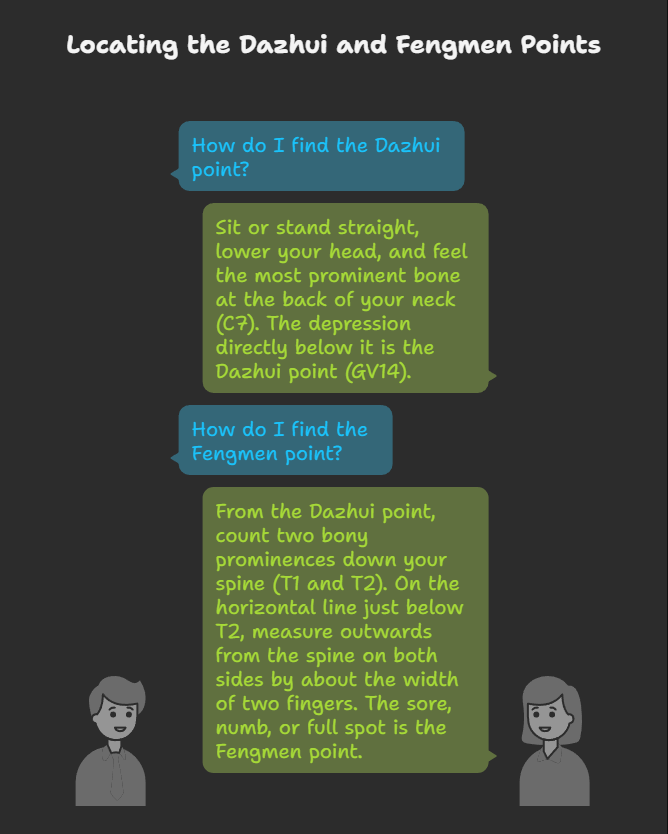
To activate this powerful health switch, the first step is to locate it with precision. Don't worry, the method is very simple, and you can absolutely do it yourself.First, please sit or stand up straight and gently lower your head. You will be able to feel the most prominent bone at the back of your neck. This is your 7th cervical vertebra (C7), and the depression directly below it is the Dazhui point (GV14).Next, from the Dazhui point, count two bony prominences down your spine (these are your 1st and 2nd thoracic vertebrae, T1 and T2).On the horizontal line just below that second prominence (T2), measure outwards from the spine on both the left and right sides by about the width of two of your fingers (your index and middle fingers held together).The spot that feels particularly sore, numb, or full when you press it is the Fengmen point.
Technique One: The Gentle Power of Your Fingertips—The Daily Soothing Massage Method
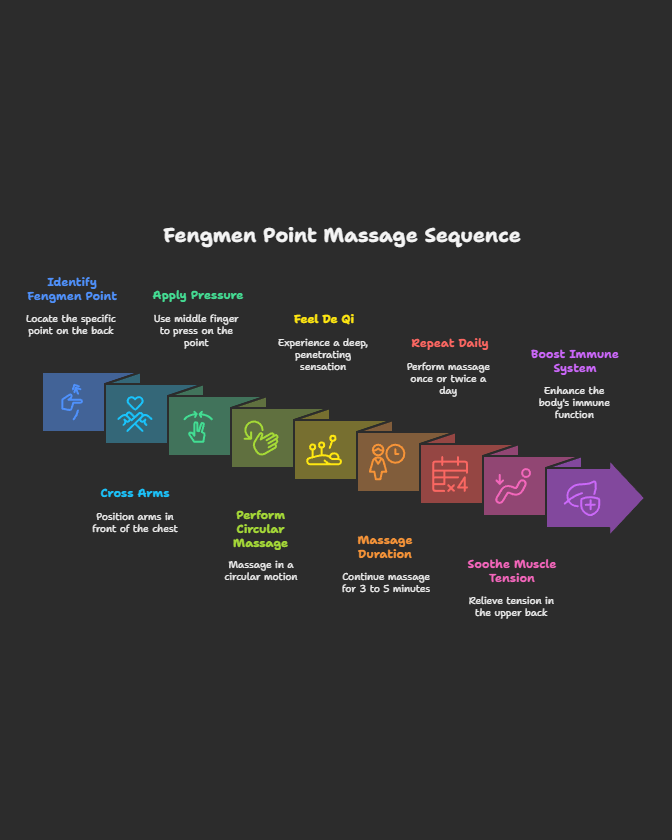
This is the simplest and most convenient method of self-care, and you can easily do it whether you are taking a short break at the office or watching TV at home.You can cross your arms in front of your chest and use the pad of your middle finger on the opposite hand to press on the Fengmen point. Please remember, the pressure is not a case of "the harder, the better"; the key is for it to be **"deep and penetrating."** Use a moderate force to perform a continuous, circular kneading massage until you feel a sore, full sensation that transmits deep into the muscle (this is what we professionally refer to as "De Qi").Massaging for 3 to 5 minutes each time, once or twice a day, can effectively soothe the muscle tension in your upper back and inject vitality into your immune system.
Technique Two: "Opening" the Gate of Wind—A Must-Learn Stretch for Office Workers
For those of you who work at a desk for long hours, the muscles of your back are like a tightly closed door, where the circulation of Qi and Blood is poor. This simple stretching routine can effectively "open up" the muscle groups around the Fengmen point, releasing long-held tension.1. First, sit up straight. Inhale slowly and, at the same time, open your arms out behind you. Feel your two shoulder blades forcefully squeezing towards each other in the middle. You can tilt your head back slightly. Hold this position for 5 seconds. 2. Next, exhale slowly as you cross and clasp your hands in front of your chest. Straighten your arms forward, allowing your entire upper back to round. Feel the muscles being fully stretched. Lower your head. Hold this for 5 seconds as well.Repeating this opening and closing motion several times a day can work wonders to relieve shoulder and back stiffness.
Say Goodbye to Annoying Colds: Activating Your Natural Immune Barrier
Do you feel that you tend to catch colds more easily than others? This could be because your body's "Gate of Defense" is not strong enough. The Fengmen point is the key to reinforcing this defensive line.When you feel a bit of a chill and sense that you are at the early stages of catching a cold, you can try pressing the Fengmen point with slightly more force. Press firmly for 5 to 6 seconds, then slowly release. Rest for a few seconds, then repeat. Continue this process for about 5 minutes. This action can stimulate the body's Yang Qi and help to expel the invading Wind-Cold.If you can combine this with massaging the **Fengchi points (GB20)** at the back of your neck, it is like creating an "Iron Triangle" for your body's defense system. This can significantly enhance your ability to resist external pathogenic factors, helping you to get through the change of seasons in good health.
Alleviating Stubborn Neck and Shoulder Pain: Your Portable Physical Therapist
Shoulder and neck pain is a chronic problem for many people. From an acute stiff neck to chronic strain, it often causes constant discomfort. The Fengmen point is located deep to the trapezius and rhomboid muscles, and these two muscles are the "major disaster zone" for shoulder and neck pain.By regularly massaging the Fengmen point, you can directly relax these muscle groups that are in a state of chronic tension and improve local blood circulation. When you feel your shoulders and neck are stiff, try focusing on kneading this point and combining it with the scapular opening and closing stretch mentioned earlier. You will find that this not only relieves superficial soreness but also deeply releases fascial adhesions and discomfort. The effect is comparable to having a personal, on-the-go professional physical therapist.
Smooth Breathing: Infusing Your Lungs with Fresh Air
Traditional Chinese Medicine (TTCM) holds that the Lungs govern our respiration, and the pathogenic factor of "Wind-Cold" most easily affects the function of the Lungs, leading to problems like coughing and wheezing.The Fengmen point is located in the Lung region of the back. Stimulating it can directly unblock and disseminate the Qi mechanism of the chest, helping the Lungs to resume their normal functions of "dispersing and descending." For a lingering cough that persists after a cold, or for mild asthma triggered by weather changes, regularly massaging the Fengmen point can have a very good supportive and relieving effect.It is like opening the windows of your Lungs, allowing your breath to become smoother and deeper, and infusing every inhalation and exhalation with fresh energy.
Safety First: A Gentle Reminder for Using the Fengmen Acupoint
Although the self-care method for the Fengmen point is very safe, as a professional massage therapist, I must remind you of some precautions.First, it is not advisable to perform strong stimulation when you are overly hungry, too full, or extremely fatigued. If the skin over the acupoint has any wounds, redness, swelling, or rashes, you should also avoid application.Special attention is required for pregnant women. Although the Fengmen point itself is not an absolute contraindication, during pregnancy—especially in the middle and late stages—any strong pressure on the back and lower back area should be performed with extreme caution. You must consult a professional physician for their opinion.Our goal is a "Happy Healthy Life," and safety is always the first step toward achieving that goal.
Conclusion: Taking Health into Your Own Hands
The Fengmen acupoint, our "Gate of Defense," is a precious asset left to us by our ancestors and a health gift that we can access at any time.It reminds us that a true "Happy Healthy Life" does not rely on expensive supplements or complicated rituals, but originates from paying careful attention to our own bodies and from consistent daily practice. Starting today, try to spend a few minutes each day using your fingertips to awaken this sleeping guardian of your health.When you integrate this small act of care into your life, you will discover that fending off wind and cold, saying goodbye to stiffness and pain, and embracing vitality can be so simple. Health is, and always has been, in our own hands.


