
Hello everyone, I am your old friend on the path to a "Happy Healthy Life." As a massage therapist who has been practicing for many years, my hands are not just tools for relaxing muscles; they are a medium for listening to the body's subtle signals.Many people come to me because of stiff shoulders and necks or aching lower backs. But the body's wisdom is far greater than we imagine, and sometimes, the most crucial health codes are hidden in our feet, which bear our entire body's weight every day.Today, I want to have an in-depth chat about a more private yet critically important topic: the "Urethra Reflex Zone" in foot reflexology. I will share how, by massaging the entire urinary system reflex pathway, we can promote our health and purity from the inside out.
More Than Just Relaxation: Unlocking the Dual Healing Code of Foot Massage
Many people view foot massage as a relaxing and enjoyable experience, but for us therapists, it is a delicate dialogue with the body's deep structures. Its healing philosophy is rooted in two major theories.The first is the Western concept of "Zone Therapy." This theory vertically divides the human body into ten energy zones, like ten energy highways running through the entire body. When we stimulate a specific area on the foot, it is equivalent to clearing traffic on the corresponding highway. The influence of this stimulation can travel along that zone to precisely reach the corresponding organs and tissues. This theory provides us with a clear, structured map of the body, allowing us to locate points with precision.
At the same time, the ancient Eastern wisdom of the meridians reveals another layer of mystery to us. Traditional Chinese Medicine (TCM) posits that life energy, "Qi," flows within the body along specific "meridian" pathways, nourishing the internal organs. When factors like stress, poor habits, or emotional fluctuations cause the flow of Qi to become impeded and form blockages, the function of the related organs can become imbalanced.The essence of foot massage lies in applying pressure to specific reflex zones to clear these energy blockages, promoting the restoration of smooth Qi flow, and thereby stimulating the body's innate self-healing potential. These two theories—Zone Therapy and Meridian Theory—complement each other, together forming the comprehensive and profound worldview of foot reflexology.
The Urinary System Map on Your Soles: A Guide to Precisely Locating Your Internal Purification System
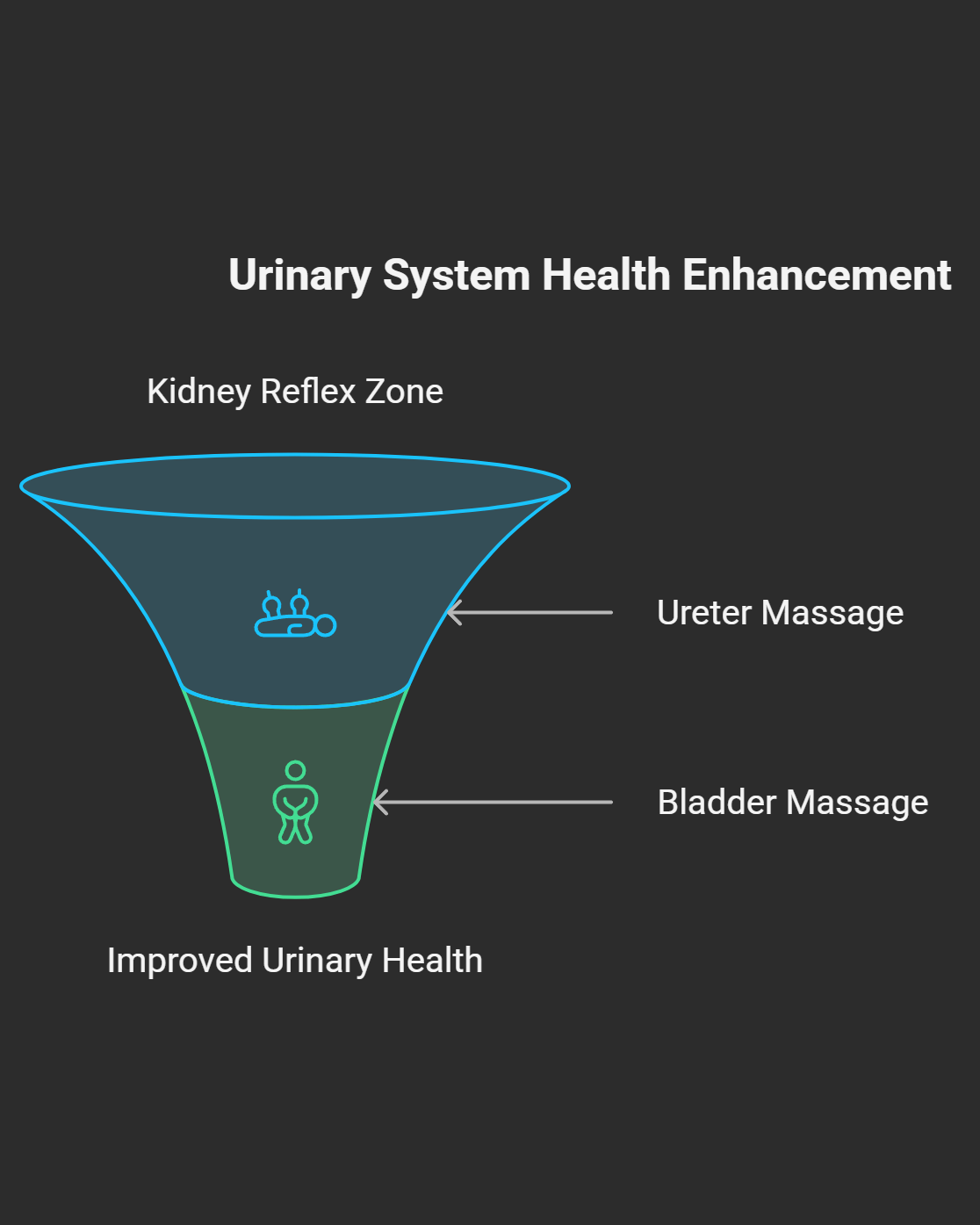
Before we focus on the urethra, let's first get a bird's-eye view of the entire urinary system's layout on the soles of your feet. Our feet are like a miniature projection map of our internal organs, and the distribution of reflex zones on the left and right foot roughly corresponds to the actual location of the organs.First, the most important Kidney reflex zone is located in the center of the sole of each foot, approximately just above the arch and below the ball of the foot. You can try curling your toes; a depression in the shape of the Chinese character "人" (resembling an inverted "V") will appear on your sole. The Kidney reflex zone is right at the center of this depression.In Traditional Chinese Medicine theory, the Kidney governs water; it is the core for regulating bodily fluids and metabolizing waste, and it also stores our vital life energy.
Extending downward from the Kidney reflex zone is a key channel known as the Ureter reflex zone. It forms a graceful arc, starting from the kidney's location and following the inner arch of the foot all the way down to connect with the Bladder reflex zone. Regularly massaging this channel helps to promote the smooth passage of urine and prevent metabolic byproducts, such as uric acid crystals, from accumulating along the way.Next, we arrive at the Bladder reflex zone. It is situated on the inner edge of the arch, in a natural depression near the front of the heel. This area directly corresponds to our urine storage organ—the bladder. Massaging this spot can effectively help relieve bladder tension and discomfort, improve its capacity to store and empty, and maintain a healthy cycle for the urinary system.
Delving into the Final Channel: The Precise Location and Function of the Urethra Reflex Zone
Now, we finally arrive at the core of our discussion—the Urethra reflex zone. Compared to the larger reflex zones like the kidney or bladder, the urethra reflex zone is more like a fine pathway.Its location is on the inner side of both feet, starting from just below and in front of the inner ankle bone and extending towards the Bladder reflex zone in the direction of the arch, forming a clear line. This pathway precisely corresponds to the final journey urine takes as it is expelled from the bladder.In practical massage application, we typically treat it in a continuous motion with the Bladder reflex zone, as their functions are interlinked to ensure the entire process of urination is smooth and unobstructed.
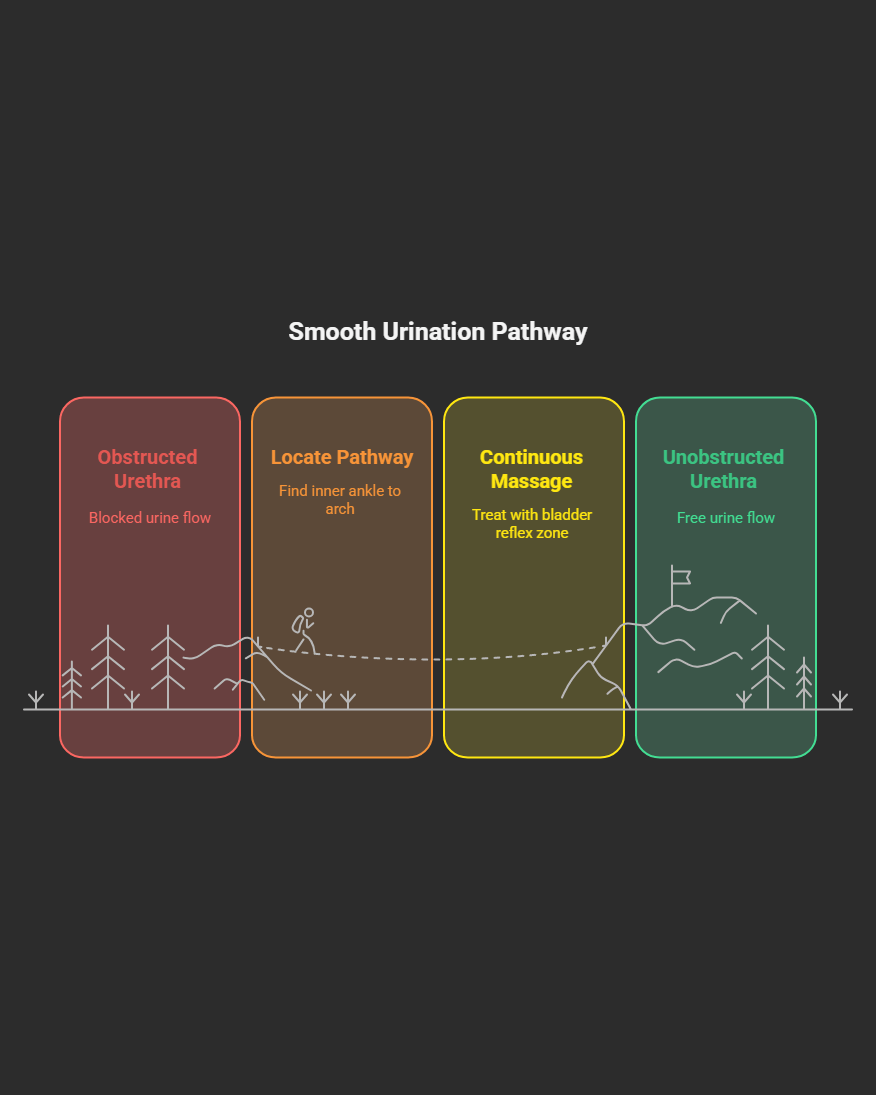
From our perspective as therapists, the main purpose of massaging this narrow area is to maintain the healthy elasticity of the urethra and ensure the process of urination is complete and smooth. It has a supportive effect on improving issues like incomplete emptying or post-urination dribbling.What's more interesting is that the location of the Urethra reflex zone is in close proximity to the "Gonad (reproductive gland) reflex zone" at the heel. For mature men in particular, massaging this pathway often simultaneously stimulates the reflex areas related to the prostate gland. This can be described as "killing two birds with one stone" when it comes to maintaining overall male urogenital health.Therefore, it is crucial to understand that the Urethra reflex zone is a "channel" and not a single "point."
The Therapist's Practical Lesson: A Complete Guide to Massaging the Urinary System
Now, let's put theory into practice. An effective reflexology massage begins with careful preparation.I strongly recommend that you first soak your feet in warm water for about 10 to 15 minutes before the massage. This simple step not only cleans your feet but also promotes blood circulation and allows the foot muscles to relax thoroughly, which will significantly enhance the effectiveness of the subsequent massage.Next, take a small amount of your favorite lotion or a natural massage oil. Although traditional reflexology sometimes opts for a "dry push" to stimulate points with greater precision, for at-home self-care, a moderate amount of lubrication allows for a smoother technique, prevents excessive skin friction, and provides a more comfortable healing experience.
In terms of technique, the most common and effective method we use is the "Thumb-Sliding Push." Imagine the pad of your thumb is like a steady caterpillar track, moving step-by-step across the reflex zone.Specifically for the two "channel-type" reflex zones—the ureter and the urethra—we will adopt a special "Toothpaste-Squeezing Method." The key to this technique is its directionality. You need to use the pad of your thumb to perform a one-way, firm, and fluid sliding or scraping motion from the beginning of the channel (the kidney or bladder zone) towards the end (the bladder or ankle direction), just as if you were squeezing toothpaste out from the bottom of the tube.Repeating this motion 5 to 7 times is the most effective way to simulate and promote the smooth flow of fluids within the body.
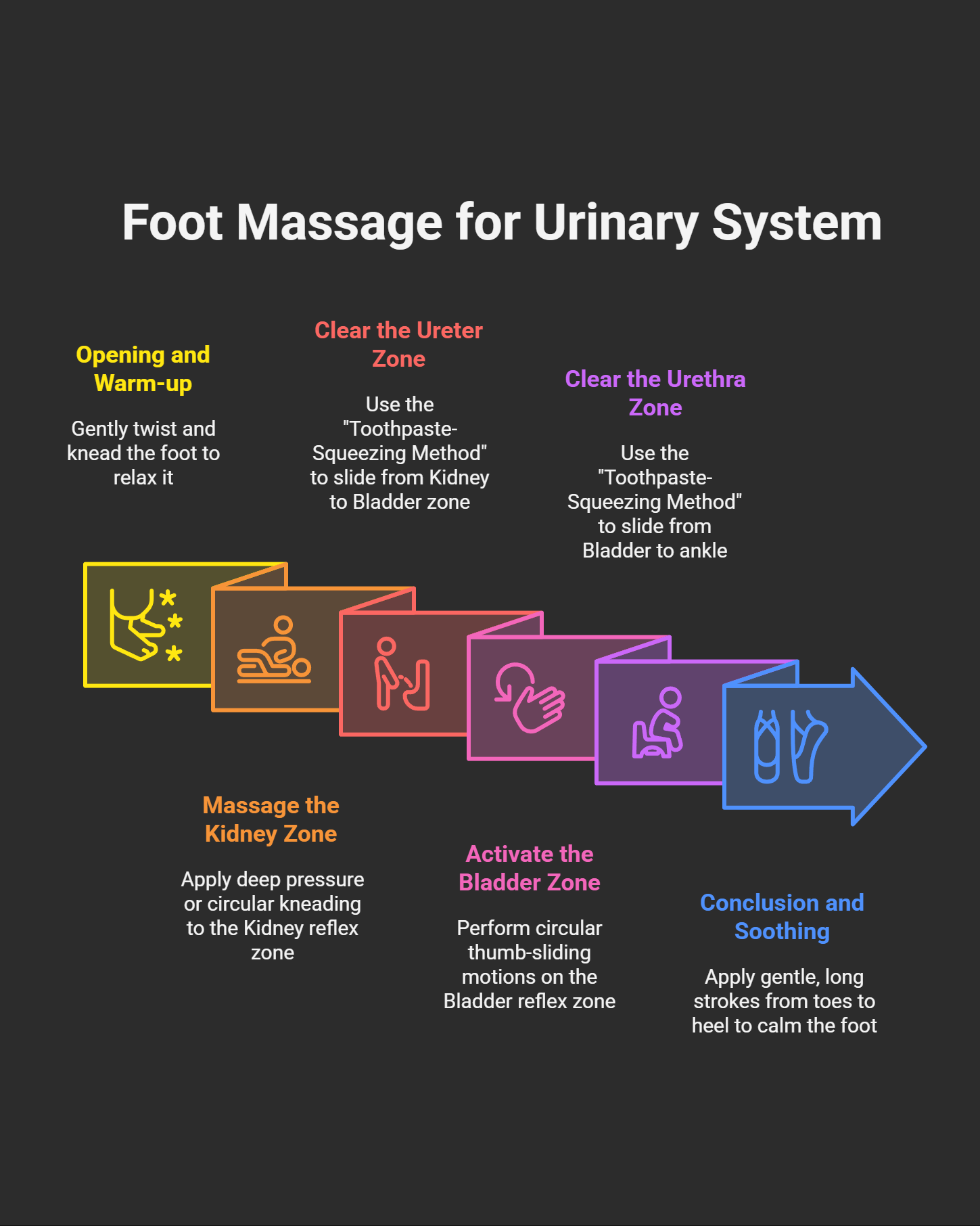
To help you perform this easily at home, I have organized a complete massage sequence for you:
- Opening and Warm-up: Begin by gently twisting, stretching, and kneading the entire foot to allow it to relax completely.
- Massage the Kidney Zone: On the Kidney reflex zone of each foot, use your thumb to perform deep pressing or circular kneading for about 1 to 2 minutes per foot.
- Clear the Ureter Zone: Using the "Toothpaste-Squeezing Method," firmly slide and push from the Kidney zone to the Bladder zone, repeating 5 to 7 times.
- Activate the Bladder Zone: On the Bladder reflex zone, perform circular thumb-sliding motions to deeply stimulate the entire area for about 1 to 2 minutes per foot.
- Clear the Urethra Zone: Once again, using the "Toothpaste-Squeezing Method," slide and push from the Bladder zone along the inner side of the foot towards the ankle, repeating 5 to 7 times.
- Conclusion and Soothing: Finally, use gentle, long, soothing strokes from the toes to the heel to calm the entire sole of the foot, concluding the treatment session.
Regarding the pressure, you must remember one principle: it is absolutely not a case of "the more pain, the better." The ideal pressure should create a "sore, distending sensation that is still comfortable." If you were to rate the sensation on a scale of 1 to 10, your feeling should be around a 6 or 7.The entire massage process is recommended to last for 10 to 15 minutes.As a daily maintenance routine, performing it 2 to 3 times per week is sufficient.If you wish to address a specific concern, you can try massaging daily for one week, and then adjust the frequency based on your body's response.
Safety First: A Gentle Reminder Before You Enjoy the Healing Session
Although foot massage is a relatively gentle form of natural therapy, we must still maintain a cautious attitude. Please be sure to view it as an excellent "complementary" therapy aimed at relieving stress and promoting circulation, but it absolutely cannot replace professional medical diagnosis and treatment.If you experience "red-flag signals" such as pain during urination, blood in your urine, an unexplained fever, or a sudden and drastic change in your urinary habits, you must seek immediate medical assistance. These could be signs of an infection, stones, or other health issues that require timely medical intervention.Safeguarding your health requires that wisdom and caution go hand in hand.
Additionally, foot massage should be avoided or performed with caution under certain specific circumstances. For example, if you have open wounds, fractures, or severe skin conditions (such as Athlete's foot or an acute eczema flare-up) on your feet, you should pause the massage to avoid worsening the symptoms or causing an infection.Groups such as pregnant women, individuals with a history of venous thromboembolism, or those with severe diabetic peripheral neuropathy must first consult their physician or a professional therapist and decide whether to proceed only under their guidance.Finally, after each massage session, please remember to drink a glass of warm water. This helps your body to more smoothly flush out the metabolic waste that was stimulated into circulation.
May this deep care, originating from the soles of your feet, add a sense of inner and outer refreshment and tranquility to your "Happy Healthy Life."


![[Happy Healthy Life] Say Goodbye to Insomnia and Brain Fog! A Veteran Massage Therapist Reveals the Hidden "Detox Switch" in Your Big Toe: A Complete Breakdown of Brain Reflexology Zones](https://happyhealthylife.cv/wp-content/uploads/2026/02/【樂健生活】告別失眠與腦霧!資深按摩師教你「大拇趾」隱藏的排毒開關:大腦足部反射區-540x360.jpg)
![No More "Blue" Days of Misery! Therapist Reveals: 15 Minutes a Day to Clear the "Nasal Reflex Zone" and Kickstart a [Happy Healthy Life] of Free Breathing from Your Soles](https://happyhealthylife.cv/wp-content/uploads/2026/01/不再「藍瘦香菇」!按摩師親授:每天15分鐘按通「鼻部反射區」,從腳底啟動呼吸自由的樂健生活-540x360.webp)