
Hello, I am your massage therapist. In my work, one of the most common complaints is, without a doubt, the nagging headache. It might arrive quietly in the afternoon like a tightening band around your head, or it could be a throbbing alarm that goes off during moments of peak stress. Many people are searching for a method of self-healing that doesn't rely on medication and can be done anytime, anywhere.Today, I want to share with you a powerful tool rooted in ancient wisdom and validated by modern science: acupressure. This is not just random pressing; it is a precise dialogue with your body to release internal tension. Let's explore together how, by massaging two key gateways—the Taiyang and Fengchi acupoints—you can take the power of relief back into your own hands and move towards a true "Happy Healthy Life."
The Root of Headaches: Why Your Body is Craving This Massage
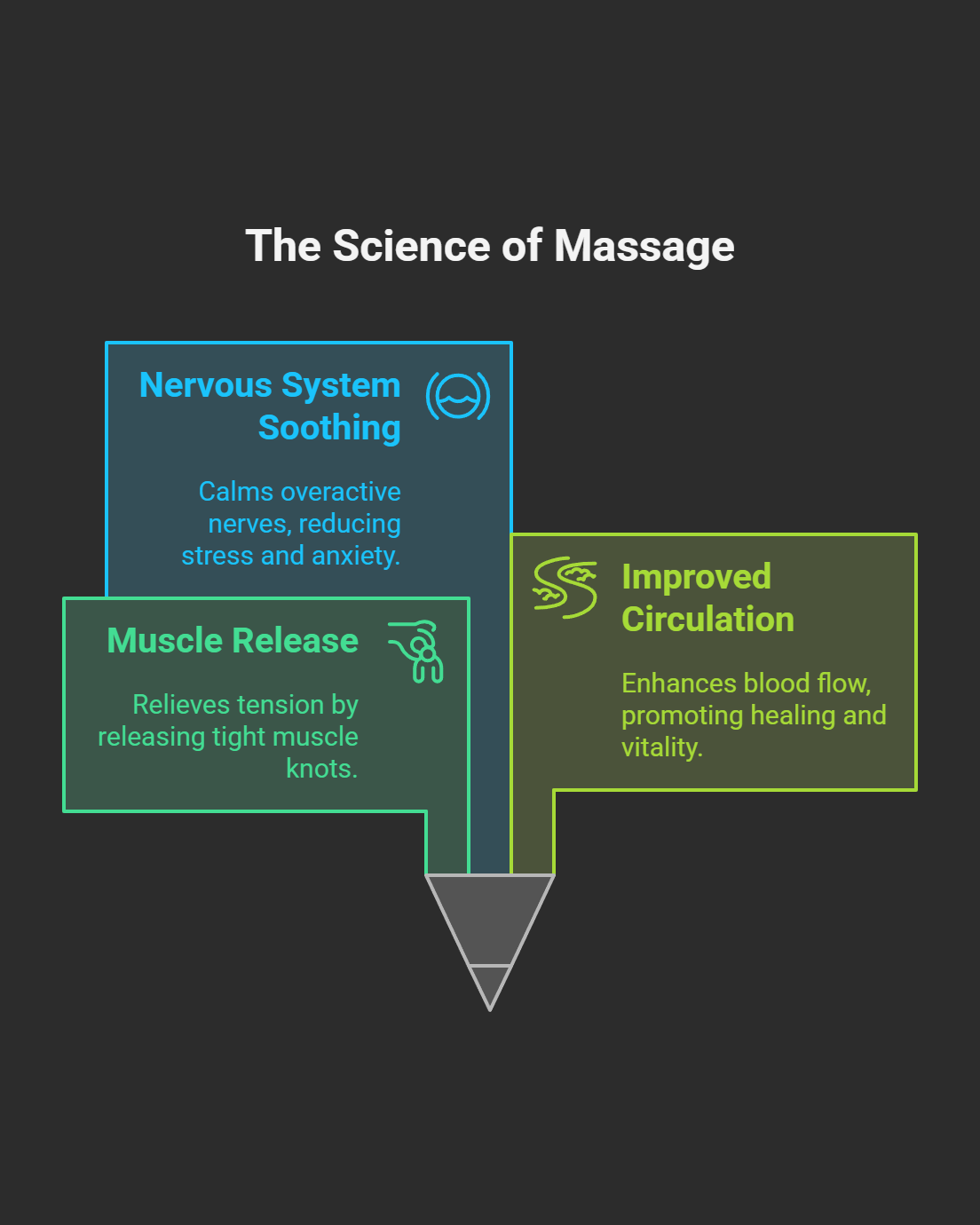
Many clients ask me why simple pressure can bring about such a significant change. It's not magic; it has a solid anatomical basis. When we talk about massage, we are actually performing a gentle mechanical intervention on tight muscles, fascia, and compressed nerves.This can effectively release the sensitive knots in muscles known as "trigger points," promote blood circulation, and soothe an overactive nervous system. It is a direct physical dialogue aimed at restoring the balance your body has lost due to stress, poor posture, or overuse. By understanding the principles behind it, you will be better able to appreciate the deep relaxation and healing power that each press brings, transforming self-care from a vague concept into a precise and effective action.
Unlocking the Taiyang Acupoint: The Key to Releasing Tension Headaches
Now, let's focus on the Taiyang acupoint (the temples). This point is located directly over a large, fan-shaped muscle called the temporalis muscle, which plays an important role when we chew, speak, or even frown.When you focus on a computer screen for long periods, experience psychological stress, or have a habit of grinding your teeth at night, this muscle unconsciously becomes overly tense, forming trigger points. These knots then refer pain to the area around your temples, your brow bone, and even your teeth—a typical pattern for a tension headache.Therefore, when we massage the Taiyang point, we are directly and purposefully soothing the tension in the temporalis muscle, increasing local blood flow, and in turn, relieving the associated nerves, particularly the branches of the trigeminal nerve.
The Path to the Fengchi Acupoint: A Healing Route to Say Goodbye to "Tech Neck"
Next, let's get to know the Fengchi acupoint (GB20), a key gateway to deep neck relief. It is located at the base of the skull where it connects to the cervical spine, lying over the suboccipital muscles.In modern life, we spend long hours looking down at our phones and using computers, leading to the condition known as "tech neck." This keeps the suboccipital muscles in a chronically tight and shortened state. This chronic tension can compress the greater and lesser occipital nerves that pass through the area, triggering a "cervicogenic headache"—a headache that radiates from the back of the neck up to the crown of the head.Massaging the Fengchi point directly relaxes this deep muscle group, relieves the pressure on these nerves, and simultaneously improves blood flow to the brain. This alleviates many headaches and dizzy spells related to neck fatigue right at their source.
Insights from Traditional Wisdom: Allowing Qi and Blood to Flow Unimpeded
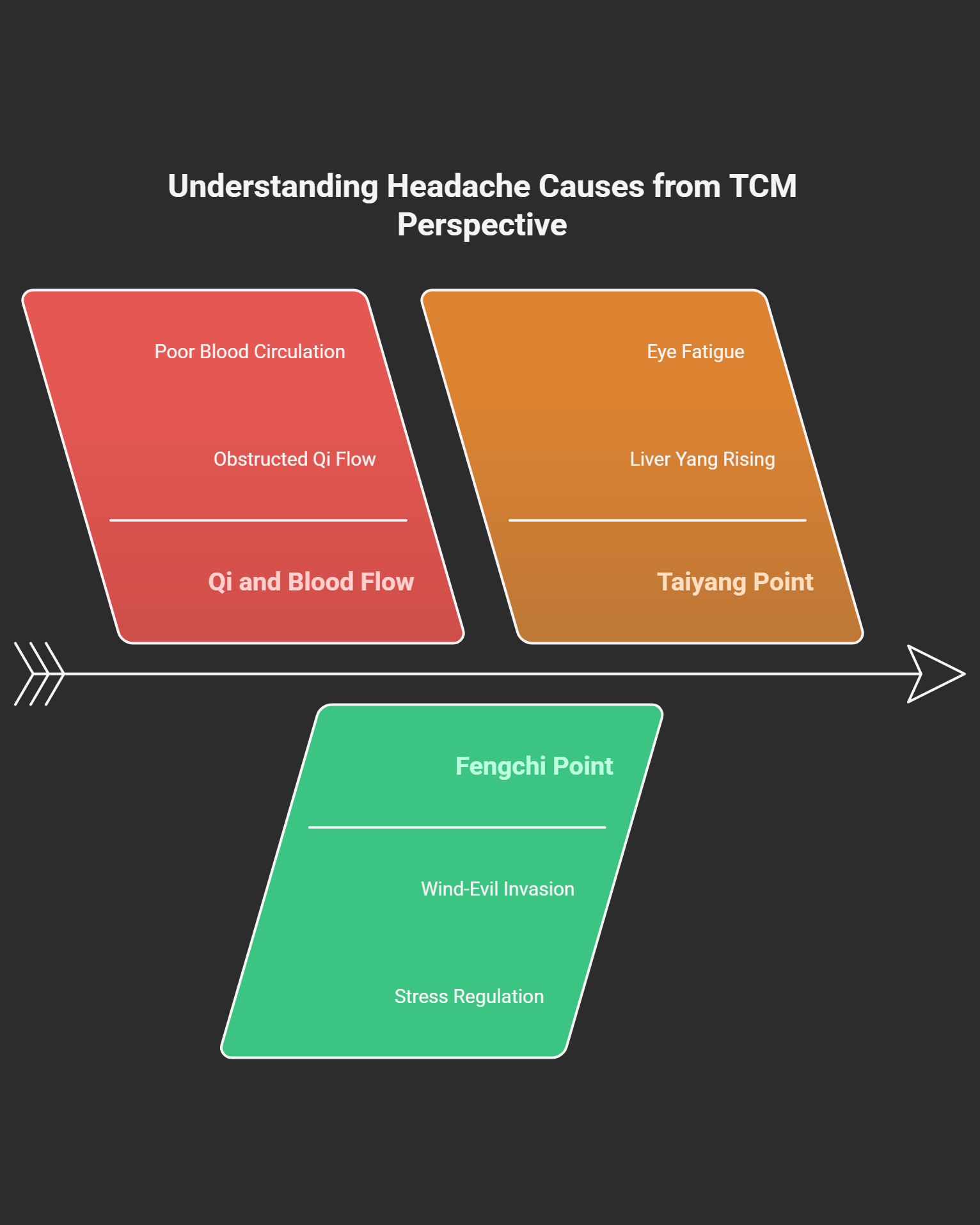
From a Traditional Chinese Medicine (TCM) perspective, the pain in our bodies stems from a core principle: "If there is no free flow, there is pain" (不通則痛). A headache, therefore, is the result of obstructed Qi and Blood flow in the meridians of the head.The Fengchi point, hailed as the "Pool of Wind," is a gateway through which external pathogenic factors (especially Wind-Evil) can invade the body, often leading to colds and neck stiffness. At the same time, it is located on the Gallbladder Meridian, which is closely related to stress regulation. Massaging this point can expel wind and clear the meridians.The Taiyang point, as an "extra point" (not on a primary meridian), has a remarkable effect on clearing Qi and Blood on the sides of the head. It is particularly effective for "Liver Yang Rising" type headaches (similar to stress headaches), which can be caused by stress or eye fatigue.These two theoretical approaches, the Western anatomical and the Eastern TCM, arrive at the same conclusion via different paths, together painting a blueprint for achieving harmony and health by restoring flow.
Your Personal Massage Lesson: Mastering Soothing Techniques Step-by-Step
Understanding the theory is for the purpose of better practice. Now, let's transform that knowledge into an art at our fingertips.Before you begin, please create a peaceful moment for yourself. Find a comfortable chair to sit in, or lie down quietly. Take several long, deep abdominal breaths to allow your mind to settle. Please ensure your hands are clean and your fingernails are neatly trimmed to avoid scratching your skin during the massage. This is more than just preparation; it's the beginning of a self-care ritual, and it will significantly enhance the experience and effectiveness of the entire process.Are you ready? Let's begin this healing journey.
Precision Location 1: Finding Your Taiyang Acupoint (The Temples)
To achieve the best results, precise location is the first step. Finding the Taiyang point (temple) is very intuitive.First, lightly place the tip of your index or middle finger on the outer corner of your eye. Next, imagine a line connecting the end of your eyebrow to the outer corner of your eye, and find the midpoint of this line. From this midpoint, move horizontally towards your ear by about the width of your own thumb. You will feel a slight depression, and when you apply pressure with the pad of your finger, it will produce a comfortable, sore sensation.Congratulations, that is the Taiyang point. The feeling of finding the spot is more important than memorizing its exact location—trust the feedback your body gives you.
Precision Location 2: Reaching the Deep Fengchi Acupoint
Locating the Fengchi point requires a bit of tactile guidance.Please place both hands behind your head, as if you were cradling it in your palms. Next, using both thumbs, trace down the centerline of the back of your head until you feel the hard edge at the base of your skull.From this centerline, slide your thumbs horizontally out to the left and right, moving past the two thick, vertical muscles (the trapezius). You will find a distinct depression just to the outside of these muscles. This depression is located at roughly the same horizontal level as your earlobes. When you press inwards and upwards with your thumbs, you will feel a deep, sore, and distending sensation. That is the Fengchi point.
The Art of the Technique: A Gentle Release for the Taiyang Acupoint
Once you have located the acupoints, using the correct technique is the key to releasing their therapeutic effects. The sensitive area of the Taiyang point (temple) requires a gentle approach.Please use the pad of your index or middle finger, as this area is thicker and can provide a soft yet focused pressure. Place your fingertip in the depression of the temple and apply a steady, comfortable pressure. The ideal intensity should create a soothing, sore sensation, not sharp pain.Next, begin to massage in small circles at a very slow speed; either clockwise or counter-clockwise is fine. Throughout this entire process, maintain deep and steady breathing. Continue the massage for about 1 to 2 minutes. You will feel the tightness along the entire side of your head gradually begin to melt away.
The Art of Technique: Deep Relief for the Fengchi Acupoint
The massage for the Fengchi point requires deeper pressure and a specific direction. Please use your thumbs, as they can provide the strongest and most stable support. Gently rest your other four fingers on the sides of your head for stability.Place the tips of your thumbs into the hollows of the Fengchi points. The direction of the pressure is crucial: you need to press inwards and slightly upwards, as if you were aiming towards your opposite eye. This angle is the most effective for acting on the deep suboccipital muscles.You can choose to either hold a steady, continuous pressure for 1 to 2 minutes, or use your thumbs to perform small, deep kneading motions. That deep sensation of soreness, numbness, distension, or heaviness that comes from the back of your neck is what Traditional Chinese Medicine calls "De Qi"—it's the sign that the therapeutic effect has been triggered.
The Cornerstone of Life: Building a Solid Defense for Your Health
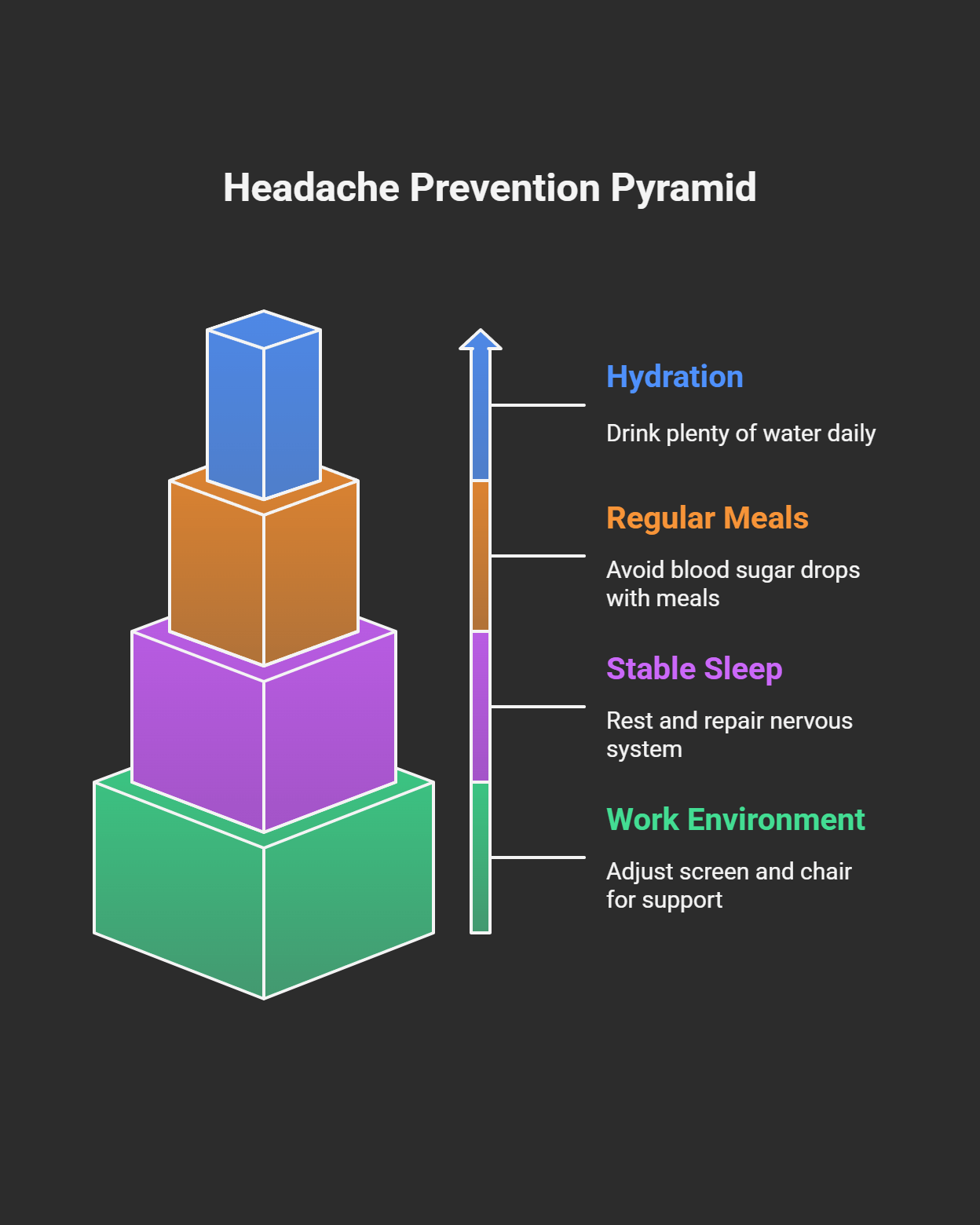
Last, but equally important, is to build a defensive line of lifestyle habits against headaches.Ensure you drink plenty of water every day, as dehydration is one of the most common headache triggers.Maintain regular meals to avoid the discomfort caused by sudden drops in blood sugar.Establish a stable sleep cycle to allow your nervous system to fully rest and repair.Furthermore, review your work environment: adjust your computer screen to eye level, choose a chair with good support, and constantly remind yourself to maintain a neutral spinal position.These seemingly small adjustments are the very cornerstones of preventing headaches at their source and building a strong, resilient body.
Safety First: When Should You Seek Professional Help?
As your therapist, my primary responsibility is to ensure your safety. Self-care is an empowering tool, but it also has clear boundaries.Acupressure should be avoided under certain specific circumstances, such as: during pregnancy (especially the Hegu, LI4 point), if there are open wounds or infections on the skin, if you suffer from a bleeding disorder, or if you are taking anticoagulant medication (blood thinners).Furthermore, when you are extremely fatigued, intoxicated, or within one hour of a large meal, you should let your body rest rather than applying additional stimulation.Understanding these contraindications is the first step toward responsible self-care, ensuring that our well-intentioned actions do not pose any unnecessary risk to the body.
Important Red Flags: When a Headache Is No Longer a Minor Issue
Although the vast majority of headaches are benign, we must be alert to certain "red-flag signals" that could indicate a serious health problem.If you experience a sudden, unprecedented, and severe "thunderclap" headache; or if a headache appears after a head injury; or if the headache is accompanied by symptoms such as fever, a stiff neck, confusion, body weakness, changes in vision, or difficulty speaking, please do not hesitate—seek immediate professional medical assistance.Likewise, a new type of headache that continuously worsens over days or weeks, or one that appears for the first time after the age of 50, should also be evaluated by a doctor. Learning to recognize these signals is vital knowledge for protecting your own health and that of your family.
Conclusion: Take Healing into Your Own Hands
Through today's sharing, I hope you can see that massaging the Taiyang and Fengchi points is not just a technique for relieving headaches; it is an art of connecting the mind and body and listening to your body's needs. Its power is rooted in the precision of modern anatomy and the holistic concepts of Traditional Chinese Medicine.However, the greatest potential of this technique is realized when it is integrated into a broader health blueprint—one that combines conscious postural adjustments, regular stretching exercises, and active lifestyle management. By responsibly applying this knowledge and clearly understanding the boundaries of self-care, you can not only effectively manage headaches but also proactively lay a solid foundation for your "Happy Healthy Life," truly taking control of your own well-being into your hands.

![[Happy Healthy Life Column] A Massage Therapist's Guide to Proper Heat Therapy for Deep Tissue Relief](https://happyhealthylife.cv/wp-content/uploads/2026/03/樂健生活專欄:推拿師教你正確溫熱敷,達到深層肌肉舒緩-540x360.jpg)
![[Happy Healthy Life] Unlocking Your Body’s Self-Healing Power: A Professional Massage Therapist’s Guide to Ending Chronic Fatigue Through Gua Sha and Fascial Release](https://happyhealthylife.cv/wp-content/uploads/2026/02/樂健生活】解鎖身體自癒力:專業按摩師帶你以刮痧與筋膜放鬆告別慢性疲勞抽象藝術圖像-540x360.jpg)
