
In my massage practice, countless clients lie down on my table with a shared problem—an indescribable feeling of chest tightness and anxiety. They describe it as if they are carrying a thousand-pound weight on their back, and even when resting, their heart sometimes races for no reason.This is not just a psychological feeling; it is a distress signal coming from the body. The high pressure of modern life, prolonged sedentary postures, and emotions that are not properly channeled are gradually eroding our physical and mental health, making that "Happy Healthy Life" we all desire—one filled with vitality and inner peace—seem distant. As a massage therapist who deals with all kinds of "knots" in the body, I know full well how these burdens leave their mark on our muscles and fascia.
When a client describes that feeling of "a stone pressing on my chest," what comes to my mind is not only a tight pectoralis major muscle, but also a profound concept from Traditional Chinese Medicine (TCM)—"Heart Qi Stagnation" (心氣鬱結).This means that the energy flow of the "Heart" system, which is responsible for our spirit and emotions, has become obstructed. Emotions, especially the daily accumulation of worry and stress, are like rush-hour traffic in a city, causing a major jam in the body's vital energy. This not only affects our mood but also directly reflects in our breathing, heart rate, and overall vitality.Fortunately, our body has sophisticated, built-in regulatory mechanisms, and what I want to share with you today is the very key to liberating this stagnation.
This key is hidden in an unexpected location—deep within the armpit, at a marvelous point named the Jiquan acupoint (HT1). In the study of Traditional Chinese Medicine meridians, it is the starting point of the Heart Meridian of the Hand (Shaoyin) and is hailed as the "Gushing Spring of the Heart."Translating this ancient wisdom into the language of modern bodywork, the importance of the Jiquan point is self-evident. It is the master switch for an energy channel that governs our emotional health and cardiac vitality. Therefore, learning how to correctly access and activate this acupoint is like mastering a powerful self-healing technique that allows you to soothe your spirit and release the heavy burden on your chest anytime, anywhere. This is the "homework" I often teach my clients at the end of a treatment session.
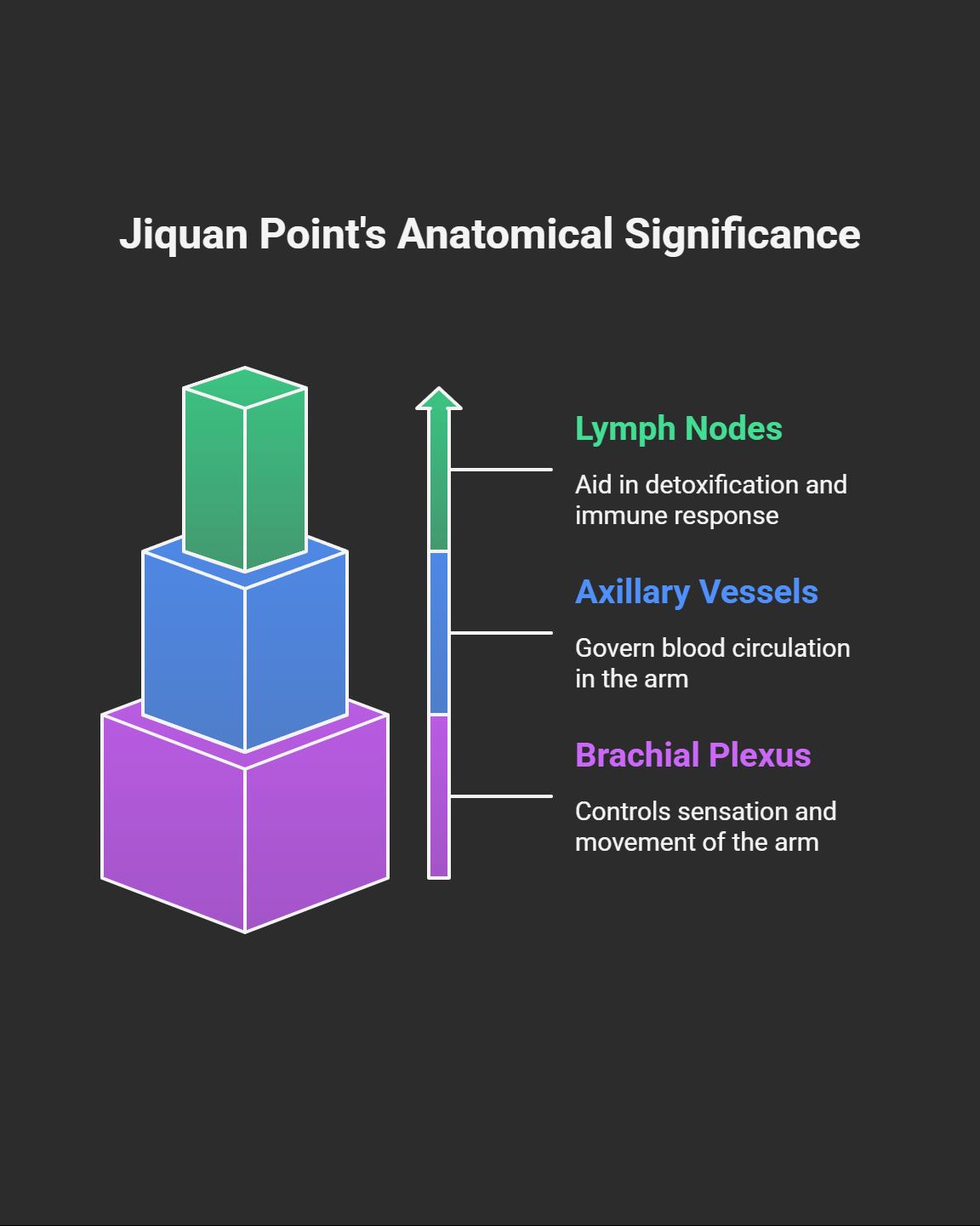
To understand why stimulating the Jiquan point has such a powerful effect, we must look at it from the perspective of modern anatomy. When I guide a client to find this location, I explain that it is not just a point in TCM theory; it is a hub of the body's physical structure.The deep part of the armpit is home to the brachial plexus, a massive network of nerves that controls the sensation and movement of our entire arm. At the same time, the major axillary artery and vein also pass through here, governing blood circulation. Even more crucially, a large number of lymph nodes are concentrated in this area.Therefore, when we massage this spot, we are not only regulating nerves but also promoting circulation and assisting the lymphatic system with its detoxification work.
From my practical experience as a massage therapist, the most rapid and effective method for activating the Jiquan point is undoubtedly the "Plucking Method." This technique can produce a unique and profound "De Qi" sensation, which is a guarantee of its therapeutic effect.First, please sit comfortably and raise your left arm, allowing your armpit to open up and relax completely. Next, using your right thumb, reach deep into the apex of the armpit. First, feel for the pulsation of the artery, then move slightly. You will find one or several tight, cord-like structures that feel like guitar strings—these are the brachial plexus nerve bundles and the surrounding tendons.Place your thumb perpendicular to one of these "cords" and, as if you were plucking a guitar string, strum it with a firm and steady motion.
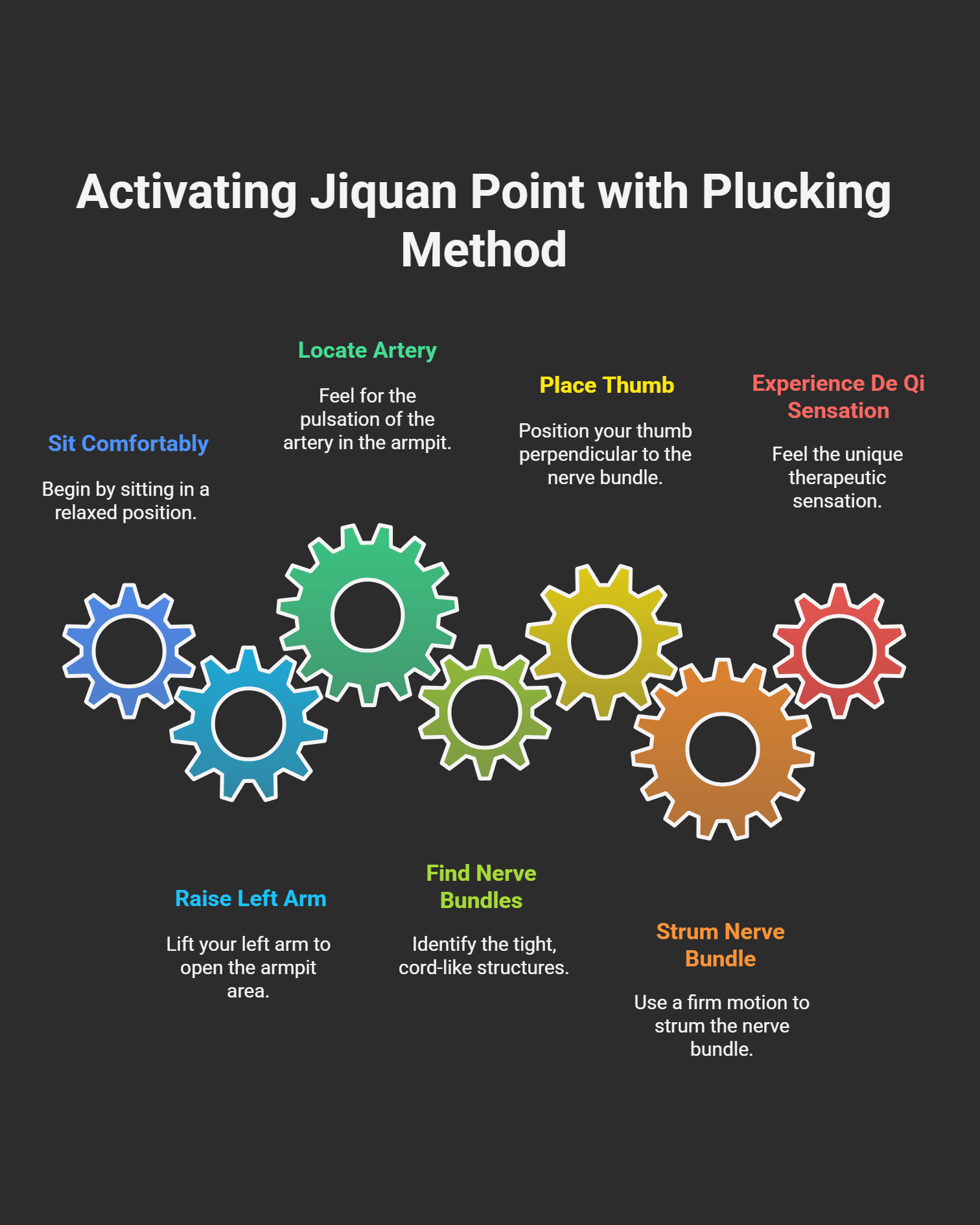
The goal of the plucking motion is to feel that "De Qi" sensation, which is the same objective I aim for when performing deep tissue massage for my clients. A successful pluck will trigger a unique feeling of soreness, numbness, and distension. This sensation can sometimes feel like a weak electric current traveling down the inner side of your arm, perhaps even reaching your fingertips.Please do not be afraid of this feeling. It is precise proof that your stimulation is on point and has successfully activated the Qi and Blood of the nerves and meridians. Many clients are surprised when they experience this for the first time, but they quickly discover that an unprecedented sense of release accompanies this sore, numb sensation.I always recommend that clients prioritize the left side first. Because our physical heart is located more to the left, stimulating the left side first can more directly soothe palpitations and chest tightness.
Of course, not everyone is comfortable with the strong stimulation of the "plucking method," or sometimes we may just want to perform gentle, daily maintenance. In these situations, I recommend two other equally effective techniques.The first is the "Press-and-Knead Method." You can use the pads of the middle and index fingers of your opposite hand. After locating the Jiquan point, apply a steady and gentle pressure, performing a slow, circular kneading motion. Continue massaging for two to three minutes, until you feel a sense of local warmth and a slight soreness or distension. This is a very suitable relaxation technique to perform before bed, as it can effectively relieve the shoulder and arm tension accumulated throughout the day.
Another gentle alternative is the "Point-Pressing Method." This method is more static and emphasizes deep, sustained pressure.Using the tip of your middle finger, aim for the precise location of the Jiquan point and press vertically downwards, gradually increasing the pressure from light to heavy. While pressing, it is crucial to coordinate the action with long, slow, deep breaths, focusing your full attention on the sensation beneath your finger and the rhythm of your breathing. Hold the pressure for about 30 to 60 seconds, then slowly release. Repeat this several times.This method is highly suitable as a quick calming tool when you feel a sudden increase in stress at the office. It can help you rapidly find your inner peace without having to leave your seat.
As a responsible massage therapist, I must emphasize that any form of bodywork should be performed within a framework of safety. Although massaging the Jiquan point is very safe, there are several contraindications to keep in mind.First, pregnant women, patients with severe cardiovascular or cerebrovascular diseases who do not have a doctor's permission, or patients whose tumors have metastasized to the lymph nodes, should absolutely avoid this method.Second, if you have any skin damage, inflammation, redness, swelling, or infection around your armpit, please also pause the massage and wait for the skin to fully recover.Likewise, when you are extremely hungry, fatigued, immediately after strenuous exercise, or after consuming alcohol, your body is not in a normal state, and it is not advisable to perform deep stimulation.
To maximize the effects of the Jiquan point massage, we can incorporate it into an integrative healing ritual. I often tell my clients that massage is like dredging a river channel, but before you dredge it, it's best to first "clear a path" for the river.It is common for people in modern life to have a posture with rounded shoulders and a hunched back, which keeps the chest muscles in a chronically tight and shortened state. This directly compresses the space for the Heart and Lung meridians. Therefore, before your massage, spend one or two minutes doing some simple chest-opening stretches, such as the "Doorway Chest Stretch" or the "Seated Reverse Prayer Pose." Gently stretching the pectoralis major and the front of the shoulders will create excellent conditions for the subsequent flow of energy.
The next key is to use your breath as the "anchor" for the entire practice. When we feel tense, our breathing unconsciously becomes short, shallow, and rapid, which activates the body's "fight or flight" response. Conversely, deep, slow "abdominal breathing" activates the parasympathetic nervous system, which represents relaxation.While massaging the Jiquan point, it is crucial that you integrate abdominal breathing. Inhale slowly through your nose for four seconds, feeling your abdomen expand like a balloon. Then, exhale even more slowly through your mouth for six seconds, feeling your abdomen draw inward. Place your focus simultaneously on the plucking sensation under your finger and the rise and fall of your abdomen. You will find that the effect of the relaxation will take a quantum leap.
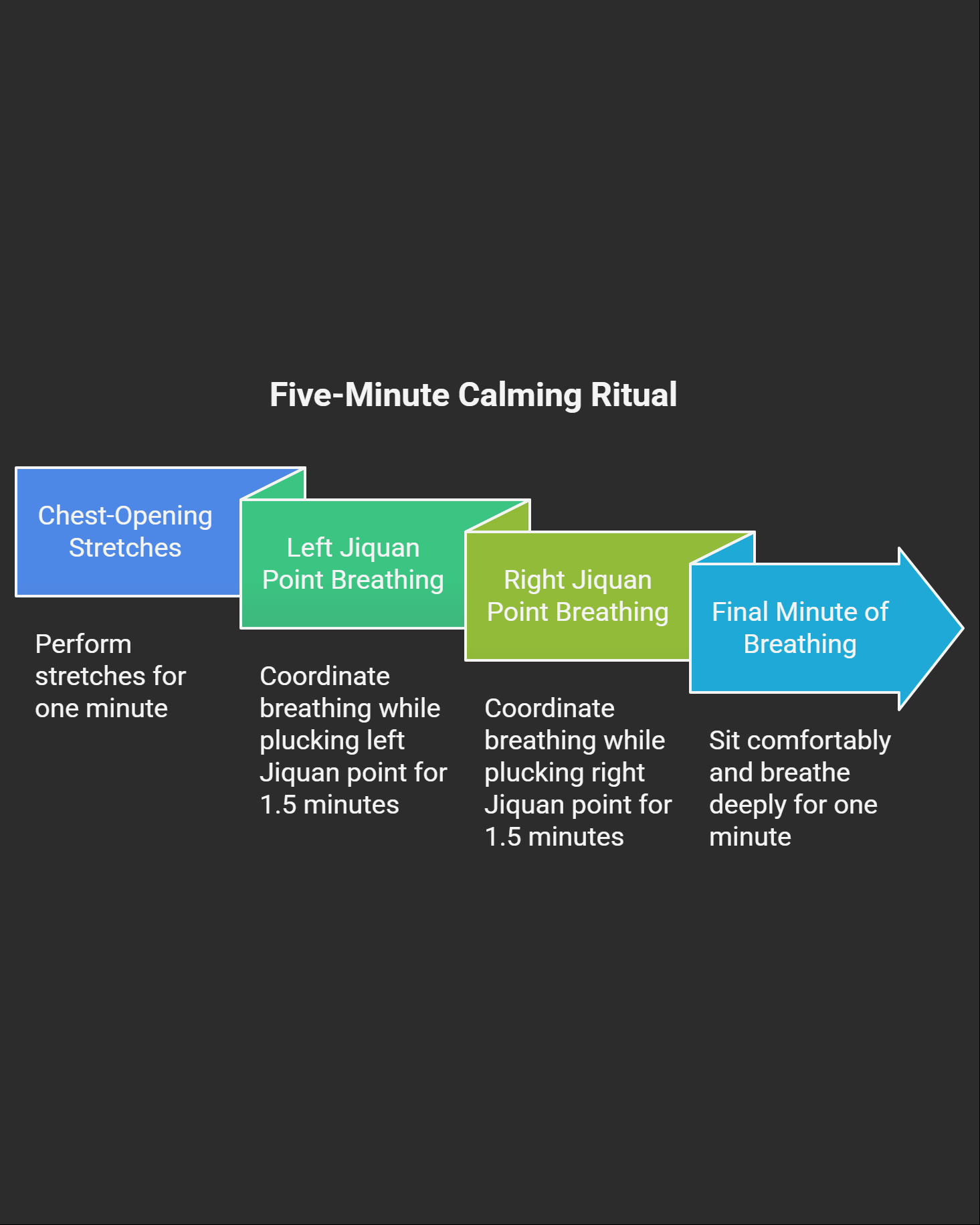
Now, let's integrate all the steps into a "Five-Minute Calming Ritual" that you can practice daily at home.First, spend one minute performing chest-opening stretches.Next, for one and a half minutes, coordinate your abdominal breathing while plucking the left Jiquan point, focusing on finding that sore, numb, radiating sensation.Then, for another one and a half minutes, switch sides and perform the same procedure on the right side.In the final minute of the ritual, put your hands down, sit comfortably, close your eyes, and simply perform one minute of abdominal breathing, taking time to savor the feeling of openness in your chest and the tranquility within your mind.This simple routine can become an effective daily tool for you to clear away stress and emotional baggage.
I encourage you not to view the Jiquan point as merely a "first-aid button" for relieving symptoms, but to treat it as a precious tool for having a dialogue with your own body.When you feel your stress multiplying and your emotions becoming tense, proactively reach for it and feel it. If it feels unusually sore, this is your body gently reminding you, "Hey, I need your attention." When this happens, consider putting aside the work at hand and giving yourself five minutes to complete the calming ritual described above.Through this approach, you can shift from passively "treating symptoms" to proactively "preventing imbalance." This is the very core of a "Happy Healthy Life."
A true "Happy Healthy Life" is not an imaginary state free of all ailments, but rather a sense of vitality that radiates from within, emotional resilience, and a profound feeling of inner peace.Regularly caring for the "Gushing Spring" (Jiquan), the wellspring of our Heart meridian, and proactively clearing away suppressed emotions and stress is, in itself, a profound act of self-compassion. What you hold in your hands is not just a massage technique; it is a golden key to unlocking mind-body harmony and returning to a natural state of joy.May you use it well, listen to the voice of your body, live from the "heart," and be at ease and in peace.


![[Happy Healthy Life] A Professional Massage Therapist's Therapeutic Secrets for the Rangu Acupoint: A Dual-Action Guide to Saying Goodbye to Plantar Fasciitis and Insomnia](https://happyhealthylife.cv/wp-content/uploads/2026/02/樂健生活:專業按摩師的然谷穴理療秘笈,告別足底筋膜炎與失眠的雙效指南-540x360.jpg)
