
Hello, I am your massage therapist. In my work, I have witnessed countless distress signals that the body sends out due to stress, fatigue, or seasonal changes. Among these, one of the most common and annoying is, without a doubt, a stuffy nose.That feeling of not being able to breathe freely and of foggy-headedness not only affects our sleep but also robs us of our focus and quality of life during the day. Many people habitually turn to medication, but today, I want to share with you a more fundamental solution, one that originates from the body's own wisdom. This is a self-healing technique I often teach my clients, a natural method that allows you to take back control of your breathing—acupressure.Let's explore together how you can use your own hands to awaken the healing power built into your body.
On this journey, we will focus on one key acupoint—Yingxiang (LI20). It is hailed as the "special-effect point for nasal issues," and its name itself is full of poetry and hope: "Welcoming Fragrance."It is not just an anatomical location; it is the crystallization of a thousand years of Traditional Chinese Medicine wisdom, a "secret switch" that can effectively clear the nasal passages and allow us to say goodbye to that suffocating feeling.Next, using my professional experience as a therapist, I will guide you step-by-step to locate, understand, and effectively use this powerful acupoint, opening the natural gateway to clear breathing and truly realizing the essence of a "Happy Healthy Life."
The Name "Yingxiang"—A Poetic Name That Implies Its Function
In the world of Traditional Chinese Medicine (TCM), the naming of acupoints is never arbitrary; it is a precise description of their function. The two characters "Ying Xiang" vividly point to its core mission—to help our nose regain its clear passage, thereby allowing us to once again "welcome" the various fragrances of life.This directly corresponds to the problem mentioned in ancient texts as "bí qiú bù lì, zhì dòng qì sè"—what we today would call a stuffy nose and a loss of the sense of smell. This wisdom, passed down for thousands of years, provides us with a powerful mnemonic aid: when you think of "Yingxiang," think of it bringing back the fragrant air. As a therapist, I am constantly in awe of this ancient wisdom that perfectly combines function with poetry.
Your Anatomical GPS — Precisely Locating the Yingxiang Acupoint
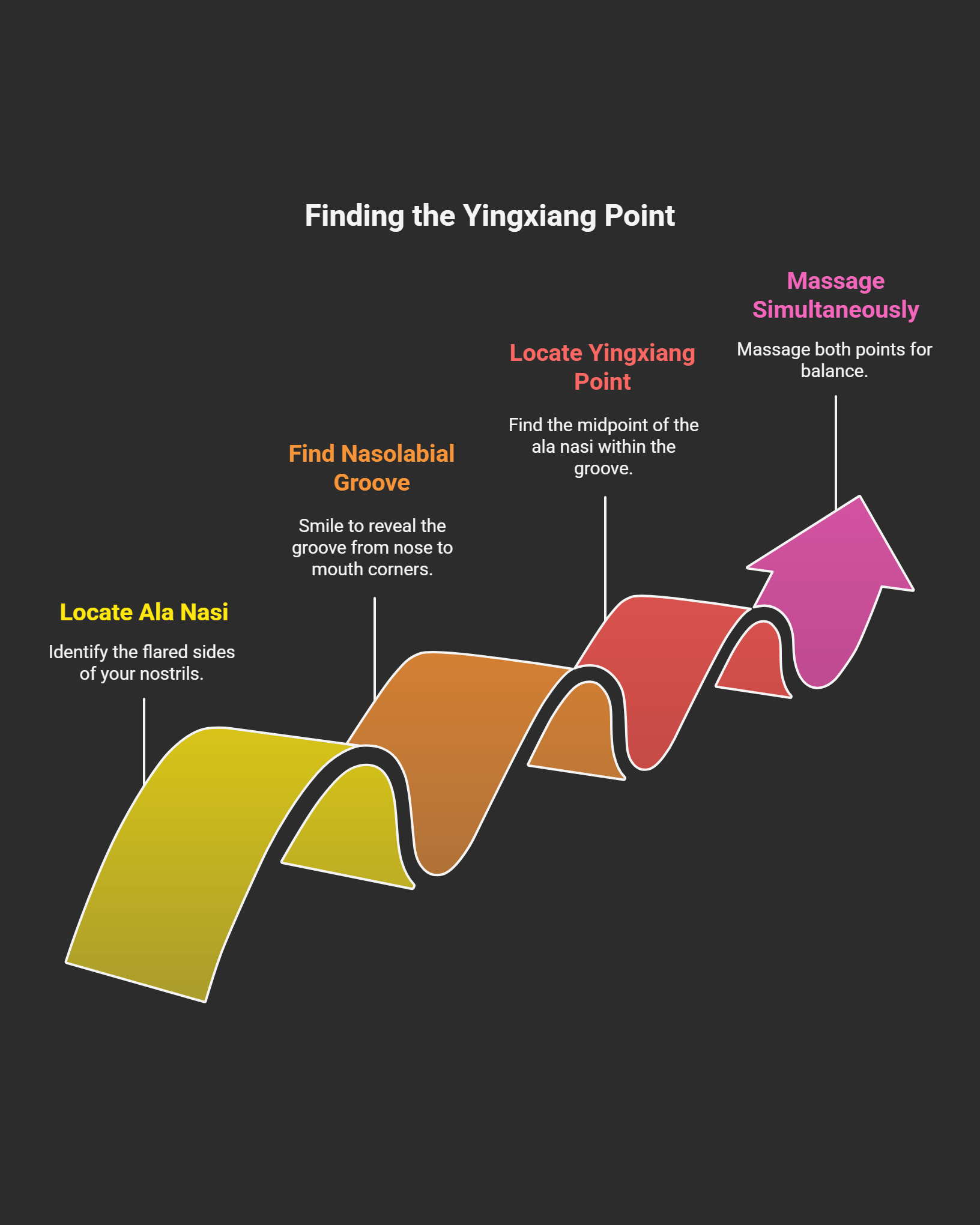
To ensure the massage has the maximum effect, the first step is precise location. Rest assured, finding the Yingxiang point is very intuitive. You can look in a mirror and follow my professional guidance:First, find the "ala nasi," which are the flared, wing-like sides of your nostrils. Next, smile gently. You will see a groove that extends from the wings of your nose to the corners of your mouth; this is the nasolabial groove, which we commonly call "smile lines" or "laugh lines."The Yingxiang acupoint is located at the midpoint of the outer border of the ala nasi, falling right within the depression of the nasolabial groove. When you gently press this area with your fingertip, you will feel a small depression with a slight sensation of soreness and distension. Congratulations, that is the Yingxiang point.Remember, there is one point on each side of your face, and they usually need to be massaged simultaneously to achieve the best balancing effect.
Meridian Connections — Why Are the Acupoints of the "Large Intestine Meridian" on the Face?
A question I am often asked is: "The Yingxiang point belongs to the Large Intestine Meridian of the Hand (Yangming), a meridian related to digestion and excretion. Why is its final point located next to the nose, which governs respiration?" This is precisely where the subtlety of the holistic view of Traditional Chinese Medicine (TCM) lies.TCM considers the Lungs and the Large Intestine to have an "interior-exterior" (Biao-Li) relationship; they are a functionally paired system. The Lungs govern respiration and "open into the nose," responsible for inhaling clear Qi. The Large Intestine governs conveyance and is responsible for excreting turbid waste. Together, they undertake the body's crucial responsibilities of "taking in the new" and "expelling the old."Therefore, when pathogenic factors ("evil Qi") or "turbid Qi" from a cold or allergy accumulate in the nasal cavity, stimulating the final station of the Large Intestine meridian—the Yingxiang point—is like opening the last gate on the "turbidity-expelling highway." This effectively disperses the entrenched pathogenic Qi and restores clarity to the airway.
The Pre-Healing Ritual
As a massage therapist, I know the deep importance of preparation. A simple ritual not only enhances the effect of the massage but also allows your mind and body to enter a relaxed, healing state.Before you begin, please ensure your hands are clean. Find a comfortable place to sit, relax your shoulders, close your eyes, and take three to five long, deep abdominal breaths.If you have time, I highly recommend an optional step: gently place a warm towel around your nose for a few minutes. The warmth helps to relax the tight local muscles and promote blood circulation, perfectly preparing your facial skin and underlying tissues for the healing touch to follow.
Core Technique: Mastering Pressure, Dynamics, and Rhythm
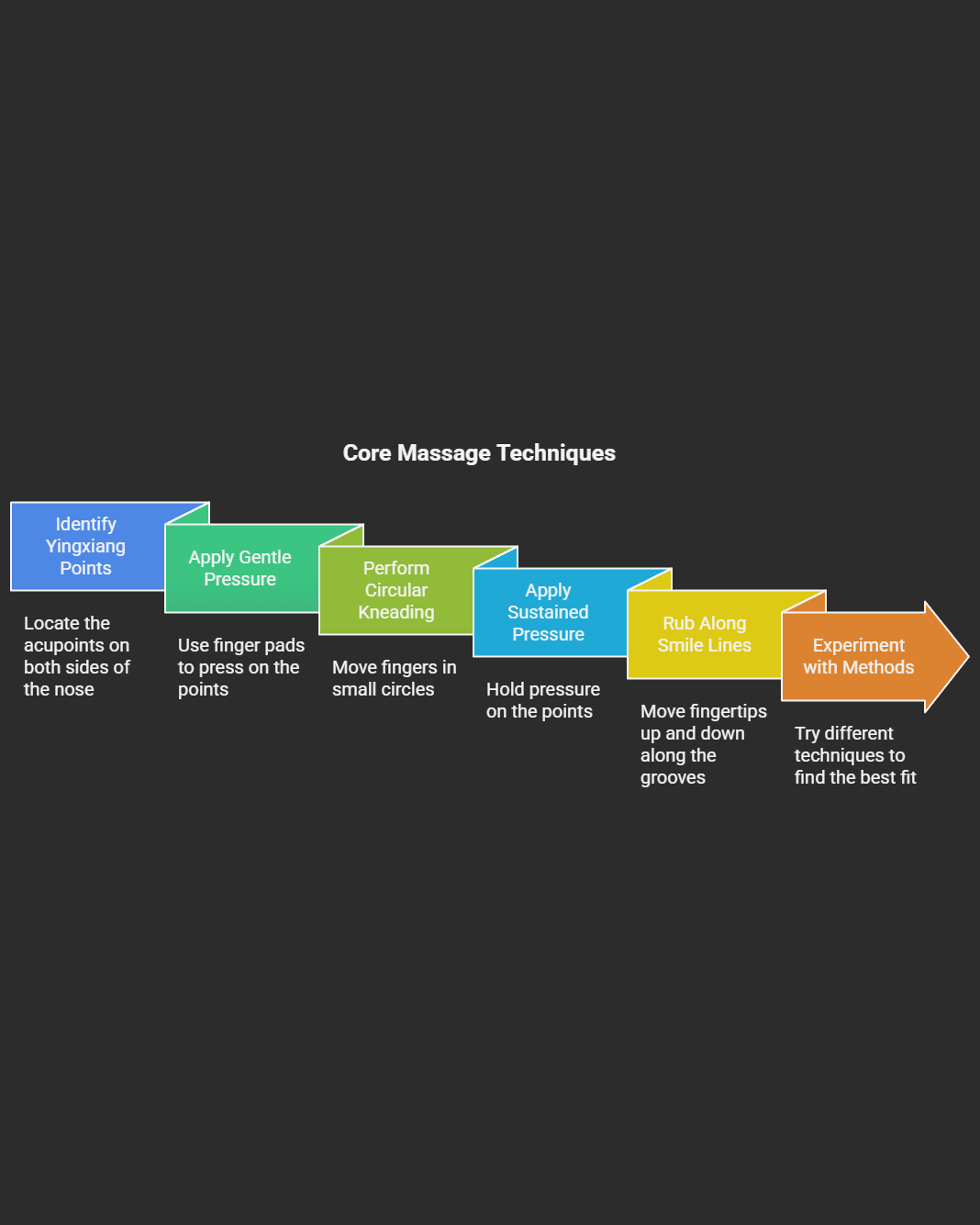
Now, let's move on to the core massage techniques. I will share with you the most commonly used and remarkably effective methods in the industry.Please use the pads of your index or middle fingers on both hands to gently press on the Yingxiang points on both sides. Apply a gentle yet firm pressure and begin to make small, circular kneading motions, either clockwise or counter-clockwise. Imagine you are gently awakening the acupoint.In addition to circular kneading, you can also try applying sustained pressure directly to the points, or use your fingertips to gently rub up and down along the smile lines (nasolabial grooves) on both sides of your nose. You can experiment with these different methods to find the one that is most suitable and feels most comfortable for you.
Calibrating Your Sense of Touch — Finding the "Golden Standard" of De Qi
The pressure of the massage is the key to its success, and the goal is absolutely not pain. We are looking for a special sensation known as "De Qi." When you apply just the right amount of pressure, the local area will produce a slight feeling of "soreness, numbness, distension, or heaviness," which I usually describe to my clients as "a comfortable, sore, and full sensation."This is the signal that the acupoint has been successfully activated, indicating that the body's Qi and Blood are gathering at this point and producing a healing effect. It is crucial to remember that the ideal pressure is one that brings about this sore and full sensation, and it should never reach the level of sharp, piercing pain. Overly aggressive pressure is not only unhelpful but can also cause minor inflammation of the local tissue, which runs contrary to our healing intention.
Optimal Timing and Frequency — Integrating Healing into Your Life
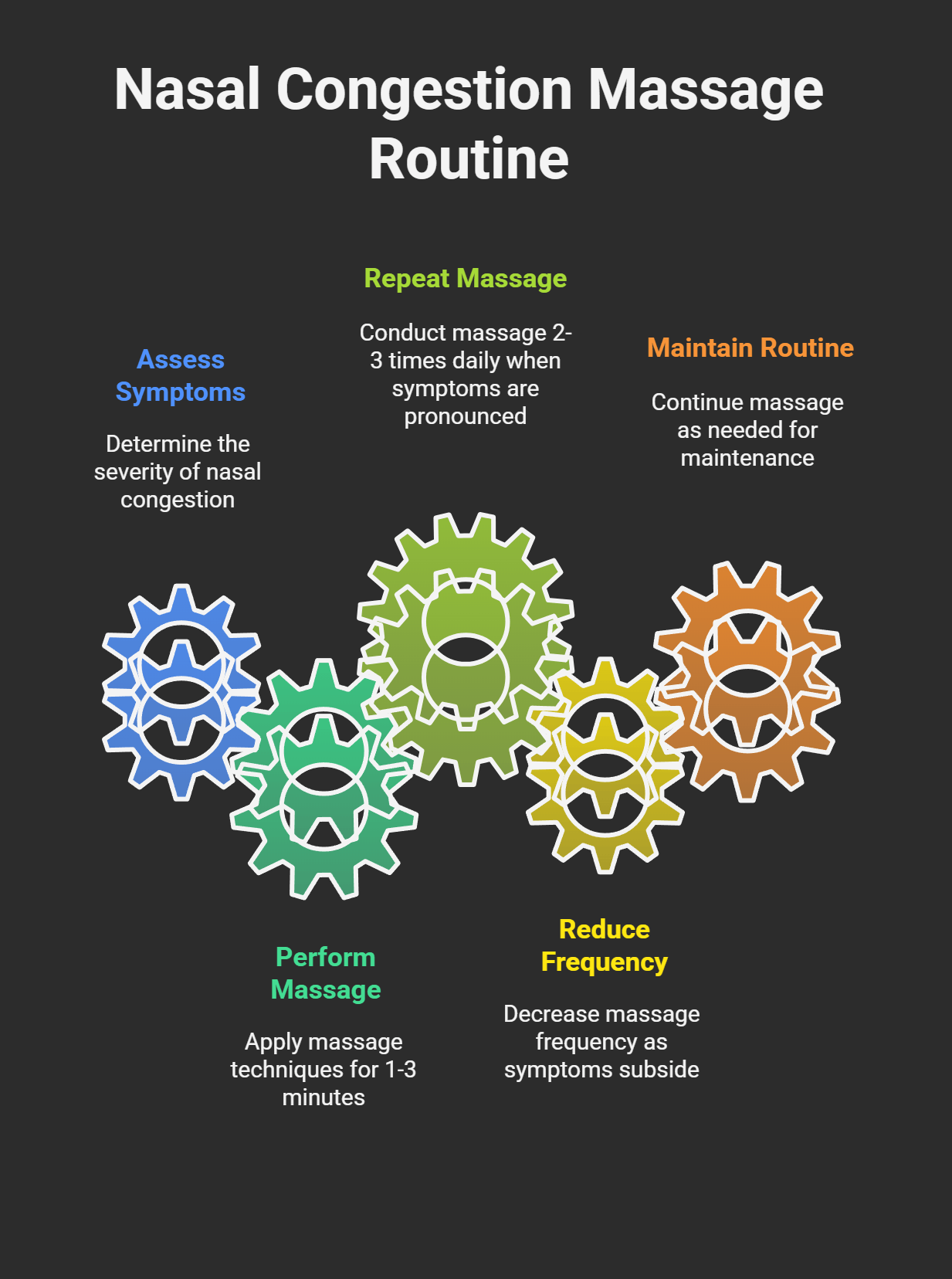
Regarding the duration and frequency of the massage, you can be flexible and adjust according to your personal needs. The practical advice I give my clients is: each massage session should last for about 1 to 3 minutes.When your symptoms of nasal congestion are more pronounced, I recommend performing the massage 2 to 3 times a day, for example, when you wake up in the morning, during your lunch break, and before going to bed at night.Once the symptoms have subsided, you can reduce the frequency, or perform it anytime as maintenance whenever you feel a little bit of nasal discomfort.Some traditional methods suggest kneading in both clockwise and counter-clockwise directions for 36 circles each. You can use this number as a guideline to help you concentrate and maintain a rhythm, but the most important thing is to focus on the sensation in the moment and have a dialogue with your body.
Through the Lens of Modern Science: A Dialogue with the Nervous System
Interestingly, when modern science has studied the massage of the Yingxiang acupoint, a phenomenon of "objective stasis, subjective improvement" has been observed. Clinical studies show that after the massage, the actual width of the nasal passages as measured by instruments may not have changed significantly. However, nearly all test subjects report that they "feel" their breathing has become much smoother.How can this be explained? The key lies in the nervous system. The area of the Yingxiang point is innervated by branches of the trigeminal nerve, and this nerve is closely related to the brain's perception of airflow in the nasal cavity. When we perform the massage, the pressure from our fingertips sends a large volume of new, benign tactile signals to the brain. These signals "override" or "modulate" the brain's processing of the blockage signals, thereby changing our subjective perception. This is not a placebo effect, but a real "neural recalibration."
The Wisdom of Shifting from Passive Emergency Relief to Proactive Maintenance
Acupressure is not just a "fire-fighting squad" for when symptoms appear; it is, more importantly, a powerful "firewall."Regularly massaging the Yingxiang point and its related acupoints can effectively improve blood circulation around the nasal cavity, enhancing the nasal mucosa's ability to adapt to changes in temperature and humidity, as well as its resistance to allergens. I encourage you to incorporate this simple massage into your daily routine, for example, to refresh yourself in the morning when you wake up, or during your evening skincare regimen.Especially during allergy season or peak cold and flu season, a few minutes of preventive massage each day can significantly reduce the frequency and severity of flare-ups, helping you to maintain the long-term health of your respiratory tract.
Safety First—Please Listen to Your Body's Voice
As a responsible health practitioner, I must emphasize that the prerequisite for self-healing is absolute safety. Please be sure to avoid massaging on skin that has open wounds, rashes, or severe acne.Most importantly, you must recognize the "red-flag signals." Acupressure is a complementary therapy; it cannot replace a professional medical diagnosis. If your nasal congestion does not improve after several weeks, if you show signs of an infection such as a fever or yellow-green nasal discharge, or if the congestion is so severe that it affects your normal breathing, you must seek timely medical attention from a qualified physician.
Conclusion: The Healing Power in Your Hands
From the ancient wisdom of the Yingxiang acupoint to the subtle explanations of modern neuroscience, we have seen the profound healing potential contained within a simple touch.The core message of this guide is "empowerment"—empowering you with the proof that the tools for healing are often right in our own hands. I hope you will transform this knowledge into action and, through an intimate dialogue with your own body, say goodbye to the troubles of a stuffy nose and once again welcome every clear, fresh breath.This is the most real and accessible practice of a "Happy Healthy Life."

![[Happy Healthy Life Column] A Massage Therapist's Guide to Proper Heat Therapy for Deep Tissue Relief](https://happyhealthylife.cv/wp-content/uploads/2026/03/樂健生活專欄:推拿師教你正確溫熱敷,達到深層肌肉舒緩-540x360.jpg)
![[Happy Healthy Life] Unlocking Your Body’s Self-Healing Power: A Professional Massage Therapist’s Guide to Ending Chronic Fatigue Through Gua Sha and Fascial Release](https://happyhealthylife.cv/wp-content/uploads/2026/02/樂健生活】解鎖身體自癒力:專業按摩師帶你以刮痧與筋膜放鬆告別慢性疲勞抽象藝術圖像-540x360.jpg)
