
Hello, I am your health advisor and massage therapist. In my studio, I have witnessed countless souls who are burdened by the pressures of modern life. They walk in with tense shoulders, never-ending thoughts, and an indescribable sense of exhaustion, all seeking a moment of peace.This widespread anxiety and stress is not just a psychological feeling; it is a chronic physiological overload. Statistics tell us that here in the UK, as many as 74% of adults feel overwhelmed, and symptoms of anxiety affect a huge portion of the population. This mental tension ultimately reflects in our bodies, especially our sleep quality, leading to many sleepless nights.
However, ancient wisdom provides us with a blueprint for dealing with this modern chaos. Traditional Chinese Medicine (TCM) theory is like a sophisticated map of the body, guiding us to find the path back to balance.Today, I will lead you on an in-depth exploration of a key node on this map—the Tongli acupoint (HT5), located on your arm. It is not just an acupoint; it is a gateway that leads directly to the tranquility deep within your heart.Are you ready to learn how to use this powerful tool, take back the remote control for your emotions, and unlock a "Happy Healthy Life" of mind-body harmony?
Decoding the Heart's Whispers: The TCM Perspective on Your Emotional Storms
In the philosophy of Traditional Chinese Medicine (TCM), the "Heart" is not merely the pump that sustains life; it is the "Monarch Official" (君主之官) that governs all our internal organs. The Heart's most important responsibility is to peacefully house our "Shen" (神)."Shen" is a beautiful and profound concept that encompasses our consciousness, mental vitality, emotional state, and the clarity of our thoughts. When your Heart Qi is abundant and flows smoothly, your "Shen" can reside peacefully within the Heart. You will experience clear thoughts, a joyful mood, and be able to sleep soundly at night. This is the ideal state of mind-body balance.
However, the constant stress, overwhelming information, and complex emotional fluctuations of modern life are continuously impacting and depleting your Heart Qi. When the energy of the Heart is disturbed or becomes weak, the "Shen" loses its peaceful home and begins to "drift restlessly."This is when you experience those all-too-familiar symptoms: a lingering sense of anxiety, insomnia and difficulty falling asleep, unsettling heart palpitations, and that state of "brain fog" where it feels as though your mind is shrouded in mist. From a TCM perspective, these are not isolated problems, but distress signals from your "Heart."
Exploring the Tongli Acupoint (HT5): The "Connecting Pathway" on Your Arm
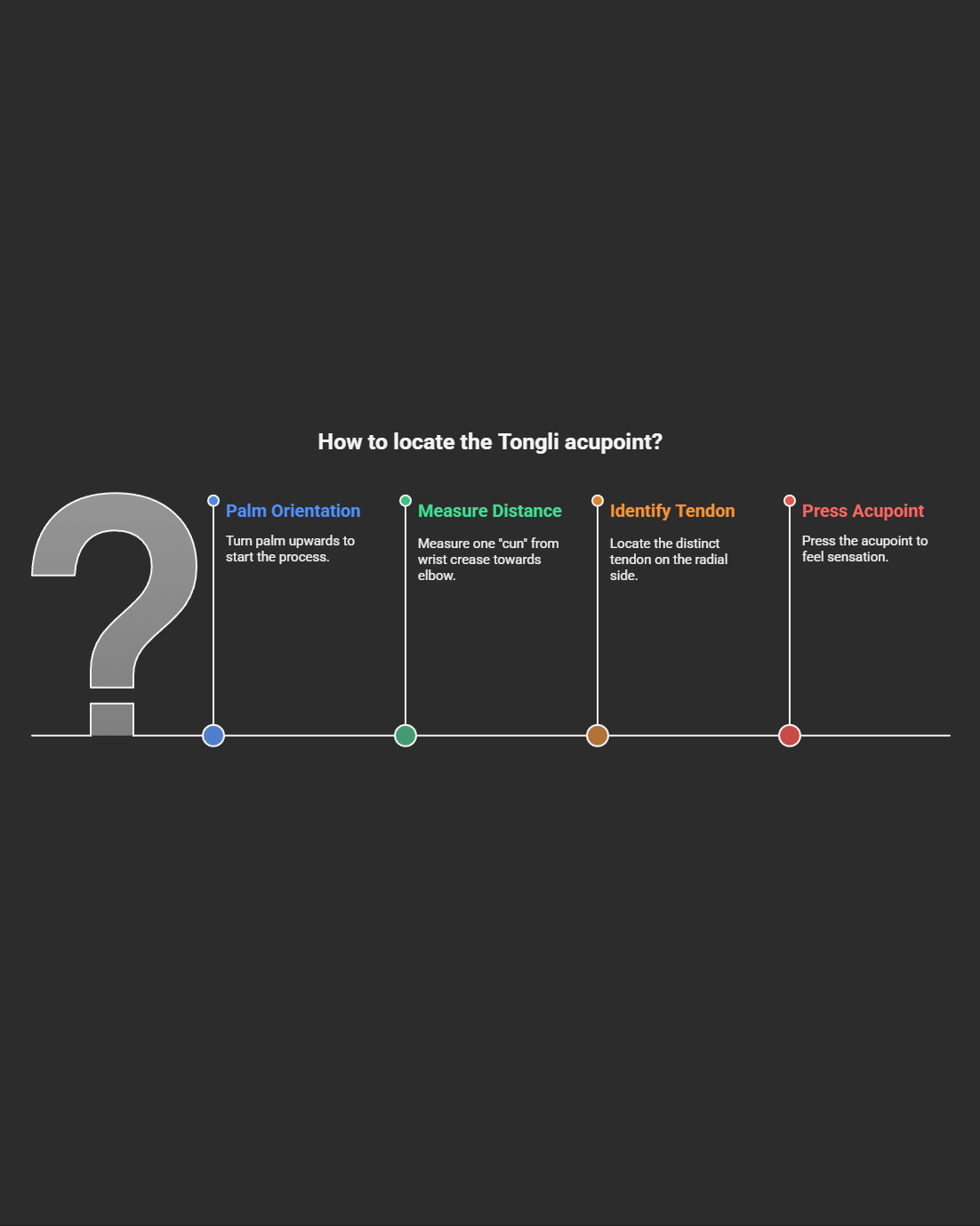
Now, let's find this powerful acupoint that can directly soothe your Heart-spirit.Please turn your palm to face upwards and look at the crease of your wrist. From this crease, measure upwards towards your elbow by about the width of your own thumb (this is known as one "cun" in Traditional Chinese Medicine). You will feel a distinct tendon, and in the small depression on the thumb-side (radial side) of this tendon, you will find the Tongli point.When you press it, you may feel a slight sensation of soreness, numbness, or distension. This is the signal that the acupoint has been activated and proof that you have found the right spot.
The name "Tongli" (通里) is itself full of poetic and functional meaning. Its literal translation is "to connect to the interior" or "connecting pathway." This name perfectly describes its unique role within our body's energy system.In Traditional Chinese Medicine theory, the Tongli point is the "Luo-connecting point" (絡穴) of the Heart meridian, acting like an energy "junction box." It sends out a connecting channel (絡脈) that tightly links the Heart meridian (which belongs to the element of "Fire") with its internally-externally paired Small Intestine meridian, thereby establishing a cross-system network for communication and balance.
The Science of Connection: How Ancient Wisdom Dialogues with Modern Neuroscience
You might be curious as to how stimulating a small point on the arm can have such a profound impact on our emotions and thoughts. The secret to this, surprisingly, aligns with the discoveries of modern neuroscience.The pairing relationship in Traditional Chinese Medicine between the Heart (which governs emotions) and the Small Intestine (which separates the pure essence from the turbid waste, symbolizing clarity of thought) perfectly corresponds to what modern medicine calls the "gut-brain axis." This is a bidirectional superhighway that connects our brain with the "second brain" in our gut, and the nerve responsible for keeping this line clear is the vagus nerve.
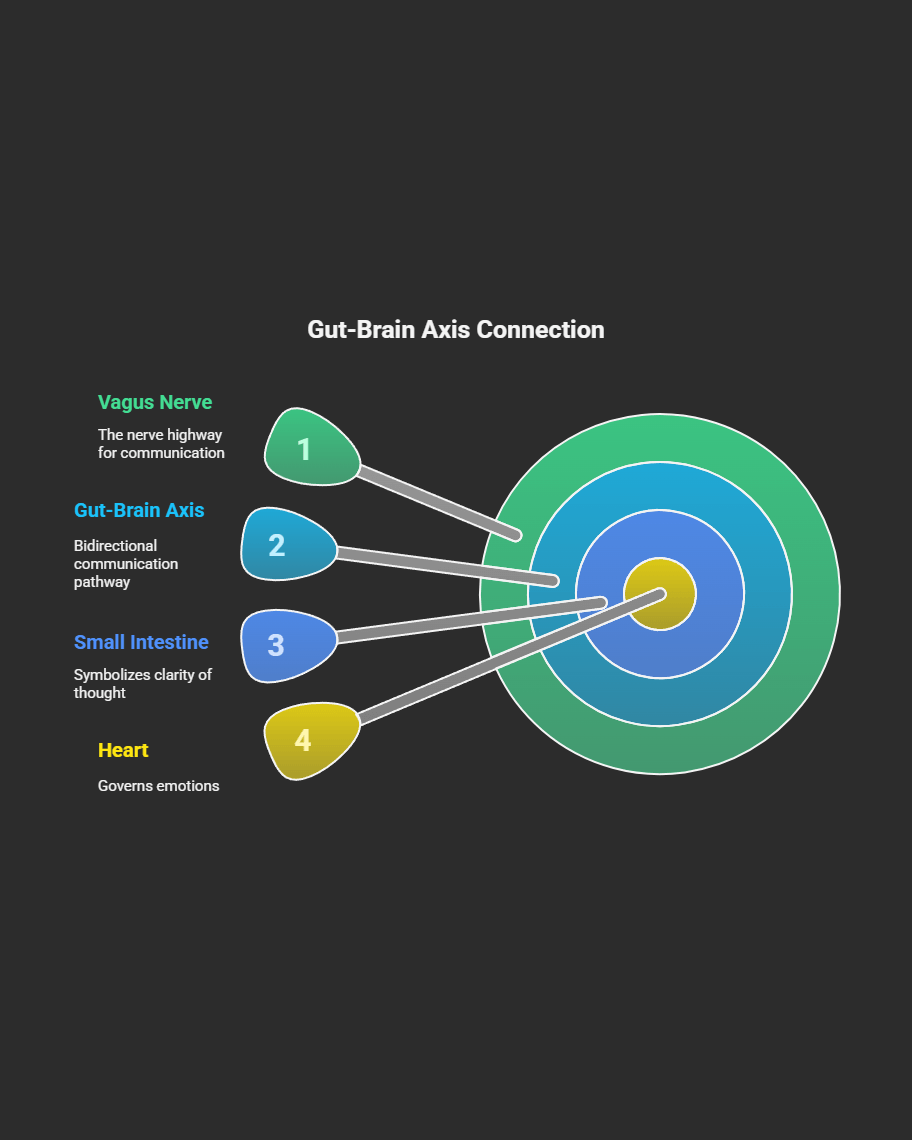
Stimulating the Tongli point, which acts as the "switchboard" for the Heart and Small Intestine, is, in effect, regulating the activity of the entire heart-gut-brain axis by activating the vagus nerve.This is not just empty talk. Scientific research has found that acupuncture at the Tongli point can significantly reduce the activity indicators of the sympathetic nervous system (which represents the "fight or flight" mode). This means it can switch your nervous system from a state of stress to the calm "rest and digest" mode.Furthermore, functional Magnetic Resonance Imaging (fMRI) studies have confirmed that stimulating the Tongli point specifically activates areas in the brain related to language function. This provides modern scientific evidence for its use in treating issues such as stress-induced aphonia (loss of voice).
The Wrist's Three Calming Treasures: How to Choose the Most Suitable Acupoint for You
On the inner side of our wrist lies a powerful "calming zone." In addition to the Tongli point, there are two other very important acupoints. Understanding the specialty of each one can make your self-care more targeted.First is the Shenmen point (HT7), located on the wrist crease. It also belongs to the Heart meridian and is the primary choice for dealing with severe anxiety, insomnia, and emotional instability. It is also very helpful for improving memory decline caused by a restless "Shen" (spirit). In short, the Shenmen point is a major acupoint for directly "calming the Shen."
Second is the Neiguan point (PC6), located two cun (about three finger-widths) above the wrist crease, between the two central tendons. It belongs to the Pericardium meridian, which is the barrier that protects the Heart. The unique specialty of the Neiguan point is its ability to treat all kinds of stuffiness and discomfort related to the chest. It is therefore particularly effective for anxiety that is accompanied by a feeling of chest tightness or nausea. It is also the well-known "motion sickness point."To put it simply:When anxiety is accompanied by palpitations, prioritize the Tongli point.When insomnia is your main concern, focus on the Shenmen point.When anxiety makes you feel chest tightness and nausea, the Neiguan point is your best partner.
From the Clinic to Your Home: Integrating Professional Techniques into Your Daily Routine
In my clinical practice, I first release the "myofascia" of the client's entire forearm. This layer of connective tissue, which envelops our muscles and nerves, can become stiff under long-term stress, obstructing the flow of Qi and Blood. I use professional Tui Na techniques, such as the "rolling method" and the "kneading method," to first release the surrounding tension, which allows the subsequent acupoint stimulation to have its maximum effect.However, true healing happens through consistent self-care. Research has confirmed that merely learning self-acupressure can significantly improve the mental health of populations under high stress.
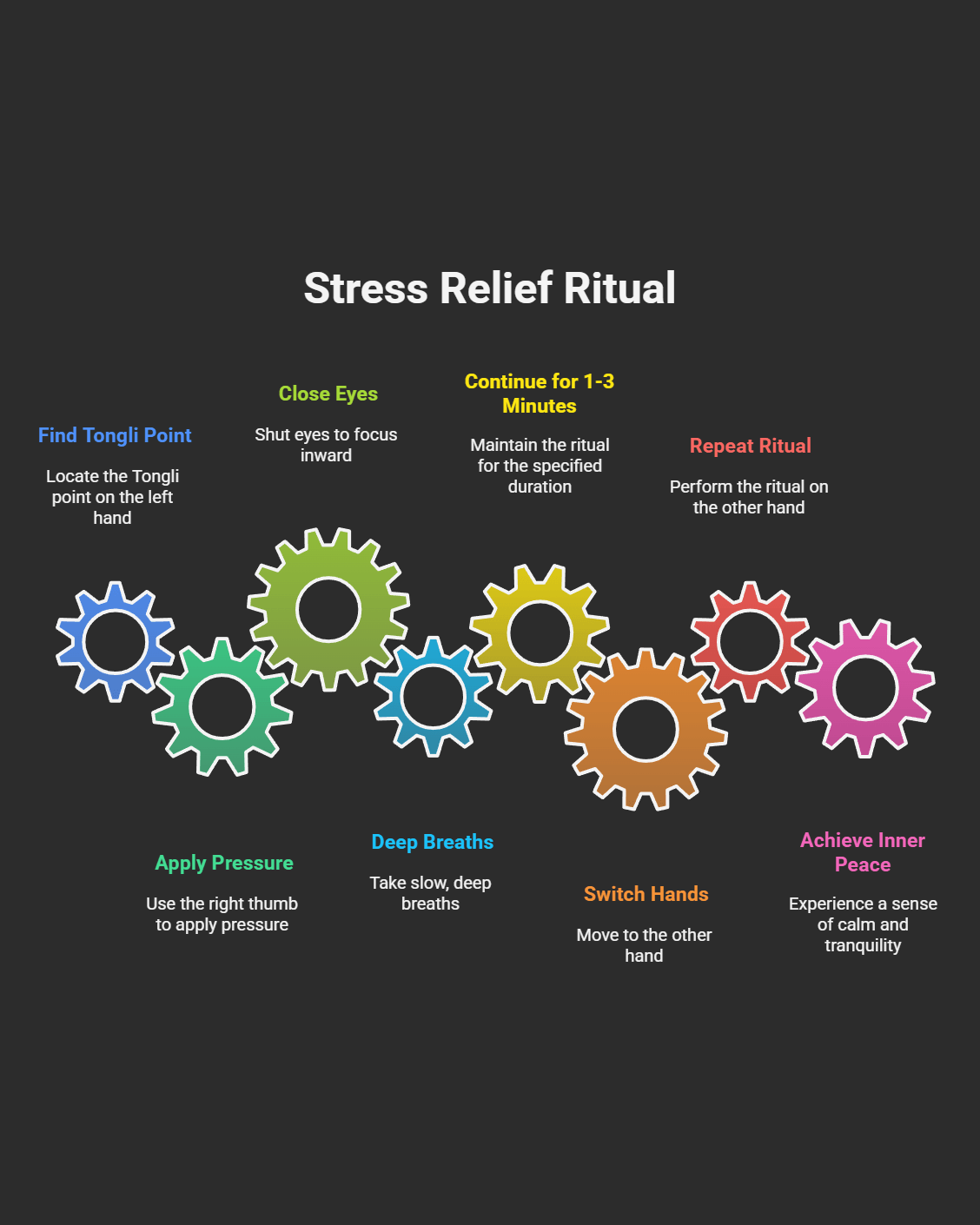
Now, I place this power in your hands.Please sit comfortably and find the Tongli point on your left hand. Using the thumb of your right hand, apply a gentle yet firm pressure. Close your eyes and begin to take long, slow, deep breaths.You can either apply sustained pressure or make gentle circular motions on the point. Continue for 1 to 3 minutes, and then switch hands. This simple ritual can be performed whenever you feel stress coming on, or before you go to sleep, to help you quickly find your inner peace.
Your Two-Minute "Desk Reset" Ritual
For those of you who work at a computer for long hours, I have designed a quick routine to combat physical and mental tension.First, extend one arm with your palm facing up. Use your other hand to gently bend your fingers downwards, stretching the inner forearm for 30 seconds.Next, turn your palm over to face down and stretch again for 30 seconds.After completing the stretches, use the remaining time to press the Tongli point on each hand alternately for 30 seconds each, focusing your full attention on your breath.This small break can effectively interrupt the accumulation of stress and give your mind and body a chance to reboot.
If your forearm feels particularly stiff, you can use a tennis ball or a massage ball for assistance. Place the ball on a table and rest your forearm on top of it. Use your body weight to slowly roll from your elbow to your wrist.When you find a particularly sore point, hold the pressure there for 10 to 20 seconds and breathe deeply until you feel the tightness gradually release. This action provides a deeper release of the myofascia, creating a more unobstructed environment for energy to flow through the Heart meridian, thereby amplifying the mind-calming effect of the Tongli point.
Conclusion: Reconnect—Calmness is in Your Hands
We started from the clamor of modern life and, in the end, found that ancient and profound healing wisdom within our own bodies. The Tongli acupoint (HT5) is not just a physical point; it is a symbol—a symbol of the innate ability we all possess to self-regulate and restore balance.It reminds us that the path to inner peace is not distant or unattainable; it is clearly marked on our own body's map, waiting for us to explore and connect with it.
Integrating the wisdom of Traditional Chinese Medicine into your daily life does not require complex tools or profound knowledge. All it requires is your awareness, your own two hands, and a heart that is willing to listen to the voice of your body.Health and happiness are never a final destination, but a continuous process of loving practice. I hope that this gift from ancient wisdom can help you find your own sense of certainty and tranquility in this turbulent world. Please remember, the power to find inner peace is, truly and tangibly, right in your own hands.


![[Happy Healthy Life] A Professional Massage Therapist's Therapeutic Secrets for the Rangu Acupoint: A Dual-Action Guide to Saying Goodbye to Plantar Fasciitis and Insomnia](https://happyhealthylife.cv/wp-content/uploads/2026/02/樂健生活:專業按摩師的然谷穴理療秘笈,告別足底筋膜炎與失眠的雙效指南-540x360.jpg)
