
Foreword: Why Do You Wake Up with a "Locked" Neck?
You wake up, and the world seems to have frozen. You just want to turn your head to look at the alarm clock, but a sharp, piercing pain shoots up from your neck, leaving you unable to move.Your neck feels as if it's trapped in invisible shackles; every tiny movement is accompanied by intense pain and stiffness. This isn't just pain; it's a profound sense of helplessness that disrupts your entire day's plans and mood.
As a practicing massage therapist, I deal with cases of stiff neck (acute torticollis) every single day. I want to tell you, from professional experience, that this is not as simple as just "bad luck" or "sleeping in the wrong position."A stiff neck is, in fact, the final cry of distress from your neck muscles after an accumulation of long-term stress. It is an acute flare-up resulting from the combined effects of chronic strain and fatigue.
But the good news is, you hold two powerful yet gentle keys in your own hands that can unlock these shackles: precise warm compresses and gentle movement.In this article, from my perspective as a therapist, I will not only teach you "what to do" but also provide an in-depth analysis of "why this is effective." This will allow you to truly understand your own body, learn to communicate with it, and thereby master the power of self-healing, moving towards a true "Happy Healthy Life."
Chapter One: Listening to Your Neck's Distress Signals—A Stiff Neck Isn't Just the Pillow's Fault
1.1 Unveiling the Deeper Truth About Stiff Necks
Many people's first reaction after waking up with a stiff neck is to blame the pillow. While an unsuitable pillow is indeed a common trigger, it's more like the spark that ignites the gunpowder, not the gunpowder itself. The real problem has long been lurking in your daily life.We must establish a "chronic-to-acute" conceptual model. Medically, this condition is known as "acute cervical periarthritis" (a form of acute torticollis).
In other words, in the moments before you woke up with a stiff neck, the muscles in your neck were already in a state of "overwork," and a poor sleeping posture merely gave them an excuse to "go on strike."This intense pain and stiffness are actually a protective mechanism of the body. Your nervous system perceives that the tissue is vulnerable and unstable, so it orders the muscles to lock up to prevent further injury.
1.2 Getting to Know the Three Main Culprits Behind the Scenes
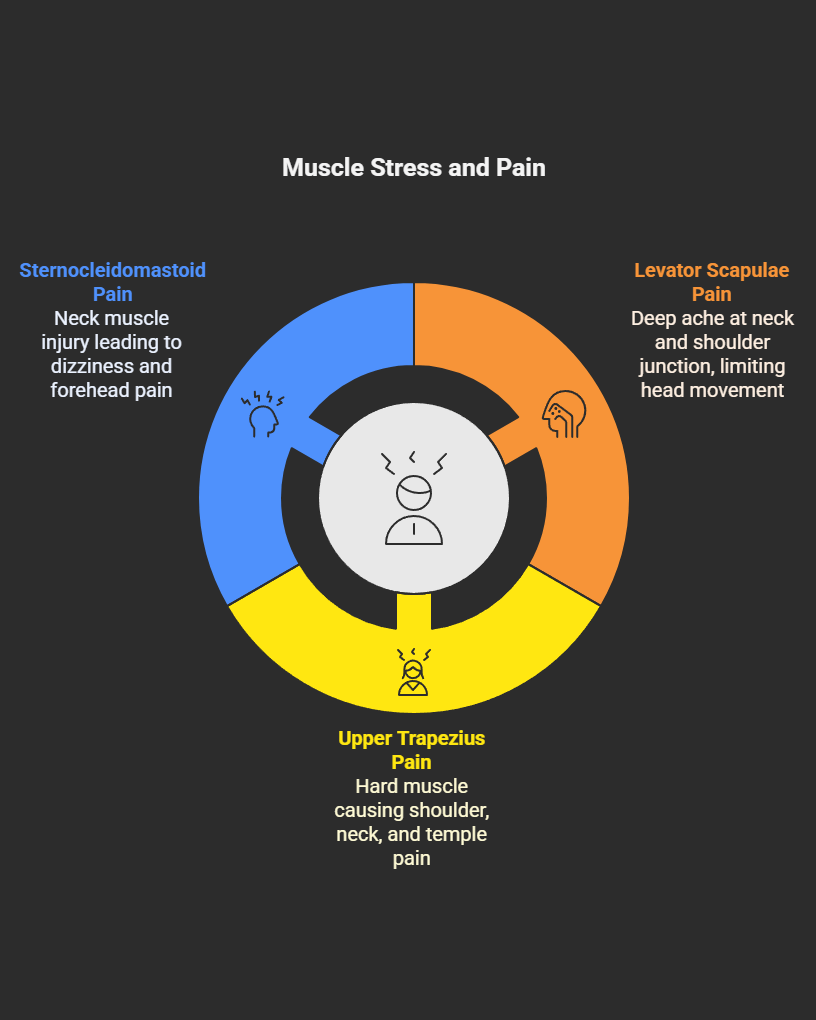
When you have a stiff neck, it's usually not just one muscle that is in pain. From my experience as a therapist, there are several "usual suspects" that are almost always involved. Understanding what they are will help you know how to soothe them with precision:
- Levator Scapulae: This "shrugging muscle" silently bears the burden when you are under prolonged stress and unconsciously shrug your shoulders. Its pain points are usually concentrated at the junction of the neck and shoulder, as well as along the inner border of the shoulder blade, creating a deep, aching sensation that makes it difficult to turn your head.
- Upper Trapezius: This "stress muscle," with which we are all too familiar, becomes as hard as a steel plate from prolonged periods of looking down at a phone, carrying heavy bags, or emotional tension. Its trigger points not only cause shoulder and neck pain but also frequently refer pain to the temples, creating a classic "tension headache."
- Sternocleidomastoid (SCM): This is the most prominent muscle on the side of your neck when you turn your head. Sleeping on your stomach or with your head excessively twisted can cause it to become injured by being held in an extremely shortened or lengthened state overnight. Problems with this muscle can sometimes be accompanied by complex symptoms such as dizziness and forehead pain.
1.3 The Invisible Neck Killer
In addition to the mechanical strain on the muscles, there are other invisible factors quietly eroding the health of your neck. When we face chronic stress, the body keeps muscles like the trapezius in a constant state of tension, as if preparing for a fight. This leads to ischemia (reduced blood flow) and an accumulation of metabolic waste, ultimately making the muscles fragile and prone to spasms.
Furthermore, water is key to maintaining the elasticity of your intervertebral discs, which are like the shock-absorbing cushions for your spine. Dehydration causes these discs to lose their cushioning ability, increasing the pressure on surrounding tissues. The muscles themselves also require water to maintain their elasticity.Finally, an imbalance of electrolytes in the body, such as magnesium and potassium, can cause errors in neuromuscular signals, making muscles more prone to uncontrollable spasms and cramps.
Chapter Two: The Healing Magic of Warm Compresses—More Than Just Warmth, It's Deep Repair
2.1 The Scientific Principle Behind Heat Therapy
When you place a warm compress on your stiff neck, it's not just about "feeling comfortable"—it's a deep physiological repair process. The heat causes the local micro-vessels to dilate, allowing a rush of oxygen- and nutrient-rich blood to flood the area. This also more efficiently carries away the metabolic waste products, such as lactic acid, that cause pain, thereby alleviating the pain at its source.
At the same time, the warmth can directly reduce the muscle spasm "alarm," breaking the vicious cycle of "pain-spasm-more pain." It also increases the elasticity of connective tissues like fascia and tendons, making stiff muscles softer and perfectly preparing them for the gentle movements that will follow. This is why heat therapy is the first-choice strategy for us therapists when dealing with muscle stiffness.
2.2 Heat vs. Ice: Debunking the Century-Old Myth About Stiff Necks
"For an injury, should I use ice or heat?" This is a classic dilemma. But for a typical stiff neck that you discover upon waking, the answer is actually very clear.Most cases of stiff neck originate from muscle spasms caused by prolonged ischemia (lack of blood flow) and tightness; there is usually no obvious redness, swelling, heat, or acute pain. In this situation, applying ice could actually cause the muscles to contract even more, exacerbating the discomfort.
Therefore, for this type of stiffness-induced stiff neck, our primary goal is to restore blood flow and break the spasm cycle, so using a warm compress from the very beginning is generally the wiser choice.Of course, if you clearly remember that the stiff neck occurred after a sudden, forceful pull and there is a localized burning sensation, then the correct approach is to first apply ice for the initial 24 hours to control the inflammation.
2.3 A Professional Massage Therapist's Guide to Warm Compresses
To achieve the best therapeutic effect, the details are key. Please follow the "Three Rights" principle below:
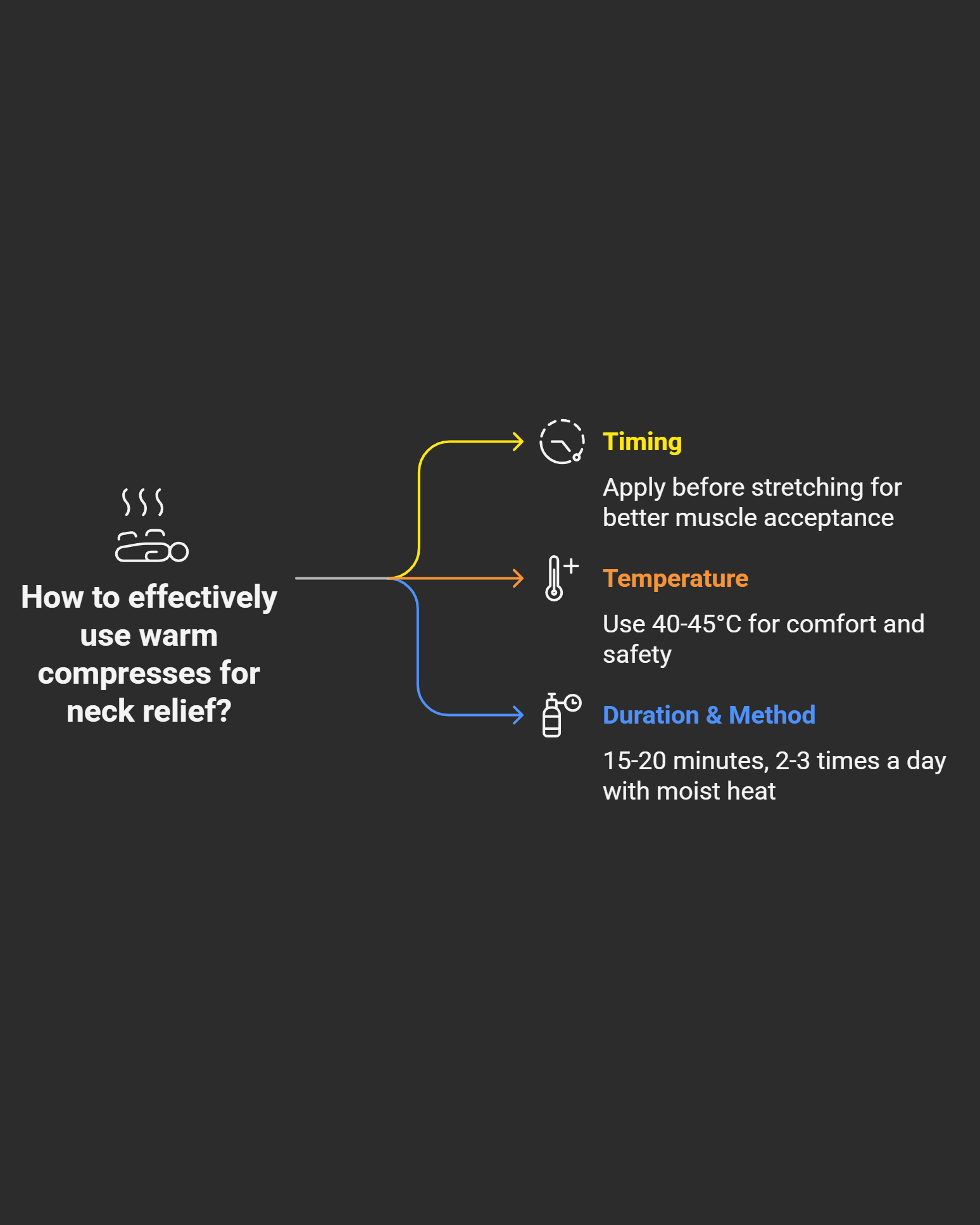
- The Right Timing: You can start as soon as you notice something is wrong with your neck. Applying a warm compress, especially right before you are about to perform stretching exercises, allows the muscle tissue to accept the subsequent activity more safely and effectively, doubling the results.
- The Right Temperature: The temperature should be between 40 and 45 degrees Celsius (104-113°F). It should feel "warm and comfortable," not scalding hot. Be sure to wrap the heat source in a towel to avoid direct contact with the skin and prevent burns. Safety first.
- The Right Duration and Method: Each warm compress session should last for 15 to 20 minutes, and you can do this 2 to 3 times a day. Moist heat (such as a heated wet towel) has better penetration than dry heat and can relax the muscles more deeply. Please focus the heat source on the base of the back of your neck and the most sore areas of your shoulders.
Chapter Three: The Art of Gentle Movement—Making Peace with Your Neck, Not Fighting It
3.1 The Therapist's Core Principle: Finding Freedom Within a Pain-Free Range
Before performing any activity, you must remember my number one rule: "Do not stretch into pain." Pain is a "stop" signal from your nervous system. Forcibly challenging it will only trigger a more intense protective muscle contraction, making the situation worse. Our goal is to gently "awaken" the neck and resend "safety" signals to the brain.
3.2 Three-Stage Neck Awakening Exercises
Please be sure to start from stage one and progress gradually, paying attention to the changes in your body.
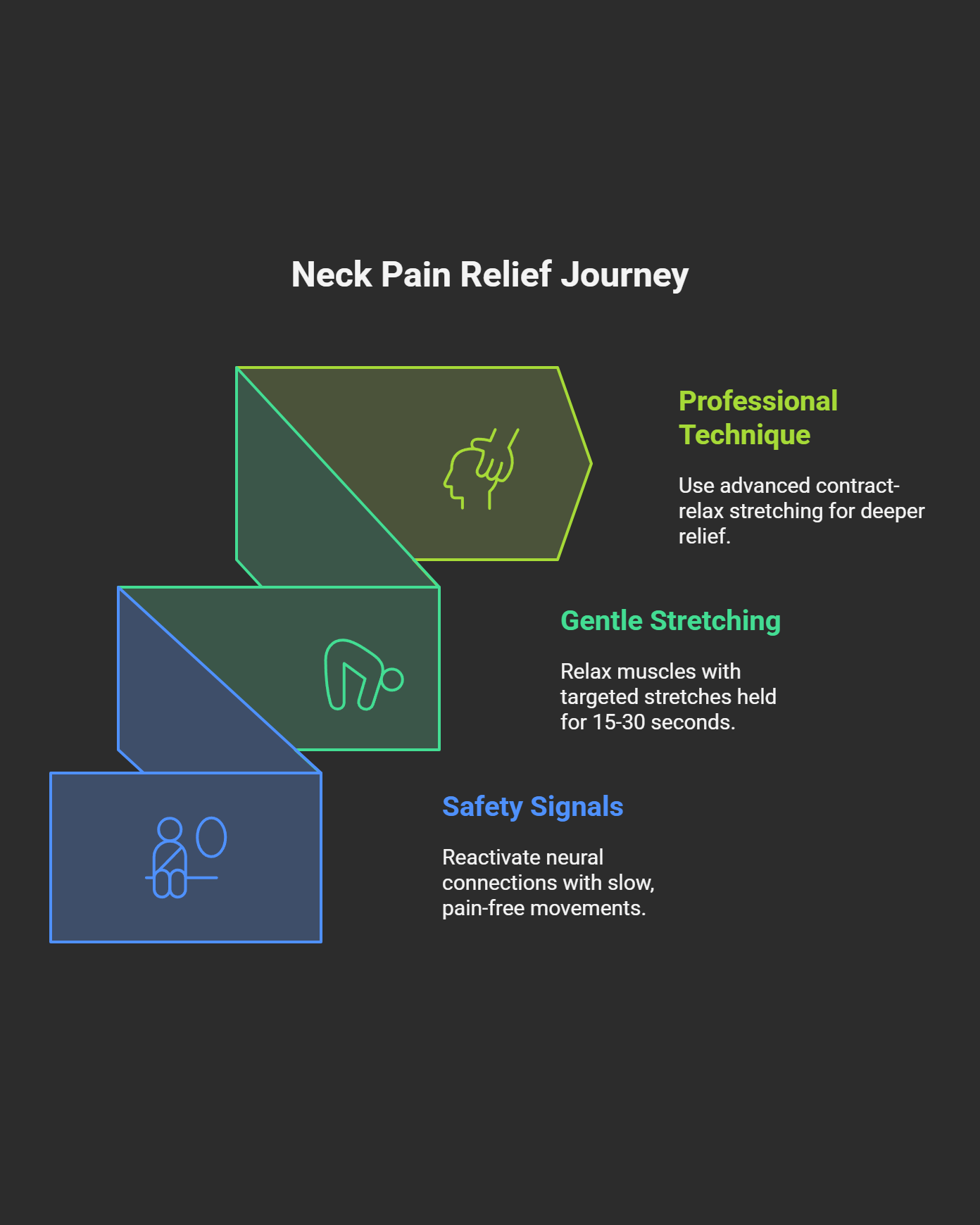
- Stage One: Sending Safety Signals (Micro-movements)The purpose of this stage is to reactivate the neural connections in the neck within a completely pain-free range. You can perform very slow and gentle nods, slowly turn your head within a very small range of motion, or do some safe shoulder shrugs and rolls. The emphasis is on being "slow" and "pain-free."
- Stage Two: Gentle Stretching (Targeted Relaxation)When the micro-movements no longer cause any discomfort, we can begin to gently stretch the "culprits behind the scenes." For example, you can gently tilt your ear towards your shoulder to stretch the upper trapezius, or adopt a "smell your armpit" posture to stretch the levator scapulae. Each stretch should be held for 15 to 30 seconds, coordinated with deep breathing.
- Stage Three: Professional Technique (Contract-Relax Stretching / PNF)Once the pain has significantly subsided, you can try this advanced technique. Using the upper trapezius as an example:First, side-bend your head to an angle where you feel a light stretch.Then, gently place your hand on your head to provide resistance.Push your head against the resistance of your hand (without actually moving your head) for about 5 seconds.Next, completely relax as you exhale. You will find that your neck can effortlessly move into a deeper angle of stretch.
Chapter Four: Prevention is Better Than Cure—Creating a Lifestyle Blueprint for a Painless Neck
4.1 Nourishment from the Inside Out
After dealing with this acute episode of pain, what's more important is to establish a lifestyle that can prevent the next stiff neck.Be sure to cultivate the habit of sipping water throughout the day to ensure your intervertebral discs and muscles are adequately hydrated. At the same time, increase your intake of foods rich in magnesium (such as dark green vegetables and nuts) and potassium (such as bananas and sweet potatoes). They are natural muscle relaxants and can effectively prevent muscle spasms.
4.2 Optimize Your Sleep and Work Space
You spend nearly a third of your day sleeping, and another third may be spent at work.Back sleepers need a lower pillow that supports the natural curve of the neck.Side sleepers need a higher pillow that can fill the space created by the width of their shoulder.In the office, please ensure the top of your monitor is level with your line ofsight, and get up to move around every 30 to 60 minutes to break the static load on your muscles.
4.3 The Daily Five-Minute De-stressing Ritual
Stress is a primary culprit for neck tightness. Abdominal breathing is our most direct tool for regulating stress.Sit comfortably, place one hand on your abdomen, and inhale slowly through your nose, feeling your abdomen rise. Then, exhale slowly, feeling your abdomen fall. Practicing this for 5 minutes daily, especially before bed, can effectively activate the body's relaxation mechanism and soothe neck and shoulder stress at its source.
Conclusion: When Should You Put Down the Warm Compress and Seek Professional Help?
A stiff neck is your body's alarm bell, reminding you to pay attention to your long-term posture, stress, and lifestyle habits. Integrating prevention into your daily life is the only way to treat the root cause.However, self-care has its limits. If you experience any of the following "red-flag signals," please be sure to seek an immediate professional evaluation from a doctor or physical therapist:
- The pain lasts for more than a week, or the symptoms worsen.
- The pain radiates down into your arm or fingers, accompanied by numbness or weakness.
- It is accompanied by a severe headache, dizziness, blurred vision, or nausea and vomiting.
- The pain originates from a specific trauma (such as a car accident or a fall).
Listening to your body's signals is the first step toward health. Learn to treat it gently, and be brave enough to seek assistance when it's needed. Please think of us as your partners on your health journey; we are always ready to work with you to rediscover your body's balance and freedom.

![[Happy Healthy Life Column] A Massage Therapist's Guide to Proper Heat Therapy for Deep Tissue Relief](https://happyhealthylife.cv/wp-content/uploads/2026/03/樂健生活專欄:推拿師教你正確溫熱敷,達到深層肌肉舒緩-540x360.jpg)
![[Happy Healthy Life] Unlocking Your Body’s Self-Healing Power: A Professional Massage Therapist’s Guide to Ending Chronic Fatigue Through Gua Sha and Fascial Release](https://happyhealthylife.cv/wp-content/uploads/2026/02/樂健生活】解鎖身體自癒力:專業按摩師帶你以刮痧與筋膜放鬆告別慢性疲勞抽象藝術圖像-540x360.jpg)
