
Hello, I am your massage therapist. In my work, I meet people every day who are deeply troubled by stiff shoulders and an aching upper back. They always have a deep frown as they point to a specific area on the front of their shoulder or their upper back, describing that persistent, deep, and dull pain that follows them everywhere. This not only affects their work efficiency but also erodes their quality of life.What's interesting is that when I shift the focus of my treatment to an unexpected point on their shoulder blade, they always let out a sigh of surprise, as if the master switch to the problem has been found. This magical point is the topic we will be exploring in-depth today—the Tianzong acupoint, an ancient key to unlocking the shoulder problems of modern life.
To effectively relieve pain, the first step is precise location. The Tianzong acupoint is located on the shoulder blade (scapula) on our back and belongs to the Hand Taiyang Small Intestine Meridian.You can try a very intuitive "Simple Finding Method": Casually place your left palm on your right shoulder, letting your hand naturally cover about half of the shoulder area. The tip of your middle finger will usually land right in a depression—that is the Tianzong point. When you gently press it with the pad of your finger, a strong sensation of soreness and distension will immediately be felt. This is the body's confirmation signal to you.This method is very suitable for beginners, allowing you to quickly find this important healing point in a short amount of time and prepare for the self-release to follow.
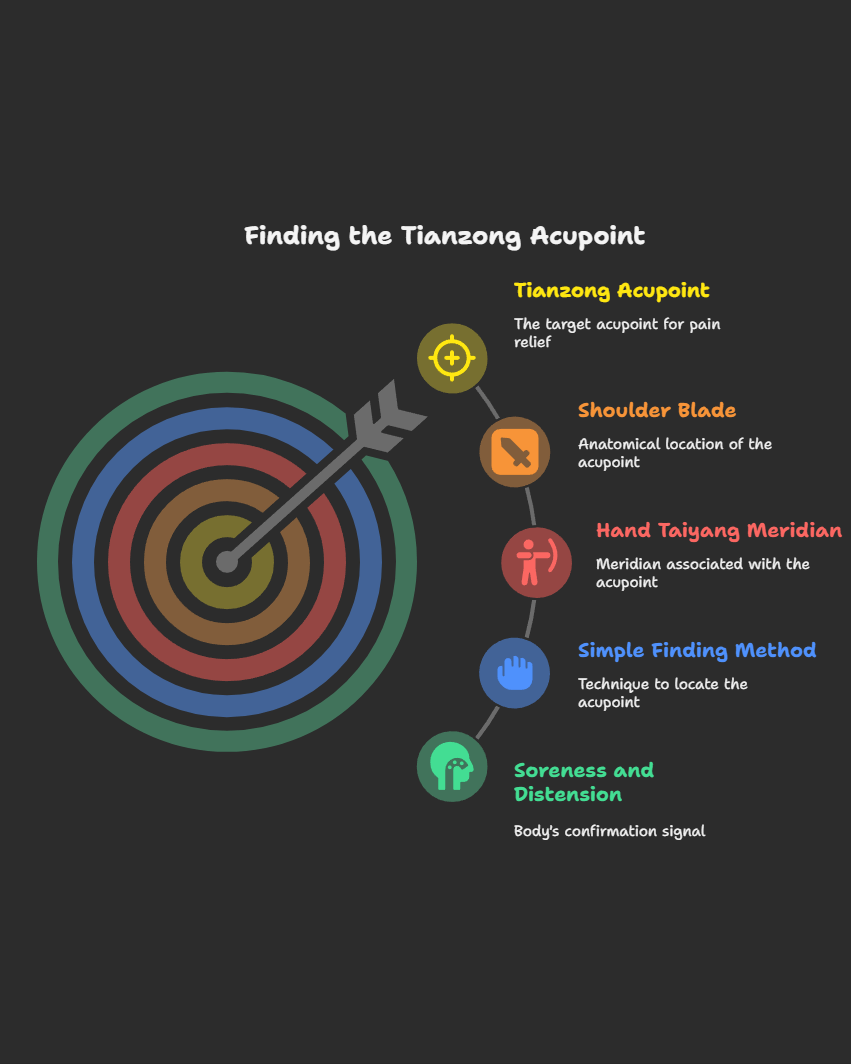
For a more professional level of precision, we can combine anatomical knowledge to perform a "Dynamic Confirmation Method."Anatomically, the Tianzong point is located right in the center of an important muscle called the infraspinatus. Please sit or stand up straight, letting the arm on the side you want to find the point hang down naturally. Next, use the fingers of your other hand to touch your shoulder blade area, then slowly rotate your arm outwards, as if you were turning your palm to face out.As you do this, you will clearly feel a muscle on your shoulder blade contracting and hardening—this is the infraspinatus. The Tianzong point is located at the center of the thickest part of this muscle, the trigger point that feels most sore when pressed, the one you "both love and hate."
So, why is the Tianzong point so crucial? Its magic lies in the fact that it perfectly corresponds to the most common trigger point location in the infraspinatus muscle, according to modern myofascial trigger point theory.A "trigger point" is a highly sensitive, taut band within muscle fibers. It not only produces intense local pain but is also adept at creating "referred pain," acting like a cunning imposter that projects pain to other parts of the body. The trigger point in the infraspinatus muscle is the "number one suspect" for shoulder pain. Its most typical referred pain pattern is the severe pain felt deep in the front of the shoulder joint, which confuses many long-term sufferers and makes them mistakenly believe the problem is located at the front.
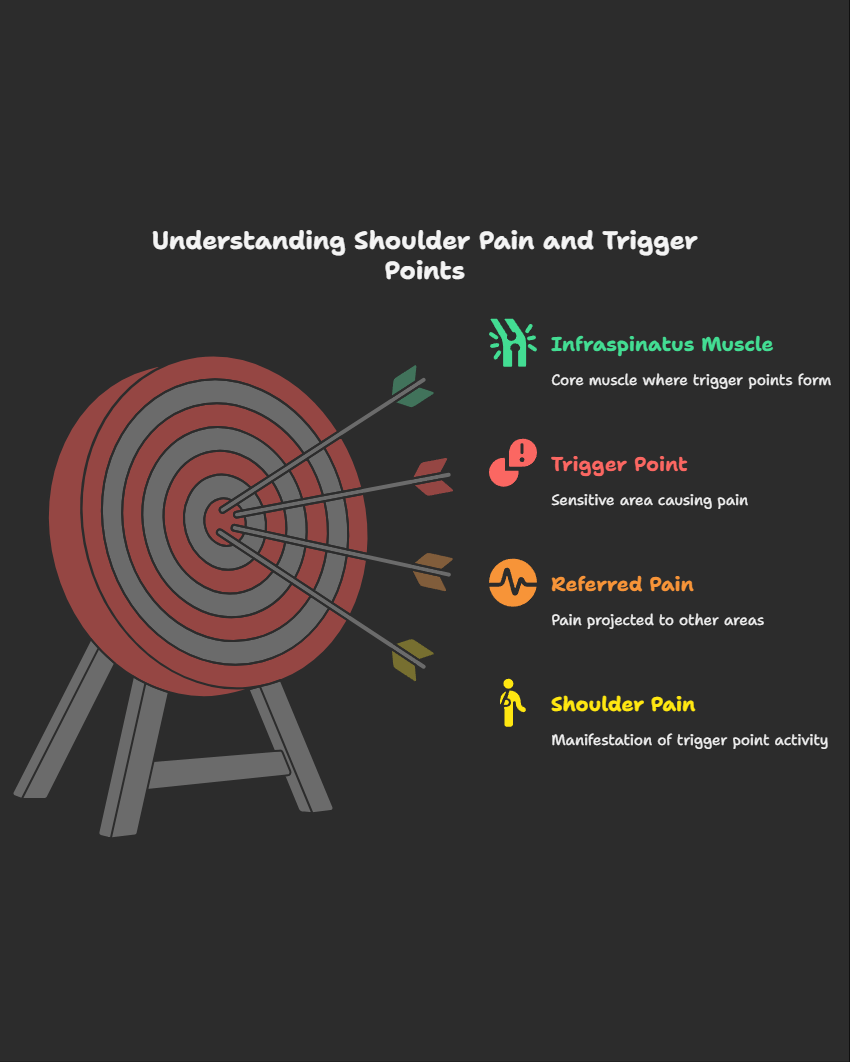
This also explains why many people who feel pain at the front of their shoulder get unsatisfactory results no matter how they stretch or massage the anterior muscles—because you are targeting the wrong culprit. The root of the problem is actually buried deep in your back, at the Tianzong point.In addition to causing anterior shoulder pain, the referred pain from this trigger point can also radiate down the arm along the biceps and the outer forearm, even extending to the palm and fingers, causing a sensation of numbness or weakness. Many daily movements, such as fastening a bra from behind or reaching into the back seat of a car, become exceedingly difficult because of this.Therefore, treating the Tianzong point is not just about "relaxing the sinews and activating the meridians" (舒筋活絡) as we say in TCM; it is the key to eradicating the problem from a myofascial level.
In modern society, our lifestyle seems almost tailor-made to activate pain at the Tianzong point. The most common culprit is, without a doubt, prolonged poor posture—what we often call "Office Syndrome."When we sit in front of a computer for extended periods, our head unconsciously tilts forward, and our shoulders follow by rounding and hunching forward. This seemingly relaxed posture actually places the infraspinatus muscle, located on the back of the shoulder blade, in a state of continuous, passive, and elongated tension.When a muscle is held in this kind of involuntary stretch, its blood circulation deteriorates, and metabolic waste products accumulate. This ultimately leads to the formation of tight trigger points, causing your Tianzong point to frequently send out protest signals.
In addition to postural problems, invisible psychological stress is another major culprit behind the scenes. When we are in a long-term state of anxiety, depression, or high pressure, the body's "fight or flight response" is quietly activated, and the sympathetic nervous system becomes hyperactive.This prompts the body to release stress hormones, causing muscles throughout the body—especially those in the neck and shoulder blade region—to unconsciously contract and tighten in order to maintain a high state of "alert." This chronic, low-grade tension consumes a large amount of muscle energy, making the muscles fatigued, vulnerable, and more prone to pain.Therefore, your shoulder pain is not just your body's cry for help; it may also be a scream from an exhausted mind.
Learning to self-massage the Tianzong point is like equipping yourself with a 24/7 personal therapist. All you need to begin is a simple massage ball (a tennis ball is very suitable for beginners due to its elasticity; if you want to increase the depth, you can choose a firmer fascia ball) and a wall.First, let's introduce the "Basic Static Pressing Method," which is particularly suitable for beginners or when the pain is more intense.Place the massage ball on the Tianzong point that you have located.Gently lean your body against the wall, using your own body weight to hold the ball steady between the wall and your shoulder blade.Next, gently roll side-to-side or up-and-down until you find the "hot spot" that is most sore and tender.
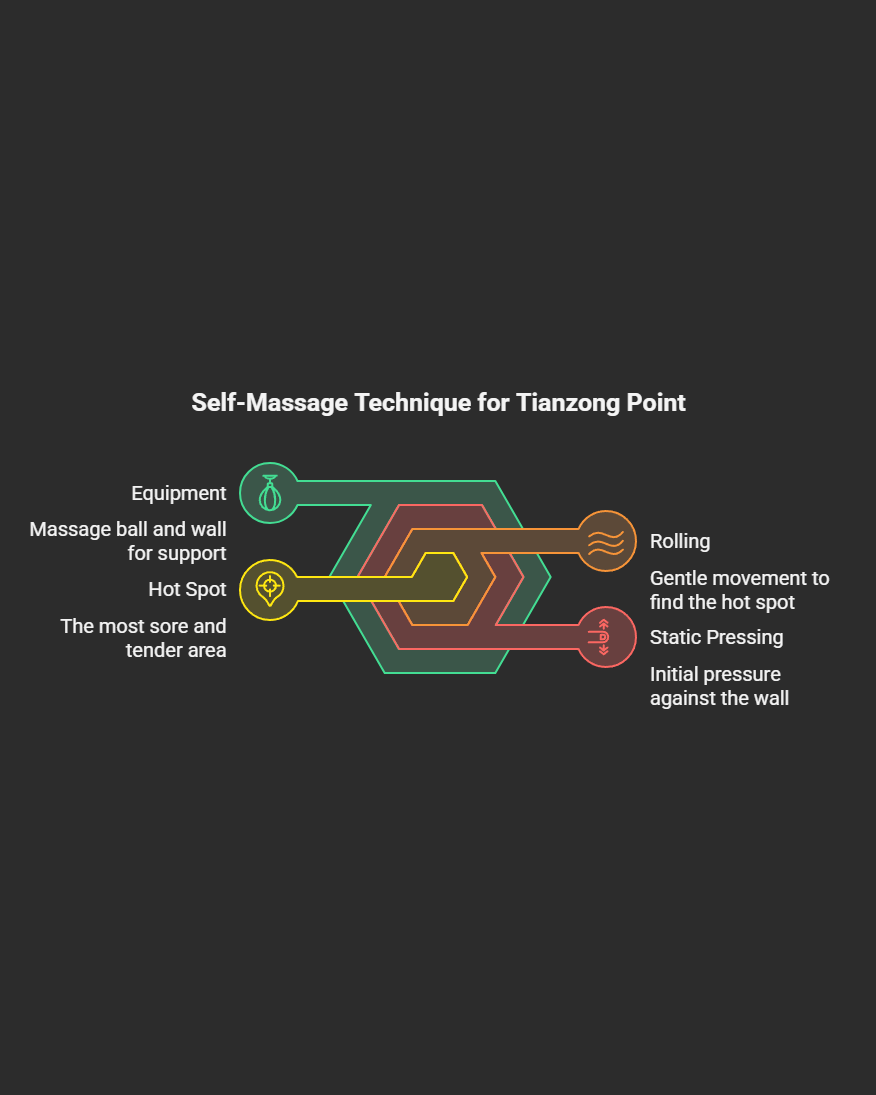
Once you have found the tender point, stop rolling and hold this position, keeping your body weight steadily pressed against the ball. Now, begin to take long, slow, deep breaths. Focus all of your attention on that point, feeling how the pressure penetrates through the surface and deep into the core of the muscle.Continue to apply pressure for 30 to 60 seconds. During this process, you will feel that the initial sharp, sore sensation gradually transforms into a gentle, dull ache, and may even slowly dissipate. This process signifies that the tight muscle fibers are relaxing and blood is flowing again—this is the signal that healing is taking place. Repeating this several times a day will bring significant improvement.
Once you have become more accustomed to the sensation of static pressing, you can try the more efficient "Advanced Dynamic Mobilization Technique."In the same way, fix the massage ball on the most tender point and maintain a steady pressure. The difference from the static method is that you will now begin to slowly move your arm to bring a dynamic stretch to the muscle.A very effective movement is:Slowly bring the arm on the affected side across your chest towards the opposite shoulder, feeling the stretch in your back muscles.Then, even more slowly, raise the arm straight up as if you were going to touch the ceiling.The entire movement process must be very slow, taking about 3 to 4 seconds to complete one cycle (out and back). Repeat 8 to 10 times.
This advanced technique combines pressure with dynamic muscle stretching, which can more deeply release muscle fibers that have become adhered due to long-term tightness. Its effect is similar to that of a professional deep tissue massage.When you actively contract and stretch the muscle while simultaneously applying pressure, you can effectively "trick" the nervous system, causing it to lower its defensive response and thus allowing the muscle to achieve a much deeper level of relaxation.This method not only provides rapid pain relief but also helps to restore the muscle's original elasticity and function, leading to a significant improvement in your shoulder joint's range of motion and allowing you to regain that pleasant feeling of moving freely.
In conclusion, pain at the Tianzong point should not be seen as a simple bodily malfunction. It is, in fact, a valuable signal from your body—a faithful messenger—reminding you that certain aspects of your life, whether it's your posture, your movement patterns, or your internal stress levels, have fallen out of balance.When you learn how to locate it, massage it, and prevent its onset through your lifestyle habits, you are no longer a passive victim of pain. Instead, you are learning to listen to your body's wisdom and have mastered a powerful self-healing tool.I hope this article helps you to transform this "point of pain" into a "point of power" for understanding and taking control of your own body, moving you towards a true "Happy Healthy Life."


![[Happy Healthy Life] A Professional Massage Therapist's Therapeutic Secrets for the Rangu Acupoint: A Dual-Action Guide to Saying Goodbye to Plantar Fasciitis and Insomnia](https://happyhealthylife.cv/wp-content/uploads/2026/02/樂健生活:專業按摩師的然谷穴理療秘笈,告別足底筋膜炎與失眠的雙效指南-540x360.jpg)
