
Hello, I am your massage therapist. In my daily work, I have touched countless tense shoulders and tired faces, all strained by the stress of modern life. Many clients confide in me that persistent tinnitus, annoying toothaches, and lingering headaches are quietly eroding their quality of life.These problems may seem difficult to tackle, but our bodies actually have a sophisticated, built-in self-repair system. The key to activating this system is hidden in the wisdom of the ancient meridians. Today, I want to share a crucial key with you—the Tinggong acupoint—and guide you on how to make good use of it and its related points to unlock your own personal "Happy Healthy Life."
Part One: The Mystery of the Healing Touch—Why is Acupressure Effective?
Many people are curious about acupressure, especially the question, "Why can pressing a point on my hand relieve a headache?" To understand the principle, we can look at it from two perspectives, both Eastern and Western.Traditional Chinese Medicine (TCM) views the human body as an energy network composed of "meridians," through which life energy—"Qi" and "Blood"—flows. When a meridian becomes blocked, the principle of "if there is no free flow, there is pain" (不通則痛) applies. Acupressure works by stimulating these energy hubs to unblock the channels, allowing Qi and Blood to flow freely once more, which in turn restores the body's balance.
From a modern scientific perspective, this process is equally logical. When we press an acupoint, the specific physical stimulation prompts the brain to release natural pain-relieving substances such as endorphins, which effectively block pain signals.At the same time, massage can significantly improve local blood and lymphatic circulation. This helps to carry away inflammatory substances and brings the oxygen and nutrients needed for tissue repair. Therefore, the TCM concept of "unblocking Qi and Blood" and the Western medical concept of "improving microcirculation" are, in fact, different ways of describing the same process of the body being stimulated toward healing.
To ensure acupressure has its maximum effect, mastering the correct technique is crucial. When locating acupoints, they are typically found in the depressions of muscles or along the edges of bones.When applying pressure, please use the pad of your thumb or index finger. Apply a steady, deep force until you feel a unique sensation of "soreness, numbness, distension, or heaviness." This is the "De Qi" signal, which indicates the point has been effectively activated. But please remember, the pressure should never cause sharp pain.
The recommended massage time for each acupoint is 1 to 3 minutes, and this can be repeated several times a day.While at-home massage is very convenient, there is still a distinction between it and professional acupuncture, as the latter can stimulate the points more deeply and precisely. Therefore, we can view daily massage as an excellent tool for managing mild to moderate symptoms and for preventive care.Finally, please be sure to avoid any skin that has open wounds, rashes, or inflammation. A special reminder: pregnant women should avoid pressing certain acupoints, such as the Hegu point (LI4), to prevent any unnecessary risks.
Part Two: The Tinggong Acupoint—The Core Hub for Auditory and Facial Health
When dealing with issues of the ear and its surrounding area, there is one core acupoint we must know: the Tinggong point. Its name means "Palace of Hearing," which directly points to its dominant role in auditory function.Finding it is actually very simple: please open your mouth slightly. The depression that forms directly in front of the middle of the small cartilage at the opening of your ear canal (the tragus) is the precise location of the Tinggong point. When you open your mouth, you will feel a distinct hollow; this is where the joint of your mandible is located.
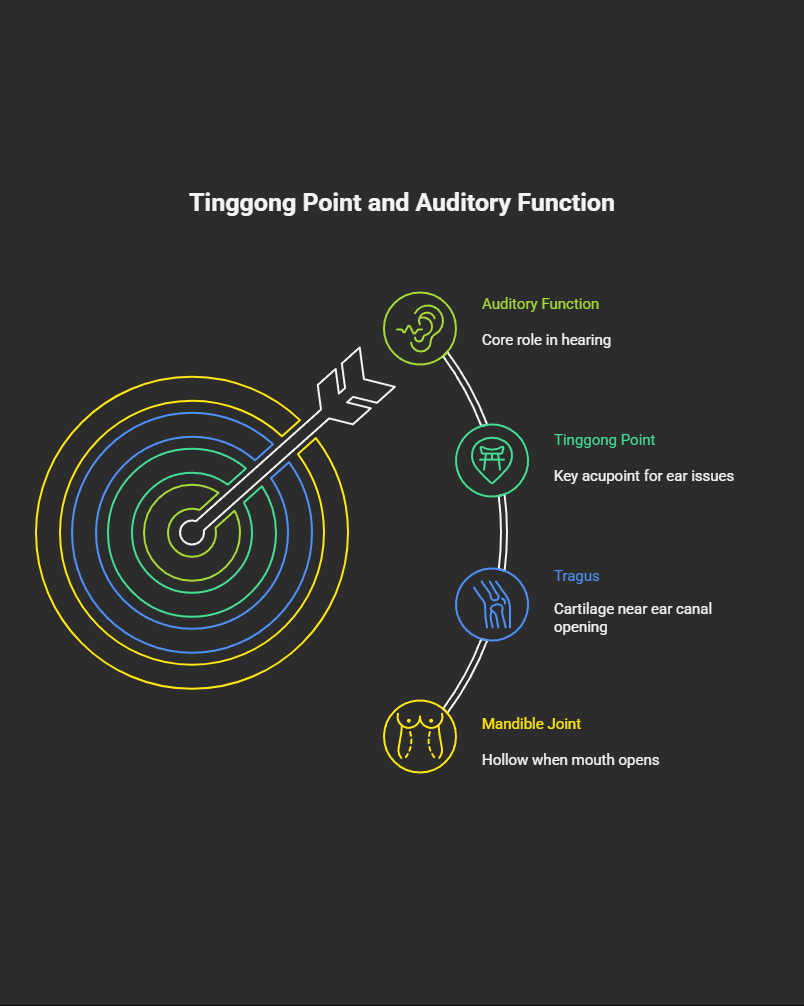
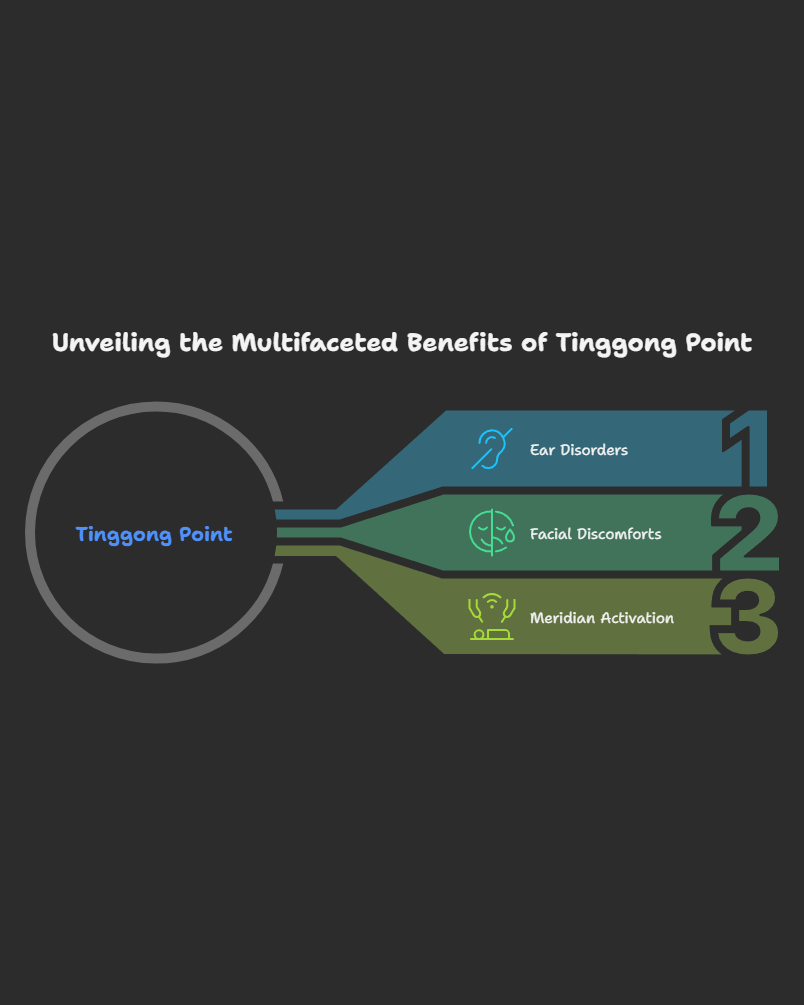
According to Traditional Chinese Medicine (TCM) theory, the primary functions of the Tinggong point are to "open the orifices to benefit the ears" and "clear heat and activate the meridians." It is the first-choice point for treating ear disorders such as tinnitus, deafness, and otitis media.Not only that, but due to its special anatomical location, it also has a very significant effect on relieving facial discomforts such as a clicking or stuck jaw and pain caused by temporomandibular joint (TMJ) dysfunction, and even toothache and trigeminal neuralgia. It can be said that it is the guardian of our auditory and facial comfort.
Although the Tinggong point is very powerful on its own, its effects can be multiplied if combined with its two "neighbors"—the Ermen point and the Tinghui point. These three acupoints are arranged vertically in front of the tragus and are collectively known as the "Three Points Anterior to the Ear," a golden combination for local treatment.The uppermost point, Ermen (SJ21), is in charge of "opening" the ear orifice.The central point, Tinggong (SI19), is responsible for regulating core auditory function.The lowermost point, Tinghui (GB2), excels at "clearing" fire-heat and is particularly effective for loud tinnitus and vertigo.Massaging these three points at the same time comprehensively activates the circulation of Qi and Blood around the ear, which can more effectively soothe the nerves and eliminate discomfort.
Part Three: Personalized Massage Programs for Common Modern Ailments
Now, let's put theory into practice. I have designed three targeted massage protocols for you, which you can choose to use based on your own specific condition.
Protocol One: Alleviating Tinnitus and Auditory Discomfort The causes of tinnitus are complex. Traditional Chinese Medicine (TCM) broadly divides it into an "Excess pattern," characterized by a loud ringing, and a "Deficiency pattern," characterized by a low, faint sound. Our strategy is to combine local and distal acupoints to treat both the symptom and the root cause.First, focus on the ear area. Sequentially press and knead the "Three Points Anterior to the Ear" (Ermen - SJ21, Tinggong - SI19, Tinghui - GB2).Next, find the Yifeng point (SJ17), located in the depression behind the earlobe. It can effectively expel the "Wind-Evil" that disturbs the ear orifice.Then, press the Fengchi points (GB20), located below the hairline at the back of the neck, to relax the neck and improve blood supply to the head.Finally, stimulate the Hegu point (LI4) on the hand and the Taichong point (LV3) on the top of the foot to enhance the body's overall ability to ensure the smooth flow of Qi and Blood.
Plan Two: Relieving Temporomandibular Joint (TMJ) and Tooth Pain Many problems with toothache and jaw tension are related to the obstruction of Qi and Blood or excessive fire-heat in the facial meridians. This treatment plan focuses on three key acupoints on the face.First is the Tinggong point (SI19), located at the temporomandibular joint.Second is the Xiaguan point (ST7), located in the depression below the cheekbone, which specifically treats upper toothache and difficulty opening and closing the jaw.Third is the Jiache point (ST6), which is found at the center of the muscle that bulges on your cheek when you clench your teeth. Regularly pressing these three points can greatly relieve muscle soreness.Finally, you must combine this with pressing the Hegu point (LI4) in the webbing on the back of your hand. It is a special-effect point for treating all disorders of the head, face, and five sense organs, earning it the famous saying, "For the face and mouth, Hegu is the key."
Strategy Three: Beating Headaches and Intracranial Tension The location of a headache often gives us clues about its root cause.For a "tension headache" caused by tightness in the back of the neck, focus on kneading the Fengchi points (GB20).For an aching fullness in the brow area or forehead, you should press the Yintang point (EX-HN3) between the eyebrows and the Hegu point (LI4) on your hand.If the pain is on the sides of the head (a "migraine-type" headache), you can gently knead the Taiyang points (EX-HN5) at your temples and combine this with stimulating the Zhongzhu point (SJ3) on the back of your hand.Regardless of the type of headache, if it is also accompanied by jaw tension or tinnitus, you should always add the massage of the Tinggong point (SI19) to your routine. It can release the "pressure valve" of the head, making the relief more comprehensive.
Part Four: Integrating Acupressure into Your "Happy Healthy Life"
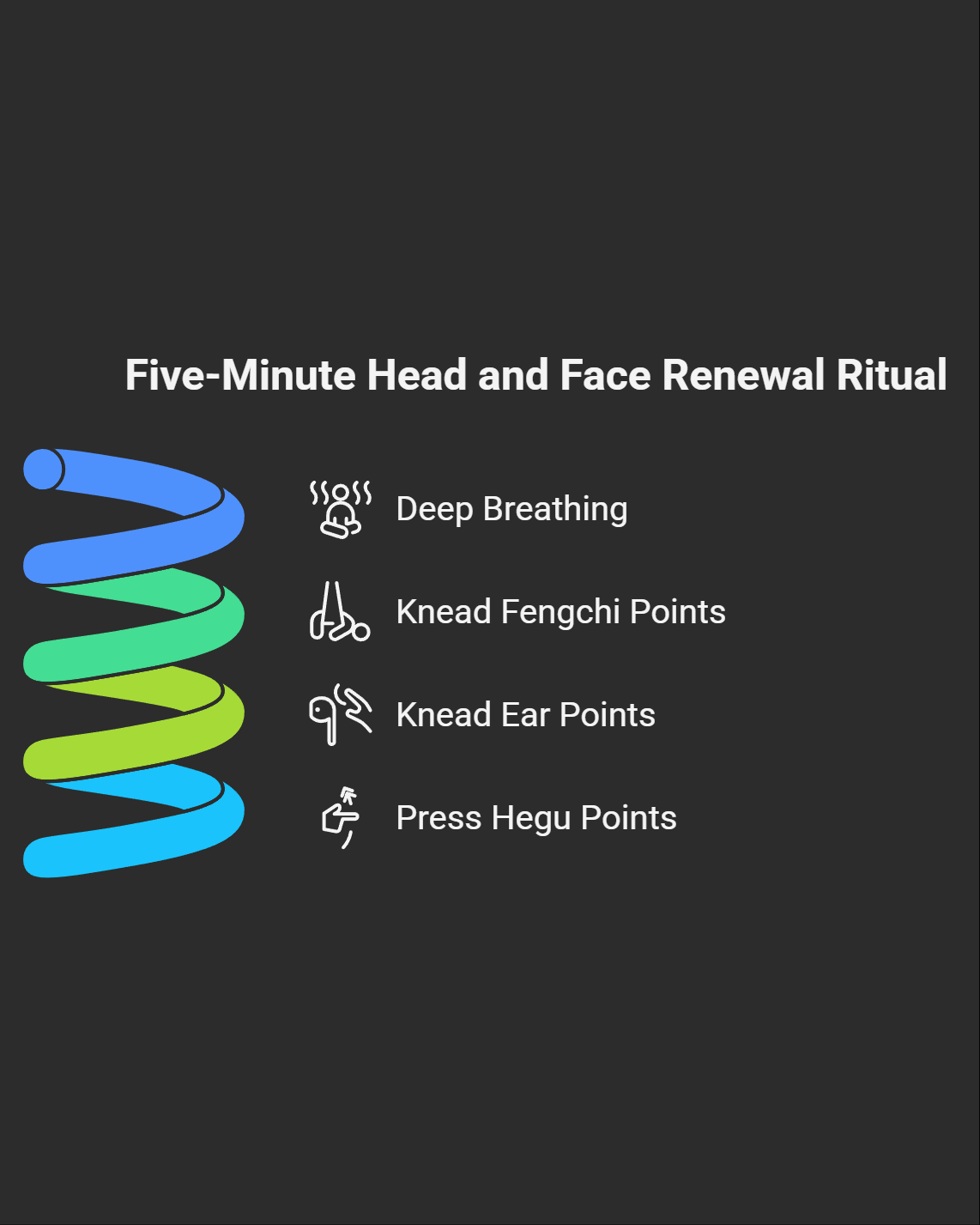
The value of knowledge lies in its practice. To truly benefit, persistence is key. Here, I have designed a simple "Five-Minute Head and Face Renewal Ritual" for you, which you can incorporate into your morning or bedtime routine.First, spend one minute on deep breathing. Rub the palms of your hands together until they are warm and then gently massage your entire face.Next, for one minute, deeply knead the Fengchi points (GB20) at the back of your neck to release pressure from the head and neck.For the following two minutes, focus on kneading the "Three Points Anterior to the Ear" (Ermen-SJ21, Tinggong-SI19, Tinghui-GB2).Finally, use the last minute to alternately press the Hegu points (LI4) on both hands, bringing the ritual to a perfect close.
Conclusion: The Integrated Path to Mind-Body Harmony
Acupressure is a self-healing tool that is always available to us, but it should be just one piece of a larger, holistic health blueprint. A true "Happy Healthy Life" comes from taking comprehensive care of your lifestyle.When you press the Tinggong point to relieve tinnitus, please also remember to avoid noisy environments. When you use the Hegu point to combat a headache, perhaps also review your diet and reduce spicy and irritating foods. Stress is the root of many problems; combining this practice with meditation, mindfulness, or regular exercise will help to relieve that stress at a fundamental level.Ultimately, by integrating acupressure into your daily routine, you will be paving a broad path for yourself toward a vibrant state of mind-body harmony.


![[Happy Healthy Life] A Professional Massage Therapist's Therapeutic Secrets for the Rangu Acupoint: A Dual-Action Guide to Saying Goodbye to Plantar Fasciitis and Insomnia](https://happyhealthylife.cv/wp-content/uploads/2026/02/樂健生活:專業按摩師的然谷穴理療秘笈,告別足底筋膜炎與失眠的雙效指南-540x360.jpg)
