
Do you also often have that indescribable feeling of being "stuck"? You're not seriously ill, yet you constantly feel exhausted, your upper back is as stiff as if you were carrying a stone, your breathing is shallow, and you're even occasionally bothered by indigestion or acid reflux.As a massage therapist, these are the most common complaints I hear in my practice. Many people see these as separate, annoying little issues, but I always tell them that these are often warning signs of an imbalance in our body's most central command system: the Qi and Blood.Fortunately, our body's blueprint has a powerful reboot button built right in, and this is the treasure I want to share with you today: the Geshu acupoint (BL17).
This acupoint is like our body's unsung hero, a behind-the-scenes master coordinator who silently manages the bigger picture. Its very name, "Geshu" (膈俞), reveals its secrets:"Ge" (膈) refers to the diaphragm, the primary breathing muscle that separates our chest and abdominal cavities."Shu" (俞) carries the meaning of "to transport" or "to infuse."Together, the name vividly illustrates how this point regulates the flow of energy between the chest and the abdomen. More importantly, in the wisdom of Traditional Chinese Medicine, the Geshu acupoint is revered as the xué huì (血會), the "Hui-Meeting Point of the Blood." This means it acts as the master switch for all issues related to the "Blood."It can not only move stagnant Blood but also nourish deficient Blood, making it a commander capable of intelligent, bi-directional regulation.
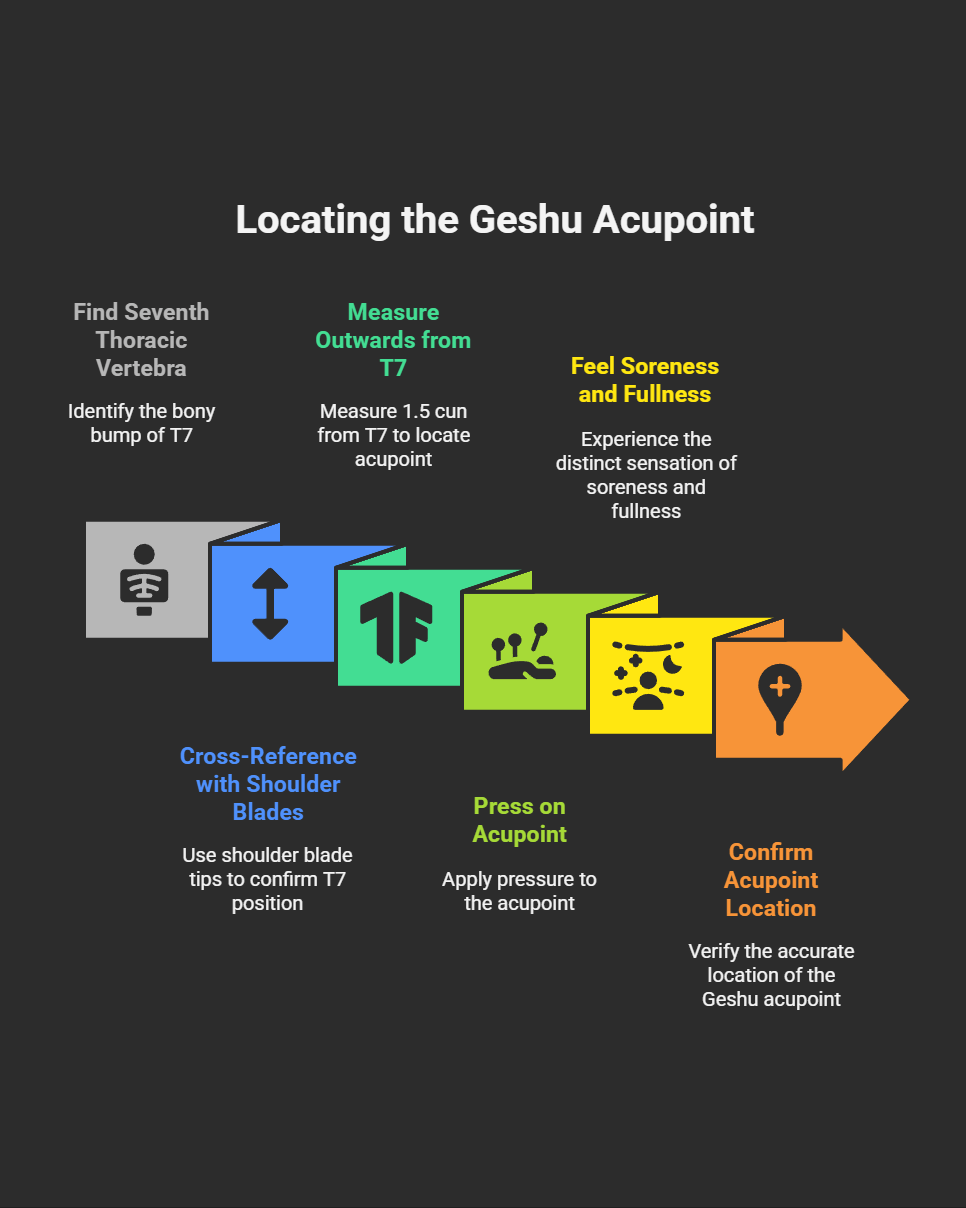
Before we delve into its amazing benefits, let's first learn how to precisely locate this "commander-in-chief" within our bodies.The essence of acupressure lies in accuracy, so please follow my guidance, using your own body as the most precise ruler.Define Your Measurement Unit (the cun): First, we need a unit of measurement. In Traditional Chinese Medicine, this is called a "cun." The width of the joint of your own thumb is approximately equal to 1 cun.Find Your Starting Point (C7): Sit comfortably in a chair and lower your chin as close to your chest as possible. Now, feel for the most prominent bone at the base of the back of your neck. This is your starting point—the seventh cervical vertebra (C7).Count Down to T7: From C7, use your fingertips to count down seven of the bony bumps (the spinous processes) along your spine, one by one. You have now arrived at the seventh thoracic vertebra (T7).
Cross-Reference with Your Shoulder Blades: After finding the seventh thoracic vertebra, there is an even simpler way to double-check its location. Let your arms hang down naturally by your sides and feel for the bottom tips (the inferior angles) of your two shoulder blades. An imaginary horizontal line connecting these two points generally corresponds with the position of T7.Locate the Geshu Acupoint (BL17): Now, you are just one step away. From the depression directly below the bony bump of the seventh thoracic vertebra (T7), measure outwards to the left and right by 1.5 cun (which is approximately the width of your index and middle fingers held together).When you press down on these spots and feel a distinct sensation of soreness and fullness (suān zhàng), congratulations! You have accurately found the body's master coordinator for blood, breathing, and digestion—the Geshu acupoint.
Now, let's unveil the three core departments managed by this "commander-in-chief."First is the Circulatory System. The Geshu acupoint's ability to regulate the Blood is unparalleled.When your body experiences poor circulation due to stress or exhaustion—manifesting as a stiff neck and shoulders, a fixed, stabbing pain, or a dull complexion—massaging the Geshu acupoint acts like a powerful catalyst. It helps to invigorate the Blood and dispel stasis (huó xuè huà yū), allowing the "river of life" to flow smoothly again.Conversely, when you feel fatigued, dizzy, or have a pale complexion due to Blood deficiency, it can transform into a master of nourishment. In this role, it helps the body to generate and replenish Blood more efficiently, infusing you with a boundless supply of vitality.
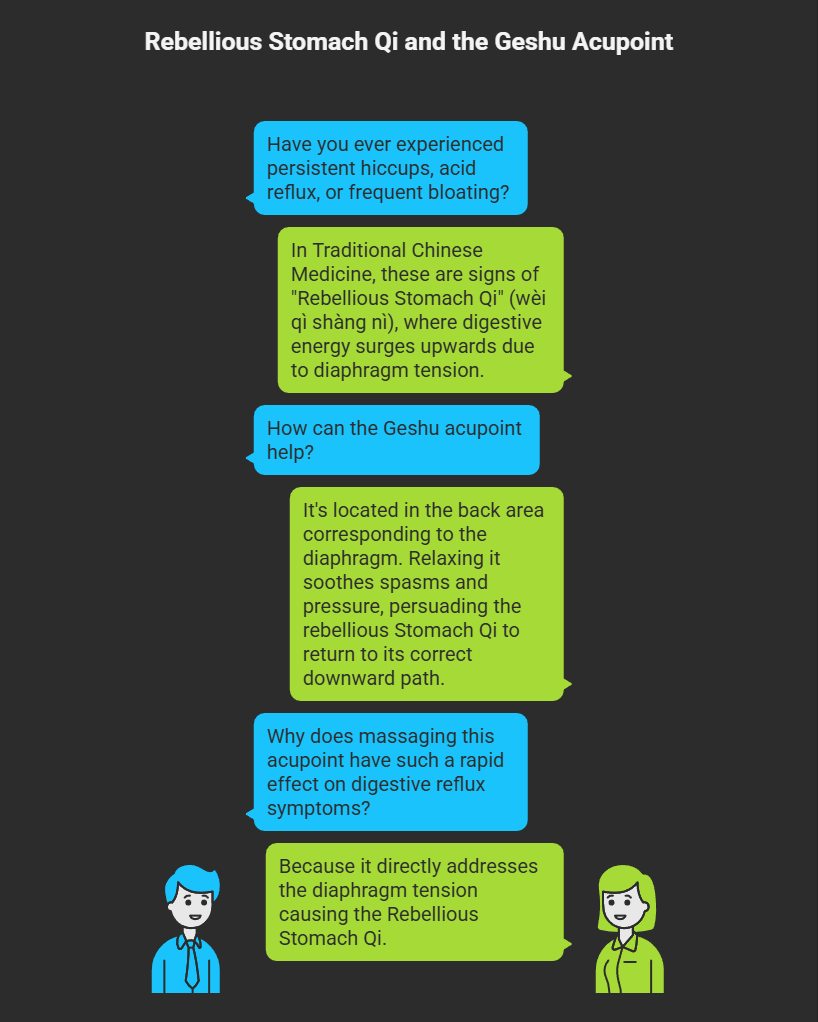
Next is the Digestive System. Have you ever experienced persistent hiccups, acid reflux, or frequent bloating? In the view of Traditional Chinese Medicine, these are signs of "Rebellious Stomach Qi" (wèi qì shàng nì). This means that the digestive energy, which should properly move downwards, "rebels" and surges upwards due to tension in the diaphragm.The Geshu acupoint is located precisely in the area of the back that corresponds to the diaphragm. By relaxing this point, one can directly soothe spasms and pressure in the diaphragm, acting like a gentle negotiator who persuades the rebellious Stomach Qi to return to its correct downward path.This explains why massaging this acupoint can have such a rapid and significant effect on calming various symptoms of digestive reflux.
The third major department is the Respiratory System. The diaphragm is our most important muscle of respiration; its every rise and fall determines the depth and quality of our breath. When we are in a chronic state of stress, the diaphragm unconsciously tightens, causing our breathing to become shallow and creating a sensation of tightness in the chest, as if we can only ever take half a breath.Massaging the Geshu acupoint can release the tension in the diaphragm, creating more space within your chest cavity. This effect of "expanding the chest and regulating Qi" (kuān xiōng lǐ qì) not only allows you to immediately experience a deeper, more satisfying breath but also provides an optimal physical environment for your lungs to function properly, making it a powerful aid in relieving coughs and asthma.
Now that you have learned single-point massage, we can go a step further and learn how to orchestrate a "healing concerto" to multiply the effects.For example, when your digestive system is acting up, you can try this "Digestive Harmony Trio": Geshu (BL17) + Neiguan (PC6) + Zusanli (ST36).Neiguan (PC6), located about three fingers' width below your inner wrist crease, is a star acupoint for calming nausea and vomiting.Zusanli (ST36), found about four fingers' width below the outer side of your kneecap, is the "power station" for strengthening the Spleen and Stomach and energizing the digestive system.When you massage this trio, Geshu is responsible for opening the passageway between the chest and abdomen, Neiguan is responsible for calming reflux, and Zusanli is responsible for providing the driving power. Working in concert, these three points can more effectively re-establish a healthy order within your digestive system.
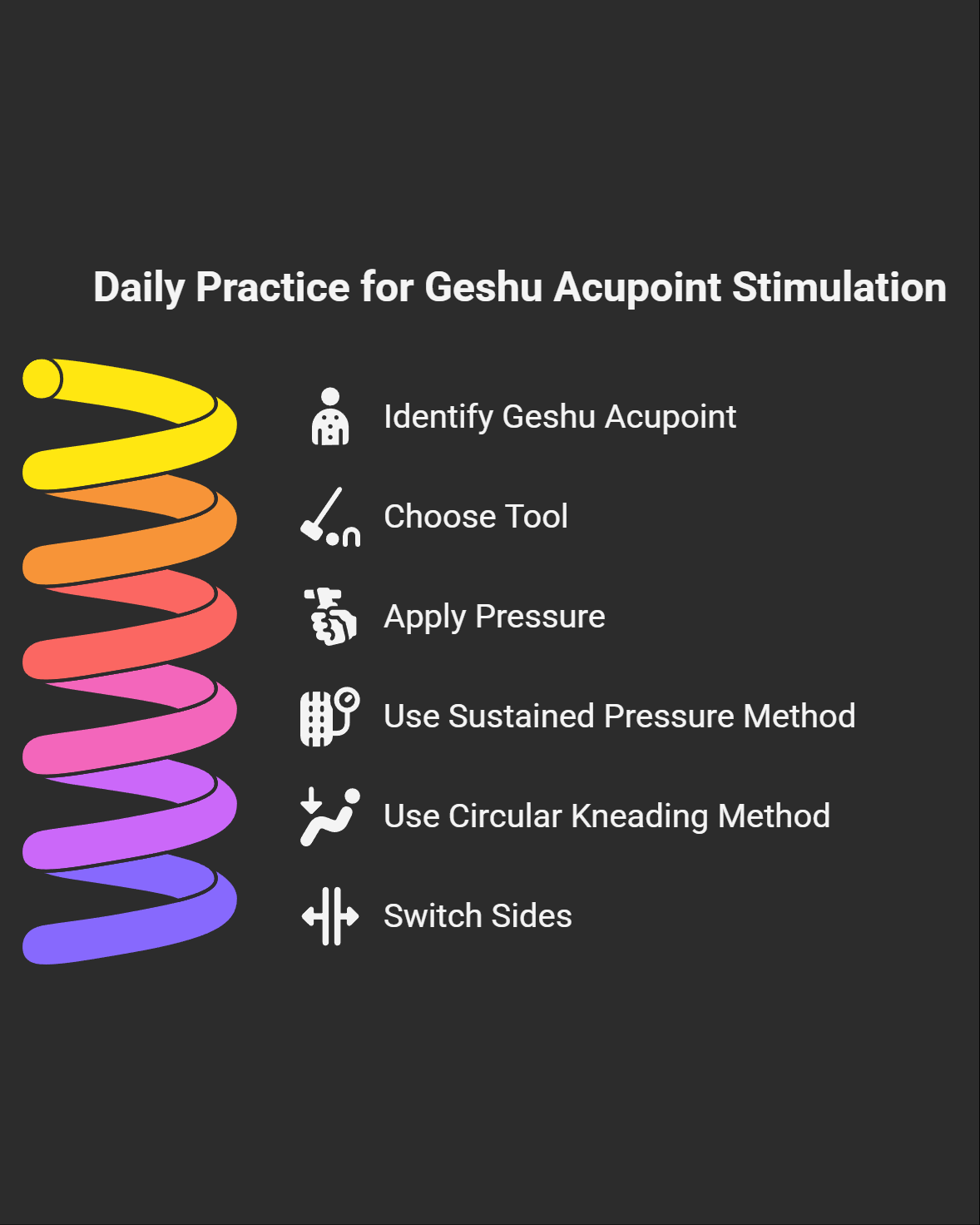
Now, let's transform this ancient wisdom into a simple daily practice.Since the Geshu acupoint is located on the back, reaching it with your own hands can be challenging, but you can make excellent use of some simple tools.Using a Ball: Place a tennis ball or a massage ball between your back and a wall. Through slight movements of your body—forwards, backwards, and side-to-side—allow the ball to roll and apply pressure directly to the acupoint.Using a Massage Cane: You can also use a commercially available massage cane (or S-hook massager) to precisely reach over your shoulder and apply targeted pressure to points on your back.I recommend using the "Sustained Pressure Method": apply a steady pressure for 30-60 seconds until you feel that characteristic sensation of soreness and fullness (suān zhàng), and then switch to the other side. Alternatively, after applying direct pressure, you can use the "Circular Kneading Method," making small circles to further release the surrounding fascia.
Before we conclude, I would like to share a personal tip from a massage therapist: prior to performing your self-massage, try applying a heating pad or a hot water bottle to your upper back for 5 to 10 minutes.The warmth will effectively promote local blood circulation and relax tight muscles. This not only makes the subsequent acupressure more comfortable but also makes the treatment twice as effective with half the effort.This simple step is like performing a warm "opening ceremony" for the deep healing that is to follow, allowing your body to receive the care and regulation from the acupoint in its most relaxed state.
In summary, the Geshu acupoint is a key hub within our body that integrates three major systems: circulatory, digestive, and respiratory. It reminds us that all parts of our body are intimately connected and mutually influential.Incorporating self-massage of the Geshu acupoint into your daily routine—whether as a way to activate your vitality upon waking in the morning or as a relaxing ritual before sleep at night—is a profound act of self-care.Please remember, health is not a distant, unattainable goal, but rather a potential hidden within our own bodies, waiting to be awakened. Starting today, let's learn to communicate with this "commander-in-chief" of the body and, proactively and gently, cultivate our very own "Happy, Healthy Life" from the inside out.


![[Happy Healthy Life] A Professional Massage Therapist's Therapeutic Secrets for the Rangu Acupoint: A Dual-Action Guide to Saying Goodbye to Plantar Fasciitis and Insomnia](https://happyhealthylife.cv/wp-content/uploads/2026/02/樂健生活:專業按摩師的然谷穴理療秘笈,告別足底筋膜炎與失眠的雙效指南-540x360.jpg)
