Introduction: That Familiar Ache — It's More Than Just Poor Posture
At the end of a long day, do you also find yourself slumped in front of a screen, feeling like the muscles between your shoulder blades are on fire? Does a tight band seem to constrict the back of your neck, while the thoughts in your mind race like out-of-control traffic, refusing to stop?For many of us, this feeling is all too familiar. As a massage therapist, I have seen countless bodies plagued by this type of chronic tension. Over time, I have come to understand that this stubborn tightness is rarely as simple as just "poor posture." More often, it is the physical manifestation of our internal state: stress, frustration, and that sense of powerlessness that comes from feeling constantly chased by life.If this emotional energy is not properly channeled or released, it ends up getting "tied into knots" in our upper back, shoulder, and neck regions.
What if I told you that on your back, there is a master switch that can directly release both this deep muscular tension and this emotional blockage?This incredible switch, in the ancient wisdom of Traditional Chinese Medicine, is called the "Ganshu acupoint" (BL18). It is not merely a muscular trigger point; it is a critical hub that connects our emotions with our physical body.Today, from a therapist's perspective, I will guide you on a deep exploration of this acupoint. We will learn how to use it to unlock the shackles that modern life has placed upon us and to rediscover a sense of peace and ease in both mind and body.
Get to Know Your Stress Release Point: The Ganshu Acupoint (BL18)
Before we locate the Ganshu acupoint, let's first understand an important concept in Traditional Chinese Medicine (TCM): the "Back-Shu points" (背俞穴, bèi shū xué).You can imagine the human back as the main electrical control room of a large building. The Back-Shu points, distributed on either side of the spine, are the individual circuit breakers corresponding to each of the internal organs (Zang-Fu). All of these points are located on the Bladder Meridian and are one of the most direct and effective ways to regulate the Qi and Blood of their respective organs.The Ganshu acupoint (BL18) is precisely the officially designated Back-Shu point responsible for regulating the "Liver" system. This explains why stimulating this particular point can produce such profound and powerful effects.
From a modern anatomical perspective, the area where the Back-Shu points are located is precisely where the spinal nerves exit the intervertebral foramina. These nerves directly innervate their corresponding internal organs.When we massage these acupoints, we are not only clearing what Traditional Chinese Medicine (TCM) refers to as "meridian Qi" (jīng qì), but we are also using physical stimulation to modulate the autonomic nervous system's control over visceral (internal organ) functions.This is the fascinating intersection where ancient wisdom and modern science meet, providing us with an excellent pathway to both understand and heal the body.
How to precisely locate the Ganshu acupoint?
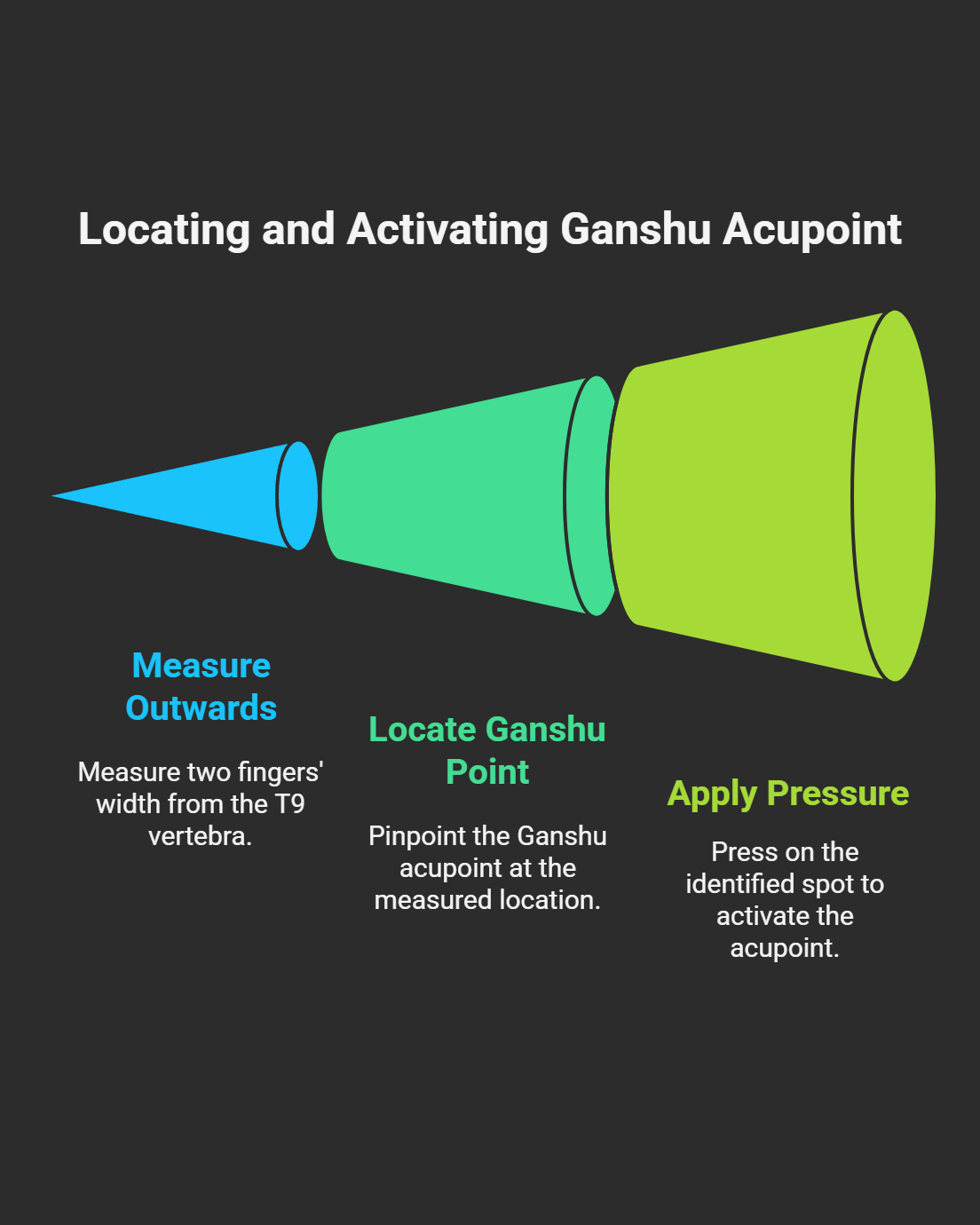
The Ganshu acupoint may be powerful, but if you can't find it, all discussion is moot. Please follow this "physical treasure map" I've created for you to locate this pressure-releasing treasure, step-by-step.Get into Position: First, assume a comfortable seated or prone (lying on your stomach) position.Find Your Landmarks: Ask a partner to help you with the next steps.First, have them find the most prominent bone at the junction of your neck and back as you lower your head (this is the seventh cervical vertebra, C7).Next, have them locate the bottom tips (inferior angles) of your two shoulder blades. An imaginary horizontal line connecting these two tips generally passes through the seventh thoracic vertebra (T7).Count Down to T9: Starting from the bony bump (spinous process) of T7, have your partner use their finger to count down two more vertebral bumps. This is the spinous process of the ninth thoracic vertebra (T9).
Pinpoint Ganshu (BL18): For the final step, from the depression directly below the bony bump of the ninth thoracic vertebra (T9), measure outwards to the left and right by approximately two fingers' width (your own index and middle fingers held together). This location is the Ganshu acupoint.The unit of measurement here is the Traditional Chinese Medicine "cun," which is roughly the width of your own thumb joint (two fingers is a common approximation for 1.5 cun).When your partner presses on the correct spot, you will typically feel a distinct, deep sensation of soreness and fullness (suān zhàng), and sometimes even a slight radiating sensation. This is the signal that the acupoint has been successfully activated.
Unlocking 'Liver Qi Stagnation': A Traditional Chinese Medicine Interpretation of Modern Stress
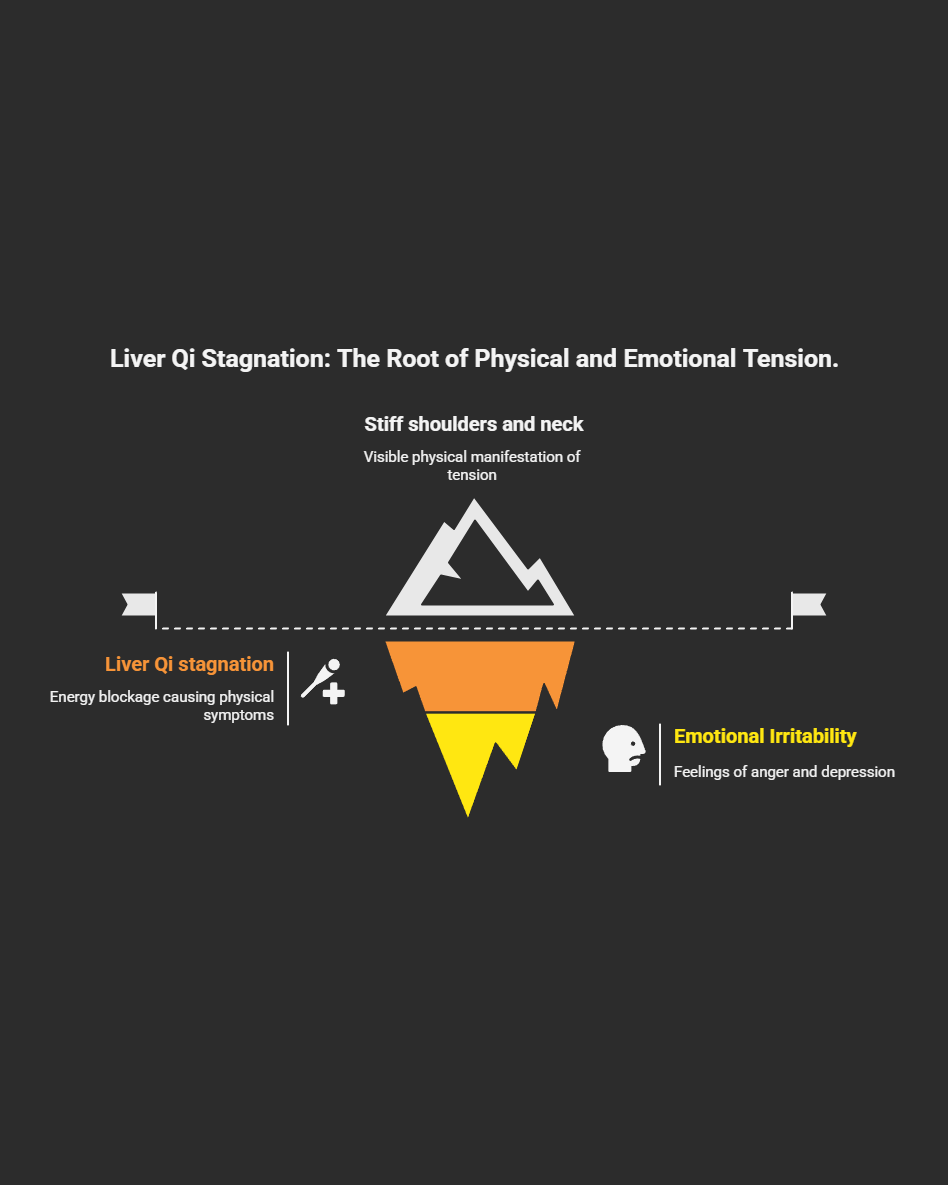
To make the best use of the Ganshu acupoint, we must first understand the root problem it targets: "Liver Qi Stagnation" (gān qì yù jié).In Traditional Chinese Medicine (TCM), the "Liver" is like a great general, responsible for ensuring the smooth flow of Qi, Blood, and emotions throughout the entire body. It thrives on being expansive and unobstructed, and it despises repression and constraint. However, the endless work, complex interpersonal relationships, and anxiety about the future that characterize modern life all act as roadblocks for this general.When its decrees (the flow of Qi) are frequently blocked, the energy begins to stagnate, swirl, or even flow in the wrong direction. This is the very essence of "Liver Qi Stagnation."
This energy blockage expresses itself directly through the language of the body. Traditional Chinese Medicine (TCM) theory holds that "the Liver governs the sinews" (gān zhǔ jīn). When Liver Qi stagnates, this pent-up energy often surges upwards, causing our neck and shoulders (especially the trapezius muscles) to tense up unconsciously. Over time, this develops into chronic pain.Simultaneously, our emotions can become irritable and easily angered, or alternatively, depressive and melancholic. Therefore, the stiff shoulders and neck that we so often treat are, in reality, the perfect physical embodiment in modern life of the ancient concept of "Liver Qi Stagnation."Massaging the Ganshu acupoint is precisely for the purpose of breaking this vicious cycle of mind-body imprisonment.
A Hands-On Guide: How to Activate Your Ganshu Acupoint
Now, let's learn how to safely and effectively activate the Ganshu acupoint. The most direct method is to ask a partner or family member for help.Positioning: The person receiving the massage should be in a comfortable prone (lying face down) or seated position.Locate the Point: The person giving the massage should locate the acupoint as previously described.Choose a Technique:Sustained Pressure: Using the pad of the thumb, apply slow, steady, and deep pressure to the point. Hold for about 30-60 seconds, then slowly release. Repeat 3-5 times on each side.Deep Kneading: Alternatively, perform small-circle, deep kneading on the point for 3-5 minutes. Imagine that your finger is trying to go deep to "loosen up" any tight nodules you feel under the skin.
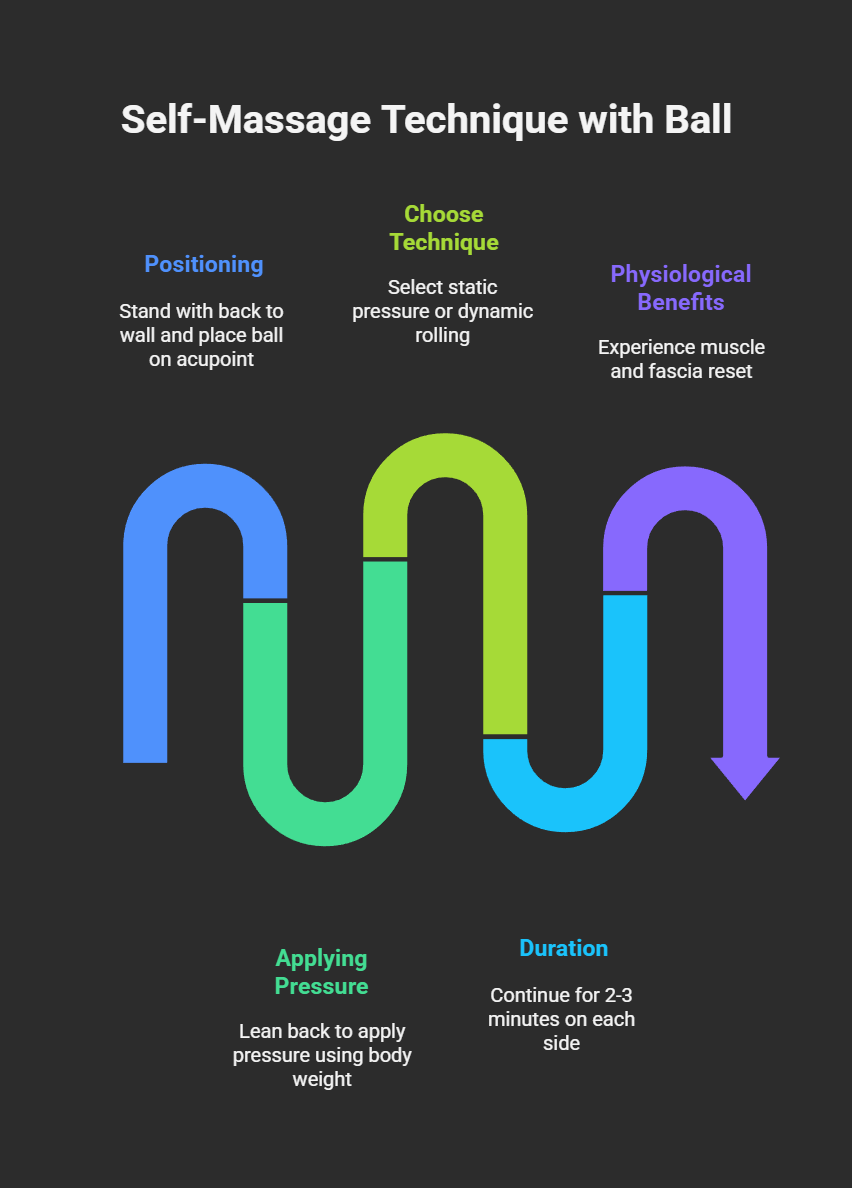
If you wish to perform this on your own, an excellent tool is a massage ball (or a simple tennis ball).Positioning: Stand with your back to a wall. Wedge the ball between your back and the wall, positioning it precisely on the Ganshu acupoint on one side.Applying Pressure: Use your own body weight, leaning back into the wall, to apply the desired amount of pressure.Choose a Technique:Static Pressure with Breath: You can maintain a static, steady pressure on the point. As you do this, visualize "sending" your long, deep breaths directly into the point of soreness.Dynamic Rolling: Alternatively, you can make small up-and-down or side-to-side movements, allowing the ball to perform a rolling massage over the area.Duration: Continue for 2-3 minutes on each side.This method not only stimulates the acupoint but is also an effective form of "self-myofascial release." From a physiological level, it provides a deep "reset" for your muscles and fascia.
A Comprehensive Toolbox for Lasting Relaxation
Activating the Ganshu acupoint is the starting point of our healing journey, but to make the relaxing effects last, we need to create a supportive lifestyle.1. Pair with the Taichong Acupoint (LV3): You can pair your Ganshu massage with the "Taichong" acupoint.Location: Find it on the top of your foot, in the hollow just before the point where the bones of your big toe and second toe meet.Benefit: Taichong is the master switch of the Liver Meridian. Using it in tandem with the Ganshu acupoint is the most effective way to promote the free flow of Qi throughout the entire body and to quickly alleviate irritability and stress.2. Soothe the Liver with Your Diet: Incorporate foods and drinks that help to "soothe the Liver and regulate Qi" (shū gān lǐ qì) from the inside out. This includes:Green vegetables, such as spinach.Mildly sour foods, such as lemon.Herbal teas, such as chrysanthemum & goji berry tea or rose tea.
3. Incorporate Movement and Breath:It is critically important to regularly interrupt static postures throughout your day.Stretches: In the office, you can try a "Neck Side Bend Stretch" to lengthen the Gallbladder Meridian on the sides of your neck, or practice a "Chest Opener/Shoulder Squeeze" exercise to counteract a rounded-shoulder, hunched-back posture.Breathwork: Finally, don't forget the power of your breath. Diaphragmatic (belly) breathing directly activates the body's "rest and digest" mode. Spend a few minutes each day with one hand on your abdomen: inhale slowly through your nose, feeling your belly rise, and then exhale slowly. This simple practice is one of the quickest ways to regulate your nervous system and reduce stress hormones.
Conclusion: Reclaiming Your Peace and Comfort
The tension in our shoulders and neck is often the body's way of telling our inner story in a language we can "hear." It is reminding us that perhaps we have taken on too much, or that we need an outlet for release.The Ganshu acupoint is not just a point for alleviating symptoms; it is a key that helps us learn to listen and respond to these messages from our body. It shows us that healing is not a passive process of waiting, but rather a series of active choices filled with love and self-care. It is the beginning of a collaboration between you and your body.
By integrating these simple yet profound practices—acupoint massage, mindful movement, nourishing foods, and conscious breathing—into your daily life, you cease to be a victim of stress and instead become the active creator of your own physical and mental well-being.Your body possesses an incredible capacity for self-repair. When we learn how to collaborate with it, we can reclaim that innate sense of peace, comfort, and vitality.Start with just this one small acupoint, and see where this journey back to inner harmony takes you.


![[Happy Healthy Life] A Professional Massage Therapist's Therapeutic Secrets for the Rangu Acupoint: A Dual-Action Guide to Saying Goodbye to Plantar Fasciitis and Insomnia](https://happyhealthylife.cv/wp-content/uploads/2026/02/樂健生活:專業按摩師的然谷穴理療秘笈,告別足底筋膜炎與失眠的雙效指南-540x360.jpg)
