
Preface: Are You Listening to Your Body's Warning Signs?
In my professional practice, I encounter cases every day of people seeking help for the ailments that come from a sedentary lifestyle, or "sitting disease." The scenarios they describe are strikingly similar: long hours spent at a desk, a nagging ache that emanates from the lower back, accompanied by a deep-seated fatigue that they can never seem to shake.Many people assume this is just muscle fatigue, but when we delve deeper, we often uncover a broader pattern of imbalance, including a decline in sleep quality and a sense of feeling completely "hollowed out" or drained. This is more than just a protest from the surface layers of the body; it's like a flashing "engine warning light," alerting us that our deep, vital energy may be quietly draining away, causing us to drift further and further from the "Happy, Healthy Life" we aspire to live.
Reconnecting with Your Body: An Introduction to the Shenshu Acupoint (BL23) — Your Core Energy Gateway
What I want to share with you today is not some complex therapeutic device, but rather an incredibly practical, built-in tool that originates from the ancient wisdom of Traditional Chinese Medicine (TCM)—the Shenshu acupoint (BL23).You can imagine it as an "energy refueling station" that recharges your body's core vitality, or as an important "gateway" to your inner life force. In my many years of clinical practice, I have personally witnessed the key role this acupoint plays in strengthening the lower back, replenishing the body's vital essence (Jing-Qi), and soothing the nervous system.It is not just a therapeutic point; it is a key to reconnecting with our bodies, listening to their needs, and proactively infusing ourselves with vitality. Next, let us explore this incredible acupoint together and learn how to use it to unlock your healthy life.
Precise Location: Finding Your Body's Source of Vitality
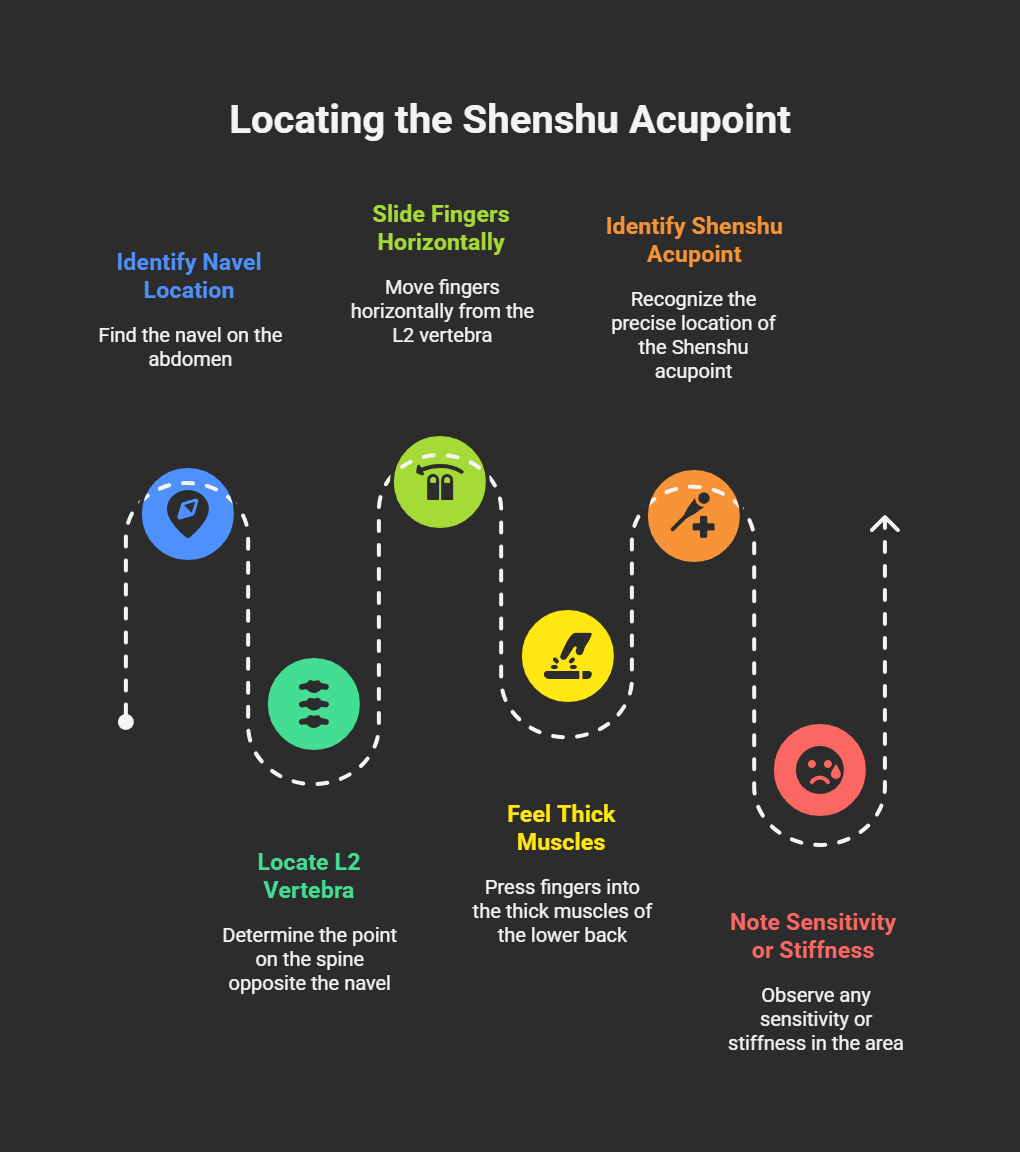
To maximize the effectiveness of the Shenshu acupoint, precise location is the first step.According to Traditional Chinese Medicine (TCM) theory, the Shenshu acupoint is located on the lower back, level with the lower border of the spinous process of the second lumbar vertebra (L2), and approximately 1.5 cun out to the left and right sides.For non-professionals, the "cun" unit can be abstract. A simple way to estimate this distance is to hold your own index and middle fingers together; their combined width is approximately 1.5 cun. The Shenshu points are conveniently located on either side of the "Mingmen" (GV4) acupoint, which is directly on the spine at the same level. This should help you create a clear positioning map in your mind.When you press on the correct spot, you will experience a unique, deep sensation of soreness and fullness. In TCM, this is known as "deqi," and it is a positive feedback signal from your body.
The "Navel Location Method": An Acupoint-Finding Technique You Can Master Instantly
To help everyone find the Shenshu acupoint with ease, here is a very practical technique.First, stand or sit up straight and identify the location of your navel (belly button). The point on your spine that is directly opposite your navel is the approximate location of the second lumbar vertebra (L2), where the Mingmen (GV4) acupoint lies.Next, from this point on your spine, slide your fingers horizontally out to the left and right by a distance of about two fingers' width.You will feel your fingers pressing into the thick muscles of your lower back; this is the precise location of the Shenshu acupoint. If your lower back has been chronically tense, this area may feel particularly sensitive or stiff. This is a clear sign that you have found the key area that needs to be addressed, and it is here that the healing process begins.
Why the Shenshu Acupoint? The Cornerstone of Health and the Battery of Life
In the Traditional Chinese Medicine (TCM) classic, The Yellow Emperor's Inner Canon (Huangdi Neijing), there is a famous maxim: "The lower back is the mansion of the Kidneys" (yāo wéi shèn zhī fǔ). This pithily explains the profound connection between the lumbar region and the TCM "Kidney" system.This means that the strength and health of our lower back are a direct reflection of the energetic state of our Kidney system. We can compare the Kidney Qi to the foundation of a house and the lower back to the house's frame; if the foundation is unstable, the frame will naturally struggle to be strong. Therefore, the root of many chronic lower back problems often lies in a deeper deficiency of Kidney Qi.In TCM theory, the Kidneys store our innate, original life source—the "Essence" (Jing). The Jing is like our body's "life battery," and massaging the Shenshu acupoint is one of the most direct and effective ways to recharge this battery.
A Therapist's Touch: Four Self-Massage Techniques You Can Master
Before you begin, create a peaceful environment for yourself and take several deep breaths. It is crucial to keep your lower back area warm, as cold can obstruct the flow of Qi and Blood.Below are four core techniques that I frequently teach my clients:
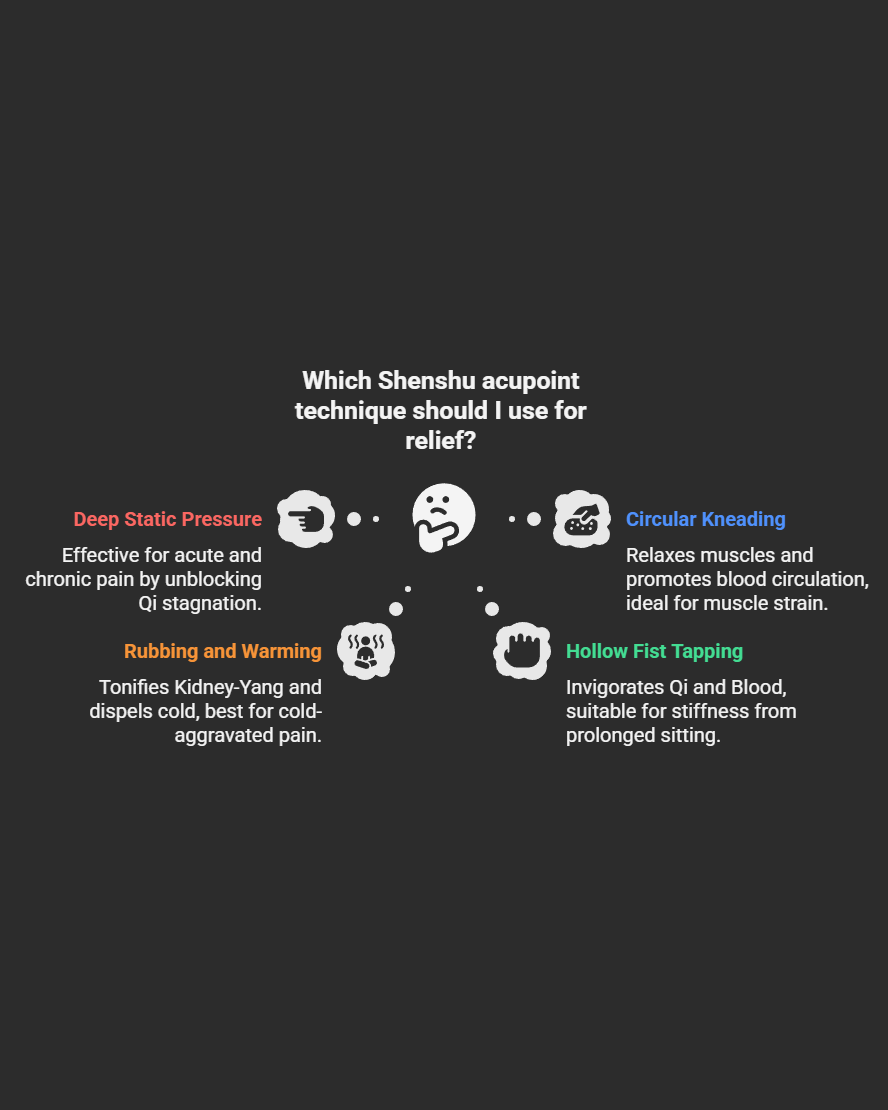
- Deep Static Pressure Method How-to: Place the thumbs of both hands, or the knuckles of your clenched fists, on the Shenshu acupoints on both sides of your spine. Use your body weight to apply a steady and deep pressure until you feel a distinct sensation of soreness and fullness (suān zhàng).Duration: Hold this pressure for 1-3 minutes.Benefit: This method is remarkably effective for alleviating both acute and chronic lower back pain, as it precisely unblocks the stagnation of Qi in the meridians.
- Circular Kneading Method How-to: Using the pads of your thumbs or middle fingers, perform small, deep, circular kneading motions on the Shenshu acupoints. The pressure should be even, and the speed should not be too fast.Duration: Continue for 2-3 minutes on each side.Benefit: This method effectively relaxes the tense muscles of the lower back, promotes local blood circulation, and alleviates the discomfort caused by stiffness.
- Rubbing and Warming Method How-to: Vigorously rub your palms together until they feel warm. Quickly cover the area of the Shenshu acupoints with your warm palms. Close your eyes and feel this warmth penetrating deep into your lower back.Benefit: This action is ideal for performing before bed or upon waking in the morning. It can gently tonify the Kidney-Yang, dispel Cold and Dampness, and bring about a profound sense of relaxation.
- Hollow Fist Tapping Method How-to: Make a hollow fist with each hand and, in a comfortable rhythm, gently tap the area around the Shenshu acupoints. The force should be just enough to produce a pleasant sensation of vibration.Duration: Tap each side 30-50 times.Benefit: This method can be done anytime, anywhere. It effectively invigorates the Qi and Blood in the lumbar region—which often become sluggish from prolonged sitting—and helps to counteract stiffness.
A Reminder from Your Therapist: Safety and Consistency Are Key
Important Reminders for Self-Massage When performing self-massage, it is crucial to remember a few key principles:Pressure: The pressure should be moderate. The optimal standard is to feel a comfortable sensation of soreness and fullness (suān zhàng). You should never feel a sharp or intense pain.Consistency: Consistency is far more important than single-session intensity. The benefits of a regular maintenance routine of just a few minutes each day will far outweigh those of an occasional, lengthy massage.Skin Condition: Avoid massaging any areas with open wounds, rashes, or skin inflammation.Special Precautions: Pregnant women and individuals with severe kidney disease must consult a qualified physician or therapist before performing any acupressure to ensure it is safe for them.
The Power of Synergy: How to Amplify the Effects
In the application of Traditional Chinese Medicine (TCM), cleverly pairing acupoints can produce a synergistic effect where one plus one is greater than two.The Shenshu acupoint and its "neighbor"—the Mingmen acupoint (GV4), located on the midline of the spine at the same level—are considered a "golden pair." Mingmen governs the Yang Qi of the entire body and is the source of our motive force, while Shenshu nourishes the Kidney Essence (Jing). Combining the two can strengthen the lumbar spine more comprehensively. You can use the "Rubbing and Warming Method," simultaneously covering both Shenshu points and the Mingmen point in the middle with your warm palms.Furthermore, the old TCM saying, "yāo bèi wěi zhōng qiú" ("For the lower back, seek Weizhong"), tells us that stimulating the Weizhong acupoint (BL40), located at the back of the knee, can effectively clear the entire Bladder Meridian, thereby alleviating lower back pain.By combining these acupoints, your self-healing practice will become even more comprehensive.
Cultivating Wellness Through Movement: Simple Stretches to Complement Massage
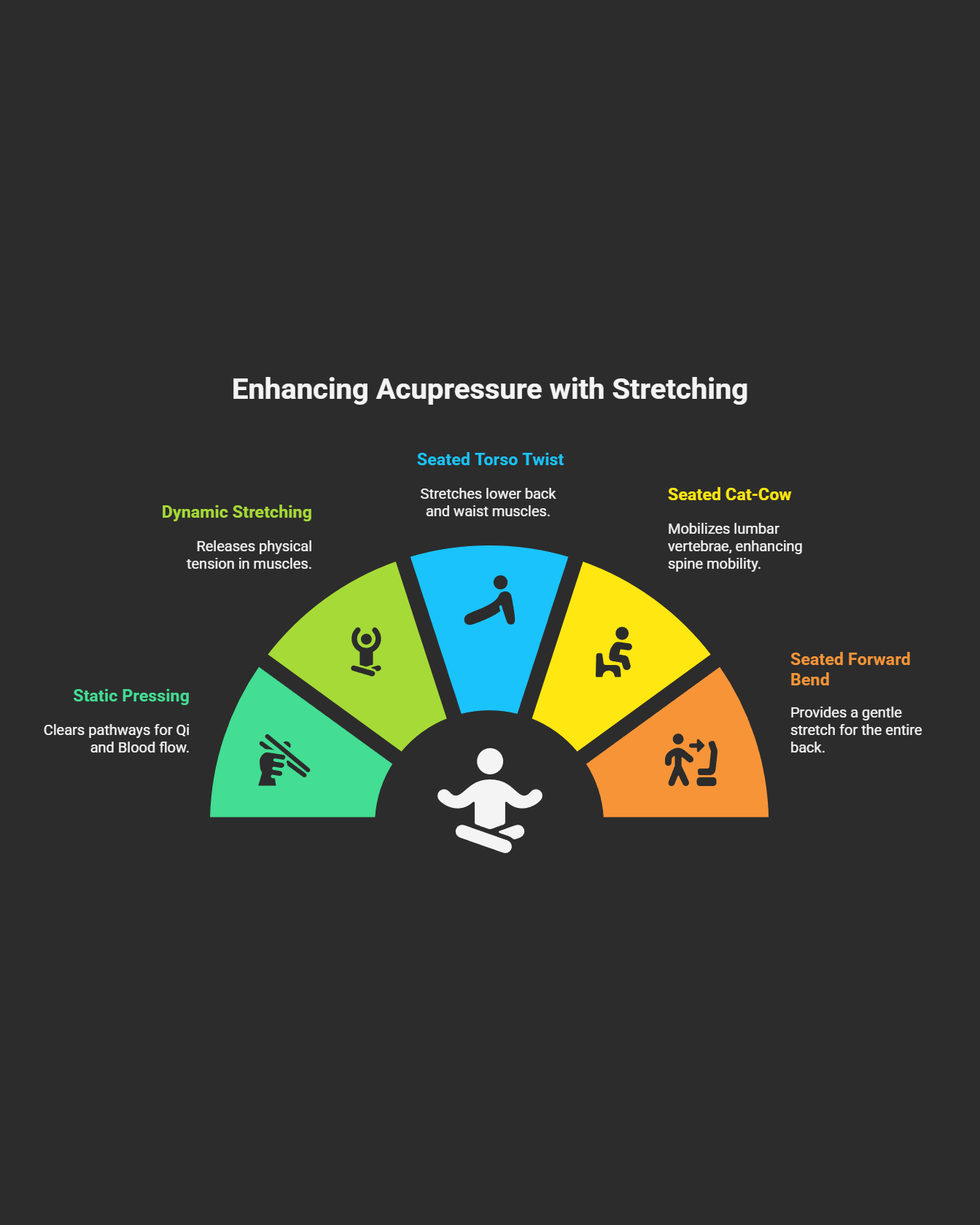
The effects of acupressure can be even more significant when combined with appropriate stretching. Static pressing clears the pathways for Qi and Blood, while dynamic stretching releases the physical tension held in the muscles. You can easily complete several effective movements right from your office chair.Seated Torso Twist: Gently stretches the muscles of the lower back and waist.Seated Cat-Cow: Mobilizes each of the lumbar vertebrae, increasing the mobility of your spine.Seated Forward Bend: Provides a gentle stretch for the entire back.Integrating these simple movements into your work breaks is an excellent way to supplement your Shenshu acupoint self-care and maintain the long-term health of your lower back.
Bridging Past and Present: How Modern Science is Validating Ancient Wisdom
Perhaps you're wondering: is there really any scientific basis for these ancient acupressure techniques? The answer is a definitive yes.In recent years, multiple clinical studies have confirmed that acupressure has a significant effect on alleviating chronic lower back pain, with its effectiveness in some cases even surpassing that of conventional physical therapies. Scientists have discovered that pressing on acupoints stimulates the nervous system, prompting the brain to release endorphins, which have a natural pain-relieving (analgesic) effect.At the same time, acupressure can also effectively regulate our autonomic nervous system, helping the body switch from the tense "fight-or-flight" mode to the relaxed "rest-and-digest" mode. It has also been shown to help lower the levels of the body's primary stress hormone, cortisol. This perfectly explains why stimulating the Shenshu acupoint can not only alleviate physical pain but also calm emotional stress.
Conclusion: Take Your Health into Your Own Hands
Looking back on what we've shared today, the core message is very clear: the health of your lower back is a mirror reflecting your overall vitality, and the Shenshu acupoint is the direct gateway to this core energy. Through the four simple techniques we've introduced—static pressing, kneading, warming, and tapping—you can not only effectively alleviate lower back pain but also recharge your body and reduce stress.Please think of these as your personal "Happy, Healthy Life" toolbox, ready to be used whenever you need them. Knowledge by itself cannot bring about change; only practice can create value.Tonight before bed, begin with one simple experiment: spend five minutes warming your Shenshu acupoints using the "Rubbing and Warming Method." Please see this as an act of intentional self-care, and take a steady step onto the broad path that leads to a true "Happy, Healthy Life."


![[Happy Healthy Life] A Professional Massage Therapist's Therapeutic Secrets for the Rangu Acupoint: A Dual-Action Guide to Saying Goodbye to Plantar Fasciitis and Insomnia](https://happyhealthylife.cv/wp-content/uploads/2026/02/樂健生活:專業按摩師的然谷穴理療秘笈,告別足底筋膜炎與失眠的雙效指南-540x360.jpg)
