![[Happy Healthy Life] Shedding the Invisible Armor: A Massage Therapist’s Perspective on “Tight Suit Syndrome” and Secrets to Awakening the Body’s Flow](https://happyhealthylife.cv/wp-content/uploads/2026/02/【樂健生活】脫下隱形盔甲:按摩師眼中的「緊身衣症候群」與喚醒身體流動的秘密.jpg)
As a massage therapist with years of clinical practice, my hands read the varied stories of the body every day. In the treatment rooms of 'Happy Healthy Life,' I often encounter modern individuals in pursuit of fashion and the perfect silhouette. Yet, when they disrobe for treatment, their skin frequently bears indentations of varying depths. These red imprints are not merely pressure marks from fabric; they are silent distress signals from the body.We often call clothing our 'second skin,' but when this layer hardens into armor, it severs our innate 'flow.' The inexplicable backaches, indigestion, and even lingering anxiety that many suffer from are often rooted not in muscular injury, but in the long-term physical constriction we impose on our bodies for the sake of aesthetics. Today, I invite you to re-examine these beautiful yet dangerous constraints through the lens of physiological fluid dynamics and the flow of Meridian Qi.
Let’s start by focusing on the body’s core hub—the waist and abdomen. From a Traditional Chinese Medicine (TCM) perspective, this area houses the "Middle Jiao," the seat of the Spleen and Stomach. It is also the pathway of the "Dai Mai" (Girdle Vessel), the only one of the Eight Extraordinary Meridians that flows horizontally around the body.When you wear overly tight high-waisted pants or shapewear, intra-abdominal pressure skyrockets. According to Pascal’s Law in physics, this pressure is transmitted equally in all directions.In my clinical practice, I have encountered many clients suffering from Gastroesophageal Reflux Disease (GERD) for whom medication was ineffective. It wasn’t until I suggested they loosen their belts that their symptoms were miraculously alleviated. This is because a tight waistline acts like a pair of invisible hands, forcefully squeezing stomach acid back up into the esophagus.Even more critically, this constriction restricts the downward movement of the diaphragm, forcing you to rely on neck and shoulder muscles for shallow "chest breathing." This creates continuous stimulation of the sympathetic nervous system, tricking the brain into believing the body is in a "fight or flight" state, thereby triggering unexplained anxiety and stress.

Venturing further down, we arrive at the body’s busiest transportation hub—the groin (inguinal region). This is the vital gateway connecting the trunk to the lower limbs, and it is also the area most susceptible to injury caused by modern skinny jeans and low-rise pants.Anatomically, the femoral artery, femoral vein, and a multitude of lymph nodes all converge here. Imagine this: if you were to step on a garden hose, what would happen to the water flow? Similarly, when the rigid creases of trousers dig deeply into the groin, venous return from the lower limbs is obstructed. This explains why many young women, despite having perfectly normal kidney function, often experience swollen feet by evening.Furthermore, a sensitive pathway known as the 'lateral femoral cutaneous nerve' runs through this area. Once subjected to continuous compression from stiff fabrics, it can cause a burning sensation or numbness on the outer thigh. Medically, this is known as 'meralgia paresthetica,' and it is one of the most frequent complaints I hear on the massage table.
In the meridian landscape of Traditional Chinese Medicine, the inguinal region (groin area) serves as a crucial thoroughfare for the Liver Meridian of Foot Jueyin and the Spleen Meridian of Foot Taiyin.For women in particular, the Liver Meridian encircles the reproductive system and governs the smooth flow and dispersion of Qi and blood. Prolonged physical compression in this area acts like a dam constructed across a river, causing the "Qi mechanism" to stagnate. This not only exacerbates Premenstrual Syndrome (PMS) and dysmenorrhea (menstrual cramps) but also renders one prone to irritability or low spirits.The acupoints we frequently massage, "Qichong" (ST30) and "Chongmen" (SP12), are located in this very region. Both names contain the character "Chong" (衝), meaning "Surge," symbolizing that Qi and blood should flow vigorously like powerful waves.However, if this gateway is sealed off by tight clothing, the "Spleen Qi" fails to ascend and clarify, causing "Dampness" to pour downward. Over time, this facilitates the accumulation of metabolic waste and can even lead to the formation of stubborn localized fat and edema—completely running counter to the light, agile physique we strive for.

Moving our gaze further down, we arrive at the often-overlooked back of the knee, known as the popliteal fossa. This area features a complex structure and serves as a vital conduit for major blood vessels and nerves.Modern fashion staples like tight leggings or form-fitting athletic wear often create a tourniquet-like compression behind the knee—a problem exacerbated by prolonged sitting at work. In Traditional Chinese Medicine, the "Weizhong" acupoint (BL40) located here is a major detoxification point along the Bladder Meridian. There is an ancient saying: "Seek the Weizhong for waist and back ailments," implying that lower back pain often requires treatment focused on clearing blockages in the popliteal fossa.When tight pants leave indentation marks behind the knee, they not only impede the detoxifying function of the Bladder Meridian but also disrupt the mechanism of the calf muscle pump. Consequently, blood stagnates in the lower legs, unable to flow efficiently back to the heart. Over time, this sustained high pressure damages the venous valves, leading to the formation of earthworm-like varicose veins.During manual lymphatic drainage sessions for clients, I often find the back of their knees to be abnormally cold. This is a classic sign of obstructed Qi and blood flow, indicating that Yang energy is failing to reach the extremities.
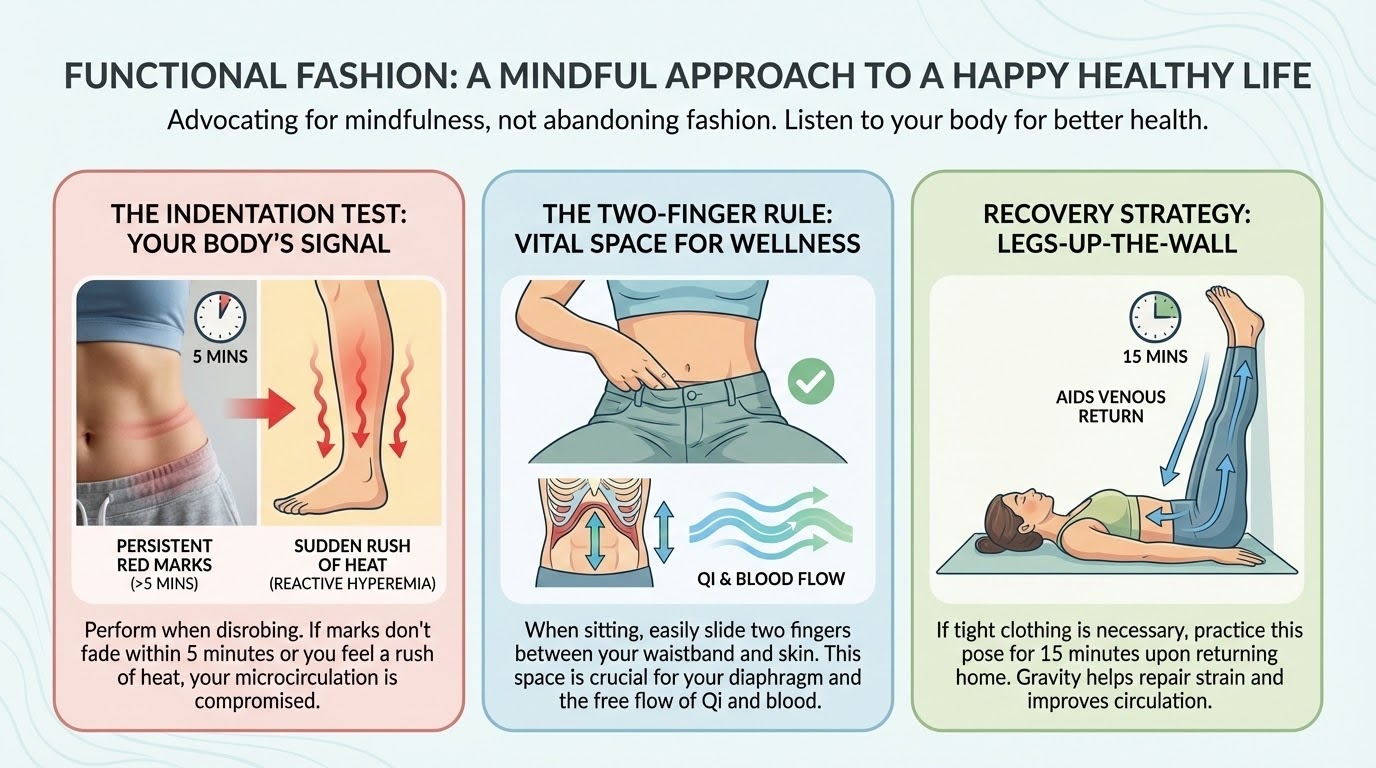
As a therapist championing the "Happy Healthy Life" philosophy, I am not asking you to abandon fashion entirely, but rather advocating for a mindfulness regarding "functional fashion." I suggest performing a simple "Indentation Test" when you disrobe at the end of the day: if red marks on your skin do not fade within five minutes, or if you feel a sudden rush of heat down your legs the moment you remove your pants (known as reactive hyperemia), this indicates your microcirculation has already been compromised.Furthermore, when shopping for clothes, please adhere to the "Two-Finger Rule"—when sitting, you should be able to easily slide two fingers between your waistband and your skin. This tiny gap is the vital space reserved for your diaphragm to function and for your Qi and blood to flow freely. If an occasion demands tight clothing, make sure to practice "Legs-Up-The-Wall" for 15 minutes upon returning home. This uses gravity to aid venous return, repairing the strain accumulated throughout the day.
Finally, I would like to share a simple home self-care routine to help unlock your constricted body.After a bath or shower when your body is warm, lie on your back and splay your legs outward in a frog-like position. Using the heel of your palm, gently push and stroke from the inner thigh toward the groin; this effectively promotes lymphatic drainage and reduces swelling in the lower limbs.For the waist, use both hands to grasp and lift the muscles on your sides, particularly the area along the upper edge of the iliac crest (the top of the hip bone). This helps release entrapped cutaneous nerves, allowing your breathing to become deep once more.For the back of the knees, wrap your four fingers around the front of the knee cap and use your thumbs to pluck crosswise across the large tendons in the knee pit (popliteal fossa).Remember, the essence of health lies in flow—whether it is blood, lymph, or the Qi of the meridians. In this high-stress era, let us learn to be kinder to our bodies. Choose clothing that allows your body to feel free and breathe in sync with your mind; this is the true elegance and wisdom of a "Happy Healthy Life."

![[Happy Healthy Life Column] A Massage Therapist's Guide to Proper Heat Therapy for Deep Tissue Relief](https://happyhealthylife.cv/wp-content/uploads/2026/03/樂健生活專欄:推拿師教你正確溫熱敷,達到深層肌肉舒緩-540x360.jpg)
![[Happy Healthy Life] Unlocking Your Body’s Self-Healing Power: A Professional Massage Therapist’s Guide to Ending Chronic Fatigue Through Gua Sha and Fascial Release](https://happyhealthylife.cv/wp-content/uploads/2026/02/樂健生活】解鎖身體自癒力:專業按摩師帶你以刮痧與筋膜放鬆告別慢性疲勞抽象藝術圖像-540x360.jpg)
