
Foreword: When a Stiff Neck Becomes the Defining Note of Modern Life
Hello, I am your massage therapist.In my practice, the most common complaint is undoubtedly a stiff neck that "feels like it doesn't even belong to my own body." It's not just muscle soreness; it's a heavy annotation left on us by modern life: prolonged screen fatigue and the accumulation of invisible stress have made us gradually forget the sense of ease and freedom our bodies are meant to have.Today, I want to share a "Happy Healthy Life" proposal with you—a key to reconnecting with your body and rediscovering your inner balance. The answer, perhaps surprisingly, isn't found in your tense shoulders or the back of your aching head. It lies in the part of us we most often neglect: our feet, the very foundation of our body.
The Shackles of Modern Life: Why Your Neck Is Always in 'Alarm Mode'
Let's be honest about a fundamental fact: our lifestyle is often at war with our physical structure. The state known as "tech neck"—prolonged periods of looking down at smartphones and maintaining a fixed posture in front of a computer—multiplies the pressure of our head's weight on the cervical spine. This forces muscle groups like the trapezius and levator scapulae into a chronic state of being "overworked."On a deeper level, psychological stress acts like an invisible puppeteer. It activates our primitive "fight or flight" response, causing the shoulder and neck muscles to unconsciously tighten and contract, as if in constant preparation for a threat. These two factors intertwine, creating a vicious cycle where pain and stress feed each other, leaving us feeling trapped and unable to break free.
The Rebirth of Ancient Wisdom: Your Feet as a Miniature Map of Your Body
So, where is the way out of this cycle? The answer may lie in the ancient practice of foot reflexology. The core concept of this therapy is to view our feet as a detailed map of the body, covered with "reflex zones" that correspond to every organ, gland, and part of the body.From a modern neurological perspective, the dense network of nerve endings in the feet transmits stimulus signals to the brain, which in turn can regulate the function of distant body parts. From an Eastern meridian theory perspective, six of the body's primary meridians either begin or end in the feet, making them a crucial hub for the circulation of Qi and Blood throughout the entire body.Regardless of the explanation, both perspectives point to a common core mechanism: through therapeutic touch, we can effectively activate our "rest and digest" system (the parasympathetic nervous system), fundamentally relieve stress, and allow the body to begin its self-repair process.
The Key to Unlocking the Shackles on Your Neck: A Precise Guide to the Reflex Zones of the Foot
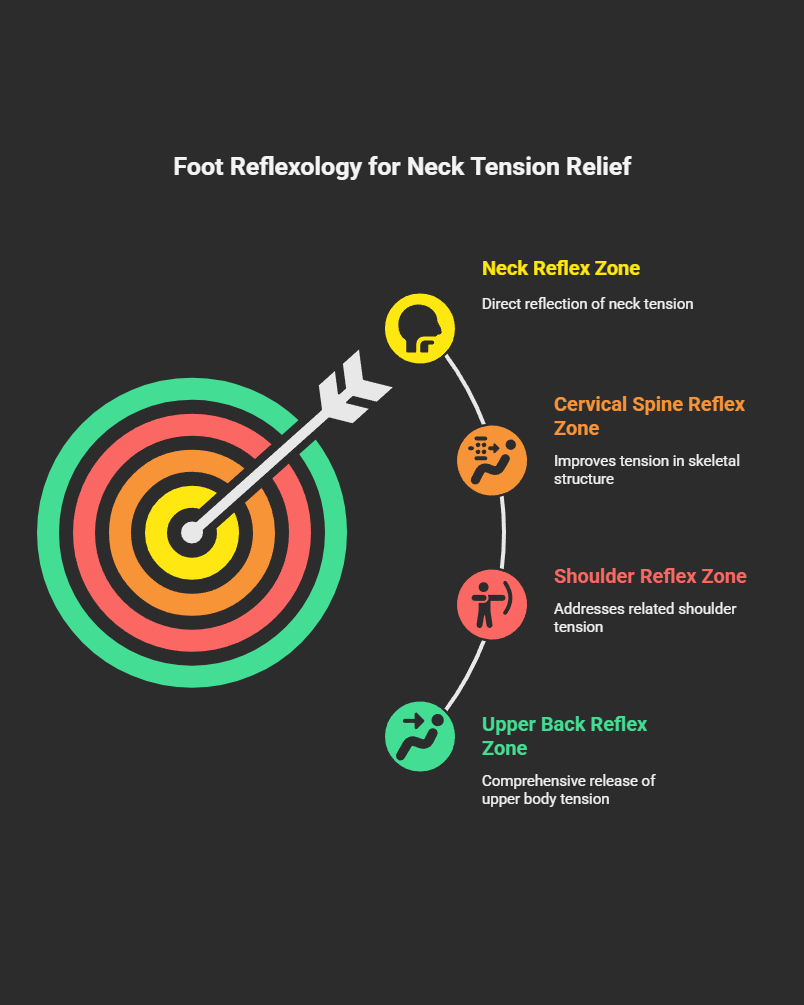
To effectively release neck tension, we need to learn how to read this map on the soles of our feet.The Neck Reflex Zone: First and most importantly, the neck reflex is located at the base of your big toes, in the fleshy, padded area that encircles the main joint. If you feel soreness, fullness, or a granular/gritty texture when you press here, that is a direct reflection of the tension in your own neck.The Cervical Spine Reflex Zone: Next, extending down along the bony inner edge of the big toe, you will find the linear zone for the cervical spine. Working on this area helps to improve tension related to the skeletal structure of your neck.The Shoulder Reflex Zone: Remember, neck pain is rarely an isolated issue. Therefore, we also need to address the shoulder reflex, which is located on the outer edge of the foot, in the area below the little toe.The Upper Back Reflex Zone: To achieve a truly comprehensive release, we must also work the upper back reflex, which is the zone that stretches across the ball of the foot.
Healing in Practice: A 15-Minute Conversation with Your Feet
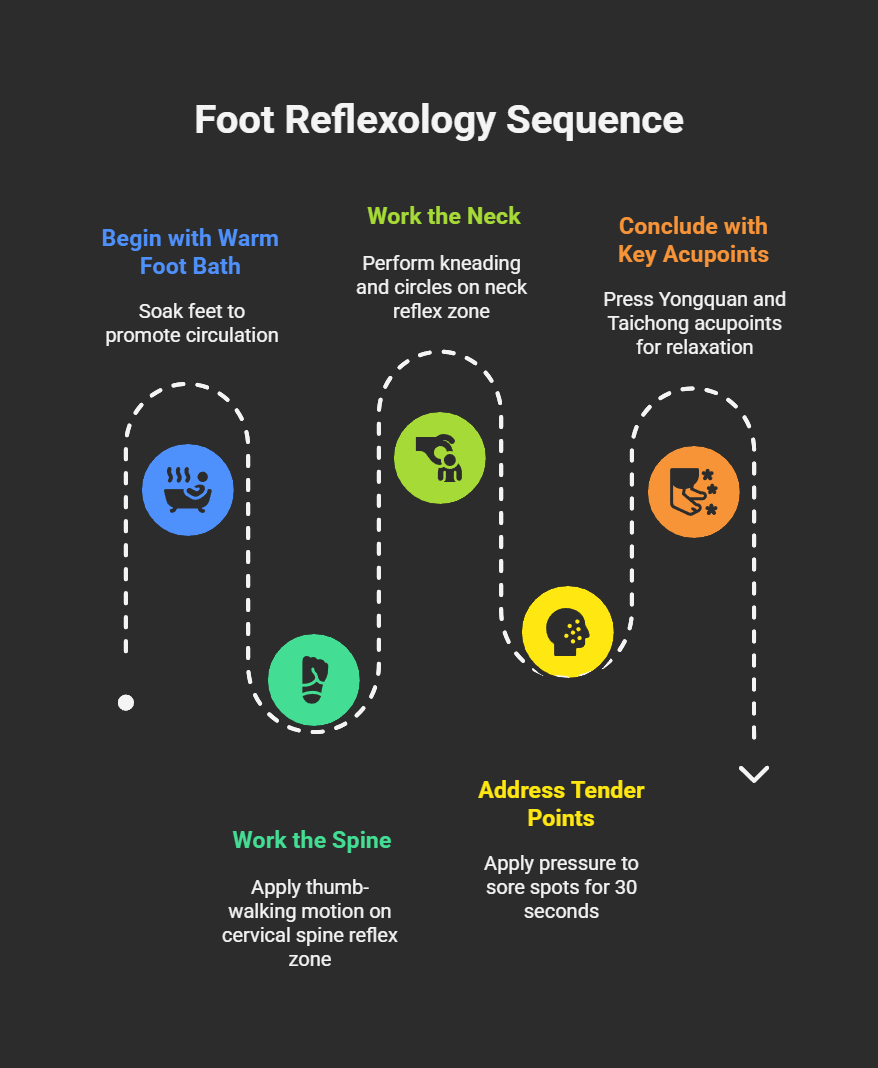
Now, let's turn knowledge into action. Carve out an uninterrupted 15-minute session for yourself.Begin with a Warm Foot Bath: This will promote circulation and make your feet more receptive to the therapeutic touch that follows.Work the Spine: Using your thumb, perform a slow "thumb-walking" (like a caterpillar) motion along the cervical spine reflex zone (the inner edge of your big toe).Work the Neck: Next, perform deep kneading and small circles on the neck reflex zone (the fleshy base of your big toe).Address Tender Points: When you find a particularly sore spot, apply steady, direct pressure. Hold for 30 seconds while visualizing the tension melting away.Conclude with Key Acupoints: Finally, finish by deeply pressing two key points:The "Yongquan" acupoint (KD1) in the center of the sole of your foot.The "Taichong" acupoint (LV3) on the top of your foot.These last two points are critical switches for activating full-body relaxation and relieving emotional stress, providing the perfect conclusion to this healing ritual.
For Enhanced Effects: A Supportive Neck and Shoulder Stretching Routine
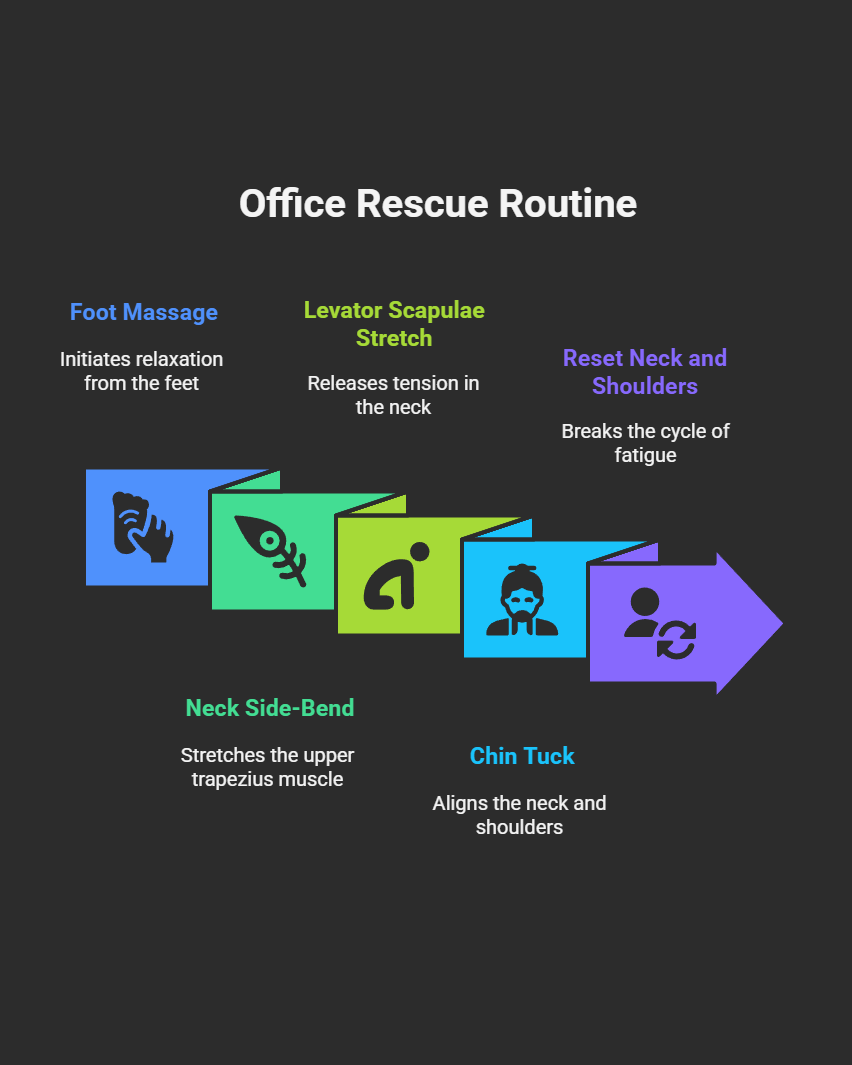
Foot massage sends a relaxation signal "from the bottom up"; if you can pair it with direct stretching exercises, you can solidify the effects "from the top down."During breaks in your workday, you can perform this simple "Office Rescue" combination:Neck Side-Bend: Gently tilt your head to one side, feeling the stretch in your upper trapezius muscle. Hold for 20 seconds, then repeat on the other side.Levator Scapulae Stretch: Next, turn your head about 45 degrees to the left, and then gently lower your chin towards your collarbone. You should feel a release in the back-right side of your neck (in the levator scapulae muscle). Hold for 20 seconds, and then repeat on the opposite side.Chin Tuck: Finally, perform a "chin tuck." Imagine a string pulling the crown of your head straight up toward the ceiling as you simultaneously draw your chin horizontally backwards, creating a "double chin."This short, two-minute routine can effectively reset the state of your neck and shoulders, breaking the cycle of fatigue accumulated from prolonged sitting.
Building a Pain-Free Foundation: Integrating 'Happy Healthy' Principles into Your Life's Blueprint
A true "Happy, Healthy Life" involves integrating health consciousness into every choice you make throughout the day.Review Your Workspace: First, examine your workstation. Ensure the top of your screen is level with your line of sight, which allows your neck to remain in its most natural position.Cultivate Postural Awareness: Second, be mindful of your posture. Constantly remind yourself to keep your "ears directly above your shoulders." Also, choose a pillow that provides proper support for the natural curve of your neck while you sleep.Manage Stress: More importantly, learn to manage stress. Practice deep diaphragmatic (belly) breathing, or incorporate calming activities that you enjoy into your life, such as walking or yoga.Keep Your Neck Warm: Finally, a frequently overlooked detail is keeping your neck warm. Especially in air-conditioned rooms, a simple scarf can prevent your muscles from tightening up due to the cold, providing the gentlest protection for the health of your neck.
Conclusion: Your Health Begins with Every Step
I hope this guide becomes your key to unlocking a "Happy, Healthy Life." Please remember, healing is not something achieved in a single step, but is a continuous journey. By integrating foot massage, stretching, and a healthy lifestyle into your daily routine, you are actively taking responsibility for your own physical and mental well-being.When you feel neck stiffness, don't immediately rush to find an external solution. Instead, look down, gently touch your own feet, and listen to the messages they are sending. Your body possesses a capacity for self-healing that is beyond imagination, and the switch to awaken this power is held in your own hands.Disclaimer: If your pain persists or is accompanied by warning signs such as numbness or weakness, please be sure to seek professional medical assistance.Wishing you all the best, that from this day forward, you may take every step with ease and without pain.


![[Happy Healthy Life] Say Goodbye to Insomnia and Brain Fog! A Veteran Massage Therapist Reveals the Hidden "Detox Switch" in Your Big Toe: A Complete Breakdown of Brain Reflexology Zones](https://happyhealthylife.cv/wp-content/uploads/2026/02/【樂健生活】告別失眠與腦霧!資深按摩師教你「大拇趾」隱藏的排毒開關:大腦足部反射區-540x360.jpg)
![No More "Blue" Days of Misery! Therapist Reveals: 15 Minutes a Day to Clear the "Nasal Reflex Zone" and Kickstart a [Happy Healthy Life] of Free Breathing from Your Soles](https://happyhealthylife.cv/wp-content/uploads/2026/01/不再「藍瘦香菇」!按摩師親授:每天15分鐘按通「鼻部反射區」,從腳底啟動呼吸自由的樂健生活-540x360.webp)