
Introduction: Is Your Body's Foundation Sending Out Silent SOS Signals?
In the hustle and bustle of modern urban life, we seem to have collectively contracted a modern malady known as "Chair Dependency Syndrome." From the morning commute behind the wheel to eight long hours of computer work at the office, and finally sinking into the sofa to binge-watch shows at night, our spines are constantly subjected to a passive, static load.As a clinical massage therapist, I have laid hands on countless stiff lower backs and cold glutes on my treatment table. These tactile sensations tell me that a "Wellness Lifestyle" should not merely be a slogan, but must be a revolution regarding both structure and energy. When you feel a dull ache in your lumbosacral region, or your legs feel heavy as lead, or when female friends endure excruciating menstrual cramps each month, this is not merely muscle fatigue. Rather, it is the foundation of your body—the Sacrum—sending an urgent distress signal to your brain.
The true essence of a "wellness lifestyle" transcends the mere absence of disease; it seeks a state of optimal flow in mind-body functions and perfect structural alignment. Guided by this philosophy, we must re-examine a crucial area that we literally "sit on" for extended periods.The sacrum serves not only as the mechanical pivot connecting the upper body to the lower limbs but also, in Traditional Chinese Medicine theory, as the energy center where Kidney Qi is stored and sealed. However, the modern lifestyle is relentlessly eroding this vital center. Prolonged sitting with a posterior pelvic tilt disrupts the Sacroiliac joint's precise mechanism of "nutation" (nodding) and "counternutation" (counter-nodding). This leads to what is known as "Dead Butt Syndrome" and deep fascial adhesions.Today, I will guide you on a deep dive into a magical switch located on the sacrum—the Ciliao point (BL32). I will teach you how, through a professional lens combined with simple self-care, to reshape your body's balance and vitality.
An Anatomical Perspective: Why Prolonged Sitting Makes the Sacrum "Suffocate"
To understand the root of pain, we must first comprehend the mechanics of how our body operates. The sacrum is an inverted triangular bone formed by the fusion of five vertebrae. Like a wedge, it slots securely between the bilateral iliac bones, forming the critically important sacroiliac joint. This region not only bears the weight of the torso but also serves as a bustling intersection for the nervous system.When we maintain a seated position for prolonged periods—especially in that relaxed but harmful "slouched" posture—the gluteus maximus suffers from ischemia (lack of blood flow) due to continuous compression, leading to a decline in neural control. In a clinical setting, this phenomenon is known as "Gluteal Amnesia." Once the gluteal muscles "forget" how to function, the burden of protecting the joints shifts to the deep ligaments and fascia, causing them to become overly tense and fibrotic, eventually resulting in tissue that feels as stiff and tough as leather.
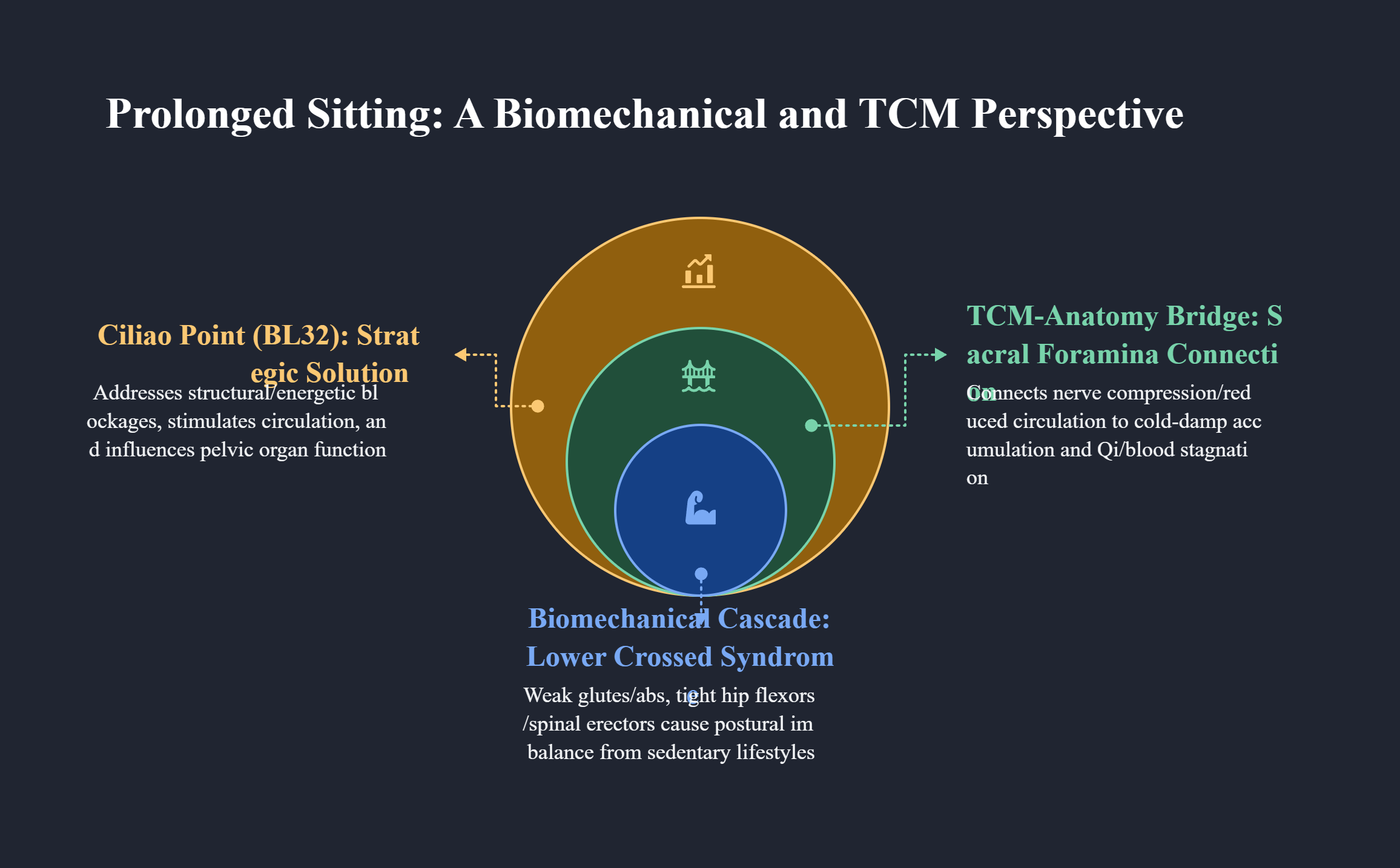
This structural stiffness triggers a chain reaction that we call "biomechanical compensation." When the gluteal muscles are weak, the erector spinae in the lower back and the iliopsoas muscles must work overtime to compensate in order to maintain stability while standing or walking. This is the classic "Lower Crossed Syndrome."This imbalance not only leads to chronic lumbosacral pain but also affects the nerves and blood vessels passing through the posterior sacral foramina. From the perspective of Traditional Chinese Medicine, this area is also a "depression" where "cold and dampness" are most likely to accumulate. The resulting sluggishness in pelvic blood circulation directly impacts the metabolic functions of the uterus, bladder, and intestines.Therefore, solving the problems caused by prolonged sitting requires more than just rest; we must actively break this structural and energetic impasse. The key to unlocking this deadlock lies hidden within the second posterior sacral foramen—at the "Ciliao" point (BL32).
Ciliao (BL32): The Master Switch Connecting Nerves and Energy
In my massage therapy practice, the Ciliao point (BL32) is an indispensable "golden point" when addressing issues related to the Lower Jiao (lower abdomen). It is located medially and inferiorly to the Posterior Superior Iliac Spine (PSIS), corresponding precisely to the second posterior sacral foramen.From the perspective of modern anatomy, the S2 nerve segment emerges here. This segment contains parasympathetic nerve fibers that directly regulate the contraction and relaxation of smooth muscles within the pelvic organs. This means that stimulating the Ciliao point is not merely about relieving superficial muscle soreness; it is fundamentally about regulating the deep nervous system.For modern individuals who live under chronic high pressure with an overactive sympathetic nervous system, "awakening" the Ciliao point can effectively activate the parasympathetic nervous system. This helps the body shift into a "rest and repair" mode, yielding surprising benefits for improving sleep quality and alleviating anxiety.
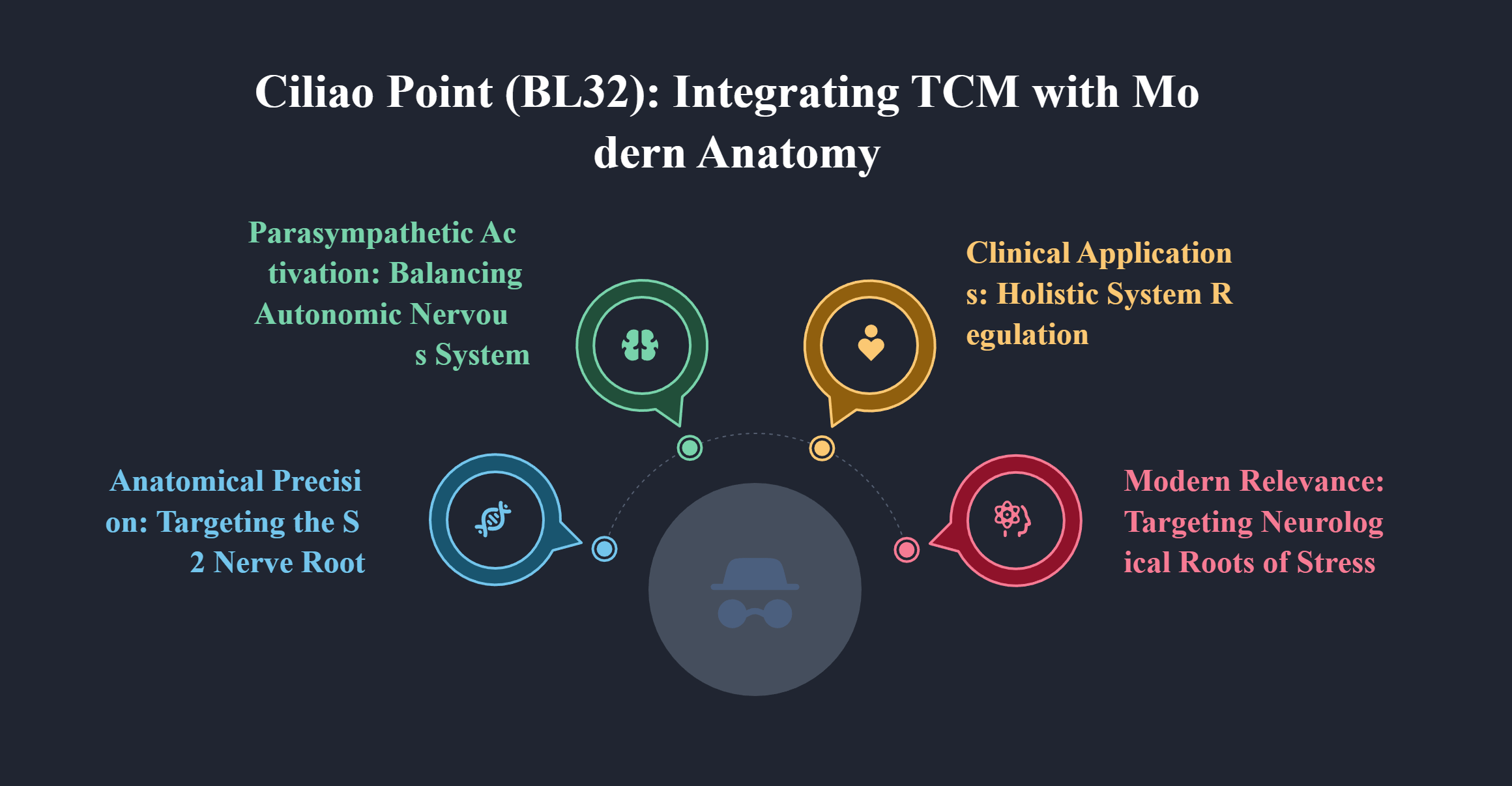
In the meridian theory of Traditional Chinese Medicine (TCM), the Ciliao point (BL32) belongs to the Bladder Meridian of Foot-Taiyang and serves as the most clinically valuable core among the "Baliao points" (Eight Crevice points). As the TCM saying goes, "The waist is the dwelling of the Kidneys," and Ciliao is precisely the key to regulating the Chong (Penetrating) and Ren (Conception) vessels and nourishing the Lower Jiao (Lower Burner).For women, this is a highly effective point for treating dysmenorrhea, irregular menstruation, and infertility caused by "uterine cold." Clinical studies indicate that warm stimulation of the Ciliao point can significantly reduce blood flow resistance in the uterine arteries and relieve spasms in the uterine smooth muscles. For men, it is also a vital gateway for improving prostate function.In essence, the Ciliao point acts like a "master switch" connecting the physical body with internal organs, and structure with energy. Once you master the method to activate it, you can fundamentally resolve the "Qi stagnation and blood stasis" caused by a sedentary lifestyle, thereby rebooting the vitality of the pelvic region.
Professional Techniques Revealed: How to Use "Rubbing" and "Point Pressing" to Dispel Cold-Dampness
As a massage therapist, I frequently employ a classic technique known as "Rubbing the Baliao" (or rubbing the Eight Sacral Crevices) to address issues in the sacral region. This is also a highly effective self-care method that you can try at home.It is a technique that utilizes friction to generate heat that penetrates into the deep tissues. To perform it, press the heel of your palm firmly against the sacrum area and rub up and down repeatedly with rapid speed (high frequency) and moderate pressure. Our goal is not to chafe the skin, but to allow the sensation of heat to penetrate beneath the surface, reaching deep into the crevices of the bones and the interior of the pelvic cavity.When you feel a warm current permeating toward your lower abdomen, you have achieved the effect of "Penetrating Heat" as described in Traditional Chinese Medicine. This heat significantly promotes local microcirculation and accelerates the elimination of metabolic waste products caused by inflammation. It is a preferred solution for relieving chronic lower back pain and addressing gynecological issues related to "cold stagnation and blood stasis."
In addition to the warming friction technique, to address deep fascial adhesions, we need to apply precise "deep point pressure."Try to locate the two bony prominences on your lower back (the Posterior Superior Iliac Spine, or PSIS). Move inward and downward about two centimeters, and you will find a distinct bony depression; this is the "Ciliao" point (BL32).Using the pad of your thumb, press vertically downward slowly, coordinating the movement with your breathing. When you reach a certain depth, you may experience a characteristic sensation of "soreness, numbness, or distension." This sensation might even radiate toward your buttocks or lower abdomen; this is the manifestation of "De Qi" (the arrival of Qi).Maintain this pressure for about one minute. This effectively loosens tension at the origin of the piriformis muscle and releases entrapped nerves. For those who frequently experience deep gluteal pain, this action often brings a sense of relief akin to "the clouds parting to reveal the sun."
Home Self-Recovery: Taking Proactive Action with Tennis Balls and Yoga
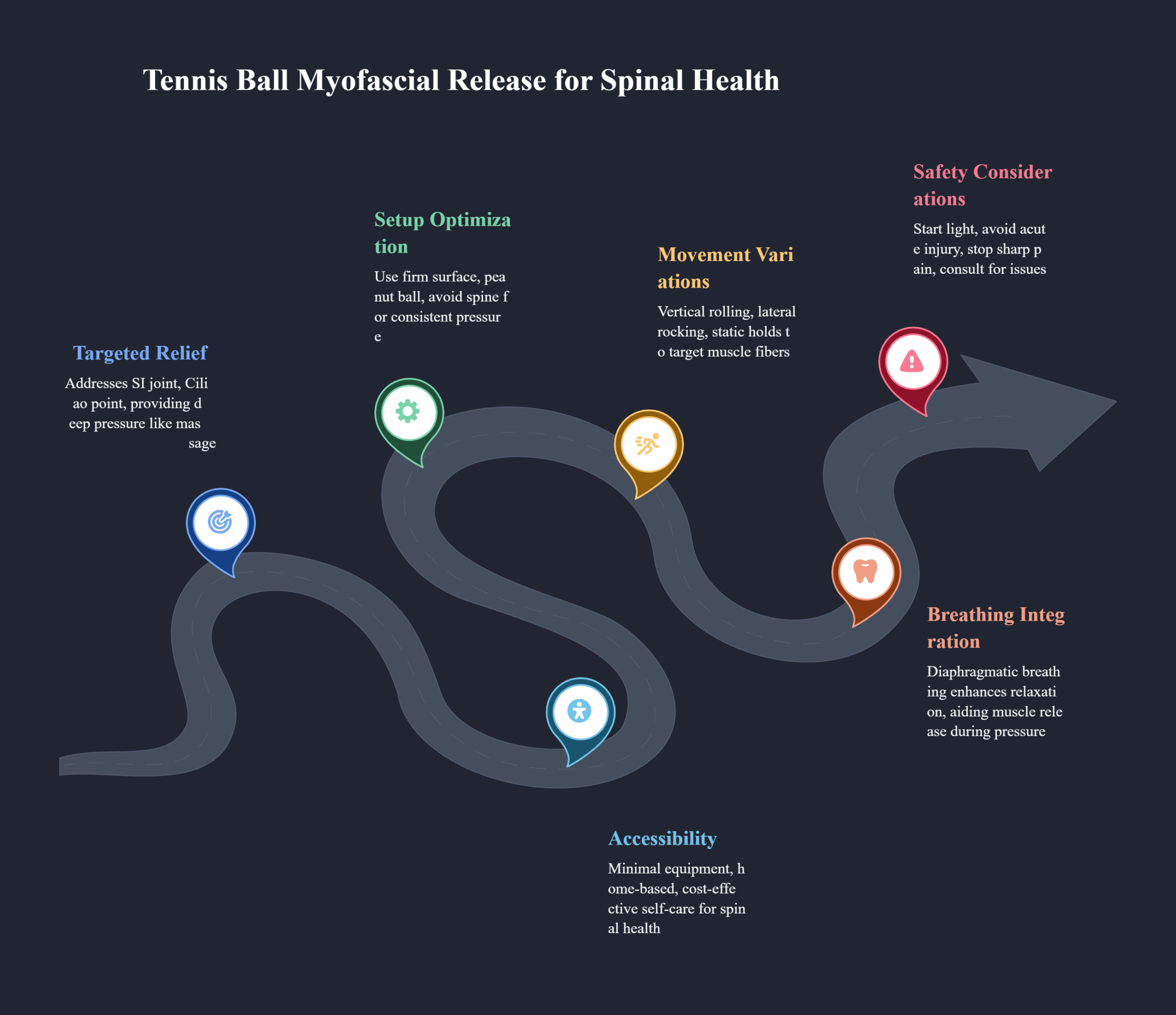
While professional massage yields significant results, the philosophy of a "wellness lifestyle" places even greater importance on daily, proactive maintenance. I strongly recommend the "Tennis Ball Myofascial Release" technique.Simply prepare two tennis balls (or a professional "peanut ball") and lie on your back on a yoga mat with your knees bent and feet flat on the floor. Place the balls on either side of the sacrum in the area of the "Ciliao" (Bladder 32) points (please be careful to avoid the spine directly in the center). Using the strength of your legs, gently roll up and down or rock your pelvis side to side.When you roll over a particularly sore spot (a trigger point), stop there. Maintain deep breathing for 30 to 60 seconds until the sensation of pain gradually melts away. This method utilizes your own body weight to apply deep pressure, effectively mimicking a therapist's elbow technique. It is an excellent home remedy for relieving tension in the sacroiliac (SI) joints.
Conclusion: Reboot Your Life of Wellness, Starting from the Sacrum
Here, I sincerely invite you to begin practicing this sacral rehabilitation guide today. Set an alarm to get up and move around after every 30 minutes of sitting. Tonight, after your shower, try rubbing your "Baliao" points until they feel warm, or use a tennis ball to roll out the stiffness in your glutes.When the qi and blood in your sacrum begin to flow freely, and the energy of the "Ciliao" point is awakened, you will be surprised to find that not only has your lower back pain vanished and your steps become lighter, but your mood has also lifted as your body relaxes and opens up.True health lies in your own hands. Let us take action together. With an upright posture, let us confidently face every challenge in life and enjoy a wellness lifestyle that is pain-free, full of vitality, and abundant.


![[Happy Healthy Life] A Professional Massage Therapist's Therapeutic Secrets for the Rangu Acupoint: A Dual-Action Guide to Saying Goodbye to Plantar Fasciitis and Insomnia](https://happyhealthylife.cv/wp-content/uploads/2026/02/樂健生活:專業按摩師的然谷穴理療秘笈,告別足底筋膜炎與失眠的雙效指南-540x360.jpg)
