
In my treatment room, I often encounter clients arriving with the same frustration: "I clearly don't eat much, and I've even tried fasting, so why won't the weight come off? And why do I always feel bloated and suffer from indigestion?"When I work on their neck and shoulders, I often discover a striking commonality: beyond just stiff shoulders, their "masseter muscles" (chewing muscles) are as hard as rock.ShutterstockIn fact, this isn't merely a physical manifestation of stress; it is a critical roadblock hindering your ability to lose weight.
As a bodyworker who advocates a "wellness lifestyle," I have noticed that people today focus excessively on what they eat, while overlooking how they eat.From a young age, we are taught to "chew carefully and swallow slowly." This is not merely a cliché about table manners; it is the key to igniting the body's metabolic engine. Today, from the perspective of muscular anatomy and fascia, I would like to guide you in rediscovering this simple yet powerful health habit: chewing 30 times per bite.
Why You "Can't" Chew Thoroughly and Eat Slowly: It Could Be Your Muscles Protesting
Many people have tried "slow eating," only to give up after a couple of days because they find it "exhausting" or simply "cannot control the urge to swallow." This is not actually a failure of your willpower; rather, it is because your "oral-jaw system" is overworked.Our masseter muscles (on the sides of the cheeks) and temporalis muscles (near the temples) serve as reservoirs for stress and emotions. When you are under chronic high pressure, anxiety, or habitually clench your teeth, these muscles stay in a state of "hypertonicity" (high tension), becoming filled with knots and trigger points.
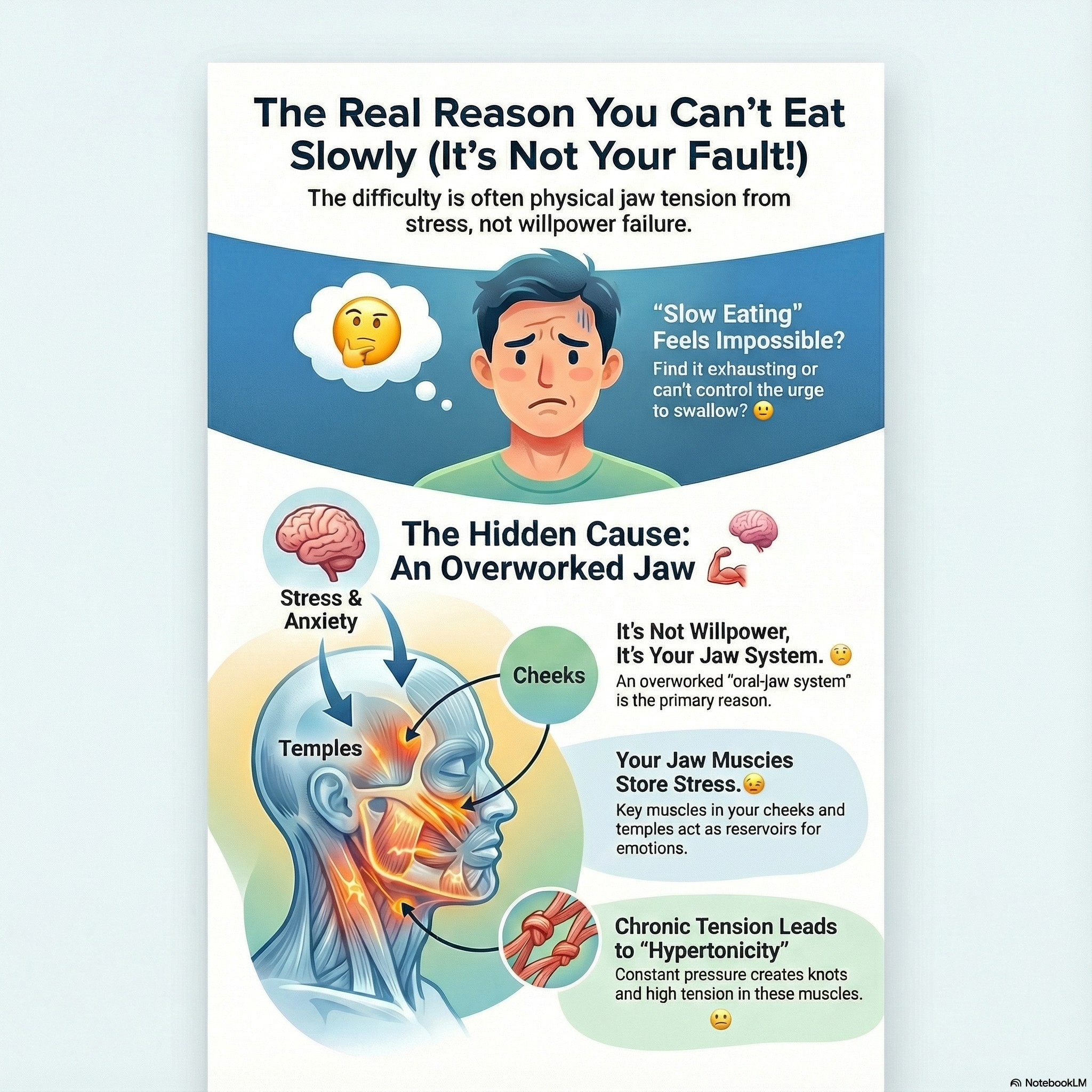
Imagine this: if your thigh muscles were sore and weak after just finishing a marathon, could you still do squats?The same principle applies here. When your chewing muscles are already stiff and fatigued from stress, expecting them to chew 30 times per bite is simply an impossible task. To avoid the discomfort of muscle soreness, your brain subconsciously commands you to "just chew a couple of times and swallow," forcing your stomach to do the work your teeth should have done. This is why relaxing your jaw is the first step toward restoring healthy eating habits.
The 20-Minute Time Lag: Trick Your Brain and Let the "Slimming Hormone" Help You Lose Weight
Have you ever finished a bento box and still felt hungry, so you stuffed yourself with dessert, only to feel so full half an hour later that you wanted to throw up? This is because there is a "20-minute time lag" between your brain and your gut. When food enters the stomach, the body needs time to release satiety signals and send them back to the brain. People who wolf down their food often end up consuming excessive calories before that signal even arrives.
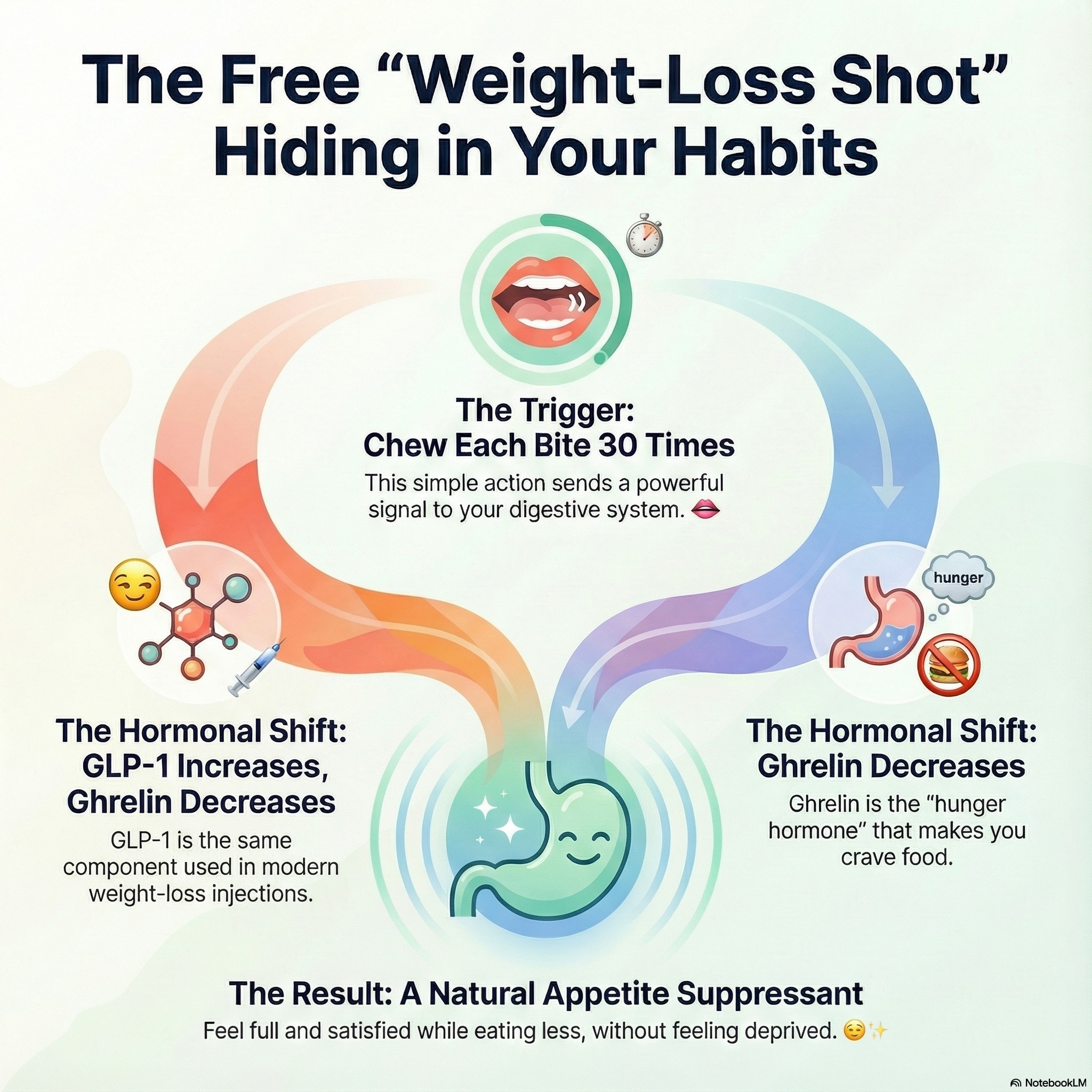
Even more fascinating is that scientific research has confirmed that thorough chewing can alter your body's hormonal landscape. When you chew each bite 30 times, it stimulates the intestines to secrete GLP-1—the very component mimicked by today's popular weight-loss injections—while simultaneously suppressing ghrelin, the "hunger hormone."Simply put, chewing a few more times acts as the body's built-in, completely free "appetite suppressant" and "blood sugar stabilizer." It allows you to eat less naturally, without any sense of deprivation.
A TCM Perspective: Spleen and Stomach Transport and the Truth About "False Fat"
In the wisdom of Eastern medicine, there is a famous saying: "The Spleen opens into the mouth." The oral cavity serves as the gateway to the Spleen and Stomach system, while chewing is the very first step in the process of "transportation and transformation." Many people who claim they "gain weight even just by drinking water" are actually not dealing with excess body fat, but rather with a heavy accumulation of "Phlegm-Dampness." When chewing is insufficient—meaning food enters the stomach without being fully ground and mixed with saliva—it depletes a significant amount of "Spleen Qi" to process it.
Once Spleen Qi becomes deficient, the body's ability to eliminate excess fluids and metabolic waste diminishes. This leads to water retention (edema) and soft, weak muscles, resulting in what is known as "puffiness" (or deficiency-type weight gain). Through conscious chewing, we are, in fact, exercising the Qi of the Spleen and Stomach. Furthermore, focusing on the present moment while chewing—practicing "Mindful Eating"—helps shift our awareness from an overthinking brain back to the body. In Traditional Chinese Medicine, this helps to inhibit "Liver Qi invading the Stomach," thereby reducing the occurrence of stress-induced binge eating.
A Massage Therapist’s Insider Tips: Two Moves to Release the Masseter Muscles and Reclaim Your Jawline
To successfully practice chewing slowly and thoroughly, we must first let the muscles "loosen up." I recommend performing the following simple self-massage routine 5 minutes before meals. It will not only enhance your chewing endurance, but you may also reap an unexpected bonus: a face-slimming effect:
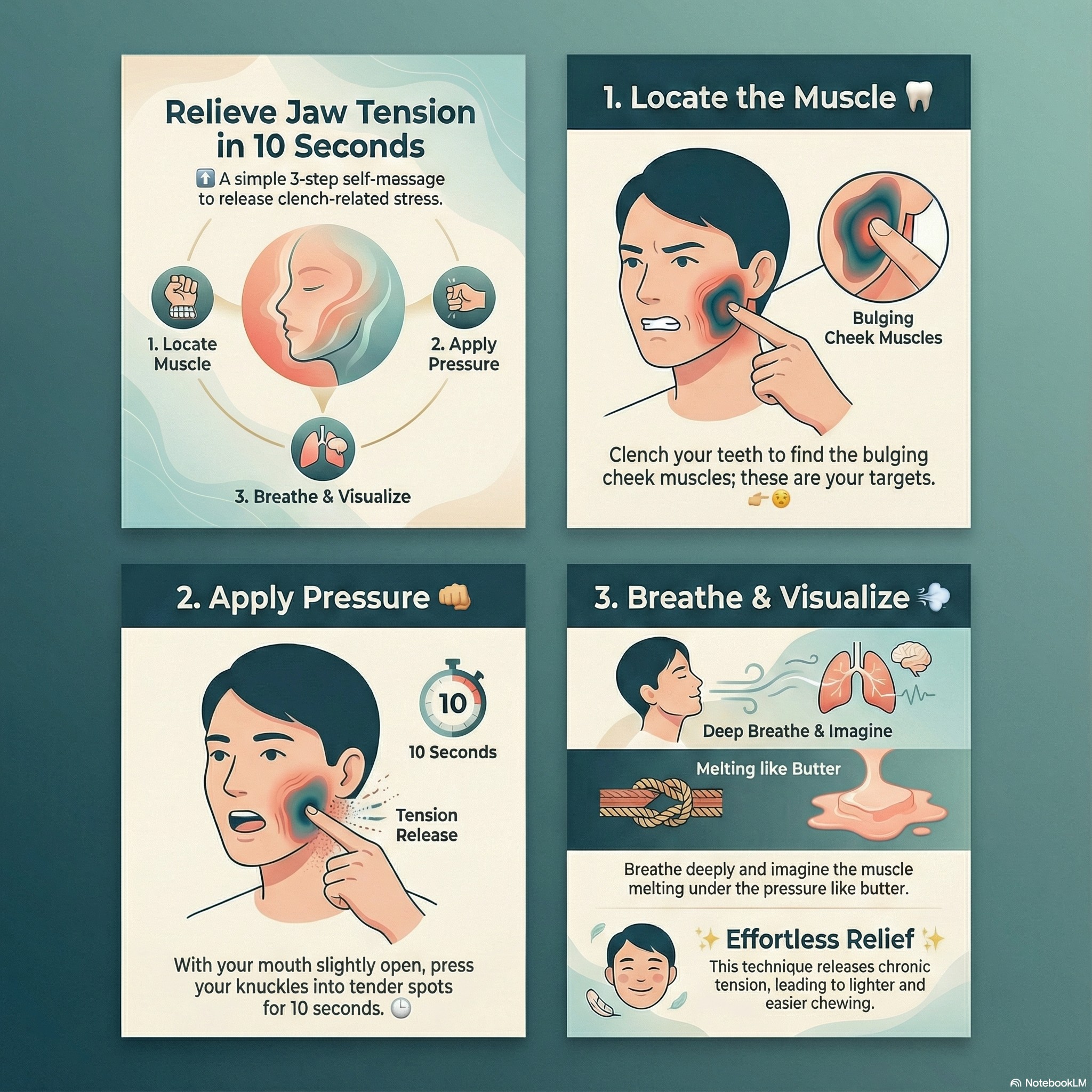
1. Deep Masseter Release: Make a fist and use your knuckles to press against the muscles on both sides of your cheeks—the ones that bulge when you clench your teeth. With your mouth slightly open, locate the specific points that feel tender to the touch. Apply deep, static pressure to these points for 10 seconds. As you breathe deeply, visualize the muscle melting under your fingers like butter. This technique releases the accumulated tension from chronic jaw clenching, making chewing feel light and effortless.
2. Soothing the Temporalis Muscle: Use the pads of your fingers to massage in circular motions over your temples and the scalp area above your ears. This is a key region that governs both emotions and jaw movement. Relaxing this area not only improves chewing flexibility but also alleviates tension headaches, allowing you to feel calmer during meals rather than rushing through them in "fight or flight" mode.
The Activation Ritual: Transforming Mealtime into a Healing Experience
Finally, I would like to invite you to try a small experiment. Starting with your next meal, try to view the act of eating as a sacred ritual. You can use a simple behavioral modification technique:"Put Down Your Utensils".After every bite you take, completely set down your chopsticks or spoon, and take your hands off the utensils.
Focus intently on the process of food transforming from solid to liquid in your mouth, continuing until the texture is completely smooth and free of particles. Take a deep breath, swallow, and only then pick up your utensils for the next bite. This seemingly awkward sequence acts as a hard reset, forcing a break in your body's habitual rhythm of rushing. Trust me: stick with this for just one week, and you will find that bloating vanishes, regularity returns, and the numbers on the scale may even bring you a pleasant surprise.
On the path to a "Wellness Lifestyle," we do not need expensive remedies or extreme diets. Sometimes, health is simply hidden within the rhythmic motion of chewing. Starting today, let us slow down. With a rhythm of 30 chews per bite, let us mindfully savor the flavor of life and the taste of health.

![[Happy Healthy Life Column] A Massage Therapist's Guide to Proper Heat Therapy for Deep Tissue Relief](https://happyhealthylife.cv/wp-content/uploads/2026/03/樂健生活專欄:推拿師教你正確溫熱敷,達到深層肌肉舒緩-540x360.jpg)
![[Happy Healthy Life] Unlocking Your Body’s Self-Healing Power: A Professional Massage Therapist’s Guide to Ending Chronic Fatigue Through Gua Sha and Fascial Release](https://happyhealthylife.cv/wp-content/uploads/2026/02/樂健生活】解鎖身體自癒力:專業按摩師帶你以刮痧與筋膜放鬆告別慢性疲勞抽象藝術圖像-540x360.jpg)
