
Hello, I am your massage therapist. In my work, I encounter many clients every day who are troubled by physical discomfort. The most common issues are, without a doubt, nagging indigestion, abdominal bloating, and the cyclical menstrual pain that many women dread.We all desire a "Happy Healthy Life," which is not just the absence of illness, but a state filled with energy and inner harmony. Today, I want to share a secret weapon with you—a key I often use in my treatment sessions and teach my clients for at-home self-care: a body energy switch located on the inner side of your calf called the Diji acupoint (SP8).This article will give you an in-depth understanding of this point and teach you how to activate it to inject vitality into your health.
Unlocking the Body's Hub: The Mysteries of the "Diji" Acupoint
The name of an acupoint often holds clues to its function, and the name "Diji" is highly descriptive.The character "Di" (地) corresponds to "Earth" in the Five Elements theory. The Spleen organ also belongs to the Earth element, symbolizing its role in bearing, transforming, and nourishing all things. This directly points to the acupoint's deep connection with the functions of the Spleen and Stomach.The character "Ji" (機) refers to a mechanism, a hub, or a crucial switch.Therefore, "Diji" is like a master switch deep within the earth that governs vital functions. When you activate it, you are directly regulating the core operations of the Spleen—the body's energy factory—and managing a key control point for the body's digestion, absorption, and blood circulation. Its importance is self-evident.
Precision Location: Finding the Diji Acupoint Like a Professional
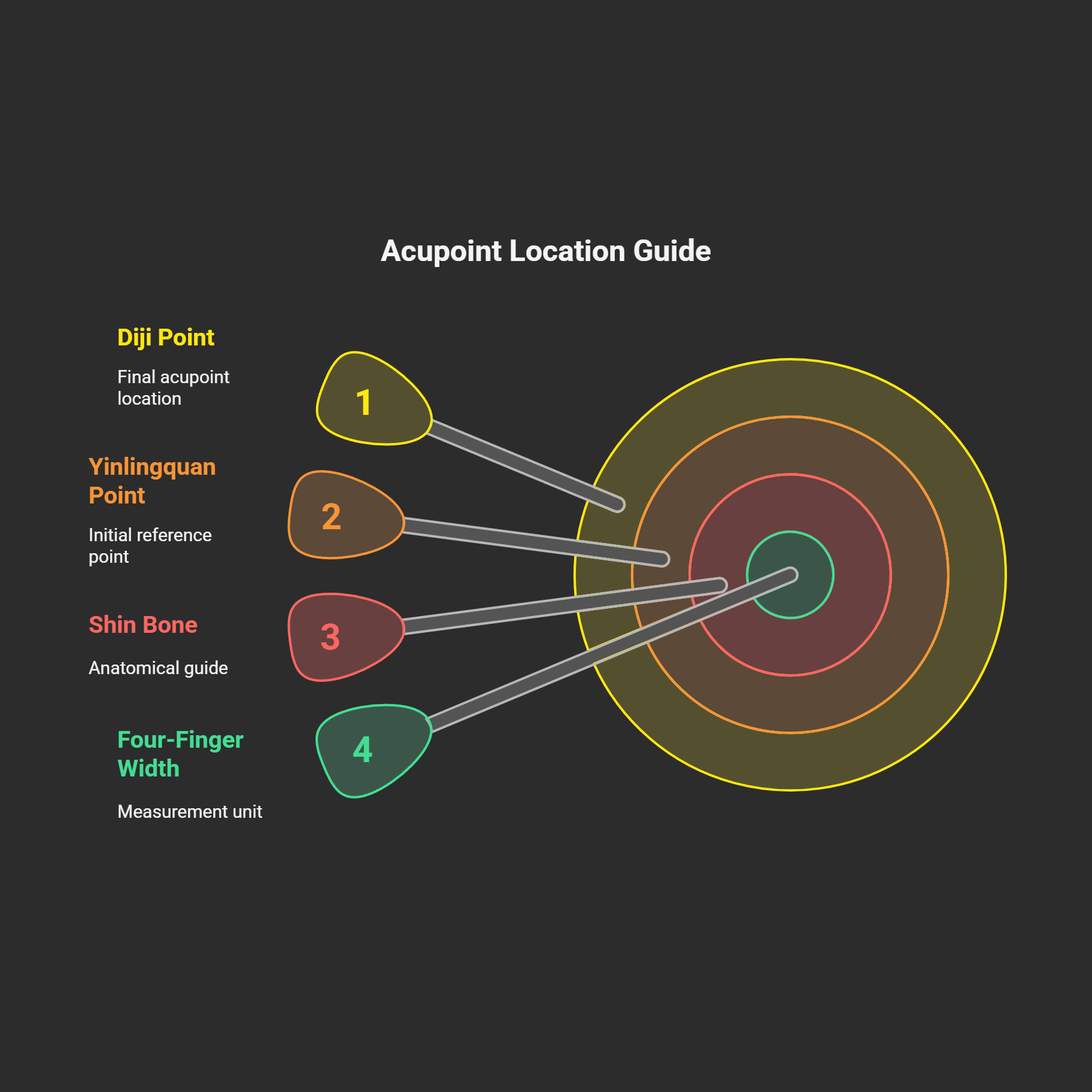
As a therapist, I know that precise location is the foundation of effectiveness. Please follow along with me as we use a simple "anatomical triangulation method" to find it.First, sit down and locate the lower border of the inside of your knee. Slide your finger up along the edge of your shin bone (tibia), and you will feel a distinct depression. This is the Yinlingquan acupoint (SP9).Next, place your four fingers (from index to little finger) together. This four-finger width will serve as a unit of measurement (known as 3 "cun" in Traditional Chinese Medicine). Place your hand horizontally just below the Yinlingquan point. Where the four-finger measurement ends, right on the posterior border of the shin bone, is the Diji point.Please remember, the point you press is on the rear edge of the bone, not on the bone's surface. You should be able to feel a clear sensation of soreness and distension.
The Art of Self-Massage: Releasing the Healing Power of the Diji Acupoint
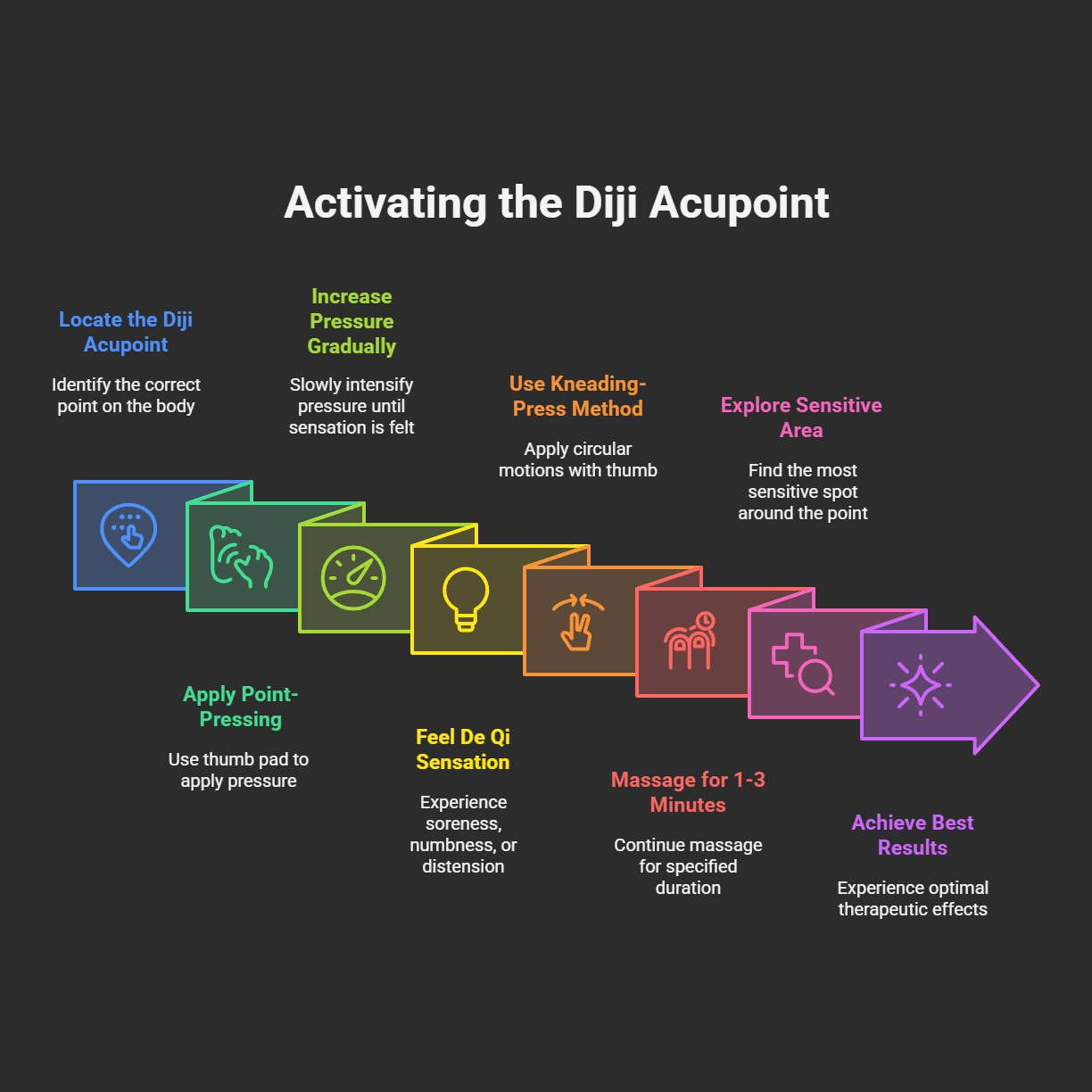
Once you have located the Diji acupoint, the next step is to activate it effectively. In my treatment sessions, I use deep pressure, which you can also easily do at home.I recommend using the pad of your thumb to apply perpendicular "point-pressing" to the acupoint. Start with light pressure and gradually increase it until you feel the "De Qi" sensation of soreness, numbness, distension, or ache. Alternatively, you can use a "kneading-press" method, making small circles centered on your thumb.Each massage session should last for 1 to 3 minutes, and you can do this once or twice a day. While massaging, feel free to gently explore the area around the point to find the most sensitive spot. That is where the Qi and Blood are gathered, and stimulating that specific point will yield the best results.
The Body's Whispers: Interpreting the Pain Signals from the Diji Acupoint
The Diji acupoint is not just a treatment point; it's also like a "display screen" for your body's condition. When we press it, that unique sensation of soreness and distension, which TCM calls "De Qi," signifies that the body's energy has been successfully mobilized—this is a good sign.But what makes the Diji point special is that it also functions as a diagnostic alarm. If you feel an abnormally sharp, piercing pain when you press it, especially in the week leading up to your period, this is often an indication that there may be stagnation or poor circulation of Qi and Blood in your uterine area.This signal allows us to upgrade from "treating pain" to "predicting pain," enabling us to perform massage and conditioning in advance to effectively prevent the onset of menstrual pain.
The Digestive System's Power Pump: Say Goodbye to Bloating and Discomfort
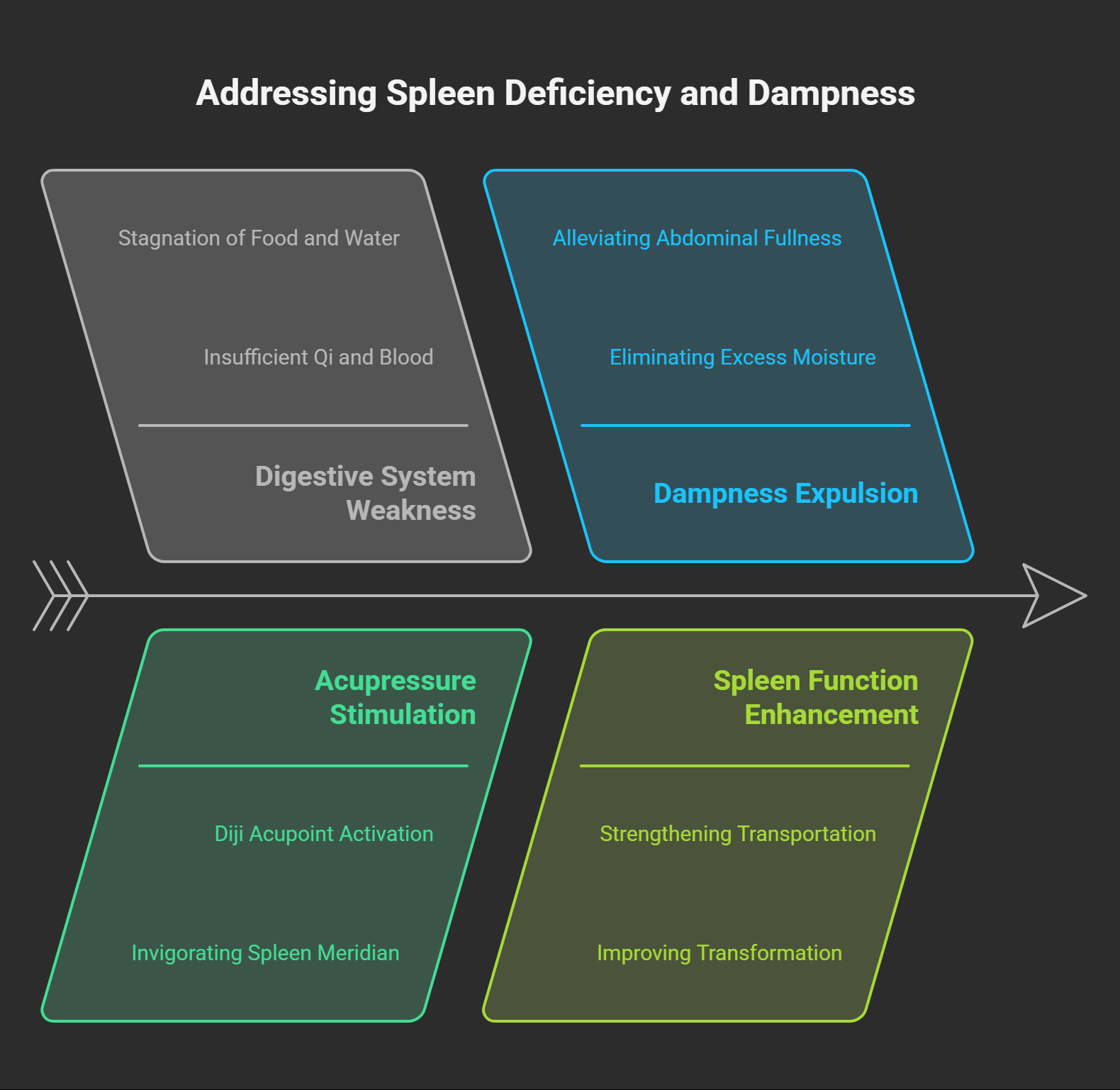
In my clinical experience, many clients' issues with abdominal bloating, pain, or poor appetite are related to what Traditional Chinese Medicine (TCM) calls "Spleen deficiency with encumbering dampness." You can imagine it as the body's digestive system lacking sufficient power, which leads to the stagnation of food and water, creating a feeling of heaviness and oppressive fullness.The Diji acupoint is the very power pump that restarts this system. Through acupressure stimulation, we can effectively invigorate the Qi and Blood of the Spleen meridian and strengthen the Spleen's function of transportation and transformation. This is like adding horsepower to a slow-running machine, enabling it to smoothly expel "dampness," which significantly alleviates the feeling of abdominal fullness and restores smooth order to the digestive system.
A Woman's Intimate Ally: The First-Aid Button for Menstrual Pain
For women, the Diji acupoint is undoubtedly an intimate ally. It is the "trump card" point in Traditional Chinese Medicine for treating Blood Stasis-type dysmenorrhea (menstrual pain). This type of menstrual pain is characterized by a fixed location, a sharp, stabbing sensation, and dark menstrual blood, often with clots. This is a classic manifestation of the principle, "If there is no free flow, there is pain."As the Xi-cleft point of the Spleen meridian, where the Qi and Blood of the channel gather deeply, Diji possesses a powerful ability to invigorate blood and dispel stasis. It can rapidly clear blockages, acting like a "first-aid button" for acute pain. When menstrual pain strikes, applying firm pressure to this point can quickly and effectively alleviate the pain, truly achieving the state of "If there is free flow, there is no pain."
Synergistic Effects: Building Your Acupoint Healing Team
In Traditional Chinese Medicine practice, combining acupoints can multiply their effects. If you want to enhance the therapeutic results, you can try the following combinations:For Menstrual Pain and Blood Stasis: Combine Diji (SP8) with Sanyinjiao (SP6), located above the ankle, and Xuehai (SP10), located on the inner thigh. In this team, Diji acts as the vanguard for stopping pain, Sanyinjiao comprehensively regulates the Liver, Spleen, and Kidney, and Xuehai focuses specifically on the Blood itself. Working together, these three points treat both the symptom and the root cause. For Indigestion: Pair Diji (SP8) with Zusanli (ST36), located on the outer side of the calf, and Zhongwan (CV12), on the upper abdomen. This combination regulates the Spleen and Stomach in unison, comprehensively restoring the digestive function of the Middle Jiao.
Holistic Care: Integrating Spleen-Fortifying Habits into Your Daily Life
True health requires integrating good habits into your life.First is diet. The Spleen and Stomach prefer warmth and dryness, so please choose more warm, yellow foods like pumpkin and millet, and make good use of ginger to warm the stomach. Try to avoid iced, raw, and greasy foods, as they increase the burden on your digestive system.Second is emotions. Chronic worry and overthinking directly harm the function of the Spleen and Stomach, leading to impeded Qi flow. Practicing meditation, cultivating hobbies, and maintaining a peaceful state of mind are crucial.Finally, there is exercise. Prolonged sitting causes the Qi and Blood throughout the body to stagnate. Regular, gentle exercises like walking, yoga, or Tai Chi can mildly promote the circulation of Qi and Blood and are the best complementary practices for nurturing the Spleen and Stomach.
Conclusion: The Diji Acupoint, Your Lifelong Health Partner
In summary, the Diji acupoint (SP8) is a powerful, built-in health consultant within your body. It is both an expert at handling acute menstrual pain and a capable assistant for improving digestive discomfort. All of its power stems from its deep regulation of our body's "energy factory"—the Spleen.Mastering the use of the Diji acupoint is not just about learning a skill; it's about learning a language to communicate with your own body. I hope you will put the knowledge you've gained today into practice, incorporate this simple and effective self-massage into your daily routine, actively listen to your body's voice, and personally create a "Happy Healthy Life" for yourself, filled with vitality and joy.


![[Happy Healthy Life] A Professional Massage Therapist's Therapeutic Secrets for the Rangu Acupoint: A Dual-Action Guide to Saying Goodbye to Plantar Fasciitis and Insomnia](https://happyhealthylife.cv/wp-content/uploads/2026/02/樂健生活:專業按摩師的然谷穴理療秘笈,告別足底筋膜炎與失眠的雙效指南-540x360.jpg)
