
Introduction: The Body's Dialogue with Autumn
Autumn always reminds us of the changing of the seasons in a way that is both gentle and clear. There is a hint of coolness in the air, the sunlight softens, and the leaves quietly don their golden coats.As a massage therapist, I find that at this time of year, the bodies of many clients who walk into my studio seem to be telling the same story: an inexplicable stiffness in the shoulders and neck, an indescribable sense of fatigue, and breathing that has become shallow.This is no coincidence. As nature transitions from the exuberance of summer to the quiet storage of winter, our bodies are also silently undergoing an internal recalibration. This season is the perfect time for us to listen to our bodies, synchronize with the rhythm of nature, and deeply nourish our "Lungs." This is not merely to prevent colds or a dry cough, but more importantly, to release deep-seated stress and rediscover our inner vitality and peace.
Why is autumn the golden time for lung nourishment?
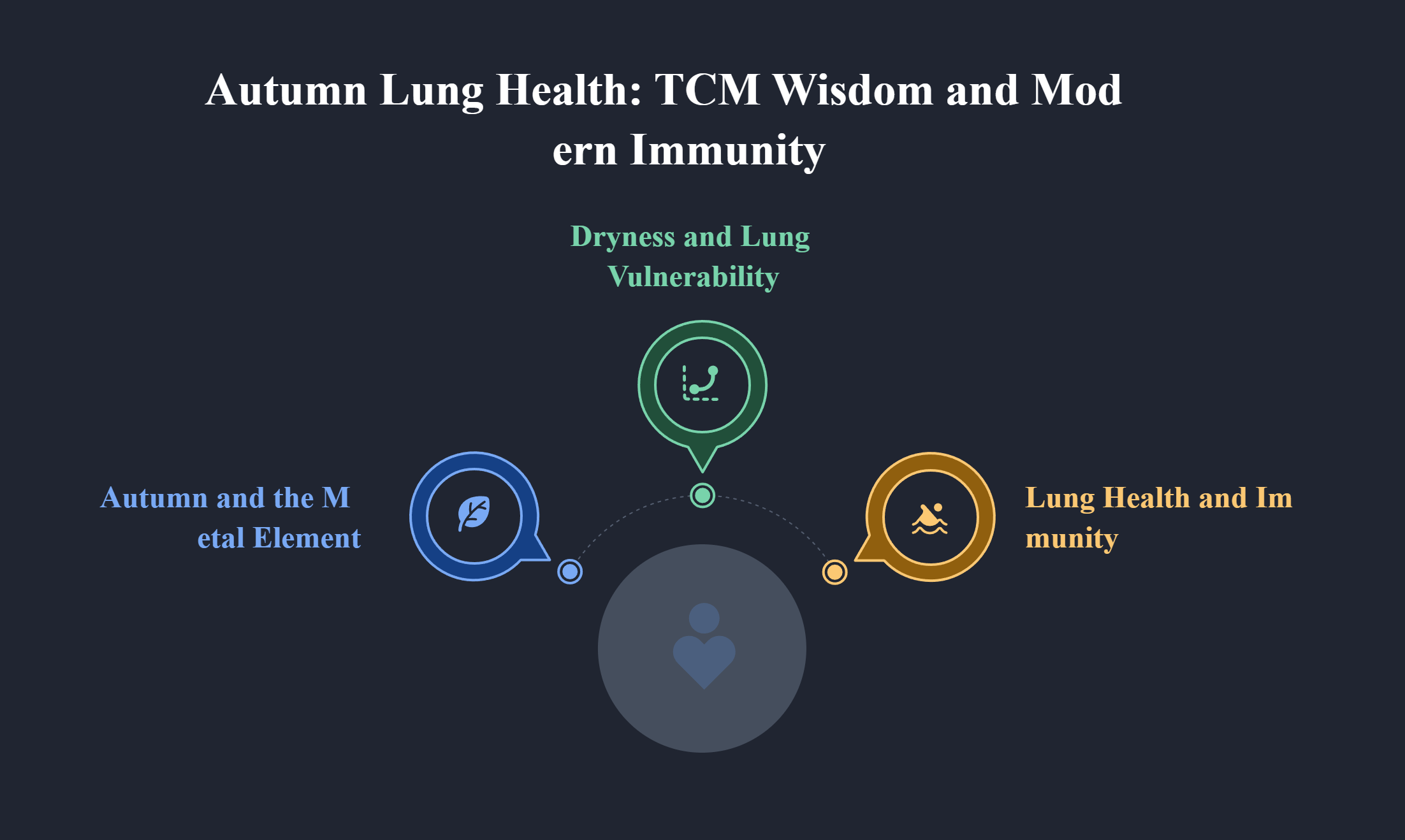
You may be curious as to why particular attention should be paid to the lungs during autumn. Ancient wisdom on health preservation and modern observations happen to coincide. In Traditional Chinese Medicine, the autumn season corresponds to the "Metal" element among the Five Elements, and the internal organ that "Metal" corresponds to is precisely the "Lungs." The most prominent characteristic of this season is "dryness." This intangible "dryness evil" quietly depletes our body's moisture, leaving the lungs vulnerable. This is also why many people experience a dry, itchy throat, taut skin, or even a dry cough in the autumn. From my clinical experience, the health of the lungs is intimately connected to our body's entire defense system. When lung qi is abundant and breathing is deep, the body's immunity is naturally enhanced, making it better able to withstand the various challenges of seasonal transitions and to store up healthy energy for the coming winter.
Do you truly know how to breathe? Unlock the power of deep breathing.
On the treatment table, one of the most common things I guide clients to do is simply to "breathe." Many people chuckle when they hear this instruction, but they soon discover just how shallow our everyday breathing is. Under stress, we tend to breathe with our chest and shoulders, an inefficient and anxiety-inducing pattern known as "thoracic breathing" or "chest breathing." This pattern keeps your neck and shoulder muscles in a constant state of overwork, which explains why your trapezius muscles are always so tense.In contrast, "abdominal breathing," also known as "diaphragmatic breathing," is our body's most natural and efficient mode. As you inhale, allow your abdomen to expand naturally like a balloon. This not only draws oxygen deep into the base of your lungs, enhancing your energy, but more importantly, it activates our body's "relaxation switch."
The Diaphragm: Your Body's Built-in Massage Therapist
Practicing abdominal breathing regularly is akin to giving your internal organs a gentle massage. When you inhale deeply, the primary muscle of respiration—the diaphragm—descends, softly massaging the stomach, liver, and intestines beneath it. As you exhale, it rises, releasing the pressure. This process of descent and ascent promotes blood circulation within the abdominal cavity and activates the functions of the digestive system.Interestingly, in the theory of Traditional Chinese Medicine, the Lungs' complementary partner in an exterior-interior relationship is the Large Intestine. The dryness of autumn not only affects the Lungs but also frequently leads to a deficiency of fluids in the intestinal tract, which can cause constipation. Therefore, as you nourish your lungs through abdominal breathing, you are also indirectly aiding intestinal peristalsis. This perfectly embodies the inseparable, holistic connection between the various parts of the body.
A Therapist's Insider Tip: The Art of Self-Massage to Release Your Breath
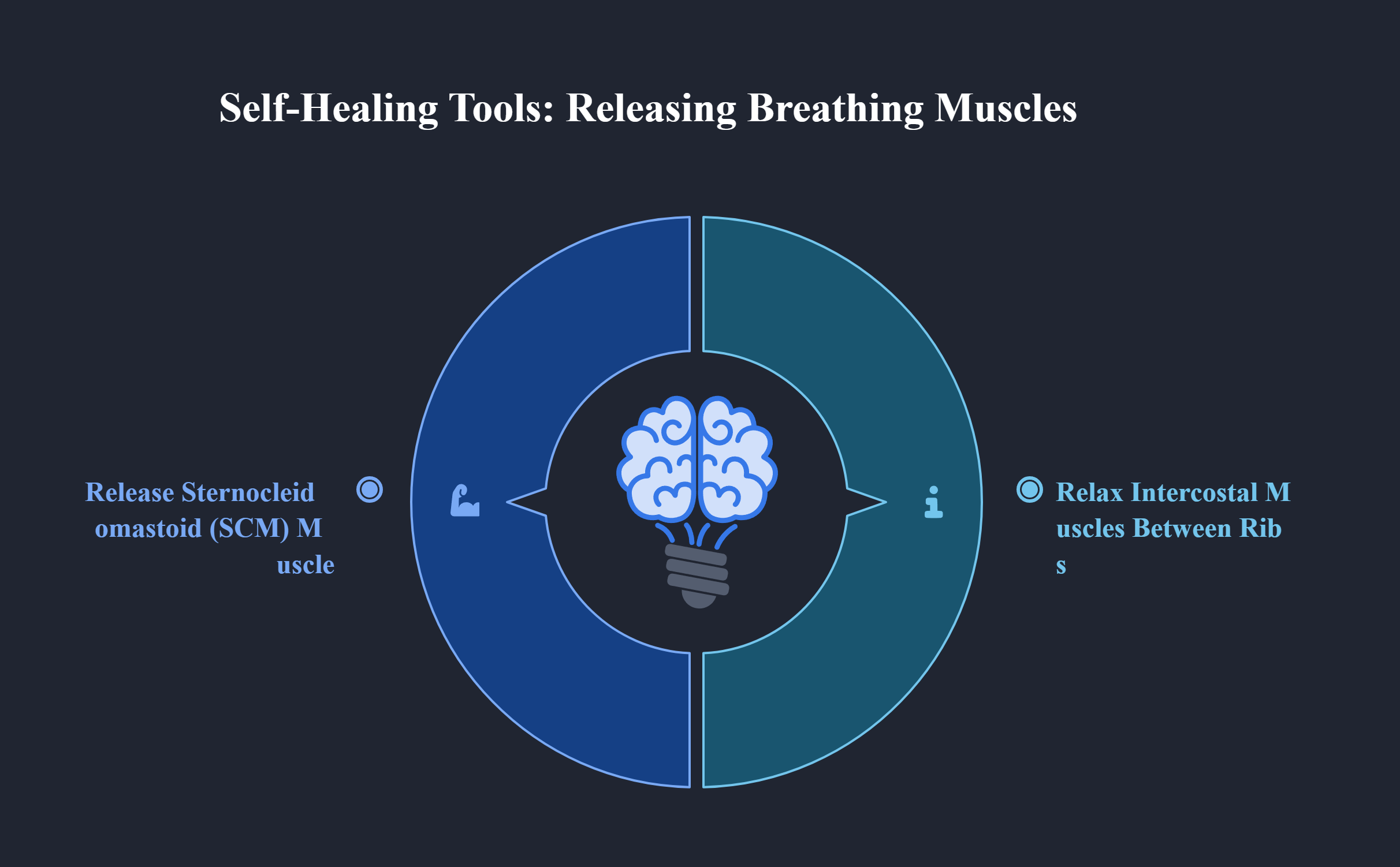
As a therapist who cannot be by your side at all times, I hope to teach you a set of "self-healing" tools that you can take home. When chronic stress and poor posture make breathing feel labored, we can use gentle touch to release those overly tight "accessory breathing muscles."First, we can address the "sternocleidomastoid" (SCM) muscle in the neck, which often contributes to headaches and stiffness. Turn your head to one side, and with your fingers, gently pinch and knead the prominent muscle that extends from behind your ear down to your collarbone.Next, we can relax the "intercostal muscles" between the ribs. Place the pads of your fingers in the gaps between your ribs. As you exhale, gently glide your fingers forward along these spaces. You will feel the space in your rib cage instantly open up, allowing each breath to become easier and fuller.
Awakening the Body's Energy: Autumn Acupressure for Nourishing the Lungs
In the meridian theory of Traditional Chinese Medicine (TCM), there is an energy channel that flows directly to the lungs—the "Lung Meridian of Hand-Taiyin." By applying pressure to specific acupoints along this meridian, we can directly "communicate" with the lungs and help them restore balance. Here are a few acupoints that are particularly useful during the autumn season.First is the **"Chize" (尺澤穴) point**, located in the crease of your elbow. When you feel heat from dryness or have a dry cough, applying deep pressure to this point can provide a moistening effect, much like a clear spring.Second is the **"Lieque" (列缺穴) point**, found on your wrist. It is a key point for addressing the initial stages of a cold, as well as headaches and throat discomfort.Finally, there is the **"Yuji" (魚際穴) point**, located on the fleshy mound at the base of your thumb on the palm side. When you feel a dry, sore throat, pressing this point can bring swift relief.Spending a few minutes each day pressing these acupoints is like performing daily maintenance on your body's energy channels.
Your 15-Minute Autumn Wellness Ritual
Now, let's integrate breathing, touch, and acupressure into a cohesive daily ritual. Find a quiet corner, set aside 15 minutes, and give yourself a profound mind-body reset.
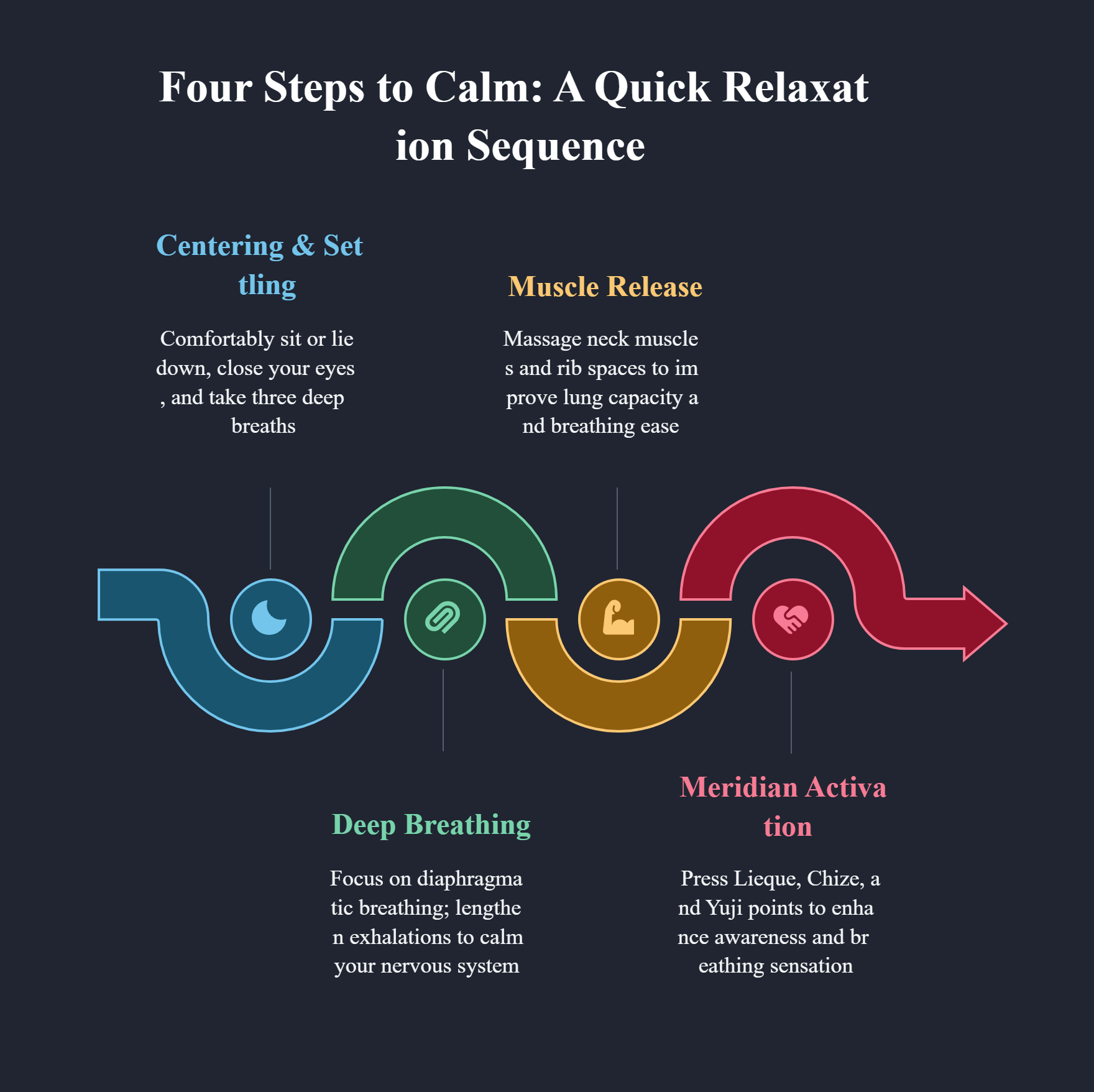
(2 Mins) Centering & Settling:Sit or lie down comfortably and close your eyes. Take three deep, cleansing breaths, and with each exhalation, release the disturbances of your day.
(5 minutes) Deep Breathing: Place a hand on your abdomen and focus on diaphragmatic breathing. Feel the warm expansion of your belly as you inhale, and consciously lengthen your exhalation to allow your nervous system to calm down completely.
(5 minutes) Muscle Release:Following the method described previously, gently massage the sternocleidomastoid (SCM) muscle in your neck and the area above your collarbones. Next, gently glide the pads of your fingers through the spaces between your ribs to create more room for your lungs to breathe.
(3 Minutes) Meridian Activation:Press the Lieque point on your wrist, the Chize point in your elbow crease, and the Yuji point on the palm of your hand in sequence. Hold each point for about 30 seconds on each side, bringing your awareness and your breath to the sensation under your fingertips.
Conclusion: Breathe Health into Every Day
Nurturing the lungs in autumn is more than just a set of techniques for coping with seasonal change; it is a philosophy of life. It reminds us that we, like nature, should live in accordance with the natural rhythms, knowing the right time to release and the right time to conserve.By incorporating these simple exercises into your daily life—perhaps a few deep breaths during a break at work, or a gentle neck massage before sleep—these seemingly small actions will accumulate into significant health benefits. Through conscious breathing and mindful, caring touch, we not only strengthen our body's defenses but also stabilize our emotions, allowing us to greet every moment of life with a more open and tranquil state of being.May you bring this clear, crisp essence of autumn into your life, keeping your body and mind in an optimal state of harmony and vitality at all times.

![[Happy Healthy Life Column] A Massage Therapist's Guide to Proper Heat Therapy for Deep Tissue Relief](https://happyhealthylife.cv/wp-content/uploads/2026/03/樂健生活專欄:推拿師教你正確溫熱敷,達到深層肌肉舒緩-540x360.jpg)
![[Happy Healthy Life] Unlocking Your Body’s Self-Healing Power: A Professional Massage Therapist’s Guide to Ending Chronic Fatigue Through Gua Sha and Fascial Release](https://happyhealthylife.cv/wp-content/uploads/2026/02/樂健生活】解鎖身體自癒力:專業按摩師帶你以刮痧與筋膜放鬆告別慢性疲勞抽象藝術圖像-540x360.jpg)
