
Hello everyone, I'm your massage therapist. In my treatment room, one of the most common complaints I hear is, "My shoulders are so tight and sore!"Modern life almost inevitably pulls us forward: we hunch over our phones, work long hours at a computer, and lean forward while driving. These day-to-day postures cause the muscles in our chest and the front of our shoulders—especially the anterior deltoids—to become progressively shorter and tighter.This tightness not only leads to shoulder and neck pain but also gradually pulls our shoulders forward, creating what we commonly call "rounded shoulders" or "computer shoulder." This affects our posture, can even restrict the depth of our breathing, and leaves us feeling drained of vitality.
Today, I want to share with you a stretch that seems simple yet holds profound meaning—the "cross-body stretch." But we're going to do more than just pull an arm across the chest. From a therapist's perspective, I will guide you to deeply understand the essence of this movement, teaching you how to use subtle adjustments to precisely release the "invisible shackles" that cause your body to lean forward.This isn't just a stretch; it's a journey of reconnecting with your body and rediscovering balance and vitality. Let's learn how to properly care for our shoulders and move towards a true "Happy Healthy Life."
Why Is the Front of Your Shoulders Always Tight? Get to Know Your Anterior Deltoid
To solve a problem, we must first understand its root cause. Imagine a muscle on the front of your shoulder that runs from the outer edge of your collarbone down to your upper arm bone—this is the anterior deltoid.Its primary job is to help you lift your arm forward (flexion) and rotate it inward (internal rotation), such as when you reach for an object in front of you or type on a keyboard. When we maintain this arms-forward posture for extended periods, this muscle remains in a shortened state. Over time, it "forgets" how to fully relax and lengthen, becoming chronically tense—much like a rubber band that has lost its elasticity.
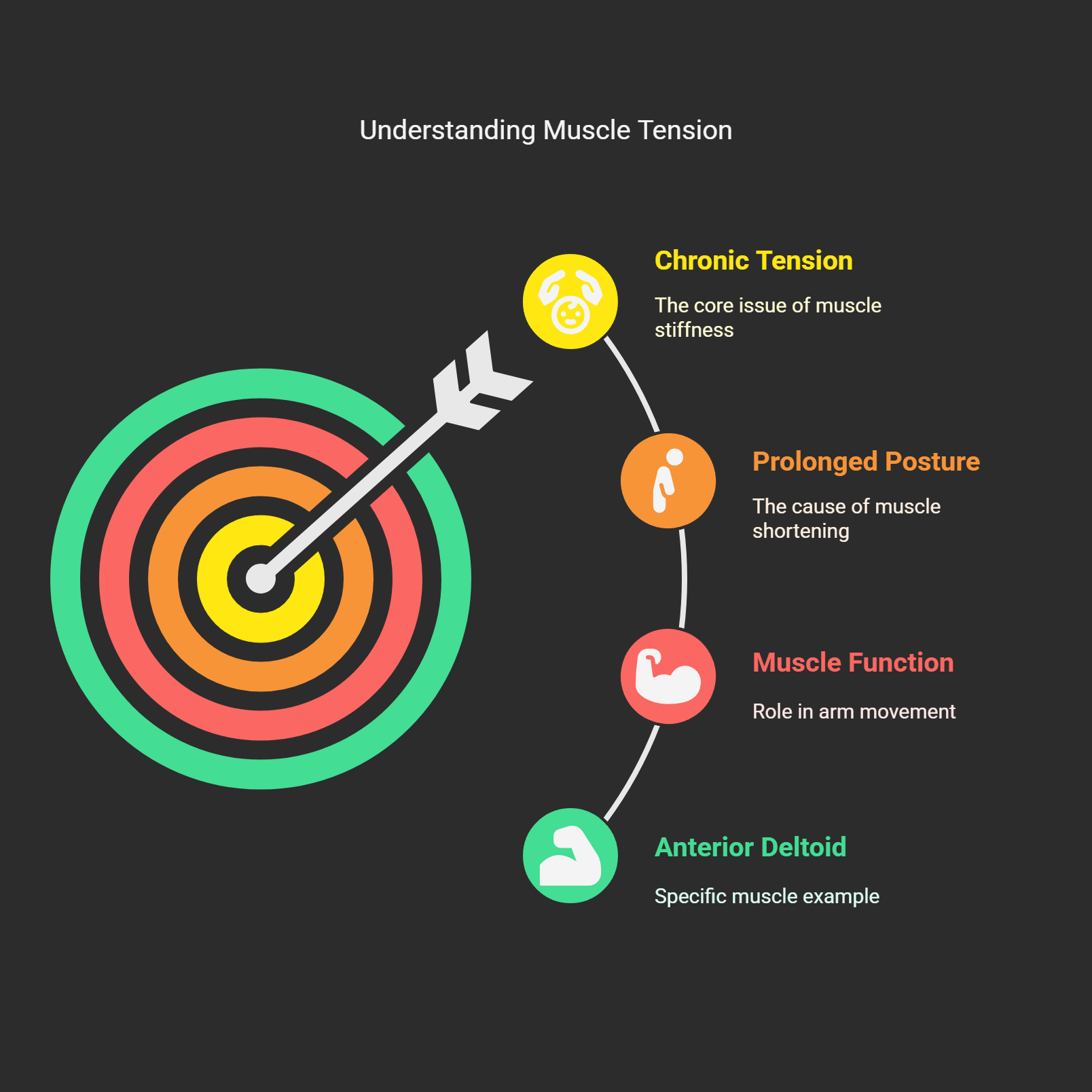
More importantly, the anterior deltoid doesn't work in isolation. It forms an "anterior fascial chain" along with the pectoralis major (chest muscle) and the coracobrachialis. The muscles in this chain have similar functions, so when one area becomes tight, it often implicates the others.This is precisely why attempting to fix your rounded shoulders by only relaxing your back has limited results. We must address the issue from the "front" of the body, gently stretching this chronically contracted muscle chain to truly "open up" your chest and shoulders, allowing your body to return to a more neutral and relaxed posture.
The First Step to a Precise Stretch: The Sensation Is More Important Than the Movement
Now, let's learn the "refined version" of this cross-body stretch. Remember, our goal isn't to achieve the maximum range of motion, but rather to find the "right" stretching sensation.You can do this standing or sitting, just keep your torso upright. Extend your right arm straight across your chest towards your left side. Now, here comes the key part: use your left hand to gently support your upper right arm (near the elbow, but not on the joint itself), and then slowly draw the right arm closer to your body.At this point, focus all of your attention on the front of your right shoulder.
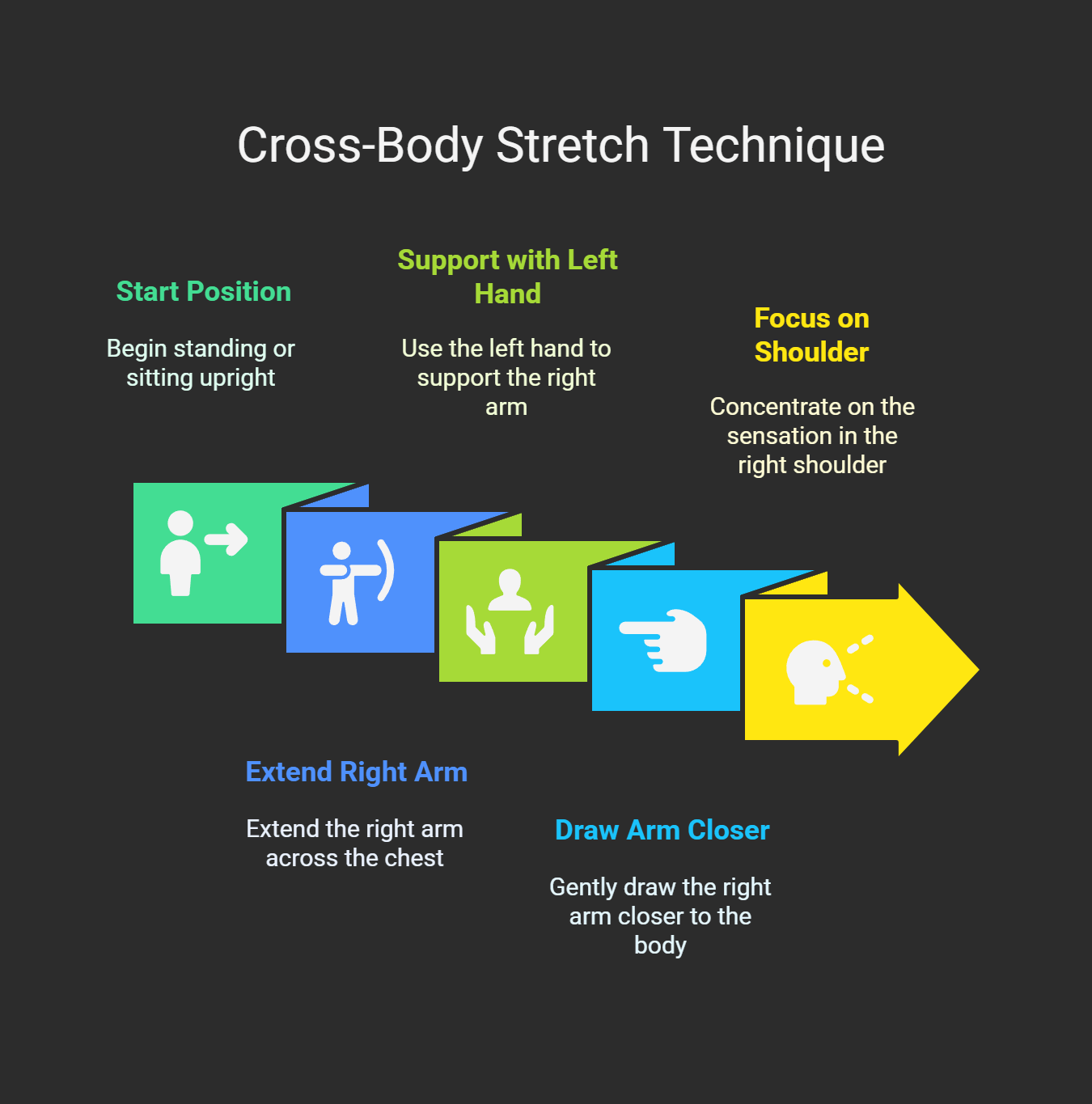
Are you feeling a gentle lengthening in the muscles below your collarbone and at the front of your shoulder? If so, congratulations—you're doing it right!If the sensation is primarily at the back of your shoulder, try making a subtle adjustment: imagine you need to slightly "anchor" your right shoulder back, preventing it from being pulled forward along with your arm. At the same time, ensure your arm is parallel to the floor, not tilting upwards or downwards.This focus on "proprioception" (your sense of body awareness) is the key to transforming a common stretch into a precise therapeutic tool. Find that point, and then hold it.
A Therapist's Advice: Common Mistakes to Avoid
When I guide clients through stretches, I notice several common mistakes that can greatly reduce the effectiveness and even introduce risks.The first is "shrugging the shoulders." As you feel the stretch, your shoulders might unconsciously creep up towards your ears. This causes your upper trapezius muscle to become overly tense, which in turn creates a new problem. Consciously keep your shoulders depressed and away from your ears.The second is "rotating the body." If your upper body twists in the direction of your arm, the force of the stretch is dispersed. Keep your core stable and your belly button facing directly forward at all times.
Another major mistake to avoid is "ballistic stretching," which involves repeatedly bouncing at the end-range of a stretch. This can trigger a protective contraction in the muscle, causing it to tighten up further, and may even lead to micro-tears. What we are aiming for is a slow, steady entry into the stretch, followed by a static hold for 15 to 30 seconds.Finally, here is the most important principle: "A stretch should be performed with a feeling of comfortable tension; it should never involve sharp pain." Pain is your body's alarm signal, telling you that you have pushed past your limit. Please be sure to treat your body gently.
The Four Major Lifestyle Benefits of Unlocking Your Shoulders
When you perform this stretch consistently and correctly, you will discover that its benefits go far beyond simply relieving shoulder tightness.First, you will feel an increase in your shoulder joint's "freedom of movement." Whether you're reaching for something on a high shelf or exercising, your movements will become smoother and easier. This freedom will directly translate into greater confidence in your daily life.Second, the most visible change will be an "improvement in your posture." As the tight muscles on your front side are released, your shoulders will naturally return to a more neutral position. The issue of rounded shoulders will be alleviated, making you appear more upright and energetic overall.
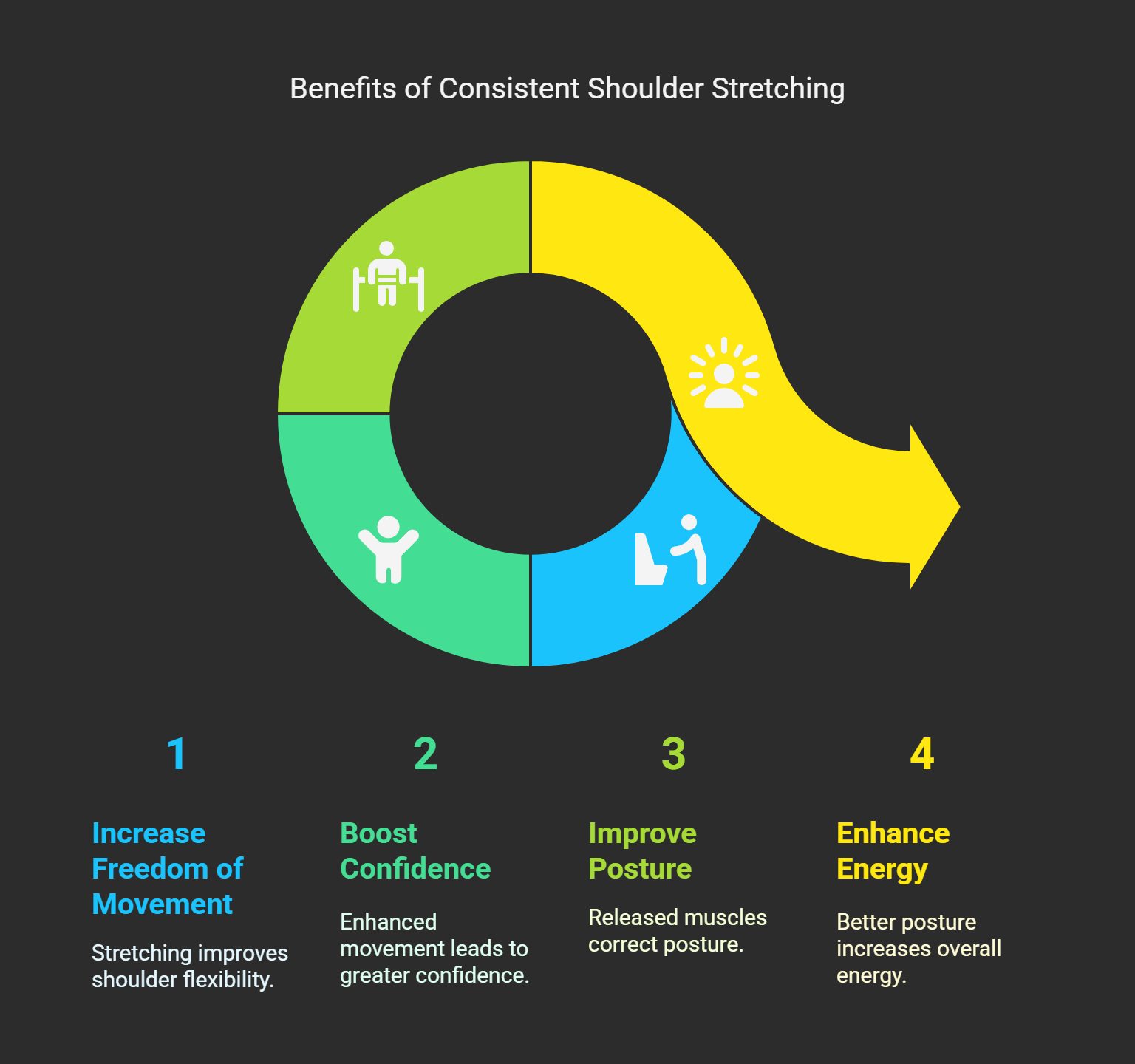
Third, it provides an unexpected benefit to your "breathing." An open chest cavity means your lungs have more space to expand, allowing each breath to be deeper and more efficient, which brings more oxygen and energy to your body.Finally, this is the most proactive form of "preventative care." Maintaining good muscle flexibility can significantly reduce the risk of shoulder injuries caused by muscle imbalances and overuse. This isn't about treating pain; it's about investing in a painless and vibrant future.
Safety First: When to Stretch and When to Stop
As a massage therapist, I must emphasize that while stretching is incredibly beneficial, it is not a cure-all, especially in certain situations.If you have an acute shoulder injury, such as a recent strain or joint inflammation, please prioritize rest and ice application first; stretching at this stage will only exacerbate the problem.Furthermore, if you feel a "pinching sensation" or a sharp, stabbing pain in the front or top of your shoulder while performing the cross-body stretch, this may not be simple muscle tightness. It could be a warning sign of "subacromial impingement" (shoulder impingement). If this occurs, stop immediately and seek a professional evaluation.
For those with a history of shoulder dislocation or feelings of joint instability, you need to be extra cautious with any end-range stretching to avoid placing excessive stress on the joint.In summary, please treat your body as your smartest partner. A "gentle pulling sensation" is a green light, indicating you are effectively lengthening the muscle. In contrast, "any form of pain or feeling of instability" is a red light, telling you that you must stop or change course.If you are ever unsure whether your condition is suitable for this stretch, consulting a physical therapist or a professional massage therapist like myself is always the safest choice.
Enrich Your Stretching Toolbox: More Ways to Care for Your Shoulders
To care for your shoulders more comprehensively, the cross-body stretch is an excellent starting point, but we can also incorporate more diverse movements.I particularly recommend the "doorway stretch." Stand in the middle of a doorway and place your forearms on either side of the frame, with your elbows at the same height as your shoulders. Then, slowly lean your body forward, and you will feel your entire chest and the front of your shoulders being gently opened.You can experiment by placing your hands slightly higher or lower to feel the subtle differences in the muscle stretch at various angles.
Another movement I often teach clients is the "hands-clasped-behind-the-back stretch." Stand up straight, lift your chest, and clasp your hands behind your back. If you can't reach, you can use a towel to bridge the gap.Then, slowly roll your shoulders back and down, feeling your shoulder blades draw towards each other, while lifting your hands up and away from your body. This movement is incredibly effective at counteracting the forward-leaning posture of our daily lives.Incorporate these movements into your daily routine; it's like building a "wellness toolbox" for your body that you can use for self-care at any time.
Conclusion: Stretching as a Daily Ritual for a Happy, Healthy Life
The anterior deltoid stretch we've explored in depth today is far more than just a technique to relieve soreness. It is an act of physical self-awareness, a proactive effort to counteract the imbalances brought on by modern lifestyles. It serves as a reminder that our physical health cannot be taken for granted, but rather requires our daily attention and care.Integrate this simple stretch into your life—whether during a break at the office or as a moment of relaxation after your workday ends—and treat it as a valuable ritual of communicating with your own body.
Remember, a true "Happy, Healthy Life" stems from these small but consistent acts of self-care. It's about balance—not only muscular balance, but also the balance between work and rest, between effort and nourishment.When you "open" the front of your body through stretching, you simultaneously open a door to deeper breathing, a more upright posture, and freer movement.Start today. Use this mindful stretch to release your tight shoulders and welcome a healthier, more open, and more vibrant version of yourself.

![[Happy Healthy Life Column] A Massage Therapist's Guide to Proper Heat Therapy for Deep Tissue Relief](https://happyhealthylife.cv/wp-content/uploads/2026/03/樂健生活專欄:推拿師教你正確溫熱敷,達到深層肌肉舒緩-540x360.jpg)
![[Happy Healthy Life] Unlocking Your Body’s Self-Healing Power: A Professional Massage Therapist’s Guide to Ending Chronic Fatigue Through Gua Sha and Fascial Release](https://happyhealthylife.cv/wp-content/uploads/2026/02/樂健生活】解鎖身體自癒力:專業按摩師帶你以刮痧與筋膜放鬆告別慢性疲勞抽象藝術圖像-540x360.jpg)
