![[Happy Healthy Life] The Massage Therapist's Secret Prescription: Use Your "Non-Dominant Hand" for 10 Minutes a Day to Give Your Brain and Neck a Deep SPA](https://happyhealthylife.cv/wp-content/uploads/2025/12/【樂健生活】按摩師的秘密處方:每天用「非慣用手」十分鐘,給大腦與肩頸做一場深層-SPA.jpg)
Introduction: Why Is Your Right Shoulder Always Stiffer Than Your Left?
As a massage therapist with years of practice, the complaint I hear most often at my table is: 'My right shoulder just never seems to relax.' When my fingers make contact with a client's trapezius and levator scapulae, I often find the muscle fibers on the right side as taut as steel cables, while the left side remains relatively soft.This isn't merely because you are 'right-handed'; it is because your body has been in a state of biomechanical imbalance for a long time. In the philosophy of 'Happy Healthy Life,' wellness shouldn't be about passively waiting for a weekly massage to fix you—it is about actively seeking balance in your daily life. Today, I want to share a free 'self-restoration technique' that you can practice anywhere, anytime: consciously using your 'non-dominant hand' (usually the left). This is not just about saving your shoulder; it is about giving your brain a deep, energetic massage.
An Anatomical Perspective: Unlocking the "Habitual Shackles" of One-Sided Dominance
From the perspectives of human anatomy and fascial dynamics, our body is an integrated structure held together by tension. For the vast majority of right-handers, prolonged and repetitive use of the right hand—whether operating a mouse, holding a mobile phone, or carrying heavy objects—causes the Deep Front Arm Line and Superficial Front Arm Line on the right side to remain in a chronically shortened and high-tension state.This unilateral overuse transmits force upward along the fascial chains, resulting in a rounded right shoulder (protraction). Consequently, it forcefully pulls the cervical spine toward the right side. This explains exactly why your cervical spine issues consistently manifest on the right side.
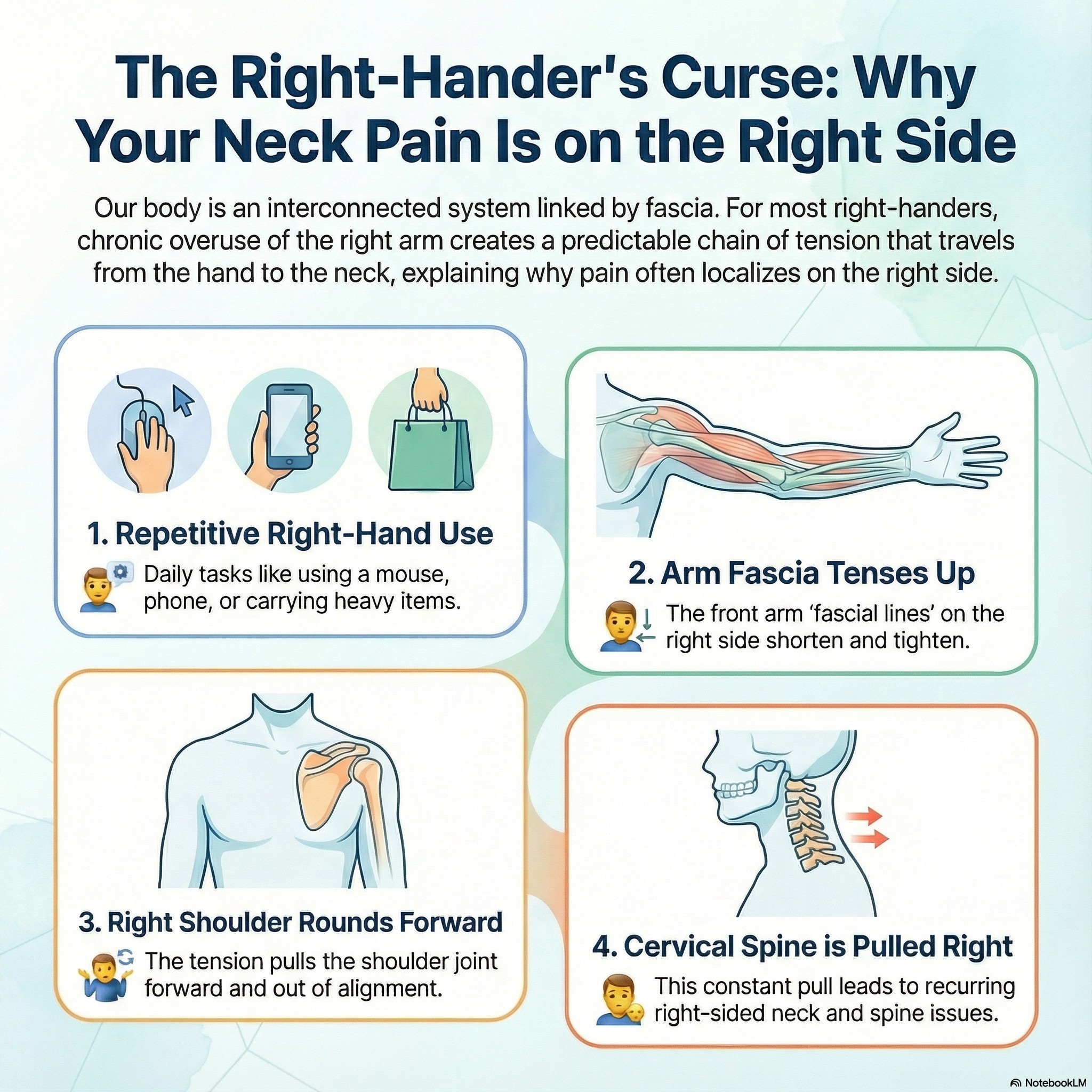
When we consciously begin using our "non-dominant hand" for small daily tasks—such as opening doors or holding a cup—it creates a highly valuable ergonomic "unloading effect." This acts like a brief vacation for the chronically overworked muscle groups on the right side, while simultaneously activating the typically dormant myofascial chains on the left. This rebalancing of tension between the left and right sides effectively enhances the overall stability of the shoulder girdle. It helps correct postural misalignment caused by unilateral dominance, offering results that are often more enduring than passive stretching alone.
Neuroscience: Why Hand Activity Is "Aerobic Exercise" for the Brain
Beyond musculoskeletal balance, using your non-dominant hand serves as a form of "neuro-aerobics" for the brain. Within our Cortical Homunculus (the brain’s map of the body), the amount of neuronal territory dedicated to the hands is disproportionately large, far exceeding that of the legs or torso. This means that every fine motor movement of the hand activates extensive neural networks. When you rely habitually on your dominant hand, the brain shifts into an energy-saving "autopilot" mode; while efficient, this can lead to the rigidity and accelerated aging of the cerebral cortex.
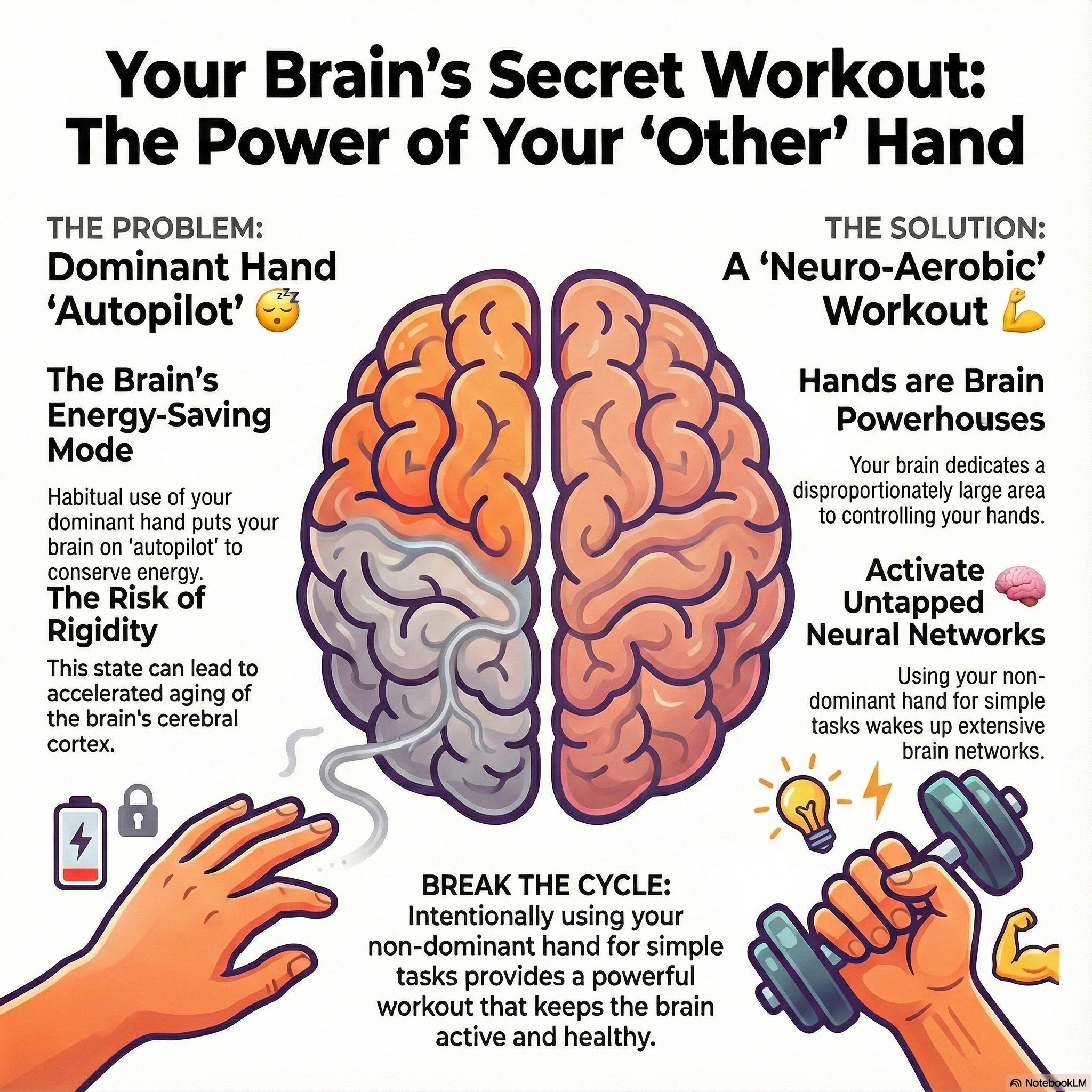
Conversely, when you clumsily attempt to brush your teeth or write with your left hand, your brain is forced to snap out of "standby mode." To manage this unfamiliar motor task, the brain must recruit the prefrontal cortex for decision-making and facilitate high-frequency communication between the left and right hemispheres via the Corpus Callosum.This extensive neural recruitment stimulates Neurogenesis and synaptic remodeling. For middle-aged and older adults concerned about cognitive decline or Alzheimer's disease, this serves as a drug-free "anti-aging supplement for the brain," keeping your mind youthful and resilient through the power of challenge.
Meridian Massage Theory: The Energy Switch Hidden in Your Palm
In the theories of Traditional Chinese Medicine (TCM) meridians and acupressure, the hands are not merely tools for labor; they are a crucial nexus for the circulation of Qi (vital energy) and blood throughout the entire body. Our palms are mapped with the Three Yin Meridians and Three Yang Meridians of the hand, alongside countless reflex zones linked to the internal organs (Zang-fu).When you perform actions such as grasping or rotating with your non-dominant hand, you are effectively engaging in a precise session of 'self-acupressure.' This is particularly relevant to the Laogong Point (PC8)—located in the center of the palm on the Pericardium Meridian of Hand-Jueyin—which is a highly effective acupoint for regulating emotions and heart function.
Imagine this: when you grip a toothbrush handle or a round doorknob with your left hand, the natural pressure on your palm stimulates the Laogong point. From the perspective of Traditional Chinese Medicine, this helps to "clear heart fire" and "calm the spirit and stabilize the mind."Modern life is rife with high stress and excessive "heart fire," which often leads to anxiety and insomnia. Stimulating the Laogong point while brushing your teeth with your left hand in the morning can help soothe the irritability often felt upon waking.Furthermore, when you use the outer edge of your left pinky finger to push open a heavy door, you stimulate the Houxi point (located on the Small Intestine Meridian). This acupoint connects to the Governor Vessel (Du Mai) and can directly alleviate stiffness in the cervical spine and lower back. This is why I often say that opening a door with your left hand is actually like giving your spine a free chiropractic adjustment.
Psychological Healing: Mindfulness Practices to Rediscover Your 'Beginner's Mind'
As a therapist, I have found that physical tension is often rooted in mental anxiety and 'not being present.' We have become habituated to multitasking—thinking about work while brushing our teeth, or scrolling through our phones while walking. This state of chronic distraction keeps the sympathetic nervous system on constant high alert, preventing deep muscle relaxation.ShutterstockUsing your non-dominant hand, therefore, acts as a form of enforced 'Mindfulness' practice. Because your left hand* is unaccustomed to the task, you are forced to pull your attention entirely back to the details of the present moment: feeling the texture of the bristles, controlling the angle of your wrist, and monitoring the feedback of pressure applied.
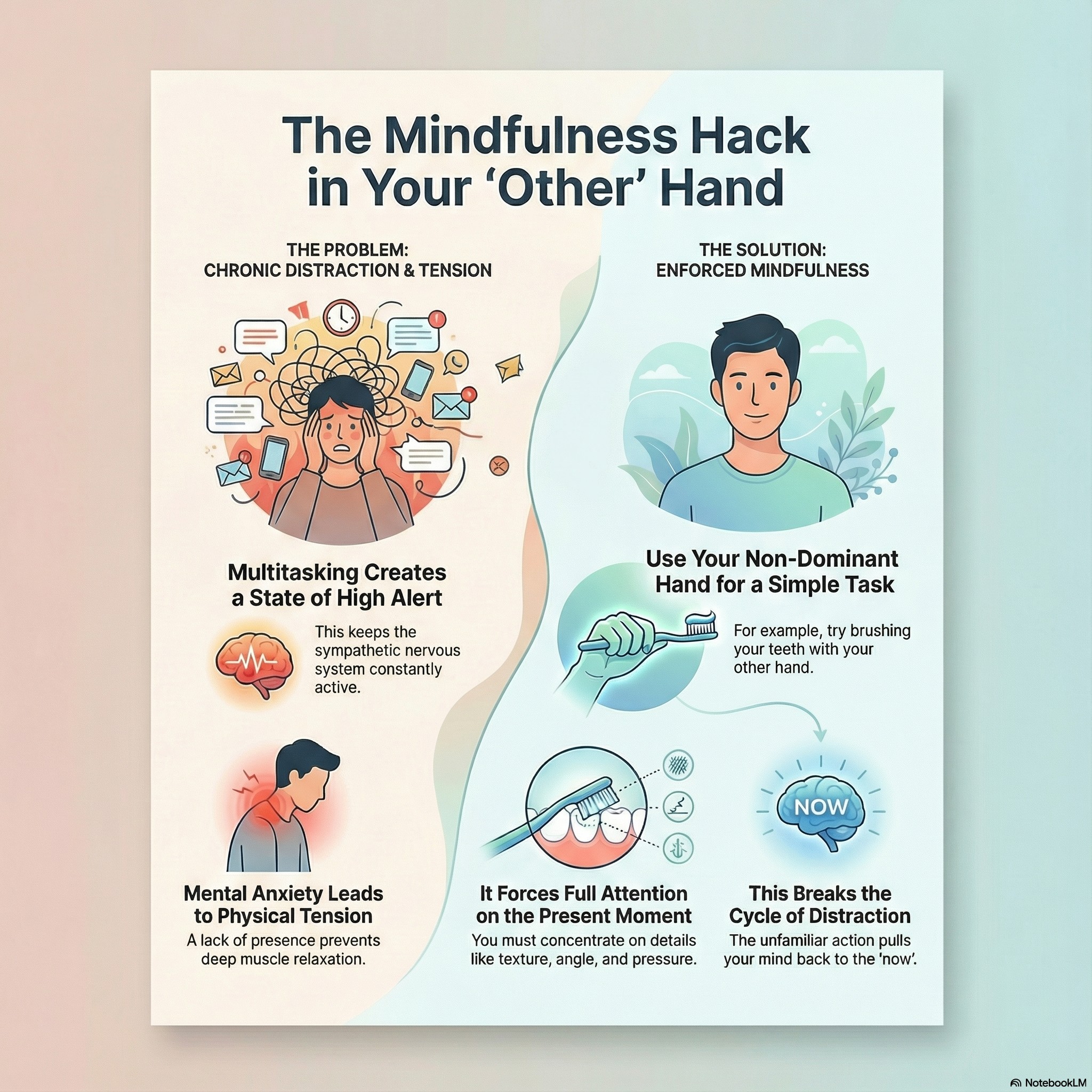
This experience of returning to a "Beginner’s Mind" is crucial. That subtle sense of clumsiness disrupts our adult pride and inertia, allowing us to explore the world anew, just like a child. Psychologically, this effectively bypasses the logical brain's defense mechanisms to engage the right brain—the seat of intuition and emotion—thereby releasing deeply repressed feelings. As you learn to accept the awkwardness of your left hand, you simultaneously learn to extend tolerance and patience toward life’s imperfections. This increase in psychological resilience ultimately translates to the body, manifesting as a significant reduction in muscle tension across the neck and shoulders.
Practical Guide 1: The Morning Ritual — The Secret Art of Brushing with Your Left Hand
Now, let’s turn these theories into concrete action. I recommend starting tomorrow morning by trying to establish a new morning ritual:Brush Your Teeth with Your Left Hand.This may seem simple, but putting it into practice is surprisingly challenging. Do not rush to put the toothbrush into your mouth; first, use your left hand to feel the weight of the handle. This activates your proprioception. As you begin to brush, focus on the rotation of your wrist rather than the stiff movement of your entire arm. Attempt to clean the inner surface of each tooth; you will discover that this requires an extremely high level of concentration.
During this process, if you experience the discomfort of a poking sensation in your gums, please slow down and take a deep breath. This is a signal that your brain is recalibrating its neural pathways.As you grip the handle, feel the gentle pressure against the Laogong Point in your palm. Visualize a stream of cooling energy flowing from your palm to your heart, carrying away the lingering dreams and anxiety of the previous night. These two minutes are more than just oral hygiene; they are a morning meditation that combines neural training with the unblocking of meridians, allowing you to begin the new day in a state of clarity and balance.
Practical Guide II: Spatial Navigation—The Wisdom of Opening Doors with Your Left Hand
Incorporate the second exercise into your movements throughout the day:Open Doors with Your Left Hand.Whether at home, in the office, or at a mall, whenever you encounter a door, take a conscious one-second pause. Resist the impulse to reach out with your right hand, and use your left hand instead.If you encounter a round doorknob, grasp and turn it with your left hand. This compound movement of 'ulnar deviation' and 'rotation' will precisely compress the 'Houxi point' located on the pinky side of the palm. Simultaneously, this stretches the fascial lines of the left arm, relieving pressure on the cervical spine.
For push-bar doors, place your left palm against the bar. Drive the movement forward by engaging your core muscles, rather than relying solely on shrugging your shoulders to generate force. This technique not only protects your wrists but also trains the stability of your body’s central axis.Every time you open a door, it serves as an exercise for your brain’s spatial navigation capabilities and a micro-adjustment for a stiff spine. Given that we may open doors over a dozen times a day, this means you have more than a dozen opportunities daily to perform this miniature session of mind-body rehabilitation.
Practical Guide #3: Tech Detox — The Art of Switching Mouse Hands
For office workers deeply plagued by 'Mouse Hand' and 'Computer Shoulder,' this is the most challenging—yet most effective—prescription:Switch your mouse to your left hand.You don’t have to do this all day; simply start with the 20 minutes in the afternoon when you feel most fatigued. Move your mouse to the left side of the keyboard. This brings your right arm—chronically tight from outward extension—back to a natural position, granting your overstretched right trapezius and rhomboid muscles a precious moment of respite.
It is perfectly normal for the cursor to feel like a wild horse slipping its reins—difficult to control at first. When this happens, try using your thumb and ring finger to gently grip the sides of the mouse, and glide across the desktop using the 'thenar eminence' at the heel of your palm (the area where the Lung and Large Intestine meridians pass). This friction stimulates peripheral blood circulation, helping to alleviate cold hands. Furthermore, as you focus on taming that erratic cursor, your brain undergoes intense neuroplasticity. This level of cognitive stimulation is of immeasurable value in preventing brain degeneration.
Conclusion: Use "Clumsy" Hands to Touch the Balance of Body and Mind
A 'Happy Healthy Life' does not require expensive equipment, nor does it rely on complex medical interventions. As a massage therapist, while I can use my hands to provide temporary relief from your pain, the true power of healing lies in your own hands—specifically, in the hand you rarely use. The human body is a treasure trove brimming with infinite potential, and our 'non-dominant hand' is the forgotten key that unlocks it.
I sincerely invite you to begin incorporating these subtle changes into your life today. Do not sacrifice these opportunities for training in the name of efficiency. Within that sense of awkwardness, slowness, and unfamiliarity, you are rewiring your brain's neural networks, awakening dormant physical energy, and clearing stagnation in your meridians and Qi flow. Let us use this 'clumsy' hand to reach for a healthier, sharper, and more balanced self. The next time you lie on my massage table, I trust your shoulders will tell me that you have succeeded.

![[Happy Healthy Life Column] A Massage Therapist's Guide to Proper Heat Therapy for Deep Tissue Relief](https://happyhealthylife.cv/wp-content/uploads/2026/03/樂健生活專欄:推拿師教你正確溫熱敷,達到深層肌肉舒緩-540x360.jpg)
![[Happy Healthy Life] Unlocking Your Body’s Self-Healing Power: A Professional Massage Therapist’s Guide to Ending Chronic Fatigue Through Gua Sha and Fascial Release](https://happyhealthylife.cv/wp-content/uploads/2026/02/樂健生活】解鎖身體自癒力:專業按摩師帶你以刮痧與筋膜放鬆告別慢性疲勞抽象藝術圖像-540x360.jpg)
