![No More "Blue" Days of Misery! Therapist Reveals: 15 Minutes a Day to Clear the "Nasal Reflex Zone" and Kickstart a [Happy Healthy Life] of Free Breathing from Your Soles](https://happyhealthylife.cv/wp-content/uploads/2026/01/不再「藍瘦香菇」!按摩師親授:每天15分鐘按通「鼻部反射區」,從腳底啟動呼吸自由的樂健生活.webp)
[Foreword: Breathing Is the Starting Point of a Happy Healthy Life]
As a massage therapist who has served on the front lines for many years, I have seen far too many people plagued by nose troubles. Whenever the seasons change, many of the 'friends' who come to my studio arrive either sporting dark circles—complaining of nasal congestion and sleepless nights—or with pockets stuffed full of used tissues.Modern medicine habitually views the nose as an isolated organ: spray medication for congestion, stop the flow for a runny nose. However, through the lens of integrative medicine championed by [Happy Healthy Life], the human body is viewed as an intricate, interconnected network. You might find it hard to imagine, but the 'switch' responsible for your breathing difficulties is actually hidden in the place furthest from your nose—your big toe. Today, like an old friend, I want to guide you to rediscover your respiratory system, starting from the soles of your feet.
[Decoding the Big Toe: The Head’s Holographic Projection]
In the landscape of reflexology, the feet are a microcosm of the body, and the big toe acts as a holographic projection of the head. Many beginners, relying on flat reflex zone charts, often struggle to locate the precise points because the foot is a three-dimensional object.According to the Ruo Shi Health Method and modern anatomy, the true nose reflex zone is not a mere dot. Instead, it is an "L-shaped" band located along the medial edge of the big toe's distal phalanx. This position perfectly overlays the area where the endings of the medial plantar nerve are most dense.When you are suffering from rhinitis, try palpating the inner side of your big toe. You will often be surprised to discover grainy, sand-like "Qi knots" there. These are distress signals sent by your body, and they are the very targets we are about to tackle next.
[Left vs. Right? Massaging Both Feet is the Gold Standard]
When learning massage, many people ask me: 'Teacher, I have a congested right nostril; should I massage the left foot or the right one?' This is a question that has perplexed the field for years.Western reflexology, based on the principle of nerve decussation (crossover), advocates that 'the left foot treats the right nostril.' Conversely, the Traditional Chinese Medicine (TCM) Meridian school believes that meridians predominantly run ipsilaterally (on the same side), adhering to the principle that the treatment side should match the affected side.In the practical philosophy of [Happy Healthy Life], we need not get bogged down in academic debates. Human nerve transmission involves both crossed and uncrossed pathways, and rhinitis is often a diffuse inflammation affecting the general area.Therefore, my standard recommendation is: Bidirectional Holographic Coverage.Regardless of which nostril is blocked, massage both feet. This strategy ensures the simultaneous activation of crossed neural regulatory pathways and ipsilateral meridian energy, achieving optimal therapeutic results.
[TCM Wisdom: Earth Generates Metal—To Treat the Nose, First Fortify the Spleen]
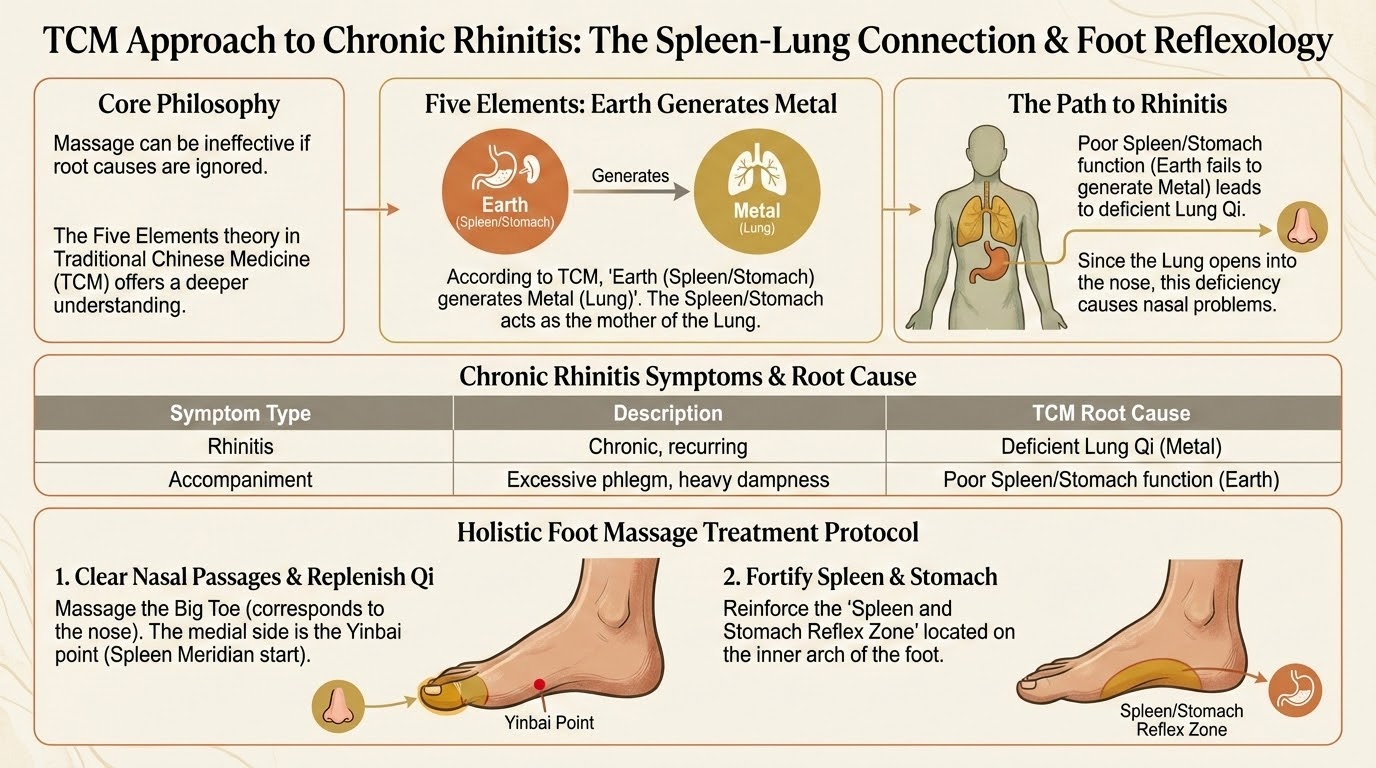
This is the core philosophy I am most eager to share, and it is also the key reason why massage remains ineffective for many people. According to the Five Elements theory in Traditional Chinese Medicine, 'the Lung opens into the nose.' Consequently, if Lung Qi is deficient, the nasal passages will not function properly.But where does Lung Qi originate? The answer is the Spleen and Stomach. In the Five Elements, 'Earth (Spleen/Stomach) generates Metal (Lung)'; the Spleen and Stomach are effectively the mother of the Lung. If you suffer from chronic, recurring rhinitis accompanied by excessive phlegm and heavy dampness, it is often due to poor Spleen and Stomach function, resulting in 'Earth failing to generate Metal.'This is why, in my treatment protocols, in addition to massaging the big toe (which corresponds to the nose), I invariably require clients to reinforce the 'Spleen and Stomach Reflex Zone' located on the inner arch of the foot. The medial side of the big toe happens to be the starting point of the Spleen Meridian of Foot-Taiyin (the Yinbai point). Massaging this area not only clears the nasal passages but also fortifies the Spleen and replenishes Qi—a deep restorative method that achieves two goals at once.
[Establishing the Ritual: Warm-up and Preparation]
Before we get "hands-on," we must first engage the mind.An effective massage is not merely physical stimulation; it is a dialogue with the nervous system. It is recommended to perform this routine before bed.Prepare a basin of warm water (40–42°C) and add 3–5 drops of eucalyptus or peppermint essential oil. Eucalyptus offers potent anti-inflammatory properties, while peppermint provides a cooling, clarifying sensation. Soak for 10–15 minutes to allow the heat to boost blood circulation while simultaneously softening the skin on your feet.This serves a dual purpose: it not only prepares the body for massage but also signals to the brain, "This is my personal relaxation time." Using massage oil or lotion is mandatory; it protects the skin and ensures your knuckles can glide smoothly to work out stubborn knots.
[SOP Step 1: Opening the Detox Pathways]
For any sophisticated treatment, the priority must be ensuring that the "exits" are clear. If metabolic waste cannot be expelled, additional stimulation merely adds to the body’s burden. Therefore, the first step in our standard protocol is always the Urinary System.First, locate the Kidney reflex zone at the center of the sole. Using the knuckle of your index finger, apply deep pressure until you feel a sensation of soreness and distension (suān zhàng). Then, glide downwards along the path toward the inner heel to stimulate the Ureter and Bladder zones. Repeat this motion 3 to 5 times.Visualize this as clearing the body’s drainage system. You are pre-opening a wide channel to flush out the inflammatory substances and toxins that we will later release from the head area. This step may seem simple, but it is the critical detail that distinguishes a professional from an amateur.
[SOP Step 2: Precision Targeting of the Nasal Reflex Zones]
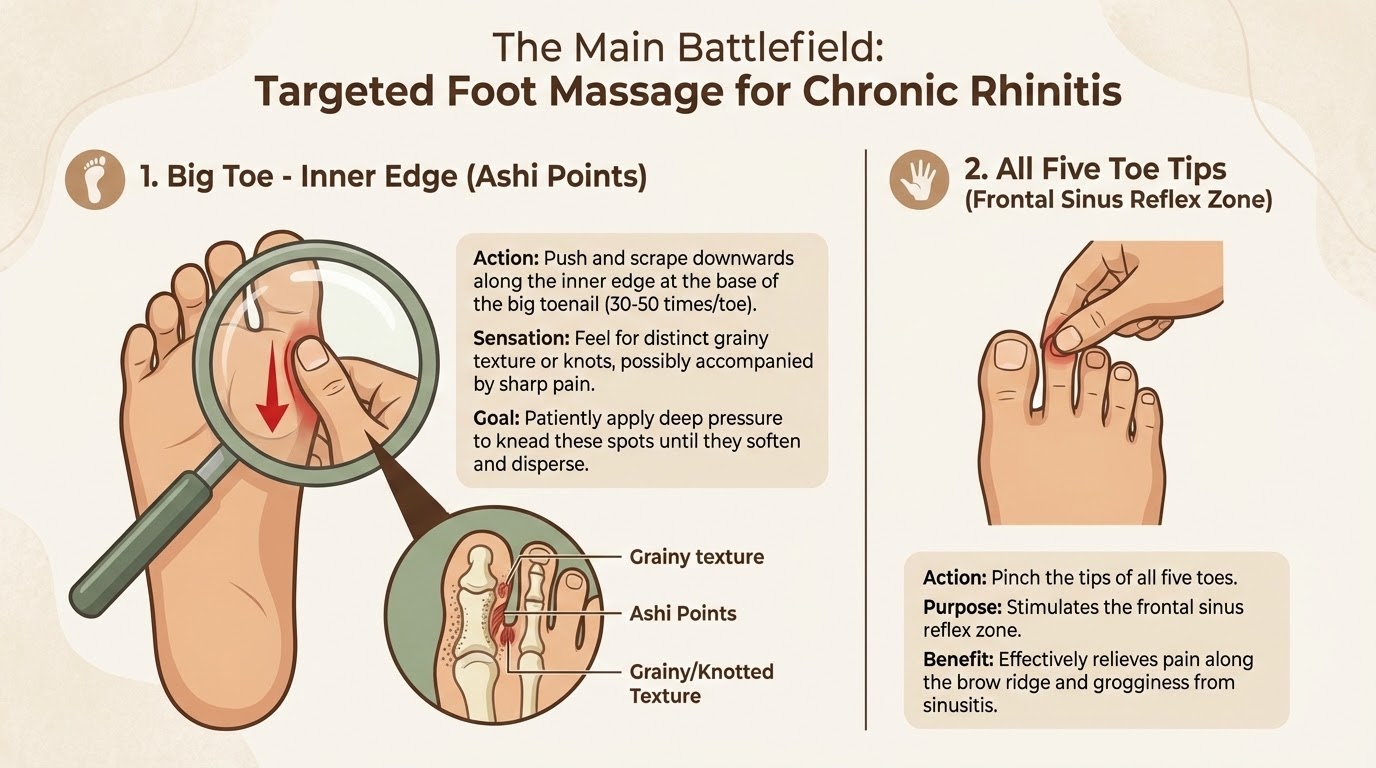
Now, we enter the main battlefield. Lift your foot and locate the inner edge at the base of the big toenail (the side that touches the other foot when your feet are together). Using the pad of your thumb or the knuckle of your index finger, push and scrape downwards along the edge of the bone.For those with chronic rhinitis, you will usually feel a distinct "grainy" texture or cord-like knots here, possibly accompanied by sharp pain. Don't be afraid—this is the principle of "Ashi points." Please patiently apply deep pressure to knead these granular spots until they gradually soften and disperse.I recommend performing this push-and-press motion at least 30 to 50 times on each big toe. At the same time, don't forget to pinch the tips of all five toes (the frontal sinus reflex zone); this effectively relieves the pain along the brow ridge and the grogginess caused by sinusitis.
[SOP Step 3: Strengthening Defenses and Drainage]
After clearing localized congestion, the next step is to boost your overall defense. Shift your massage focus to the fleshy pad on the ball of the foot—the reflex zone for the "Lungs and Bronchi." Use both thumbs to push in a fan-shaped motion, simulating the expansion of the lungs, to help ventilate Lung Qi.Immediately following this, locate the webbed area between the big toe and the second toe—the reflex point for the "Chest Lymph Glands." For those with severe nasal congestion, this spot is often extremely sensitive or even painful to the touch. Please use your thumb and index finger to pinch and pull this area outward, using a kneading motion similar to squeezing toothpaste. This technique powerfully jumpstarts lymphatic drainage, reducing congestion and edema in the nasal mucosa; it is a highly effective trigger for relieving a stuffy nose.
SOP Step 4: Cultivate Earth to Generate Metal — Fortifying the Foundation and Vitality
Finally, we return to the aspect of "treating the root cause." Focusing on the "Spleen and Stomach Reflex Zones" located along the medial (inner) arch of the foot, perform a slow, deep gliding stroke downwards, following the natural physiological curvature of the bone.This step does not call for intense pain; rather, it demands a gentle yet steady, penetrating pressure. For those with a chronic allergic constitution or a susceptibility to colds, this is the most crucial "investment" step. By strengthening the function of the Spleen and Stomach, we can reduce the production of internal "Phlegm-Dampness" at the source, while providing a continuous supply of energy to support the lungs. This is akin to reinforcing a levee to prevent the next flood.
[Conclusion: Reclaim Control of Your Life from the Soles of Your Feet]
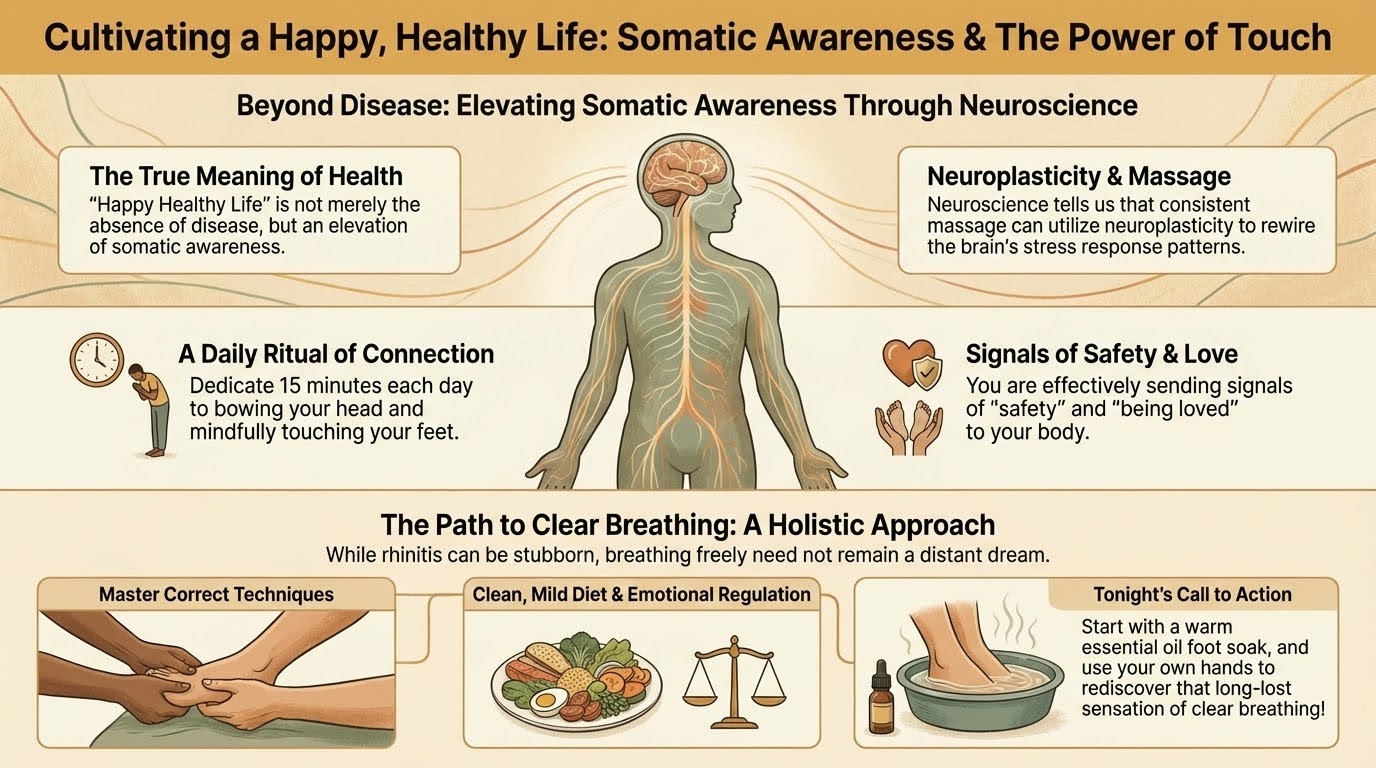
"Happy Healthy Life" is not merely the absence of disease, but an elevation of somatic awareness. Neuroscience tells us that consistent massage can utilize neuroplasticity to rewire the brain’s stress response patterns. When you dedicate 15 minutes each day to bowing your head and mindfully touching your feet, you are effectively sending signals of "safety" and "being loved" to your body.While rhinitis can be stubborn, by mastering the correct techniques and combining them with a clean, mild diet and emotional regulation, breathing freely need not remain a distant dream. Tonight, start with a warm essential oil foot soak, and use your own hands to rediscover that long-lost sensation of clear breathing!


![[Happy Healthy Life] Say Goodbye to Insomnia and Brain Fog! A Veteran Massage Therapist Reveals the Hidden "Detox Switch" in Your Big Toe: A Complete Breakdown of Brain Reflexology Zones](https://happyhealthylife.cv/wp-content/uploads/2026/02/【樂健生活】告別失眠與腦霧!資深按摩師教你「大拇趾」隱藏的排毒開關:大腦足部反射區-540x360.jpg)
