,找回身心平衡的樂健生活.webp)
Introduction: Finding the Mind-Body’s Stabilizing Anchor Within the Tiny Space of the Ankle
In our pursuit of a "Happy Healthy Life," we often get lost in a maze of complex wellness information, overlooking the fact that the body itself possesses a powerful, built-in repair mechanism. As a massage therapist with years of clinical practice, I have witnessed countless cases of mind-body imbalance caused by high-stress living on my treatment table. Some patients toss and turn until dawn; others suffer unspeakably from lower back pain; some feel a constant heaviness in their steps, or find themselves prone to habitual ankle sprains at the slightest misstep.In reality, these seemingly unrelated issues often point to a blockage in the same energy hub: the "Shenmai" point (BL62), located on the lateral side of the ankle. Though unassuming, this acupoint is the intersection of the Bladder Meridian of Foot-Taiyang and the Yang Motility Vessel (Yang Qiao Mai). It acts as the body’s anchor—a "stabilizing needle"—governing our cycles of wakefulness and sleep, as well as movement and stillness. Today, I invite you to rediscover this magical switch through the tactile perspective of a massage therapist. You will learn how to reboot your body’s self-healing powers through simple fingertip pressure, allowing you to truly live a joyful, "Happy Healthy Life."
1. Pinpoint Precision: Locating Hidden Energy Points in the Bone Crevices
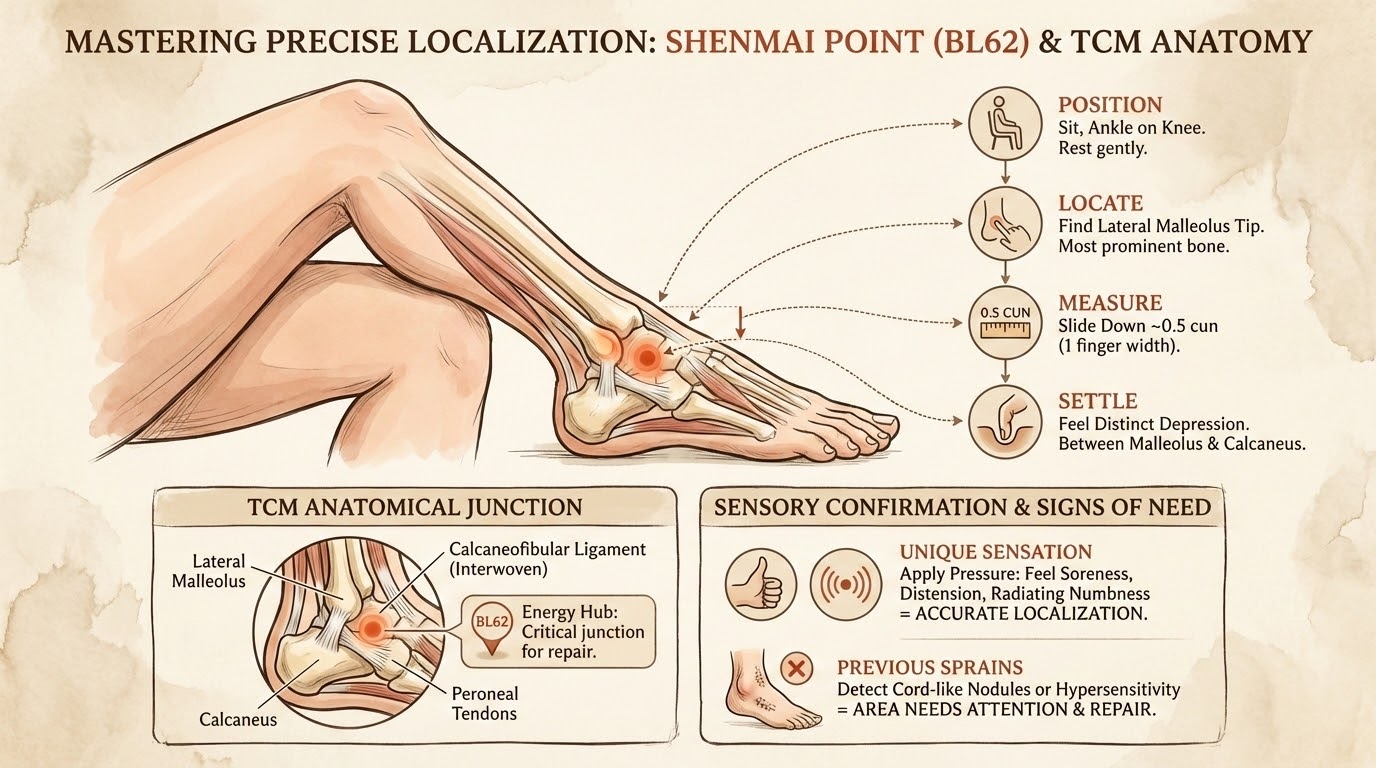
To fully unleash the miraculous benefits of the Shenmai point (BL62), the first step is mastering precise palpation and localization—simply pressing randomly around the ankle will not yield results.Please try sitting on a chair and gently resting one ankle on the knee of your other leg. Use your fingers to locate the most prominent bone on the outer ankle—this is the tip of the lateral malleolus. Next, let your finger slide vertically downward from this tip for about half a cun (approximately the width of one finger). You will feel your fingertip settle into a distinct depression between the lower edge of the lateral malleolus and the calcaneus (heel bone).In the anatomy of Traditional Chinese Medicine (TCM), this spot is not only the location of the Shenmai point but also a critical junction where the calcaneofibular ligament and the tendons of the peroneal muscles interweave. When you apply pressure here with the pad of your thumb, you will typically feel a unique sensation of soreness and distension, perhaps even accompanied by a slight numbness radiating outward—this indicates you have accurately located this energy hub.For those who have previously sprained their ankle, you might even detect cord-like nodules or experience hypersensitivity in this area. This is precisely the body telling us: this area is in need of repair and attention.
2. Say Goodbye to Insomnia: The "Biological Clock" Magic of Regulating the Yang Heel Vessel
In my massage practice, insomnia is the most common hidden struggle among modern urbanites, and the Shenmai acupoint (BL62) is my secret weapon for helping clients reclaim deep sleep.From the perspective of Traditional Chinese Medicine (TCM) meridian theory, the Shenmai acupoint connects to the "Yangqiao Meridian" (Yang Motility Vessel). This meridian governs the opening and closing of the eyes and the state of mental excitation. When the Qi and blood in the Yangqiao Meridian are excessively vigorous, our eyes feel as if they are being propped open, unable to close, and the brain remains in a high-speed, alert state—this is typical insomnia.By using specific massage techniques to "sedate" (drain) the Shenmai acupoint, we can effectively guide the overly excited Yang energy from the head down to the feet. This regulates the autonomic nervous system and reduces sympathetic nervous system arousal. Modern research has also confirmed that stimulating this point can alter the brainwave spectrum, increasing the Delta waves that represent deep sleep.It is akin to manually turning off the body’s "wakefulness switch," allowing the brain—busy from the entire day—to receive the command to "rest." A client once shared with me that after receiving treatment on the Shenmai acupoint, not only did she fall asleep faster, but the torment of vivid dreams and frequent waking was significantly reduced, allowing her to finally regain the peaceful sleep she had missed for so long.
3. Spine and Posture: Upright Confidence Extending from the Soles of the Feet
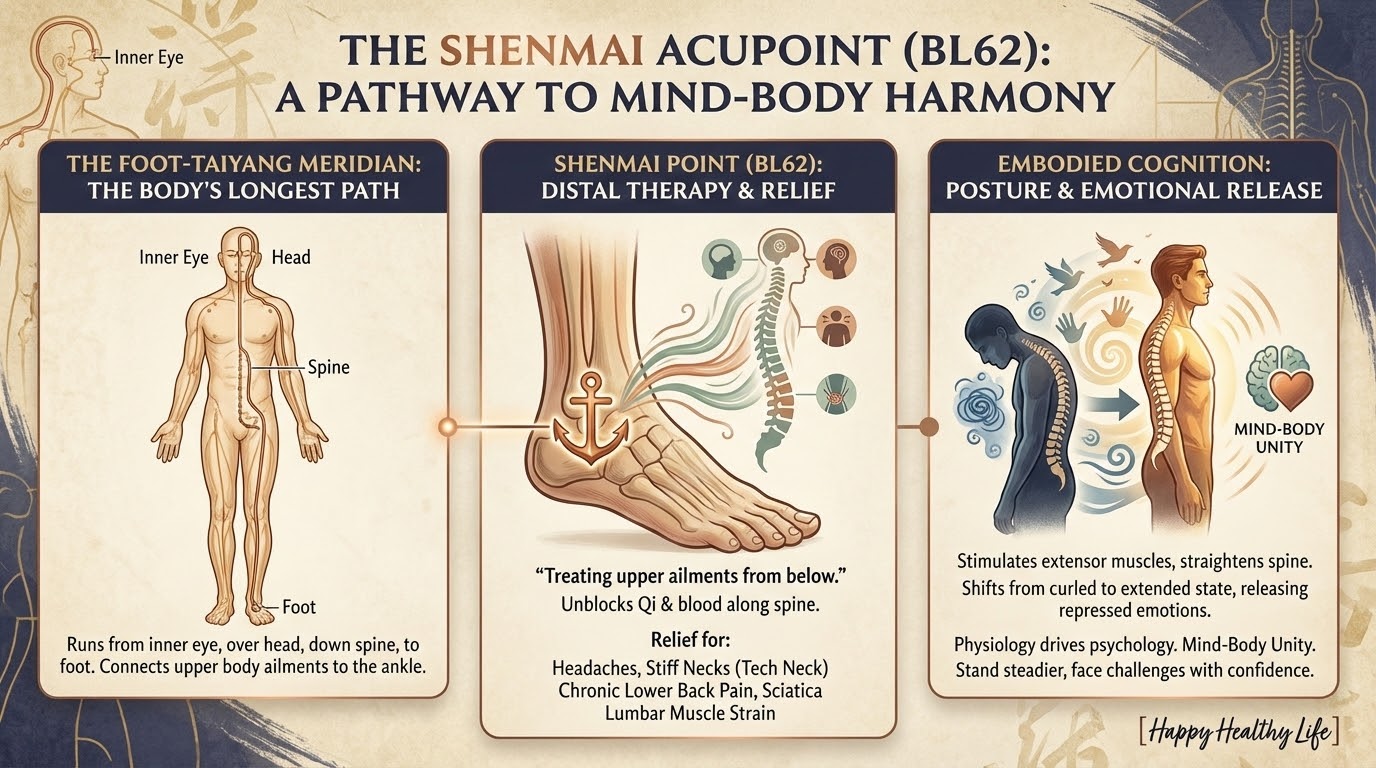
Many are surprised to discover: how can an acupoint located on the ankle treat headaches, stiff necks, and even chronic lower back pain? This is attributed to the "Bladder Meridian of Foot-Taiyang" (足太陽膀胱經), to which the Shenmai acupoint (BL62) belongs. It is the body's longest meridian, running from the inner corner of the eye, over the top of the head, down the back of the skull, along both sides of the spine, and all the way down to the foot.Therefore, the Shenmai point possesses the specific efficacy of "treating upper ailments from below"—a form of distal therapy. When we press this point, we are actually unblocking the channels of Qi and blood along the entire spine. This offers excellent relief for "Tech Neck" caused by sedentary office work, lumbar muscle strain, and sciatica.What fascinates me even more is looking at this from the perspective of "Embodied Cognition" in psychology. The Shenmai point governs the body's extensor muscle groups; stimulating it helps us unconsciously straighten our spines, improving slouched or hunched postures. As the body shifts from a curled state to an extended one, repressed emotions are released. This positive cycle, where physiology drives psychology, is exactly the "Mind-Body Unity" emphasized by [Happy Healthy Life]—enabling you to not only stand more steadily but also face life's challenges with greater confidence.
4. Ankle Care: The Key to Healing Old Injuries and Strengthening Balance
For sports enthusiasts or friends who have previously suffered an ankle sprain, daily care of the Shenmai acupoint (BL62) is of critical importance. Deep beneath the Shenmai acupoint lies the Calcaneofibular ligament (CFL), a key structure responsible for maintaining ankle stability and preventing excessive inversion of the foot.Many people continue to feel instability in their ankle long after a sprain has healed, or experience a dull ache during damp, rainy weather. This is often caused by adhesions or scar tissue that formed during the ligament's repair process. As a massage therapist, I recommend performing deep "cross-fiber friction" massage on this area. This technique promotes local microcirculation, helps break down old adhesions, and realigns collagen fibers.Simultaneously, the sural nerve passes through this region. This nerve is responsible for transmitting proprioception (positional sense) of the foot. Stimulating this nerve through massage can strengthen the brain's awareness of the foot’s position, enhance balance, and significantly lower the risk of re-injury. This is not merely treatment, but a form of preventative medicine—empowering your feet with greater adaptability and resilience when facing uneven surfaces or intense physical activity.
5. Practical Guide: The Massage Therapist’s Insider Secrets for At-Home Practice
Once you understand the underlying principles, proper technique is the key to effective results. I recommend adopting different massage strategies based on your specific needs.
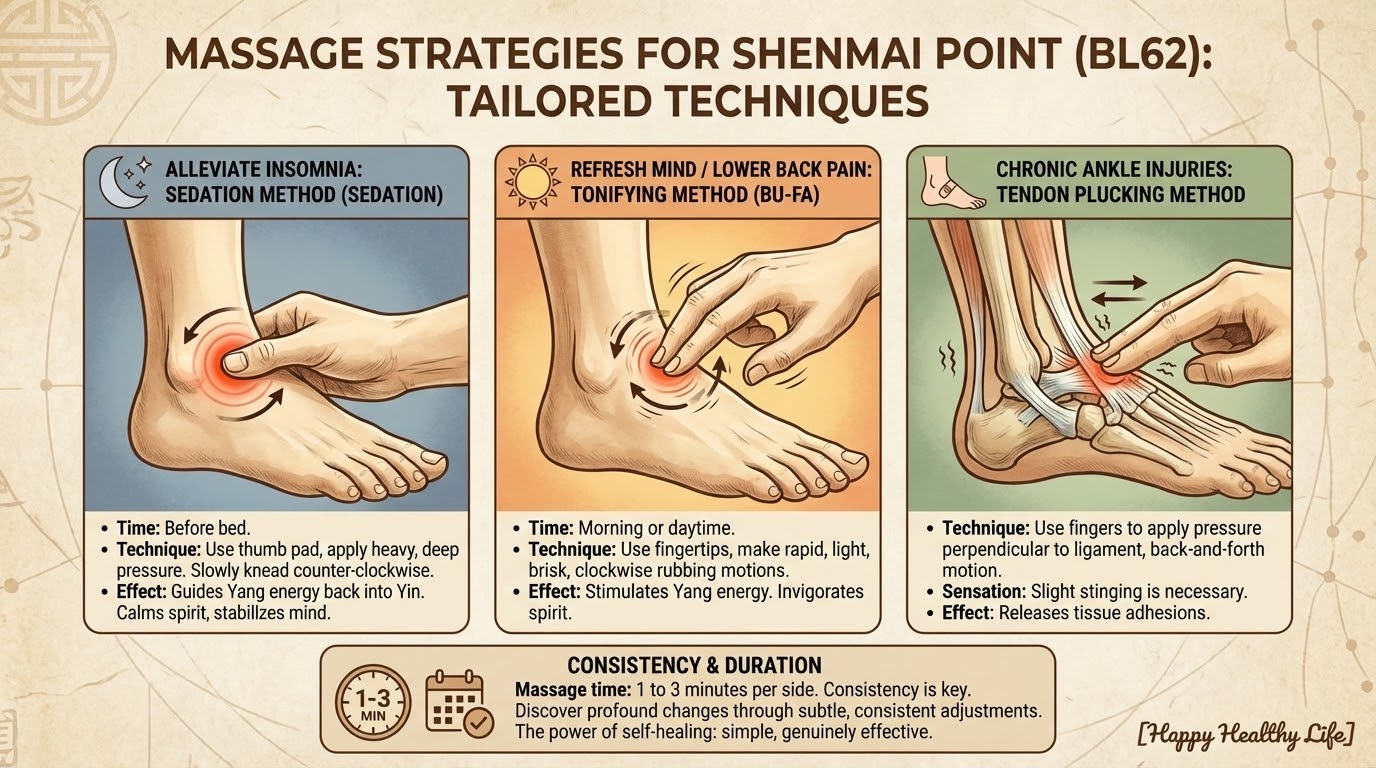
If you are looking to alleviate insomnia, perform this technique before bed: Use the pad of your thumb to apply heavy pressure to the Shenmai point (BL62). Slowly knead in a counter-clockwise circular motion. The pressure should be deep, penetrating, and deliberate. This technique is known as the 'Sedation Method'; it helps guide Yang energy back into Yin, thereby calming the spirit and stabilizing the mind.
If your goal is to refresh your mind or relieve daytime lower back pain, perform this technique in the morning or during the day. Use your fingertips to make rapid, clockwise rubbing motions. The pressure should be light, brisk, and springy. This technique is known as the 'Tonifying Method' (or Bu-fa); it stimulates Yang energy and invigorates the spirit.
For chronic ankle injuries, the "Tendon Plucking" method is recommended. Use your fingers to apply pressure perpendicular to the direction of the ligament (specifically, in a horizontal back-and-forth motion). While you may experience a slight stinging sensation, this is a necessary step to release tissue adhesions.
Keep the massage time to just 1 to 3 minutes per side. With consistency, you will discover profound changes in your body arising from these subtle adjustments. This is the power of self-healing: simple, yet genuinely effective.
6. Safety Guidelines: Happy Healthy Life’s Primary Principle is Safety
Before concluding this guide, I must offer a few critical safety warnings from a professional perspective, as the foundation of a [Happy Healthy Life] is safety and prudence.
First and foremost, pregnant women should avoid vigorous stimulation of the Shenmai acupoint (BL62). Since this point possesses potent properties for activating Yang, circulating Qi, and inducing downward movement, it may agitate the Qi and blood in the Lower Jiao, causing unnecessary instability to the fetal Qi. For the safety of the baby, please ensure you consult a professional physician during pregnancy.
Secondly, if you have recently suffered an acute ankle sprain (within the last 24 to 72 hours) and there is still visible redness, swelling, heat, or pain in the area, it is strictly forbidden to apply pressure or heat to the Shenmai acupoint. At this stage, the tissues are experiencing internal bleeding and swelling; premature intervention will only aggravate the injury. You should follow the RICE protocol (Rest, Ice, Compression, Elevation). The optimal time to introduce acupoint massage is only after the redness and swelling have subsided and the injury has entered the chronic phase.
Finally, massage pressure should be increased gradually, guided by a sense of 'comfortable soreness' that is within your tolerance limit. Never cause bruising under the skin for the sake of chasing immediate results. Respecting your body’s sensations is the highest form of wellness wisdom.
The Massage Therapist’s Conclusion and Call to Action
Although the Shenmai point (BL62) is merely a small depression on the ankle, it harbors immense power to regulate sleep, relieve pain, align the spine, and stabilize emotions. It serves as our body’s built-in balancer, bridging the wisdom of the meridians with the science of anatomy. I hope that through this article, you can master this simple yet practical tool for self-care.
You can start trying this tonight: spend three minutes before sleep sitting at the edge of your bed. Gently massage the Shenmai acupoints on both feet using a counter-clockwise motion, and observe how that distinctive soreness slowly transforms into whole-body relaxation. This is not just a gentle act of self-care; it is the first step toward a 'Happy Healthy Life.' If you have any questions about the technique or would like to share your experience, please feel free to leave a comment below. Let’s exchange wellness insights together!


![[Happy Healthy Life] A Professional Massage Therapist's Therapeutic Secrets for the Rangu Acupoint: A Dual-Action Guide to Saying Goodbye to Plantar Fasciitis and Insomnia](https://happyhealthylife.cv/wp-content/uploads/2026/02/樂健生活:專業按摩師的然谷穴理療秘笈,告別足底筋膜炎與失眠的雙效指南-540x360.jpg)
