
1. Introduction: The Winter Body Map Beneath a Therapist's Hands
In the Yellow Emperor's Inner Canon (specifically the Suwen chapter "Great Treatise on Regulating the Spirit in Harmony with the Four Seasons"), the dominant theme of winter is defined as "Bi Cang" (Closing and Storing). Just as the Yang Qi in nature lies dormant beneath the ground, the human body's Yang Qi also withdraws into the internal organs, specifically into the Kidneys—known as the "Root of Pre-natal Qi."However, the rhythm of modern life often runs counter to this natural law. We continue to stay up late working through cold winter nights, depleting the vital essence that ought to be conserved. We lead sedentary lives in climate-controlled yet poorly ventilated offices, hindering blood circulation in the lower limbs. This leads to a modern malady known as "Upper Heat, Lower Cold."This report goes beyond generic wellness advice to construct a systematic winter body management protocol. It is centered around a core triad: One Acupoint (Shenshu) , One Soak (Mugwort and Ginger Foot Bath), and One Technique (Pressing Yongquan) .
2. Winter Physiology: Cold, Fascia, and Energy Metabolism
To understand the necessity of this treatment plan, we must first analyze the specific physiological stress that the winter environment places on the human body.From a biomechanical perspective, temperature directly affects the physical properties of soft tissue. The human body's fascial system contains significant amounts of collagen and elastin, and its matrix exhibits higher viscosity at lower temperatures.Research indicates that when muscle temperature drops, the efficiency of muscle contraction decreases, and friction between muscle fibers increases. This explains why winter is a peak season for Low Back Pain and why you feel particularly stiff when waking up on a cold morning.
3. Core Intervention I: Warming, Unblocking, and Consolidating at Shenshu (BL23)
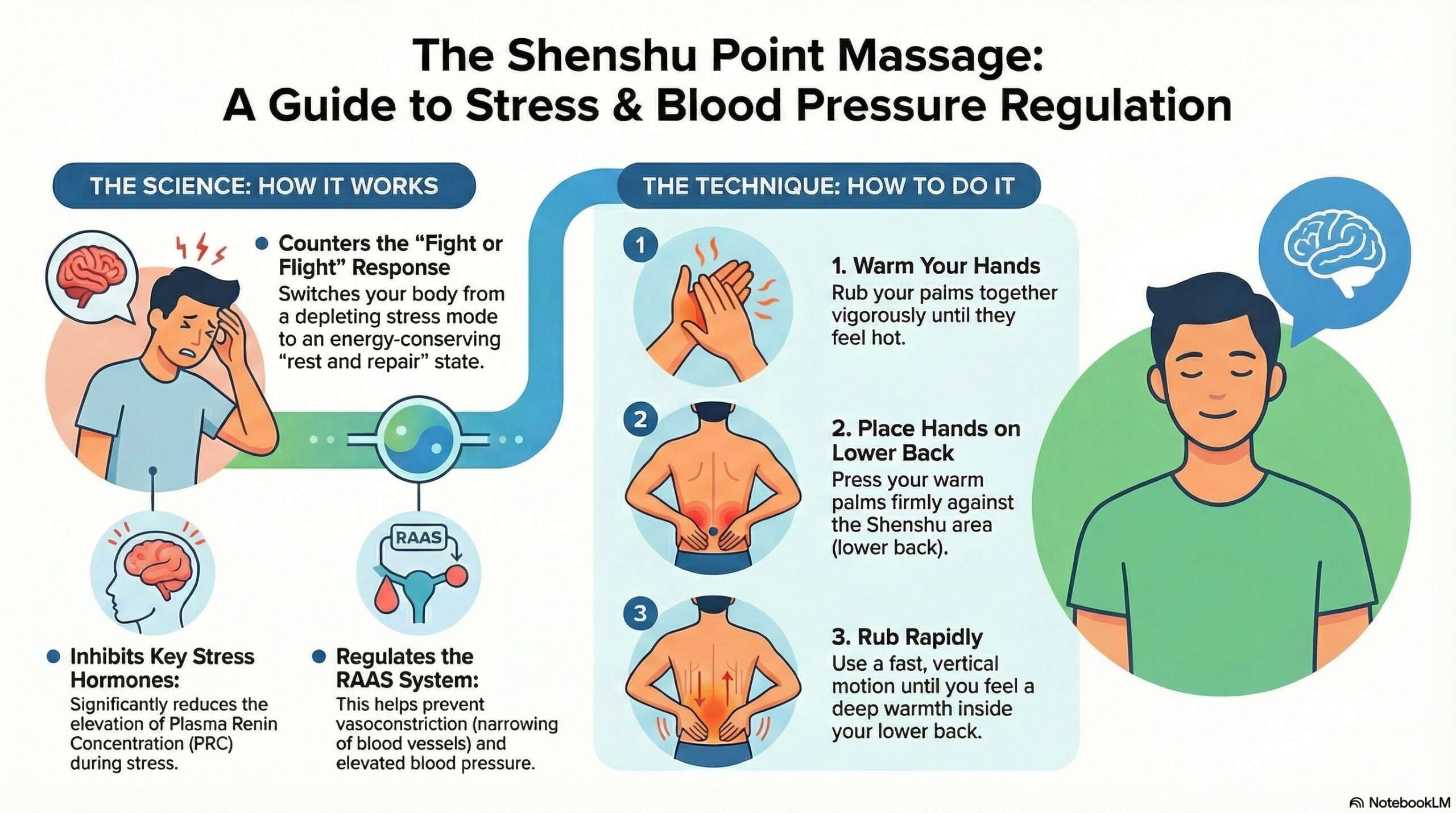
The lower back is the "House of the Kidneys." In winter wellness practices, keeping the lower back warm and stimulating it serves a purpose beyond merely relieving local muscle soreness; it is essential for guarding the gateway of the body's "Yuan Qi" (Vital Energy).First, we need to locate it precisely: The Shenshu point (BL23) is situated below the spinous process of the second lumbar vertebra (L2), 1.5 cun lateral to the midline.For non-professionals, you can use a quick location method: Place your hands on your hips and feel for the highest points of your pelvis (the iliac crests). A line connecting these two points typically crosses the fourth lumbar vertebra (L4). From there, count up two spinous processes to find the second lumbar vertebra. In the depression below this spinous process, move outward about two finger-widths. The point is located at the highest prominence of the erector spinae muscle.
Why "rub" the Shenshu point? Beyond simply generating frictional heat, the latest physiological research provides compelling evidence for this ancient therapy. Targeted stimulation of the Shenshu point can significantly inhibitPlasma Renin Concentration, PRCelevation. Under cold stress, the excitation of the sympathetic nervous system typically activates the RAAS system (Renin-Angiotensin-Aldosterone System), resulting in vasoconstriction and elevated blood pressure.Massaging the Shenshu point (Bladder 23) can generate an "anti-sympathetic" effect, enabling the body to switch from the depleting "fight or flight" mode back to the energy-conserving "rest and repair" mode. We recommendFriction:Step 1: Rub your palms together until they are hot (it is crucial to avoid touching your skin with cold hands).Step 2: Place them firmly against the Shenshu area on your lower back.Step 3: Perform a rapid, vertical rubbing motion until you feel a deep warmth within your lower back, or even until the sensation of heat radiates toward your abdomen.
4. Core Intervention Two: Fluid Dynamics of the Mugwort and Ginger Foot Bath
If we say that massaging the Shenshu point is "consolidating the foundation," then a foot bath is akin to "opening the source." It utilizes water as a medium, leveraging the dual actions of thermodynamics and pharmacology to actively alter the rheological state of blood throughout the body.When your feet are immersed in warm water between 40-45°C, vasodilation occurs, causing a decrease in peripheral resistance. According to the principles of fluid dynamics, blood flows toward the area of least resistance. Once the blood vessels in the feet dilate, blood that was previously congested in the upper body (head, face, and chest) is diverted to the lower limbs. This directly alleviates symptoms of "upper heat," such as a flushed face, red ears, and distending headaches.
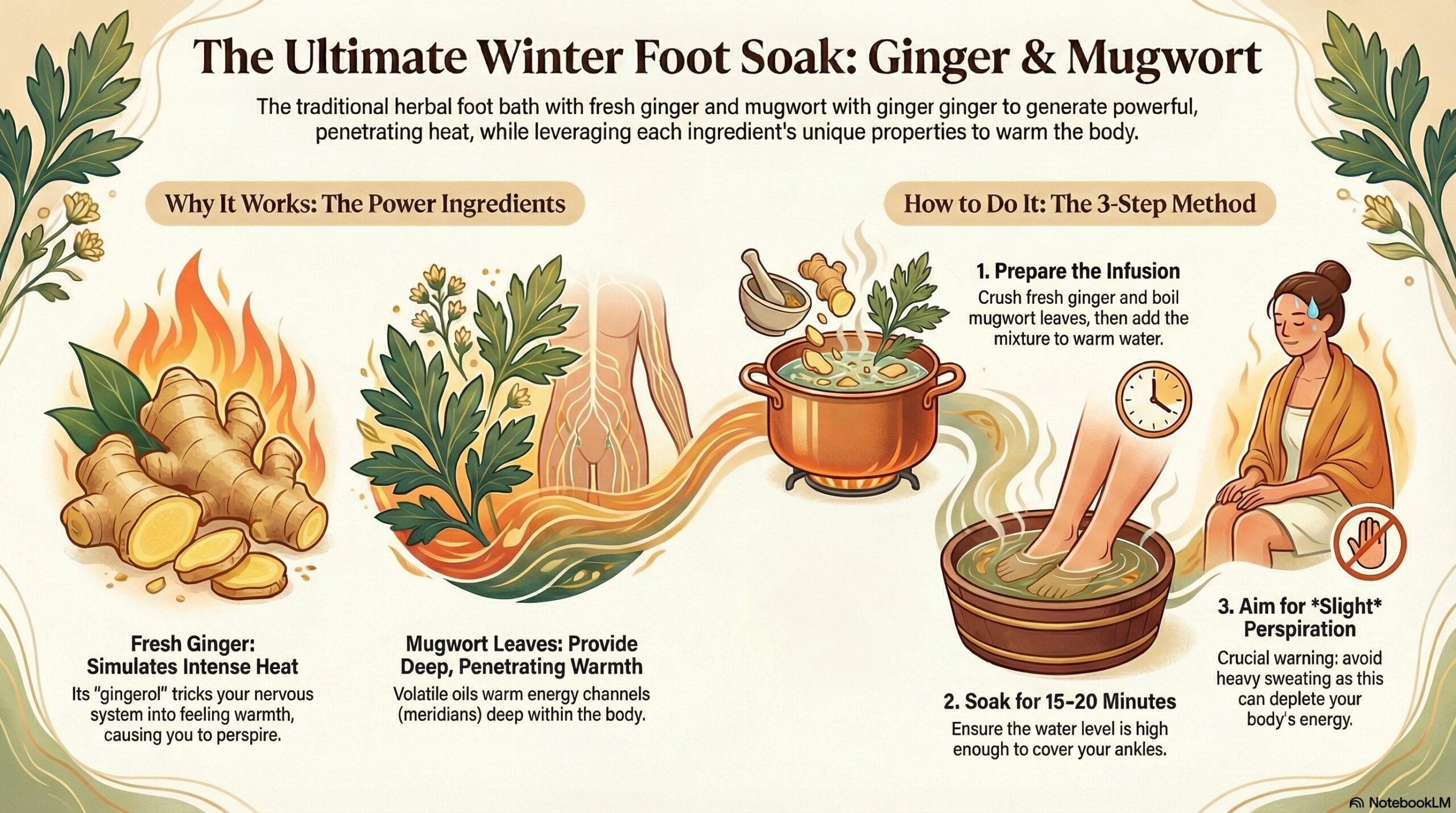
Why isn't plain water enough? Why do we have to "add something extra"? Because during the cold winter, we need a stronger signal of "bio-heat."Fresh GingerThe gingerol found within acts as a potent agonist of the TRPV1 receptor. It effectively tricks the nervous system into perceiving an intense sensation of heat, thereby stimulating perspiration to dissipate it; whereasMugwort LeavesThey contain volatile oils which, once absorbed through the skin, function to warm the meridians, arrest bleeding, dispel cold, and relieve pain. Their heat possesses a distinctly "penetrating" quality, capable of traveling upward along the meridians to warm the uterus and the Lower Jiao (lower abdomen).We recommend crushing fresh ginger and boiling mugwort leaves, then mixing the infusion into warm water. The water level should ideally cover the "Sanyinjiao" point (located 3 cun above the ankle). Limit the session to 15–20 minutes; the goal is to induce "slight perspiration." It is crucial to avoid profuse sweating, as this can deplete "Heart Qi."
5. Core Intervention Three: Grounding and Calming at the Yongquan Point (KI1)
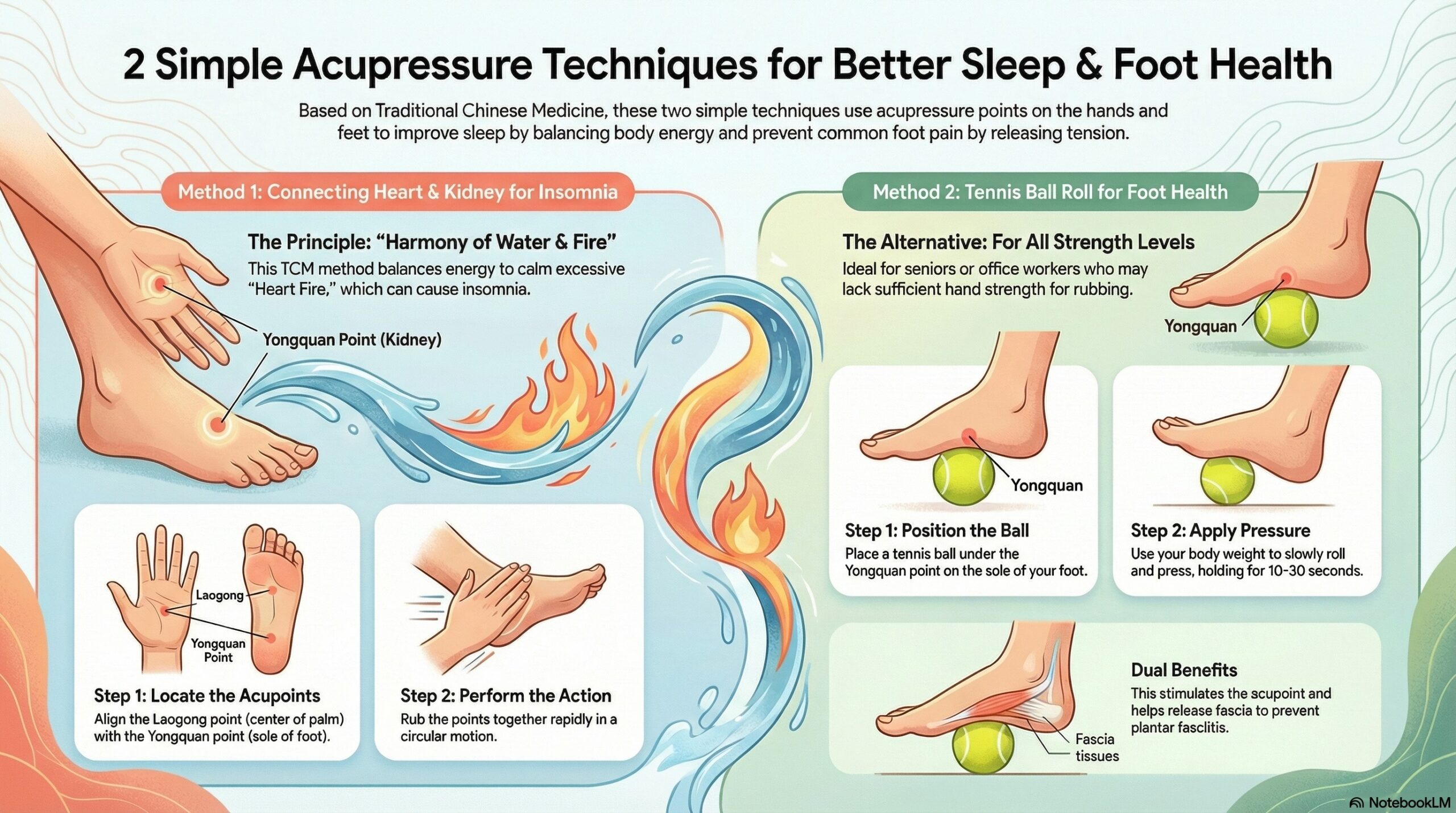
Following the foot bath, the skin on the soles is flushed with blood, the pores are open, and the soft tissues are relaxed. This presents the optimal window of opportunity for massaging the Yongquan acupoint. This step is key to anchoring the TCM concept of "guiding the fire back to its source" right down to the nerve endings.The Yongquan point (KI1) is located in the depression at the junction of the anterior one-third and posterior two-thirds of the sole. Anatomically speaking, the deep layers of this region are connected to branches of the medial and lateral plantar nerves. Massaging this area generates a strong descending sensory input, shifting the focus of neural excitation from the cerebral cortex down to the soles of the feet. This helps to calm "Liver Yang," thereby alleviating insomnia and anxiety caused by the dryness of winter.
In terms of practical application, we recommend the "Connecting Heart and Kidney Method" (心腎相交法). Align the Laogong point (the Fire point of the Pericardium Meridian, located in the center of your palm) with the Yongquan point (the Water point of the Kidney Meridian) on the sole of your foot, and perform rapid, circular rubbing. In Traditional Chinese Medicine, this symbolizes the "perfect harmony of Water and Fire," which has a remarkable effect on insomnia caused by excessive Heart Fire.Furthermore, for seniors or office workers who may lack sufficient finger strength, you can adopt the method of stepping on a tennis ball. Place the tennis ball under the Yongquan point and use your own body weight to slowly roll and press. Hold the position for 10–30 seconds, or until you feel a sensation of soreness or distension. This not only stimulates the acupoint but also physically releases the plantar fascia, helping to prevent plantar fasciitis, a condition with a high incidence rate during the winter.
6. Safety Precautions and Contraindications: The Professional Therapist's Bottom Line
While promoting wellness techniques, it is essential to clearly define their boundaries. As professional health practitioners, we must remind the following groups to exercise particular caution:Patients with Diabetesoften accompanied by neuropathy and reduced sensitivity to temperature; the water temperature for foot baths must be strictly controlled below 37°C to prevent scalding that could lead to ulcers;Patients with lower limb varicose veinsProlonged foot soaks in high temperatures are strictly prohibited, as the expansion caused by heat can exacerbate blood stasis and increase the risk of thrombosis. When massaging, use gentle strokes directed towards the heart; never apply direct pressure to the vascular clusters.Pregnant womenDeep, intense stimulation massage on the lumbosacral region and the soles of the feet should be avoided. Additionally, caution should be exercised when using blood-activating Chinese herbs in foot baths.
7. Deep Dive: Winter Office Ergonomics and Micro-habits
Beyond the active intervention therapies mentioned above, passive environmental factors equally determine the success or failure of your winter wellness regimen. As a therapist, I have noticed that the recurrence of lower back pain in many patients is rooted in the "micro-coldness" of the office environment.The breathable "mesh chairs" commonly used in modern offices are often the culprit behind the lower back getting chilled during winter. The mesh structure fails to block convective heat loss caused by cold air against the back, causing the erector spinae muscles to remain in a continuous state of contraction due to the low temperature. The solution is simple: add a lumbar cushion or drape a shawl over the mesh chair to block this flow of cold air.
Furthermore, we recommend the "5-5 Rule": Prior to any strenuous activity (such as lifting heavy objects), engage in a 5-minute dynamic warm-up to reduce fascial viscosity; once the activity is complete, follow up with a 5-minute cool-down.In terms of diet, adhere to the principle that "Black enters the Kidneys." Consume moderate amounts of black sesame, black beans, and cinnamon to help boost your body's heat-generating capacity from the inside out. By cultivating both internal and external health, and combining movement with stillness, we can build a solid line of defense for our bodies during this cold season, truly living out the essence of "Wellness."

![[Happy Healthy Life Column] A Massage Therapist's Guide to Proper Heat Therapy for Deep Tissue Relief](https://happyhealthylife.cv/wp-content/uploads/2026/03/樂健生活專欄:推拿師教你正確溫熱敷,達到深層肌肉舒緩-540x360.jpg)
![[Happy Healthy Life] Unlocking Your Body’s Self-Healing Power: A Professional Massage Therapist’s Guide to Ending Chronic Fatigue Through Gua Sha and Fascial Release](https://happyhealthylife.cv/wp-content/uploads/2026/02/樂健生活】解鎖身體自癒力:專業按摩師帶你以刮痧與筋膜放鬆告別慢性疲勞抽象藝術圖像-540x360.jpg)
