
Introduction: Finding the Body's Balance Point Amidst a Busy Life
In the modern pursuit of a "wellness lifestyle," we often discover that "prolonged sitting" has become an invisible killer of health. As a clinical massage therapist, every day I encounter countless clients walking into my clinic clutching their lower backs. Whether they are engineers desk-bound for hours or homemakers laboring for their families, their shared complaint is that persistent, lingering soreness in the lower back.In the ancient Traditional Chinese Medicine text The Great Compendium of Acupuncture and Moxibustion (Zhen Jiu Da Cheng), there is a rhyming formula passed down for a millennium: "For the lower back, seek the Weizhong." While this phrase may sound esoteric, it is actually a brilliant summation of human biomechanics.Today, I want to guide you to shift your gaze away from your aching lower back and focus downward to the inconspicuous diamond-shaped depression behind your knee—the popliteal fossa. This is the location of the "Weizhong Point" (BL40). It is not only a hub for meridian energy but also the key to unlocking the shackles of tension in our bodies.
Part 1: Why Treat the Lower Back by Starting with the Legs? Understanding "Weizhong" through the Lens of Anatomy Trains
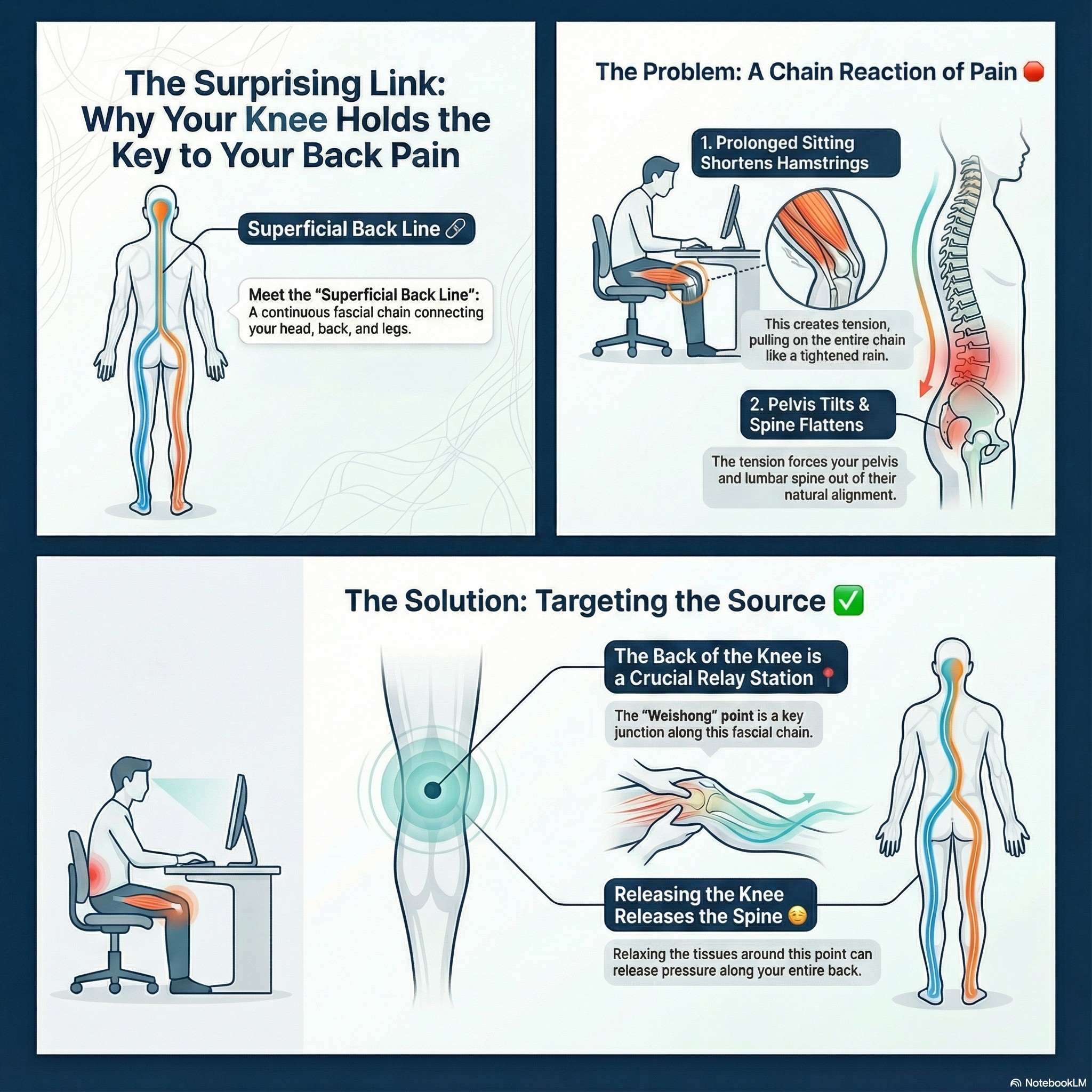
Many clients ask me, "I'm clearly suffering from lower back pain, so why are you spending so much time pressing the back of my knees?"That is actually an excellent question. From the perspective of modern biomechanics and the "Anatomy Trains" fascial theory, the human back is not made up of isolated muscles. Instead, it is a continuous fascial chain extending from the top of the head down to the soles of the feet, known as the "Superficial Back Line."The popliteal fossa (the hollow at the back of the knee), where the "Weizhong" (Bladder 40) point is located, acts as a crucial relay station along this fascial chain.When we sit for prolonged periods, the hamstrings at the back of the thighs become shortened and stiff. This tension is transmitted through the fascia, acting like a tightened rein that restricts pelvic movement. This leads to a posterior pelvic tilt, which in turn flattens the normal physiological curvature of the lumbar spine.Therefore, relaxing the soft tissues around the Weizhong point is, in effect, releasing pressure along the entire spine. This is the "hard science" logic behind the traditional adage: "Seek the Weizhong point for lower back and back issues."
Part 2: The "Red Alert Zone" Through a Massage Therapist's Eyes—Safety First
While the Weizhong point (BL40) has miraculous effects, in the eyes of professional therapists, this area is a "red alert zone" that must be approached with extreme caution.ShutterstockThe popliteal fossa (the hollow at the back of the knee) lacks the protection of thick muscle. Situated just beneath the skin are the "tibial nerve," which governs sensation and movement in the lower limbs, as well as the "popliteal artery" and "popliteal vein," which are responsible for blood return.Blindly applying heavy pressure without anatomical knowledge can easily result in nerve damage or vascular issues. This is especially true if you discover a distinct bulge or cyst behind the knee (such as a Baker's cyst),Getty Imagesor if the calf exhibits unexplained redness, swelling, heat, or pain (suspected Deep Vein Thrombosis).ShutterstockIn these cases, massage is an absolute contraindication.In the philosophy of a "Wellness Lifestyle," safety always takes precedence over treatment. Therefore, before performing any deep tissue work, self-examination and risk assessment are absolutely indispensable steps. Never ignore the warning signs your body gives you merely for the sake of momentary relief.
Part 3: Professional Techniques Revealed—How We Target It with Precision
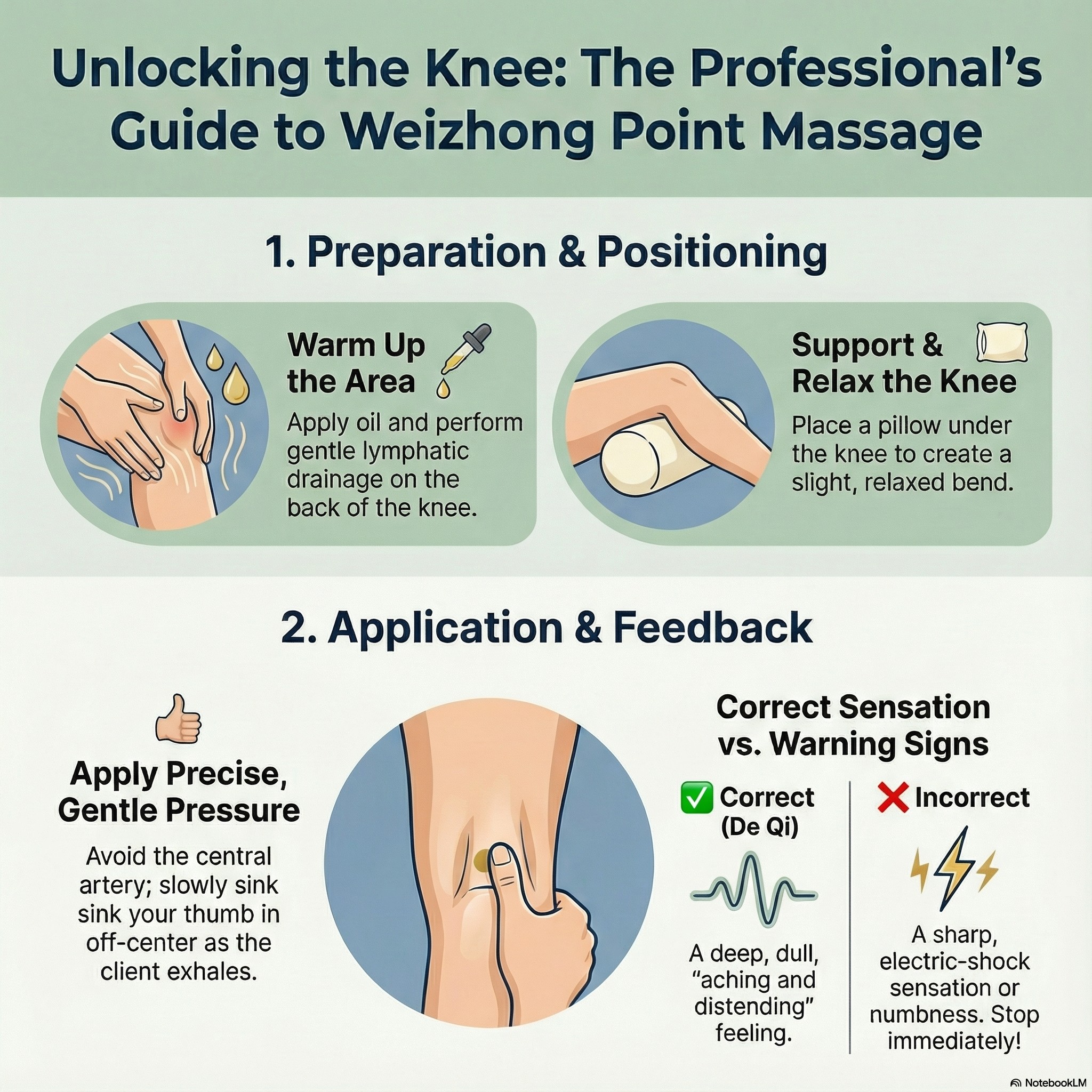
After ruling out the aforementioned contraindications, professional massage of the Weizhong point prioritizes "permeation" over "brute force." When I work on a client, I first apply massage oil to the popliteal fossa (the back of the knee) and perform gentle lymphatic drainage to warm up the area.Next, I place a pillow under the client's knees to keep them slightly bent. This allows the tight popliteal fascia to relax, enabling my fingers to access the deeper layers. When locating the acupoint, I carefully avoid the pulsing artery in the exact center. Instead, I shift my thumb slightly off-center and sink in slowly as the client exhales.The correct sensation should be a deep, dull "aching and distending" feeling, known in Traditional Chinese Medicine as "De Qi" (arrival of qi). If there is a sharp, electric-shock sensation or numbness, it indicates that a nerve is being compressed, and I must stop immediately and adjust the angle. This precise deep-tissue manipulation effectively loosens the deep-seated popliteus muscle, helping to "unlock" the knee joint and restore mobility to the lower back and hips.
Part Four: Home Self-Care Ritual—The Daily Magic of "36 Taps" for Qi and Blood
Of course, you cannot visit a massage therapist every day, so establishing a simple and effective home maintenance ritual is crucial. I highly recommend the "Daily 36 Pats" Qi and Blood Activation Method. It is a simple movement that combines traditional wisdom with modern principles of circulation enhancement.The best time to perform this is right after waking up or after a shower, when your body is warm. Stand with your feet shoulder-width apart and your knees slightly bent. Cup your hands slightly to create a "hollow palm." Using the momentum of your arms swinging naturally, rhythmically pat the hollows behind your knees (the popliteal fossae) on both sides simultaneously.Please note that the sound should be a crisp "slapping" noise, rather than a dull thud. Pat each side 36 times until the skin becomes slightly red and warm. This action creates vibration waves that travel deep into the tissue, promoting the expulsion of metabolic waste and lactic acid. It has an immediate effect on relieving swelling (edema) and the feeling of heaviness in the lower limbs.
Part 5: Office Micro-Exercises—A Self-Rescue Guide for the Sedentary
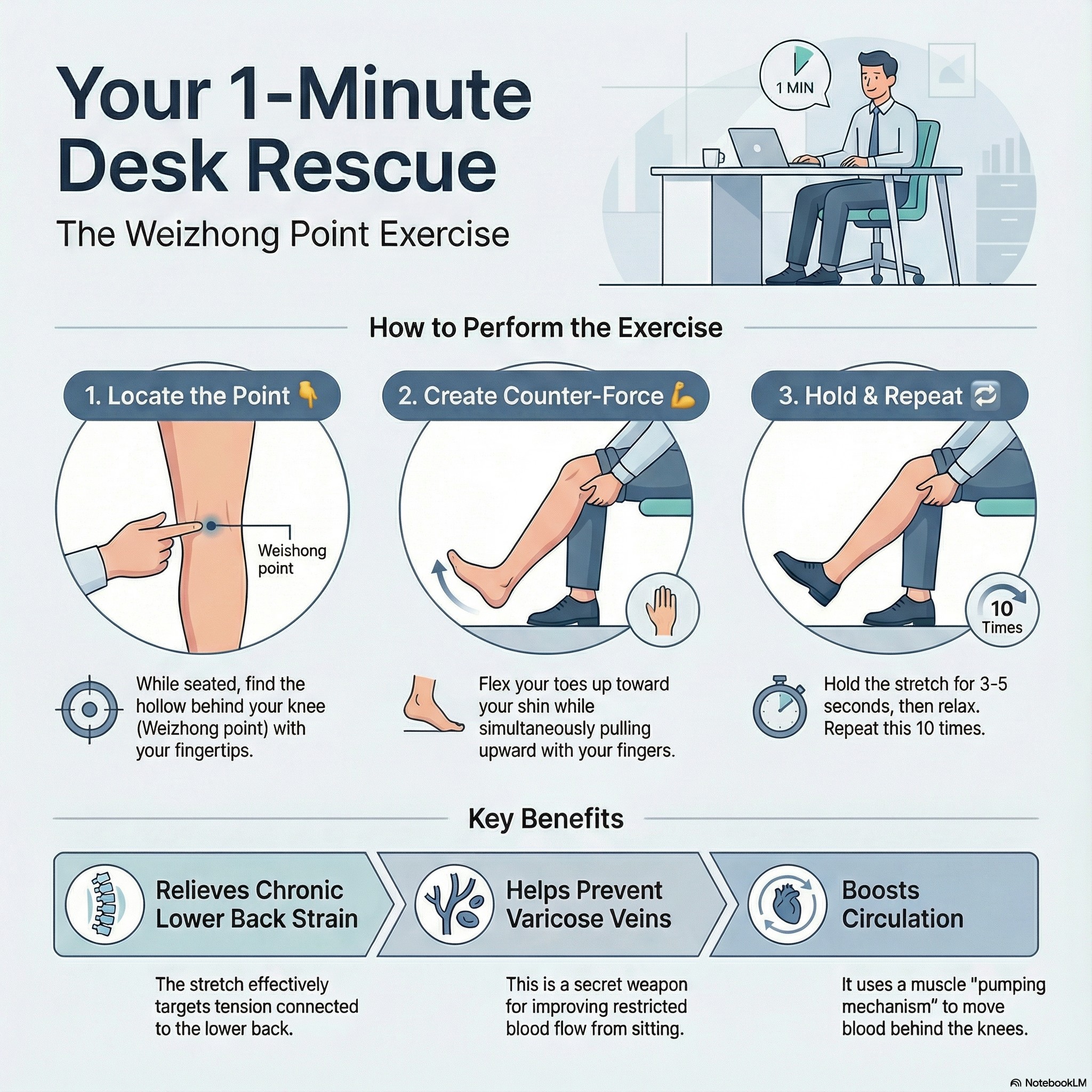
For 9-to-5 office workers, you can perform "micro-exercises" for the Weizhong point (Bladder 40) right at your desk. When your lower back feels sore or tight, there’s no need to roll out a yoga mat. Simply sit on your chair, bring the four fingers of each hand together, reach under your thighs to the hollow behind your knees (the popliteal fossa), and use your fingertips to gently hook onto the Weizhong point.Next, perform a crucial movement: forcefully flex your toes back toward your shins (dorsiflexion) while simultaneously pulling upward with your fingers. You will feel a strong stretch along the back of your calves. Maintain this counter-force for about 3 to 5 seconds, then relax. Repeat this 10 times.This simple "tendon-lifting" action utilizes the pumping mechanism of muscle contraction. It is a powerful way to improve blood circulation behind the knees—which often gets restricted by prolonged sitting—making it a secret weapon for preventing varicose veins and relieving chronic lower back strain.
Conclusion: Practicing a Wellness Lifestyle Starts by Focusing on the Back of Your Knees
The mysteries of the human body are often hidden within the details. The Weizhong point (Bladder 40)—that small hollow behind your knee—shoulders the significant responsibility of facilitating the flow of Yang energy throughout the body and regulating the balance of the spine.Through today's sharing, I hope you come to understand that treating lower back pain is not merely about pressing on the painful spot; rather, it is a form of holistic biomechanical adjustment. Whether you are seeking deep therapy from a professional massage therapist or committing to a routine of tapping and stretching at home, every bit of attention you pay to the Weizhong point is an investment in your spinal health.On the path to a "Wellness Lifestyle," let us learn to engage in a dialogue with our bodies. Using scientific knowledge and gentle techniques, we can reclaim a self that is pain-free, light, and full of vitality. If you have any concerns regarding your physical condition, please be sure to consult with a medical professional or a qualified massage therapist.


![[Happy Healthy Life] A Professional Massage Therapist's Therapeutic Secrets for the Rangu Acupoint: A Dual-Action Guide to Saying Goodbye to Plantar Fasciitis and Insomnia](https://happyhealthylife.cv/wp-content/uploads/2026/02/樂健生活:專業按摩師的然谷穴理療秘笈,告別足底筋膜炎與失眠的雙效指南-540x360.jpg)
